
STITCH! · SEASON 2 · EPISODE 23 · REACT
Stitch! Season 2 Episode 23: Minor, Minor Stitch’s Great Adventure
Stitch and Zuruko thought being tiny meant nobody could stop them. It nearly meant nobody could save them.
The episode record before somebody steps on the plot
Episode: Broadcast Season 2, Episode 23
Japanese title: 小さな、小さなスティッチの大冒険
English card title: Minor, Minor Stitch’s Great Adventure
First Japanese broadcast: May 4, 2010
Runtime: 22 minutes
Series branch: Stitch! Itazura Alien no Daibōken
Japanese voices central here: Kōichi Yamadera as Stitch and Motoko Kumai as Yuna Kamihara
Where to watch: Apple TV Japan carries the official episode record. Availability changes by region.
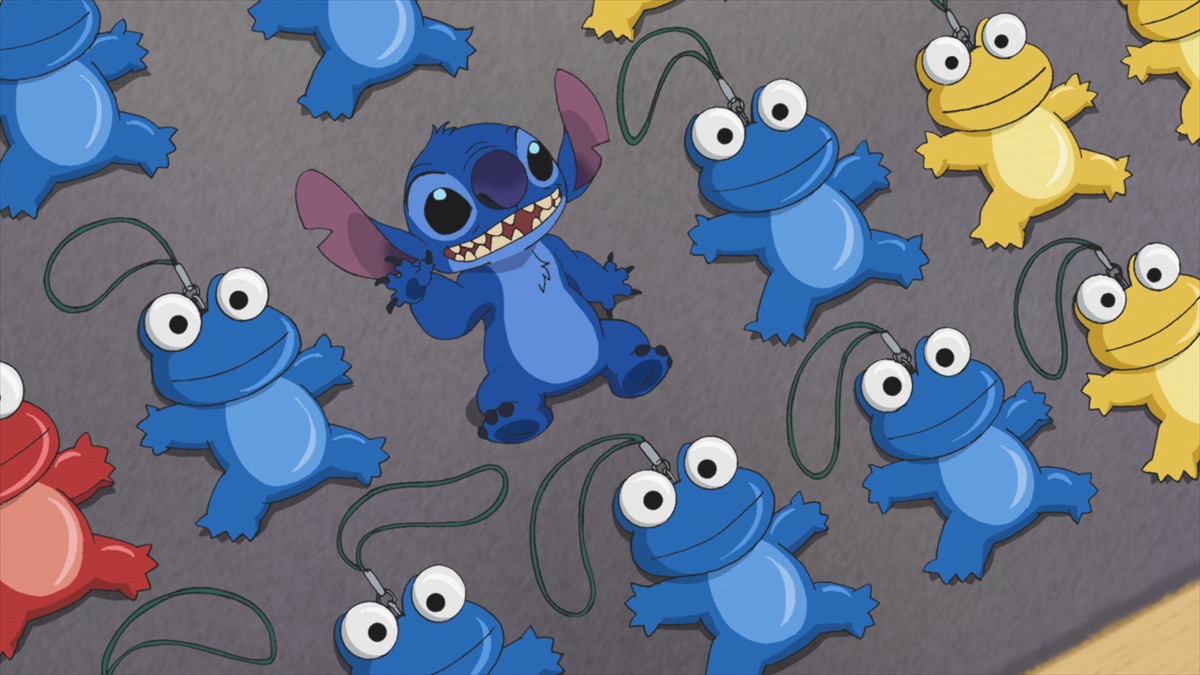
Jumba’s first prototype, Shrink, appears on Izayoi Island. Its light reduces living beings to only a few centimeters. Stitch and Zuruko get hit, discover that nobody can see them clearly, and use their new scale to bother people around town. Hämsterviel’s crew notices that Stitch is suddenly insect-sized and comes to the island because a dangerous opponent has become easy to capture.
My first reaction: invisibility did not improve either one of them
Stitch and Zuruko become tiny and immediately treat the loss of accountability like a coupon for free misbehavior. They move through ordinary spaces below everybody’s line of sight, interfere with people who cannot identify the source, and enjoy confusion that they created. Being small has not made them powerless yet because secrecy becomes its own kind of leverage.
Then Hämsterviel’s crew arrives and the joke changes temperature. Stitch is still strong in relation to his size, but every shoe, drain, animal, and careless hand is suddenly part of the threat landscape. The episode gives him the exact experience he has been imposing on other people: somebody stronger sees vulnerability and calls it opportunity.
Shrink is Jumba’s first prototype, which should make everybody ask harder questions
A first prototype is not a harmless rough draft. It is the beginning of a design history that eventually produces hundreds of specialized experiments, including Stitch. Shrink’s power changes bodily scale, mobility, visibility, and access to basic needs. That requires medical guidance and containment planning before anybody sends children to chase it.
Jumba should explain whether the change is temporary, whether repeated exposure compounds the effect, and whether Shrink can restore a target. Nobody should assume a comedy reset will arrive before dehydration, injury, or capture does.
Being tiny turns an ordinary house into hostile terrain
A floor becomes an open field with feet appearing without warning. A sink becomes a flood zone. A pet becomes a predator even when it thinks it is playing. Doors, stairs, beds, and food containers stop serving the bodies they were designed around. The episode can make those changes funny while still admitting that accessibility is a material condition, not an attitude.
Stitch and Zuruko need a protected container with air, water, food, warmth, and a way to signal larger people. Carrying them loose in a pocket would add crushing, suffocation, and accidental loss. Jumba should build a temporary habitat before anyone begins the reversal.
The prank spree is consent failure with a size advantage
Nobody in town agrees to become entertainment for two hidden pranksters. The victims cannot identify what touched, moved, or interrupted them, so they cannot set a boundary or respond proportionally. Stitch and Zuruko enjoy the control created by asymmetrical information.
Their reduced size explains why they feel untouchable. It does not excuse the conduct. A repair should include naming what they did, apologizing to the people affected, replacing damaged property, and accepting limits while Shrink remains active.
Zuruko and Stitch are bonding through the worst available activity
Shared mischief can create connection, especially for two characters who enjoy performance and dislike being managed. The problem is that their bond depends on other people being confused. They are not laughing with the town. They are using the town as an audience that cannot leave because it does not know a show has begun.
A healthier version of the same energy could become a miniature obstacle course, a controlled demonstration, or a prank where the target has agreed to participate. Fun does not require a victim who lacks the information needed to say no.
Hämsterviel treats vulnerability as permission
His crew does not see tiny Stitch and ask whether he is injured. They see a lowered defense and calculate capture. That response exposes the governing ethic behind Hämsterviel’s entire operation: power decides whose body can be handled, contained, or repurposed.
Stitch has often been physically dominant. Shrink removes the comfort of that position and shows why rights cannot depend on the ability to fight back. Protection matters most when somebody cannot enforce it alone.
Gantu still has a duty to refuse an opportunistic abduction
An order from Hämsterviel does not turn a vulnerable target into legitimate property. If Stitch is temporarily impaired, capture carries increased risk of injury and no emergency necessity. Gantu knows enough about his employer to recognize exploitation even when he continues performing it.
He should refuse unsafe handling, notify Jumba of Shrink’s effects, and document the order. Reuben can support that refusal instead of translating every abusive demand into another routine workday.
Yuna needs a reliable way to locate two centimeter-sized friends
Searching by shouting is not enough when the missing people may be trapped inside walls, drains, bags, or moving vehicles. Yuna should establish their last known location, stop foot traffic, and use sound, heat, or experiment-specific tracking rather than inviting a crowd to wander through the scene.
Stitch and Zuruko also need a signal protocol. Repeated taps, a reflective surface, a bright marker, or a communicator could distinguish them from ordinary background movement. Rescue works better when the person being found knows how rescuers are searching.
The town should stop moving before it starts helping
The instinct to gather more people can increase danger. Every new rescuer adds shoes, vehicles, doors, and objects that might crush or sweep the pair away. The first instruction should be to freeze activity in the affected zone and keep animals outside it.
One coordinator can assign narrow search lanes while Jumba monitors Shrink. People who are not trained or necessary should remain back. Concern does not automatically make somebody useful at a miniature rescue scene.
Shrink needs consent rules after the emergency
A power that changes another person’s body should never become a party trick. Shrink needs supervision, a way to communicate willingness, and clear rules about when its light may be used. Targets must understand duration, reversal, side effects, and what support will be available while they are small.
Consent also applies to Shrink. Jumba created it, but creation does not grant unlimited authority to fire its ability on command. Training should help Shrink control its power without reducing it to equipment.
Medical assessment cannot wait for somebody to look normal again
Scale change could affect breathing, circulation, temperature regulation, hearing, balance, and medication. Even if the episode restores Stitch and Zuruko visually, Jumba should check them for effects that are less obvious than height.
The pair also need a psychological debrief. Being hunted at insect size can produce fear long after the joke ends. Stitch may hide that fear behind bravado, while Zuruko may turn the story into performance before she admits how exposed she felt.
The rescue should preserve evidence of the abduction attempt
If Hämsterviel’s crew enters the island to exploit a temporary disability, that is more than another chase. Yuna and Jumba should record communications, tracks, damaged property, and witness accounts. A pattern of failed attacks remains a pattern even when each episode resets the room.
Evidence supports protective measures and limits Hämsterviel’s ability to describe Stitch as the aggressor. It also gives Gantu a record if he later chooses to disclose the orders he received.
Returning to full size does not erase the pranks
A transformation reversal solves the physical emergency. It does not repair the people Stitch and Zuruko frightened, embarrassed, or inconvenienced while they believed consequences could not find them. Comedy loves a reset, but accountability begins after the visual reset.
They should revisit the locations, explain what happened without demanding instant forgiveness, and help restore what they disturbed. An apology that only celebrates survival would center their adventure instead of the harm they caused.
The episode quietly asks whether morality changes when nobody can see you
Stitch and Zuruko behave differently because they expect anonymity. Their choices resemble online conduct, hidden-camera cruelty, and every system where distance protects the person causing harm from the face of the person receiving it. The size gimmick works because the temptation is familiar.
Character appears in what someone does without witnesses. It also appears in what they do after discovery. The strongest ending would have both pranksters choose repair before Yuna forces it, proving that being found is not the only source of conscience.
Small bodies expose how public space assumes one standard user
Nothing on the island is built for a person a few centimeters tall. That exaggeration makes an everyday design truth visible: spaces often treat one range of bodies as normal and everybody else as an exception. Safety depends on ramps, signals, handles, transport, and communication being usable by the person who needs them.
Jumba could preserve the miniature habitat and rescue tools after this incident. Another experiment, child, or injured resident may need adaptive equipment later. Emergency inventions become better community infrastructure when they are maintained rather than discarded after the credits.
Rescuers need to ask before touching even when time is short
A giant hand may look like the fastest route to safety, but from Stitch and Zuruko’s perspective it can feel like another capture attempt. A rescuer should announce the approach, offer a stable platform, and let them climb aboard whenever immediate danger permits. If someone must move them without consent to prevent crushing or drowning, that decision should be explained as soon as they are safe.
Handling matters because the pair have already been targeted by Gantu. A frightened miniature person may kick, bite, or flee from an unfamiliar grip and create a worse fall. Rescue should reduce panic rather than treating a small body like an object that can be scooped up without warning.
Zuruko’s reputation cannot become an excuse to ignore her danger
Zuruko has lied, manipulated, and chased attention before. Those choices may make adults skeptical when she reports a threat. They do not cancel her right to rescue. Hämsterviel’s crew benefits if everybody assumes she is performing again while an actual abduction unfolds.
Responders can verify claims without dismissing the speaker. They should check physical evidence, track Shrink’s energy, and compare accounts. Afterward, accountability for the pranks can proceed separately. Believing that somebody is in danger does not require endorsing every previous thing they have done.
Jumba should build a reversal plan with failure points
Restoring ordinary size cannot depend on one machine, one power source, or Shrink cooperating under pressure. Jumba needs a primary reversal method, a backup, and a safe time window. He should identify what happens if only one person is restored, if growth occurs in a confined space, or if the effect reverses too quickly.
The restoration area should be cleared and measured before activation. Returning to full size inside a drawer, pipe, or transport capsule could turn rescue into another injury. Scale is part of the environment, so reversal must coordinate body and space together.
What the episode gets right
The episode gives Stitch a vulnerability he cannot solve by punching harder. His physical identity changes, the environment becomes dangerous, and Hämsterviel weaponizes the opening. That forces survival to depend on communication, trust, and other people noticing him.
Pairing him with Zuruko also keeps the moral problem messy. They are endangered, but they are not innocent in every interaction. Viewers can demand their protection without pretending their prank spree was acceptable.
What I wanted pushed further
I wanted Yuna to confront the pranks after the rescue with the same clarity she brings to the abduction attempt. Protecting Stitch from Hämsterviel and holding him accountable are compatible actions. Friendship should be able to do both in one conversation.
I also wanted Shrink treated as a character with needs rather than a temporary plot device. A first prototype carries history. Where it lived, why it appeared, and how it understands its power deserve more than a reversal button.
The receipt I am keeping
The receipt is Stitch discovering that an enemy who usually fears his strength becomes confident the moment his body changes. Hämsterviel’s courage is entirely borrowed from somebody else’s vulnerability.
My second receipt is Stitch and Zuruko using invisibility for pranks before realizing invisibility also makes rescue harder. The condition that protects them from consequences nearly prevents the people who love them from finding them.
Final verdict
“Minor, Minor Stitch’s Great Adventure” has a clean cartoon premise and a sharper ethical center than its scale suggests. Anonymity encourages cruelty, inaccessible environments turn routine movement into danger, and predators confuse vulnerability with permission.
The best resolution restores Stitch and Zuruko, protects Shrink, documents Hämsterviel’s attempt, and requires repair for the prank spree. Getting big again should restore capability. It should not shrink the accountability.
Keep watching
Return to Season 2 Episode 22 or open the complete Stitch! episode directory.