
ANIME 101 · EPISODE ORDER · PRODUCTION STUDIOS · SPECIALS
Stitch! Anime Episode Order: 86 Episodes, Three Seasons, Five Specials, and Several Ways to Count Them
The anime has one production history. Broadcast archives, home video, international edits, and streaming menus keep counting it differently.
The clean number is 86, with an important footnote
The Japanese Stitch! television anime has eighty-six numbered episodes across three production runs. That total includes one broadcast-era or post-season special associated with each run. Two additional feature-length television specials followed in 2012 and 2015, bringing the complete Japanese screen record beyond the numbered eighty-six.
Streaming catalogs can display a different apparent total because long specials may be divided into multiple platform entries and attached to season three. A viewer counting thumbnails can therefore be correct about the service in front of them and wrong about the original production structure.
Season one contains 26 entries
The first Stitch! run was produced by Madhouse and began on TV Tokyo in October 2008. Disney Japan’s home-video record divides it into Episodes 1 through 13 and Episodes 14 through 26. Episode 26, “Pīko kara no Chōsenjō,” was identified on the official release as an episode not broadcast on terrestrial television.
That detail explains why TV Tokyo’s public broadcast archive presents Episodes 1 through 25 while the official DVD set contains twenty-six. The home-video episode belongs to the first production run even though viewers following only the original weekly broadcast would not have encountered it there.
Season two contains 30 entries
The second run, commonly titled Stitch! The Mischievous Alien’s Great Adventure in English reference work, continued the Madhouse production period. It contains thirty entries when its post-season material is counted with the run. The season expands experiment returns, island stories, family history, and the Chitama Stone framework.
International services and dubbed editions have not always preserved the same titles, order, or segment length. Some stories were trimmed or paired for markets using shorter programming blocks. CVM Sekai keeps the Japanese entry number as the stable spine and records alternate packaging beside it.
Season three contains 30 entries and a studio change
The third run, Stitch! Best Friends Forever, moved production from Madhouse to Shin-Ei Animation. It also moved Yuna into New Town, introduced a different school ensemble, and shifted the visual and social balance of the branch. Thirty entries belong to this run when its associated special is included.
The studio change matters because animation rhythm, character drawing, background priorities, and production organization can change without the franchise announcing a new continuity. A season review should evaluate the handoff rather than treating every visual difference as a mysterious decline or improvement.
Three season-associated specials live inside the 86
Each of the three runs includes material that did not behave exactly like an ordinary weekly episode. Home-video, post-season, or special-broadcast status can vary, but the entries remain part of the twenty-six, thirty, and thirty totals used for the Japanese series.
This is why “eighty-three episodes plus three specials” and “eighty-six episodes” may describe the same body of work. CVM Sekai uses eighty-six numbered entries, then identifies the special status on the relevant card so readers do not have to choose between a total and its production history.
Two later television specials sit outside the 86
Stitch and the Planet of Sand followed in 2012. Stitch! Perfect Memory followed in 2015. Shin-Ei Animation produced the later special period. These are not hidden fourth-season episodes even when a platform places them at the end of season three for navigation.
They deserve full individual Reacts and their own feature-length review treatment because their pacing, production context, and release dates differ from the weekly runs. Their presence also proves that the Japanese branch continued after the 2008 through 2011 television sequence.
Disney+ can split one special into two entries
A long television special may be divided into two streaming parts so it fits an episodic interface. When both later specials are split, two produced works can appear as four catalog entries. The service is describing playback units rather than creating two additional stories.
The directory will show the produced special as one work, identify the platform’s part divisions, and link to both parts where the current regional catalog requires them. This preserves production truth without making the official viewing route harder to use.
Japanese order is the primary directory spine
The branch was made in Japan, premiered in Japanese broadcasting structures, and uses Japanese titles and performances as its original record. CVM Sekai therefore orders the directory by the Japanese runs. English and other international titles appear as alternate metadata rather than silently replacing the source title.
This choice is especially important when the international edition combines two shortened stories or moves an entry. A React should follow the version actually analyzed. If a scene exists only in the Japanese cut, the article will say so rather than treating every regional edit as interchangeable.
Translated titles are navigation aids, not replacement originals
Japanese episode titles can be translated more than one reasonable way. Official regional catalogs may choose a short marketing title, while subtitles, home-video labels, and fan records preserve a longer phrase. The directory will retain the Japanese title in romanization or Japanese script where verified, then display the current licensed English label for practical navigation.
That policy prevents a translated title from pretending to be the one permanent original. It also helps when two international releases give the same story different names. Readers can recognize the episode without losing the source record that connects it to Japanese broadcast order.
Shortened international segments require version notes
Some international presentations reduce a full Japanese story into a shorter segment or pair two shortened stories inside one program slot. A platform may count the combined slot as one episode even though the Japanese production record counts two entries. Plot, jokes, transitions, and character beats can disappear during that compression.
A React must name the cut it analyzes. When the Japanese version and international edit differ materially, the article will separate observations instead of quoting one scene against a version where that scene never appeared. Version notes protect both the reader and the argument.
Broadcast order, production order, and platform order solve different problems
Broadcast order tells us what Japanese television viewers received and when. Production or home-video order captures entries that were made but not aired in the same weekly sequence. Platform order tells a current subscriber where the service placed the file. None of those records should be forced to perform the others’ job.
The episode card can hold all three without becoming a database dump: primary episode number and title, season, original date or special status, current platform label, concise summary, viewing route, and the React. The guide holds the explanation so every card does not repeat it.
The adult-Lilo episode belongs to season three
Season three includes the episode commonly identified in English as “Lilo.” It brings an adult Lilo into the Japanese branch and supplies an explanation for her separation from Stitch. The story has become one of the franchise’s most disputed continuity decisions.
Its placement matters. Viewers should reach it after the anime has spent years building Yuna’s relationship with Stitch, not as a franchise clip removed from sequence. The React will preserve that accumulated context and compare versions only after judging the episode’s own evidence.
The original Japanese cast remains the performance record
Kōichi Yamadera performs Stitch, Motoko Kumai performs Yuna, Shōzō Iizuka performs Jumba, Yūji Mitsuya performs Pleakley, Hisako Kyōda performs Obaa, and Kappei Yamaguchi performs Kijimunaa during the branch’s central run. Profiles will attach Japanese performers to the appropriate character and era.
International dubs remain relevant to distribution analysis, but they do not replace the Japanese cast on character profiles for this Japanese production. When a performer changes, the profile will specify the season or special rather than merging voices into an undated list.
Availability is regional and can change
Disney+ currently lists three seasons in supported regions, including Japan and Singapore. Access, subtitles, catalog order, and the treatment of specials vary by country. A page visible in one territory does not prove that the same episode is legally available everywhere.
CVM Sekai links the current licensed route and labels the region. It does not recommend an unauthorized copy because a missing season is frustrating. If the catalog changes, the viewing field can be updated without changing the original Japanese order.
How the episode directory will avoid endless scrolling
Eighty-six numbered entries plus two later specials require search, season filters, and direct episode jumps. The directory will load completed Reacts automatically from taxonomy and metadata. Cards will remain in Japanese order even when the page is filtered.
Each visible card will carry an official local still, episode number, season or special type, original and accessible title, brief description, current viewing route, and React link. A draft without full editorial content and a verified image stays private instead of appearing as an empty promise.
Sources and image provenance
The first-run count and unaired Episode 26 status come from Disney Japan’s official home-video record and the TV Tokyo broadcast archive. The current three-season presentation comes from the Disney+ Japanese catalog. Studio and special distinctions are cross-checked against contemporary Japanese broadcast and release records.
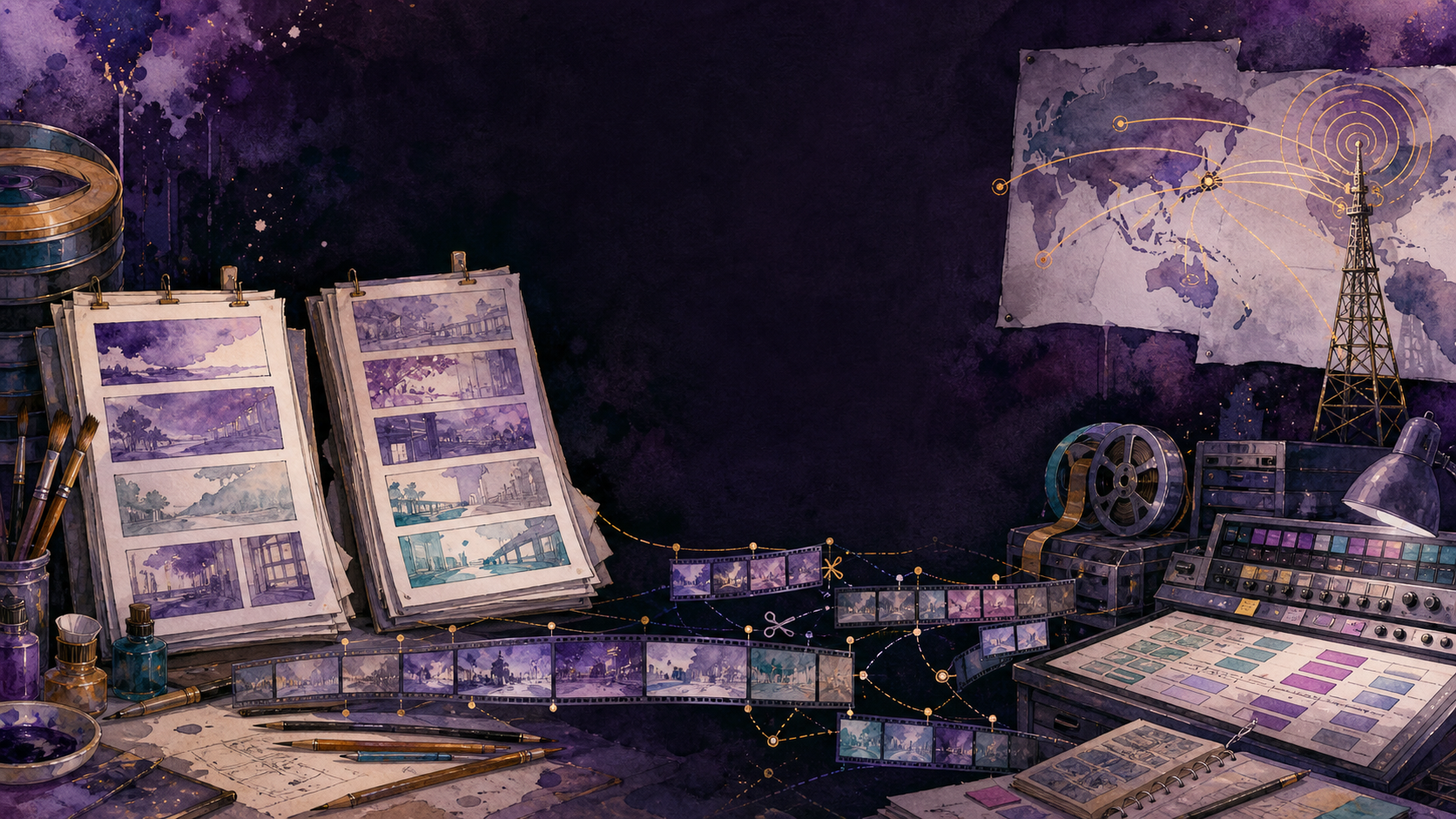
The hero is original CVM Sekai editorial art. Storyboards, film reels, editing splices, broadcast equipment, and an international distribution map visualize the difference among production, broadcast, and platform order. It contains no characters, logos, copied frames, studio marks, or readable text.
Keep exploring
Return to the Stitch! anime hub, read the forty-three-good-deeds guide, or read the Izayoi and Ryukyu guide.
The production total is 86 episodes
The three Japanese production runs contain 26, 30, and 30 episodes. That produces an 86-episode catalog when broadcast and officially released unbroadcast installments are counted according to the production-side record. A 72-card streaming interface is not the same thing as the complete production list.
The difference is systematic. A regional Disney+ presentation may display 24 cards per season, while the production runs include additional installments and bonuses. The guide must preserve both facts without forcing one numbering system to impersonate the other.
Season one contains a two-part finale and an unbroadcast release
The first production run has 26 installments. Episodes 24 and 25 form a two-part confrontation with Hämsterviel, and Episode 26, commonly rendered as “Piko’s Challenge,” belongs to the official home-video record even though it was not part of the original television broadcast sequence.
A directory can mark Episode 26 as home-video unbroadcast while keeping it in production order. Removing it makes the series look shorter. Calling it an ordinary broadcast episode erases the release distinction. Accurate status is better than either shortcut.
Season two has thirty production episodes
The second run changes the series title and expands the production catalog to thirty episodes. The final installment is treated as a bonus unbroadcast episode in the official production-side record. Regional services may show only twenty-four cards and may package titles differently.
React titles should use production season and episode numbers, store the Japanese title, and include any platform identifier as a separate field. That structure prevents a later platform rearrangement from changing the canonical CVM URL or breaking the sequence.
Season three also has thirty production episodes
The third Japanese run moves Stitch into a new-town phase, returns to the history of his creation, includes a Lilo reunion, and closes with another officially released bonus installment. It is part of the same 86-episode production branch even when a regional catalog presents fewer cards.
The site currently needs all thirty season-three Reacts before this branch can be called complete. Their order should come from the official Disney Japan production catalog, with Japanese titles preserved and any streaming match verified episode by episode.
Why 72 streaming cards cannot be stretched into 86 production episodes
A service card is a packaging unit. It can omit, combine, reorder, rename, or region-lock material. The production list records what the Japanese runs created and released through broadcast or official home video. These systems answer different questions.
Automatically mapping card 1 to production episode 1 across all seasons is unsafe. The existing audit even records a card whose synopsis describes adult Lilo and Yuna rather than the Japanese premiere. Metadata can be wrong while the image and numbering look authoritative.
Every card needs an episode-level reconciliation
A safe match compares Japanese title, English title, synopsis, key characters, release status, image content, and the surrounding sequence. One matching number is not enough. If the platform summary describes another episode, mark the conflict and find stronger evidence.
The mapping should be stored in post metadata so later audits can identify which source supported the production number and which source supported current availability. Keeping those fields separate makes corrections possible without rewriting the editorial React.
Japanese titles are the stable spine
English renderings vary across catalogs and fan lists. The Japanese production titles provide the strongest stable sequence when checked against official TV Tokyo archives and Disney Japan home-video records. Romanization or English translation can help navigation but should not replace the original metadata.
Punctuation, split stories, and repeated finale titles need care. Season one Episodes 24 and 25 share a confrontation title while functioning as separate installments. A directory should label the parts rather than collapsing them or pretending the duplication is an error.
Unbroadcast does not mean unofficial
An episode released through official home video can belong to the production catalog without having a television airdate. The status should state how viewers received it. “Unaired” is too vague if readers assume the episode leaked or never received an official release.
The React can review the installment normally while explaining its release route in the episode record. Where-to-watch information may be limited, but limited availability does not remove the episode from the franchise history.
The Lilo reunion belongs in season three, not the premiere
Regional metadata has circulated a synopsis suggesting adult Lilo and a daughter in connection with an early streaming card. The production catalog places the reunion story much later, at production Season 3, Episode 23. Copying the platform summary into Season 1 would corrupt the branch.
This error is a warning for every automated directory. Images and text from current services can help, but they cannot override verified production order. The reunion should be analyzed where the Japanese sequence places it, after Yuna and Stitch have accumulated the history that makes the return emotionally complicated.
React chronology should preserve what the viewer knows
Episode Reacts should not use season-three revelations to interpret season one as if the characters already knew them. Each React records the information available at that point. Later posts can return to earlier theories and mark what changed.
The series review has a different job. It can compare all three runs, identify long-term patterns, and judge whether the reunion or creation-history episodes repair earlier continuity. Keeping those voices separate protects the “Iconic by Mistake” reaction format from becoming a retrospective summary.
A complete directory needs search, season filters, and direct episode jumps
Eighty-six records are too many for a scroll-only page. The directory should mirror the proven Naruto-style navigation: search by title or number, filter by production season, jump directly to an episode, and display official image, episode number, title, brief summary, viewing route, and React link.
Cards should remain automatic so a completed, correctly tagged React appears without manual landing-page edits. Drafts and incomplete packaging should stay private. The count displayed above the grid should match the public records returned by the same query.
Featured image, hero, and directory card remain identical
Each episode uses one canonical local official still for the featured image, top hero, and directory card. That rule keeps recognition stable and prevents a generated reaction image from replacing the official episode evidence.
Attachments need alt text, source URL, source page, credit, rights note, and a description naming the episode. A reused still is not acceptable merely because the characters appear in both installments. Every React needs its own image.
Primary sources for the production order
Season one titles and ordering are checked against the official TV Tokyo episode archive and Disney Japan product records. Seasons two and three are checked against official Disney Japan home-video catalogs. Platform availability is tracked separately because it changes by region and date.
The guide should be updated in place when an official catalog changes or a stronger source appears. Do not create a cloned version with a new suffix. Record the correction in the project change log and keep one canonical URL.
Completion standard for this branch
The Japanese Stitch! branch is complete only when all 86 production episodes have correctly numbered Reacts, unique official local stills, full episode records, verified Japanese titles, and automatic directory inclusion. A passing season-two audit proves season two, not the entire branch.
Season three therefore remains active work. The production-order guide is the contract for that build, and the final audit must compare all three season counts against the catalog rather than stopping when a streaming interface runs out of cards.
The final audit must detect duplicates as well as gaps
A count of 86 can still be wrong if one episode appears twice and another is missing. The audit should build a season-and-episode key, reject duplicates, compare the complete expected range for each season, and confirm each public post has the correct franchise and episode tags.
It should also compare featured-image IDs. A duplicated attachment can reveal that two Reacts share a still even when titles and URLs look correct. Counts are the beginning of verification, not the finish.
Canonical URLs should not change with platform packaging
The post slug should follow the Japanese production season and episode identity, not a temporary Disney+ card number. If a service later changes seasons, combines a story, or restores a missing bonus, the CVM URL remains stable and the availability metadata can be corrected.
Stable URLs protect internal links from the hub, directory, review, and adjacent Reacts. They also stop regional packaging from rewriting the site’s historical record every time a licensing interface is refreshed.
The directory needs adjacent navigation
Every React should return to the complete Stitch! directory and offer previous and next production episodes where applicable. Season boundaries should continue naturally from the last episode of one run to the first episode of the next while still displaying the production-season change.
That navigation lets readers follow the branch without returning to a search result after every post. It also exposes missing records immediately because a broken next link becomes visible during visual QA.