
ANIME 101 · FICTIONAL GEOGRAPHY · OKINAWA · RYUKYU HISTORY
Izayoi Island in Stitch!: What Is Fictional, What Comes From Okinawa, and What the Anime Blends
The island is invented. The architecture, martial arts, history, and cultural signals it borrows are not.
Izayoi Island is fictional
Stitch! sends Stitch through a space storm and lands him on Izayoi Island, described as a remote southern island of Japan. Viewers can recognize visual and cultural signals associated with Okinawa and the wider Ryukyu region, but Izayoi is not a real municipality waiting to be found on a ferry map. It is a composite setting designed for television.
That fictional status gives the production freedom to place Yuna’s home, the karate dojo, forest paths, beaches, sacred spaces, school routes, and supernatural encounters wherever a twenty-two-minute story needs them. It also creates an editorial responsibility. Real Okinawan history cannot be inferred from every building or legend the cartoon rearranges.
Okinawa is an island chain with its own history
Okinawa is Japan’s southernmost prefecture and consists of many islands rather than one tropical location. The Japan National Tourism Organization describes a subtropical island culture shaped by the era of the Ryukyu kings, coral seas, mangrove environments, craft traditions, and regional variation. Calling the setting “Japan” is accurate and incomplete.
The Ryukyu Kingdom maintained political, economic, and cultural relationships across East and Southeast Asia. UNESCO describes the surviving gusuku sites and sacred landscapes as evidence of five centuries of Ryukyuan history and wide-ranging cultural exchange. The region cannot be reduced to mainland Japanese custom moved closer to a beach.
Red-tile roofs are climate knowledge before they become anime scenery
Traditional Okinawan houses often use red roof tiles secured with plaster against typhoon winds. Coral and limestone walls help protect the property, while a hinpun partition near the entrance creates shade, reduces wind, and marks a boundary between community space and the household. Those features developed through environment and social use.
The anime borrows red roofs, walls, courtyards, and open-air movement to make Izayoi immediately legible. A pretty roof is therefore carrying information about storms, building practice, privacy, and inherited craft. Treating it as generic island charm removes the reason the form exists.
Karate belongs to Okinawan history
Yuna is introduced as a skilled martial artist, and the dojo makes physical discipline part of her identity before Stitch becomes her responsibility. Okinawa is widely recognized as the birthplace of karate. The practice developed through local systems and historical exchange, then traveled through Japan and internationally under changing names, institutions, and styles.
The series uses karate for comedy, action, confidence, and moral instruction. Yuna can challenge a creature far stronger than herself because technique and nerve define her before alien technology arrives. Her training should not be translated into “anime girl knows martial arts.” The Okinawan frame is doing character work.
The Ryukyu Kingdom was connected, not isolated
UNESCO identifies the Ryukyu Islands as a center of interchange among Southeast Asia, China, Korea, and Japan. The surviving monuments show architectural and artistic influence moving through trade and diplomacy. That history complicates the common image of a remote island culture sealed away from everyone else.
Izayoi is narratively remote because remoteness gives Stitch room to begin again. Its cultural cues come from a region shaped by movement. Visitors, objects, stories, techniques, and political pressure have crossed these islands for centuries. The contrast between geographic distance and cultural connection is more interesting than calling the setting untouched.
Gusuku does not mean Japanese castle with tropical plants
Gusuku began as a term associated with enclosed communities and later came to describe fortified residences built by powerful local leaders. UNESCO’s listed properties include castle ruins, monuments, and cultural landscapes connected to Ryukyuan political and religious life. Their curved stone walls and elevated sites belong to a particular social history.
When the anime borrows stone enclosures, high viewpoints, or sacred-looking ruins, it may create a visual echo without reproducing a documented gusuku. A guide can name the echo and refuse a false location claim. Fictional geography should not turn resemblance into evidence that a real heritage site appeared on screen.
Kijimunaa needs more care than the label forest spirit
Kijimunaa is Yuna’s friend and a major part of the branch’s identity. The character draws on Okinawan traditions involving small beings associated with old banyan trees, but folktale descriptions, behavior, names, and local attitudes vary. The anime converts that tradition into a recurring friend with a stable personality and franchise relationships.
Calling Kijimunaa a yokai can help international viewers place the character inside a broad Japanese supernatural vocabulary. It can also flatten a specifically Okinawan reference into one national monster catalog. Coverage should retain the local name, note the adaptation, and avoid claiming that the cartoon design is a definitive cultural diagram.
Yokai is useful and too large at the same time
The anime brings Stitch into stories involving spirits, transformations, fox imagery, dream beings, and invented creatures. “Yokai” is often used as an umbrella for strange presences across Japanese folklore and popular culture, but the category contains regional variation, changing scholarship, and modern media invention.
Every supernatural episode therefore needs its own evidence. A creature may derive from an Okinawan story, a broader Japanese tradition, a franchise experiment, or a production-original combination. The visual fact that something glows in a forest does not settle which tradition the writers used.
The Chitama Stone belongs to the anime’s fiction
The Chitama Stone grants a wish after forty-three good deeds. Its power organizes the first season and gives Stitch a reason to measure behavior. The series may place the stone inside an island legend, but viewers should not carry it out of the cartoon as an Okinawan sacred object.
The invented legend still raises a meaningful question. A moral counter can reward public behavior without changing motive. Yuna repeatedly has to explain why helping somebody is different from gaming the total. The guide keeps the fictional object separate from real religious practice while taking its ethical function seriously.
Sacred landscapes are not empty wilderness
UNESCO’s Ryukyu listing includes sacred sites connected to nature and ancestor worship alongside political monuments. That record matters because international animation often treats forests, caves, cliffs, and springs as beautiful empty spaces where magic can be placed without affecting anyone.
In a lived landscape, access, ritual, memory, ownership, conservation, and community rules can shape how a place is used. Stitch! sometimes understands that the island watches the characters back. At other times, supernatural space becomes a convenient adventure mechanism. The Reacts will name which version an episode gives us.
Tourism is part of the modern picture
Okinawa is marketed through beaches, coral reefs, food, crafts, climate, and the history of the Ryukyu Kingdom. Tourism supports livelihoods and can also compress living communities into a promise of timeless relaxation. The anime participates in that visual economy when turquoise water and red roofs sell Izayoi before the story explains its people.
A cultural guide should not respond by pretending beauty is suspicious. The coast is beautiful. The issue is whether scenery becomes the only story outsiders learn. Yuna, Obaa, schoolmates, workers, craftspeople, and community events give the setting social weight beyond a vacation image.
Izayoi changes when Yuna moves to New Town
Season three relocates Yuna and shifts the branch toward a more urban social environment. That move alters the balance among island community, folklore, school conflict, and Stitch’s experiment adventures. Izayoi remains emotionally important even when it is no longer the daily setting.
The relocation also reveals how much the first two seasons depended on place. Remove the island routes, Obaa’s household, forest encounters, and community familiarity, and Yuna must renegotiate who she is. A setting can function as family without becoming a person, especially for a child already living with parental absence.
How CVM Sekai will cover the setting
Episode Reacts will identify the location and cultural reference available at that point in the story. Guides will link institutional and regional sources for claims about Okinawa or Ryukyu history. Production inventions will be labeled as inventions. Uncertain identifications will remain uncertain instead of being polished into trivia.
The purpose is not to make viewers pass a history exam before laughing at Stitch. It is to keep a fictional island from replacing the real region that supplied so much of its visual and narrative language.
It also gives readers enough context to notice when a later season changes the visual vocabulary, leaves the island, or uses a regional reference without explaining it.
Sources and image provenance
The historical and architectural foundation uses the UNESCO record for the Gusuku Sites and Related Properties of the Kingdom of Ryukyu, the Japan National Tourism Organization’s Okinawa overview, and the official Okinawa guide to traditional houses. Series details use Disney Japan and TV Tokyo records.
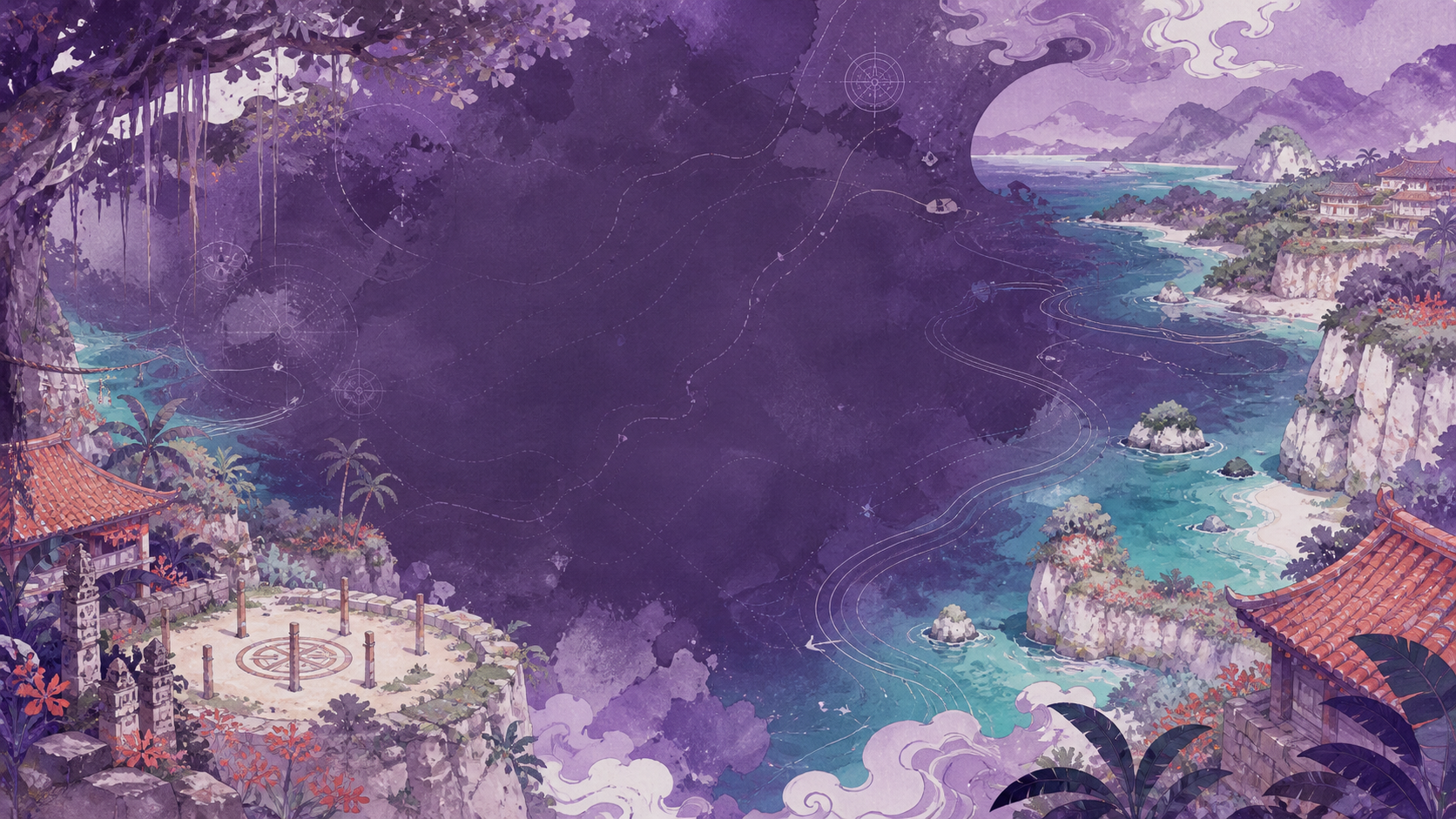
The hero is original CVM Sekai editorial art. It combines an imagined island coast, red-tile roofs, a martial arts courtyard, forest markers, and abstract map lines. It contains no franchise characters, logos, copied frames, or readable invented language.
Keep exploring
Return to the Stitch! anime hub or return to the complete Lilo & Stitch franchise.
Izayoi is fictional even when the visual language is recognizable
The anime builds Izayoi Island as a compact stage where Yuna, Obaa, classmates, yōkai, experiments, beaches, forests, homes, and sacred spaces can collide every week. Viewers may recognize Okinawan architecture and cultural references, but the island should not be placed on a real map or treated as a documentary composite.
Fiction gives the writers freedom to move locations and combine details. The guide’s job is to identify that freedom before readers use an episode route as travel information. Real Okinawa has many islands, municipalities, communities, and histories that cannot be compressed into one invented village.
Okinawa is an archipelago, not one tropical edge of Japan
The setting draws from a prefecture made up of many islands with distinct local conditions. Describing Okinawa only as southern Japan makes geography easy and history thin. The Ryukyu Islands developed through maritime contact, political change, trade, local communities, and relationships with China, Japan, Korea, and Southeast Asia.
UNESCO’s Ryukyu Kingdom property emphasizes wide-ranging economic and cultural contacts as part of the region’s historical significance. That record matters when the anime uses an island as if it were naturally isolated until Stitch arrives. The cultural landscape was connected long before the blue alien.
Red tile roofs are built for weather before they become a postcard
Official Okinawa tourism material explains that traditional red roof tiles are secured with plaster against strong winds and that coral or limestone walls and entrance partitions respond to climate and privacy. These features carry practical knowledge.
Animation can use the roofs as immediate location shorthand, but a guide should name the typhoon logic and household design underneath the color. Buildings are not costumes for scenery. They show how people adapt materials, airflow, boundaries, and maintenance to a specific environment.
Karate belongs to Okinawan history and living practice
Okinawa’s official karate resources describe roots in Ryukyuan martial practice and exchange with neighboring countries, with distinct lineages associated with Shuri, Naha, and Tomari. Karate later spread through education and teachers who carried it beyond Okinawa.
Yuna’s training should be read within that history rather than as a generic anime sign that she is tough. Technique, discipline, teachers, dojo relationships, etiquette, and the principle that karate is not for initiating violence all complicate a character who sometimes rushes into conflict.
Yuna’s skill should not make every fight culturally meaningful
A karate move in an episode can be comedy, defense, impatience, or choreography. It does not automatically represent the spirit or full history of Okinawan karate. The guide should distinguish the character’s behavior from the values institutions and practitioners describe.
That distinction allows criticism. Yuna can train in a respected tradition and still misuse a technique, ignore advice, or learn incompletely. Culture becomes real when characters can fail to embody it rather than functioning as perfect mascots.
Gusuku carries a specific Ryukyuan record
UNESCO documents more than three hundred gusuku sites and related assets, with the World Heritage property preserving five castle sites, two monuments, and two cultural landscapes across Okinawa Island. Gusuku developed through changing settlements, fortification, authority, and sacred practice.
An animated ruin with stone walls may echo that history without representing one real site. The guide should not translate every gusuku as a standard Japanese castle or assume every elevated wall has the same function. Official site documentation supplies the historical categories; the episode supplies the fictional location.
Sacred sites are not empty spaces waiting for adventure
A forest, rock, grove, or ruin can carry community rules and religious meaning even when no building or guard appears. Adventure stories often treat quiet landscapes as unowned stages where the hero can touch, move, fight, or activate anything.
The anime should be read for who grants access, who explains the place, and what repair follows disturbance. A magical reaction does not replace community consent. The absence of an English explanation does not prove the setting is spiritually blank.
Kijimunaa is a local figure, not a generic yōkai skin
The series turns Kijimunaa into a recurring character with comic habits, friendship, vulnerability, and plot functions specific to this branch. Broader Okinawan accounts should be researched separately rather than inferred from the mascot design.
Calling Kijimunaa a forest spirit may help orientation and can hide regional naming, variation, and context. The guide should preserve the name, identify what the anime shows, and point to Okinawan cultural sources for claims beyond the episode.
Yōkai is too broad to solve every translation problem
Yōkai can organize many supernatural beings in Japanese-language discussion, but it does not make every regional figure interchangeable. Local terms, story functions, ritual relationships, and modern media histories remain important.
The franchise also adds alien experiments whose abilities resemble supernatural events. Jumba may classify through science while Obaa or Yuna uses another framework. The best reading lets categories remain contested instead of announcing one universal explanation.
Obaa should carry situated knowledge, not unlimited authority
Obaa can know island stories, family history, ritual practice, weather, people, and the consequences of earlier events. She should not automatically know every yōkai, experiment, or historical question the script introduces. Limits make her knowledge credible.
The branch improves when she cites a person, place, practice, or memory and admits uncertainty where it exists. Elders are people with experience, not magical databases. Respect includes allowing disagreement and continued learning.
The Chitama Stone is franchise mythology
The wish, its conditions, and the Good Deed Counter belong to the anime’s story engine. Readers should not be told that Okinawan tradition contains this exact artifact or forty-three-deed trial unless a primary source proves a borrowing.
The writers can combine an invented stone with local visual and supernatural material. The guide simply needs to label the invention before discussing how it interacts with themes of sacred landscape, moral measurement, and Stitch’s desire for power.
Tourism changes the setting the camera wants to romanticize
Okinawa is often sold through beaches, bright roofs, food, music, resorts, and relaxed island imagery. Tourism supports jobs and can pressure land, housing, infrastructure, heritage sites, and everyday life. A fictional island may borrow the attractive surface without showing the labor underneath it.
A stronger episode could let local characters encounter seasonal work, visitor behavior, conservation rules, or disagreements about development. Paradise looks different to the child living there than to the audience arriving for twenty-two minutes.
New Town changes the social geography
When Yuna moves into a new-town setting, the branch changes more than background. School, housing, neighbors, transport, privacy, and access to Obaa or island knowledge may shift. Stitch’s behavior also lands differently in a denser environment.
The move should carry emotional and practical consequences across episodes. If every familiar relationship remains instantly available, relocation becomes cosmetic. A real transition includes lost routines, new support, changed risk, and the work of deciding which parts of Izayoi still define home.
Official stills should identify the animated invention accurately
Episode and guide images need local official sources with metadata. Alt text should say that an image depicts the fictional Izayoi setting or a Stitch! episode, not present it as a photograph of a real Okinawan location.
That wording protects both accessibility and cultural accuracy. Readers can recognize the production art while understanding that real architecture, landscapes, and heritage sites require separate official sources.
Source standard
Real-world claims in this guide are checked against Okinawa Prefecture resources, official Okinawa karate institutions, official tourism material on traditional homes, and UNESCO documentation for the Ryukyu Kingdom sites.
Anime claims come from the released Japanese production order, official TV Tokyo and Disney Japan records, and local official stills. Where the production does not name a real source, the guide marks visual or thematic comparison as RaeRae’s interpretation.
Guide verdict
Izayoi works because it gives the Japanese branch a place with recurring relationships, visual identity, and cultural questions the Hawaiian continuity did not contain. It fails whenever those references are treated like interchangeable island flavor.
The right approach keeps the fictional map visible, checks real-world history with Okinawan sources, names anime invention, and lets local people know different things. Stitch can enter the setting without becoming the reason the setting matters.
Language should not be reduced to a funny accent
Okinawa contains language histories and local speech that cannot be represented by adding one comic pronunciation to standard Japanese dialogue. Translation and dubbing may flatten distinctions further. A guide should identify only the language features official scripts or credible linguistic sources support.
Where the anime uses a local term, preserve it, explain the context, and avoid claiming one character’s speech represents the whole prefecture.
Food is labor, history, and family practice
Meals can establish household routine, local ingredients, trade history, celebration, health beliefs, and who performs care. Okinawa Prefecture’s own cultural resources describe food as living culture shaped through climate, family, region, and exchange.
An episode snack should not become a complete cuisine lesson. Name what the screen shows, check the dish through official or practitioner sources, and keep the person preparing it visible.