
Sophrona
Simon sees blankets and a skinny fist blocking his route. Sophrona sees inventory, workers under load, a corridor obstruction, and exactly which higher authority will make the boy move.
Profile
Sophrona is a logistics officer in a world that calls her work linen.
Sophrona is the Hayholt’s Linen Mistress. Book 1 shows her leading maids burdened with blankets, raising a skinny fist at Simon, and threatening to report him to Rachel. No face, age, hair, voice, origin, family, or later fate is supplied. The scene is brief; the office is not.
Linen touches every body in the castle. Sheets, blankets, towels, table cloths, underlayers, bandages, shrouds, storage, washing, drying, repair, issue, return, and loss all require control. The title “Mistress” signals responsibility within the servant hierarchy, even when the narrative filters her through a boy annoyed that adults keep interrupting his movement.
Sophrona’s blanket-laden procession makes weight visible. The maids are not decorative attendants drifting through halls. They carry bulky household necessities under supervision. Simon becomes another object in the route—something that must be moved so work can continue.
Her threat to involve Rachel demonstrates procedural authority. Sophrona does not need to strike Simon or chase him. She names the person whose discipline he fears. The servant hierarchy has escalation paths, reputation, and cross-department cooperation.
A complete profile should neither turn this into secret military command nor dismiss it as comic scolding. Sophrona’s power is scoped: substantial over linen work and the maids she leads, useful when dealing with a servant boy, and still subordinate inside the broader royal household.
She remains last confirmed alive in Book 1. The canonical image preserves the one physical receipt—slender fist and hand—while disclosing every additional visual choice.
The Dragonbone Chair · Exact evidence
One corridor encounter supplies office, workforce, burden, physical detail, conflict, and a functioning chain of authority.
Sophrona is identified by responsibility, not by relation to a noble
The text names her Linen Mistress. That title places her over a material system and differentiates her from chambermaids, kitchen maids, and the broader servant crowd.
Book 1 does not define the full office manual. The profile explains historically plausible scope at the system level without assigning every likely task as a witnessed action.
She leads workers rather than carrying the household alone
Sophrona appears with maids under her direction. The group makes linen work collective and organized. Her authority is relational: somebody plans movement, and other bodies bear the load.
The maids remain unnamed in this receipt. Their anonymity should not make their physical effort disappear.
Bulk turns domestic comfort back into weight
The maids are burdened with blankets. A blanket experienced in bed as warmth becomes awkward mass when washed, folded, counted, carried, and stored.
The word “burdened” is evidence of load, not necessarily mistreatment by Sophrona. We can discuss strain without inventing cruelty.
Simon occupies space needed by a working procession
Simon’s route intersects the linen group. From his viewpoint, Sophrona interrupts. From the workers’ viewpoint, a distracted boy is blocking or complicating assigned movement.
The scene uses comedy to reveal competing definitions of urgency. Simon’s curiosity feels important to him; household work has its own schedule.
One hand carries the entire physical record
Sophrona raises or uses a skinny fist in the confrontation. Book 1 does not generalize that adjective into a full body description. She may be lean, or only her hand may appear bony.
The portrait uses a lean build for continuity but labels that extension as interpretation. The slender hand itself remains the locked physical detail.
Rachel’s name functions as enforcement without Rachel entering the corridor
Sophrona threatens to report Simon to Rachel. She knows exactly which authority will matter to him and uses institutional connection rather than physical punishment.
The scene does not verify that she later reports him. The threat accomplishes immediate control.
No later Book 1 scene resolves her life beyond the office
The completed volume supplies no direct return, fate, family, crisis exit, or changed status for Sophrona. She remains last confirmed alive.
The page preserves this narrow certainty and awaits sequential evidence rather than inventing survival through the later Hayholt crisis.
The castle’s textile bloodstream
Linen moves between skin, sleep, food, sickness, ceremony, and death—and Sophrona’s office sits in the middle.
Textiles are infrastructure disguised as softness. Beds require sheets and blankets. Tables require cloth. Kitchens and baths require towels. Servants and nobles wear washable underlayers. Illness and injury consume bandage material. Birth and death both require clean cloth.
Each item has a lifecycle: acquisition, cutting, marking, issue, use, collection, sorting, washing, drying, mending, folding, storage, and reissue. Loss, stains, infestation, damp, fire, and theft create additional risk. A large fortress multiplies every step.
Sophrona’s title therefore implies inventory intelligence even though the scene does not show a ledger. The image includes a tally tablet as visual shorthand, carefully disclosed as role continuity rather than a described object.
The blanket procession shows distribution in motion. Warmth does not simply exist in rooms. Workers relocate it. If a cold season or siege increases demand, the linen system becomes survival infrastructure.
This context also clarifies Sarrah’s downstairs mending. Sophrona is Linen Mistress; Sarrah is a chambermaid associated with mending. Their work belongs to overlapping textile systems, but Book 1 does not state a direct reporting relationship. The site keeps both canonical identities instead of merging all cloth labor into one woman.
Household history is often written as consumption: who slept where, wore what, feasted, married, bled, or was buried. Sophrona’s office records production and maintenance behind those verbs. Complete fandom coverage follows the cloth backward.
Clean linen is a cross-department dependency. Rachel’s chambermaids cannot reset rooms without it. Judith’s kitchen and feast service need cloth. A healer requires bandages and clean wrapping. Guest arrivals, sickness, childbirth, mourning, and winter cold can each create a sudden demand that looks unrelated until it reaches the same shelves. Sophrona’s office sits where separate castle stories become one inventory problem.
That shared dependency explains why a corridor route matters. A delayed blanket procession is not merely comic inconvenience. It may delay beds, guest rooms, sick care, or redistribution of warmth. Book 1 does not specify the destination of this load, so the profile preserves the possibilities as system context rather than choosing one as fact.
Authority without nobility
Sophrona’s power is real, bounded, procedural, and legible to everybody in the servant world.
“Mistress” identifies rank within labor. She leads maids, coordinates a route, and expects compliance from a boy whose own assignments intersect hers. That is authority, even if it lacks land, soldiers, or court title.
Her threat works through Rachel because servant offices connect. Rachel’s reputation extends beyond the chambermaids she directly governs. Sophrona can invoke it as a predictable consequence.
This creates a form of horizontal institutional power. The women do not need a nobleman to settle a corridor problem. They have rules, supervisors, and knowledge of who answers to whom. The household operates because those systems resolve thousands of small conflicts below court attention.
The power remains unequal. Sophrona may command maids and threaten Simon, but nothing in Book 1 suggests she can discipline nobles who obstruct her work. Servant authority is strongest downward and sideways, fragile upward.
The profile should also avoid reading strictness as villainy. Simon often experiences adult work discipline as persecution because he does not see the full task. Sophrona’s maids are carrying heavy blankets. Moving him is a practical need before it is a character judgment.
At the same time, “burdened” invites attention to how authority distributes weight. The scene does not tell us whether Sophrona carries her share, plans fair loads, or exploits subordinates. The honest page leaves management style unresolved beyond brisk enforcement.
Simon’s viewpoint and household comedy
The joke works because Simon thinks he is the main event in a corridor full of people doing actual jobs.
Early Simon moves through the Hayholt as a magnet for stories, animals, forbidden spaces, and missed chores. Adults appear as obstacles because the narrative stays near his appetite. Sophrona enters in that mode: fist, blankets, threat, Rachel.
Rereading from the labor side changes the geometry. The maids are under load. Sophrona is responsible for them and for the linen arriving where needed. Simon’s wandering body creates delay or risk. Her impatience becomes proportionate.
This does not make Simon malicious. He is young, under-supervised in some ways and over-disciplined in others, hungry for a life beyond service. The household comedy lets readers enjoy his evasions while accumulating evidence of who pays for them.
Rachel’s name is especially effective because Simon’s relationship to her mixes fear, dependence, irritation, and maternal care. Sophrona understands the emotional chain of command. She does not need to explain linen logistics; she needs to say “Rachel.”
The scene contributes to Simon’s larger education. Before he learns magical costs from Morgenes, the castle repeatedly teaches mundane cost: lost pennies, torn clothes, missed sweeping, delayed errands, and obstructed workers. Sophrona belongs to that curriculum.
Relationships and systems
Sophrona’s network is built from supervision, escalation, material flow, and one very distractible boy.
Rachel the Dragon
Sophrona invokes Rachel as the authority Simon fears. Book 1 confirms the threat, not a direct conversation or report afterward.
Simon
His movement interferes with a blanket-laden work group. Sophrona uses fist, title, and Rachel’s reputation to regain control.
Blanket-carrying maids
Sophrona leads unnamed workers visibly burdened by household textiles. Their load gives her urgency material stakes.
The Hayholt linen system
Her office connects storage, issue, washing, repair, warmth, hygiene, ceremony, sickness, and routine household continuity.
Sarrah
Sarrah performs downstairs mending within the wider textile economy. No direct reporting line to Sophrona is verified.
Blankets and linen
Soft finished objects become inventory, weight, route, and responsibility when viewed from Sophrona’s side of the castle.
The skinny fist
The only physical description doubles as gesture. Future art must preserve the slender hand without turning it into caricature.
Reporting
Sophrona controls behavior through expected procedure rather than verified physical force. Whether she follows through is unknown.
Last confirmed alive
No later scene proves death, escape, continued office, or final fate. The scoped status remains intentionally narrow.
Fandom notes and evidence discipline
Sophrona’s page can be exhaustive without pretending one skinny fist is a full portrait sitting inside the prose.
Book 1 confirms name, office, skinny fist, blanket-burdened maids, leadership, confrontation with Simon, and threatened report to Rachel. Everything else must remain either contextual analysis or disclosed art continuity.
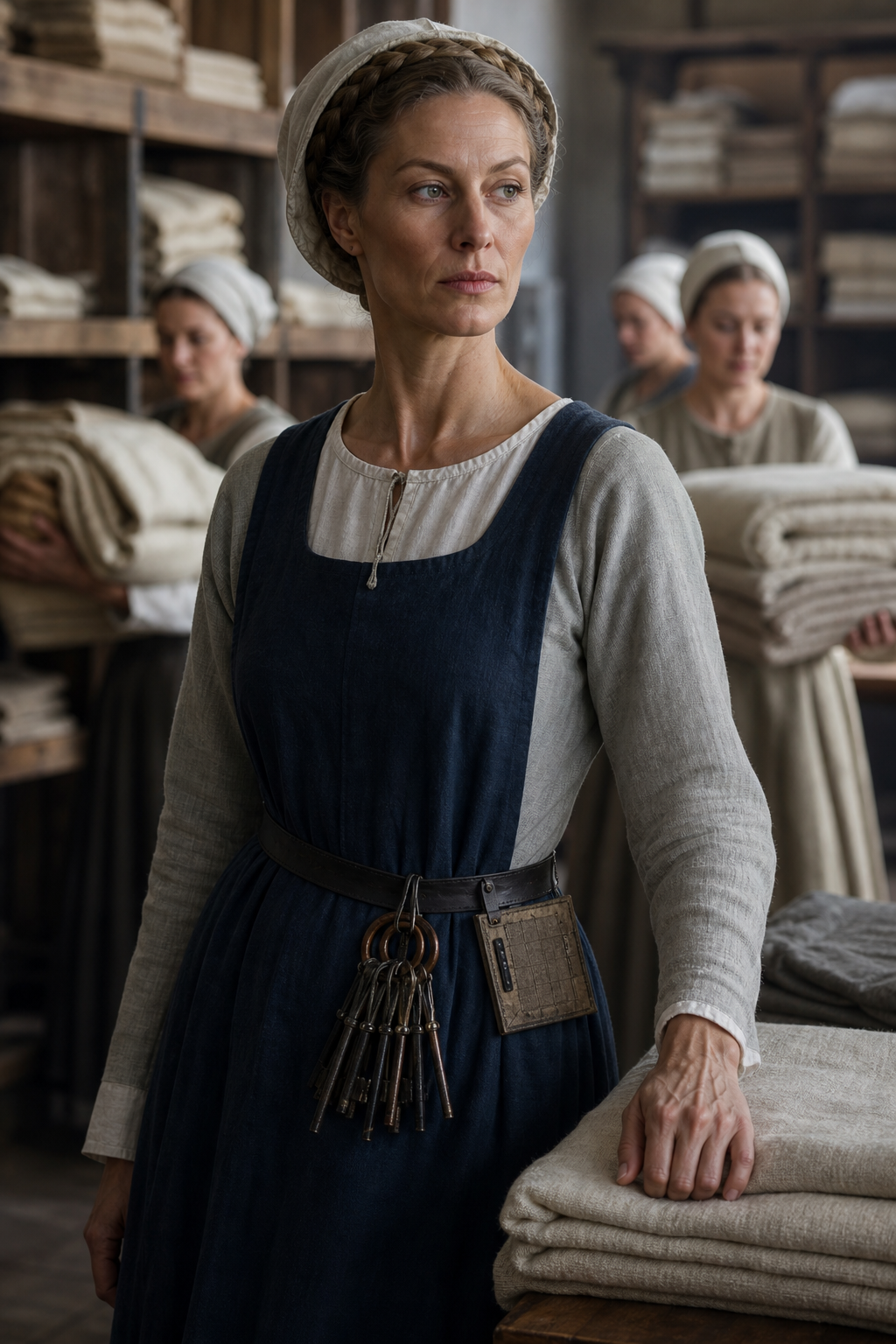
The image interprets the hand as part of a lean middle-aged woman with gray-green eyes, high cheekbones, dark-blonde hair beginning to gray, structured coif, dove-gray gown, blue over-apron, keys, and tally tablet. None of those details besides the slender hand are direct physical canon.
Why she is attractive and strict
The owner’s visual rule favors compelling adult fantasy identities unless the text requires otherwise. Sophrona can be striking without becoming soft, young, noble, or sexualized. Exacting competence is the aesthetic center.
What remains unknown
Surname, age, origin, family, full build, face, hair, eyes, voice, length of service, exact staff count, office procedures, relationship with Rachel, management fairness, later location, and final fate all remain unverified.
Canonical identity and visual-evidence disclosure
The hand is canon. The woman around it is a carefully labeled continuity decision.
The canonical image fixes Sophrona as a striking adult woman around forty with a lean elegant build, long narrow capable hands, gray-green eyes, high cheekbones, medium fair weathered complexion, dark-blonde hair lightly streaked with early gray and braided beneath a linen coif, dove-gray wool gown, deep-blue sleeveless over-apron, belt, keys, and tally tablet.
She stands among folded linens while maids carry blankets behind her. Her expression is brisk and unimpressed rather than cruel. The portrait turns office into a readable visual environment without claiming the book described the room.
On the record
What this profile can prove today
This canonical profile covers Sophrona through The Dragonbone Chair: exact name, Linen Mistress office, skinny fist, leadership of blanket-burdened maids, corridor conflict with Simon, threatened report to Rachel, servant authority, linen-system context, and last-confirmed-alive status.
Source: owner-accessed Kindle edition of The Dragonbone Chair, verified front-to-back through page 652 of 652 and reconciled with the complete Book 1 character manifest. Only the skinny fist is physically described; the remaining portrait is disclosed visual-continuity art. Later-volume evidence is excluded until sequential reading reaches it.
The Dragonbone Chair hub → · Book 1 characters → · Rachel the Dragon → · Simon → · Sarrah → · Series hub →