
Sarrah
Simon tears his clothes; Sarrah repairs them downstairs. The novel gives her one quiet sentence and accidentally hands us the entire servant economy hiding underneath a boy’s ordinary morning.
Profile
Sarrah is what complete character coverage looks like when the text gives labor instead of destiny.
Sarrah is a quiet, explicitly homely Hayholt chambermaid who is absent from her usual work because she has fluxion. She does downstairs mending, and Simon’s torn clothes create more work for her. Those are the complete verified Book 1 facts. They are few. They are not nothing.
A thin encyclopedia entry would stop there. A dishonest fandom page would fill the silence with invented family, temperament, romance, age, or fate. The useful middle path is evidence-rich rather than biography-heavy: locate Sarrah inside Rachel’s servant system, explain what downstairs mending contributes to castle life, preserve illness as material circumstance, examine the narrator’s “homely” label without treating appearance as destiny, and mark every unknown cleanly.
Sarrah’s importance is not secretly equivalent to Simon’s. Complete coverage does not require pretending every named person drives the plot. It requires recognizing that the plot’s visible lives depend on people whose work is so routine the narrative can compress them into a clause. Simon can tear clothing because someone else repairs it. He can move through the castle without tracking that repair because servant labor absorbs the consequence.
The profile therefore refuses two forms of disappearance. It will not omit Sarrah because she is minor, and it will not erase the smallness of her textual footprint by manufacturing epic significance. She remains a chambermaid with one documented condition and task. The rabbit hole is the system around those facts.
The Dragonbone Chair · Exact evidence
One early household passage establishes name, work, personality shorthand, appearance shorthand, illness, location, and consequence.
Sarrah belongs to Rachel’s governed world
Book 1 introduces the Hayholt’s servant routines through Rachel’s attention to rooms, clothing, order, and assignment. Sarrah is identified as a chambermaid, placing her within that labor structure rather than among noble attendants whose service carries court prestige.
The title includes cleaning, linens, personal spaces, and whatever additional work the household assigns. The text specifically anchors Sarrah to mending downstairs. We should not expand that into unverified specialist rank, but we can recognize clothing repair as part of the service economy.
Two adjectives do more social work than physical detail
Sarrah is called quiet and homely. “Quiet” describes observable demeanor in the household, not a complete personality diagnosis. She may be shy, reserved, disciplined, tired, cautious, or simply not talkative around Simon. Book 1 does not choose among those possibilities.
“Homely” records how the narrative or viewpoint evaluates conventional attractiveness. It does not supply hair, eyes, height, weight, age, face shape, or moral character. The profile preserves the label and refuses to let it swallow the person.
Illness enters the household as a missing worker and redistributed tasks
Sarrah is unavailable because she has fluxion. The wording identifies temporary illness rather than death, dismissal, or journey. It does not give symptoms, severity, duration, treatment, contagion, or recovery.
Her absence matters operationally. Servant work does not vanish when a servant becomes sick. It waits, shifts to colleagues, or returns to the ill worker later. The book’s brief note carries that pressure without staging a sickroom.
Repair is geographically and socially placed below the rooms it sustains
Sarrah does mending downstairs. The location distinguishes the visible garment from the hidden workroom. Clothes return upstairs repaired; the time, needlework, posture, light, and skill remain below.
“Downstairs” is more than a direction in a castle organized by hierarchy. It is where the consequences of wear are processed before privileged or protected lives continue above.
The protagonist’s freedom arrives as somebody else’s additional task
Simon’s adventures, climbing, carelessness, and ordinary movement damage clothing. The text notes that his torn garments create work for Sarrah. This is a tiny accountability receipt inside a story about a boy who often experiences maintenance as Rachel’s nagging.
The clothes do not repair because castle life is magical. A sick, quiet woman downstairs is expected to apply time and skill. Naming her prevents “the servants” from becoming a frictionless background function.
Book 1 never returns to provide a completed fate
The completed volume does not verify Sarrah’s recovery, later assignment, evacuation, death, or presence during the Hayholt’s worsening crisis. Her last confirmed state is alive and ill during the early household sequence.
The directory card therefore uses “last confirmed alive,” not “alive at series end.” A canonical profile can be comprehensive without pretending the camera stayed with her.
Mending, maintenance, and invisible time
The epic depends on repaired cloth long before it depends on enchanted swords.
Mending is preservation work. It extends the life of fabric, protects bodies, conserves household resources, and restores garments damaged by use. In a preindustrial castle, cloth represents agricultural material, spinning, weaving, dyeing, cutting, sewing, washing, and transport. A tear threatens more accumulated labor than the rip itself reveals.
Sarrah’s needle sits at the end of that chain. She is not confirmed as the Hayholt’s formal linen mistress or master seamstress; Sophrona occupies the linen-mistress identity elsewhere in the roster. Sarrah’s receipt is narrower: a chambermaid who performs downstairs mending. Keeping the roles distinct protects both women from being collapsed into generic domestic service.
Simon experiences torn clothing as a problem when Rachel notices. Sarrah experiences it as minutes or hours added to a working day. That asymmetry is the point. Protagonist freedom often has a maintenance shadow. The boy can run, climb, scramble, and daydream because adults and servants handle food, wounds, candles, laundry, rooms, and fabric afterward.
The task also requires concentration and embodied endurance: usable light, controlled hands, repetitive motion, close vision, and posture held over cloth. Fluxion may interfere with any of these, but the text does not say whether Sarrah mends while actively ill. The canonical portrait places the two verified facts in one continuity scene and labels it art, not a quotation from an unstaged moment.
Fandom coverage improves when it makes this work legible without romanticizing it. Needlework is skilled and necessary. It can also be monotonous, underrecognized, and imposed within hierarchy. Calling it “quiet feminine magic” would turn labor back into atmosphere. Sarrah is a worker, not a cottagecore mood board.
Fluxion and the fragile workforce
The castle notices Sarrah’s body because the work expected from it is temporarily unavailable.
Book 1’s word “fluxion” identifies illness without giving us a clinical chart. It would be irresponsible to translate it into a specific modern diagnosis, symptom list, prognosis, or infectious timeline. The profile retains the period term and the only certain consequence: she is absent from regular duty.
Absence is a worker’s medical fact and an institution’s logistical problem. In a household governed by fixed daily needs, colleagues must cover tasks or accept backlog. Rachel’s later protectiveness toward the servant women makes clear that these people are not interchangeable to her, even when castle operations may treat them that way.
Sarrah’s illness also corrects the fantasy of the castle as a sealed machine. Bodies get sick. Work pauses. Cloth still tears. Care itself consumes labor. The Hayholt’s grandeur cannot abolish vulnerability; it can only distribute who bears the disruption.
We do not know who cared for Sarrah, whether she had a private bed, whether she lost pay or rations, whether Morgenes treated her, or whether other chambermaids assumed her mending. Those are important historical questions and unsupported narrative claims. A trustworthy profile distinguishes the questions from answers.
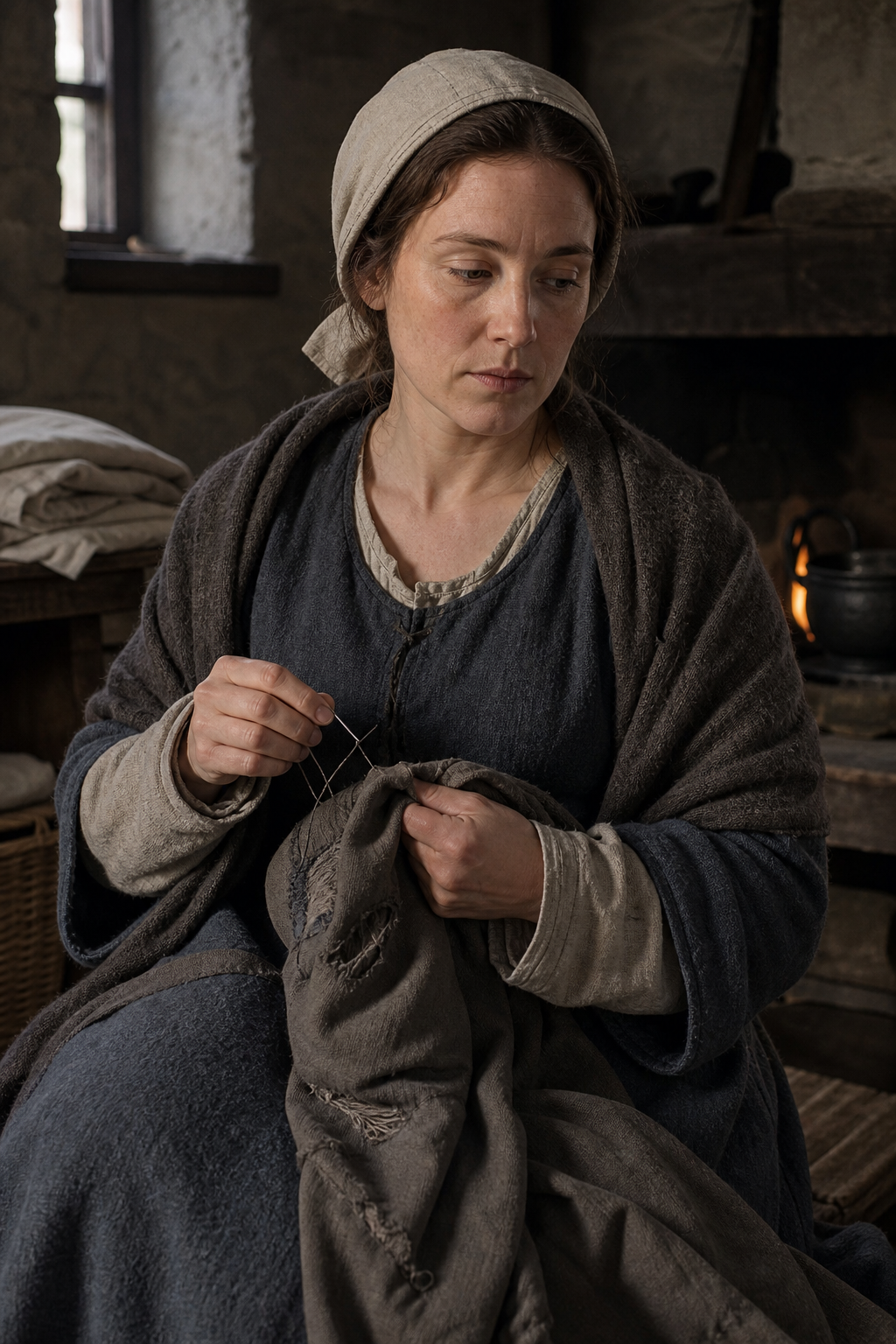
The portrait makes her pale and fatigued because illness is verified, but avoids fever spectacle, emaciation, coughing blood, or deathbed styling. Fluxion should not become visual punishment. She remains alert, capable, and occupied by a task connected to her documented role.
“Homely” without cruelty
The text’s beauty judgment belongs in the evidence column, not the verdict column.
“Homely” is a relative social label, not a facial blueprint. The word tells us Sarrah does not register as conventionally pretty to the describing perspective. It cannot tell us that she is grotesque, old, dirty, foolish, undesirable, or morally inferior. Those associations would be supplied by the illustrator, not the novel.
The site’s normal fantasy treatment favors attractive characters, but the owner’s rule is equally clear: when the book calls someone ugly or homely, canon wins. The answer is not to punish Sarrah with caricature. It is to visualize plainness with dignity—natural asymmetry, an unglamorized face, tired eyes, practical hair, and a reserved presence that becomes appealing through humanity rather than transformed beauty.
Quietness receives similar care. The portrait looks inward and downward because the scene centers close work, not because Sarrah is meek by destiny. Future art can show different emotion when verified context supports it. Canonical identity locks facial continuity, not a permanent expression.
This distinction matters across the entire ecosystem. A directory filled only with idealized nobles implies that beauty is the price of narrative memory. Sarrah’s card can be visually compelling without pretending every woman in Osten Ard has romance-cover symmetry. Fandom becomes richer when ordinary faces receive the same image quality, metadata, layout, and editorial seriousness as leads.
Relationships and systems
Sarrah’s network is small in the text but clear in function.
Simon
His torn clothing creates mending for Sarrah. The relationship is not shown as intimate; it is an unequal chain between youthful freedom and servant repair.
Rachel the Dragon
Sarrah works within Rachel’s chambermaid domain. Rachel’s vigilance supplies the organizational context even though no direct conversation is recorded.
Hayholt chambermaids
Jael, Hepzibah, and the other named women prevent Sarrah from becoming “the maid.” Their roles overlap without becoming duplicate identities.
Sophrona
The linen mistress belongs to the broader clothing and linen system. Book 1 does not explicitly define a reporting line between her and Sarrah.
Simon’s torn garment
The cloth is the only documented object connecting Sarrah to the protagonist. It records skill, time, class, and invisible aftermath.
Fluxion
Illness removes Sarrah from regular duty. Symptoms, care, duration, recovery, and contagion remain outside the verified record.
Downstairs mending room
The text locates the task downstairs but does not describe a dedicated room. The portrait’s workroom is historically grounded visual continuity.
Quiet presence
Quiet is observed behavior, not proof of shyness, fear, obedience, or lack of opinion. The profile preserves that interpretive boundary.
Last confirmed alive
No later scene confirms death or survival beyond the volume. The directory does not convert narrative silence into a false ending.
Fandom notes and canonical naming
The first act of respecting Sarrah is spelling the one thing the book tells us most clearly.
The source ledger spells the character Sarrah. An early backend registry draft incorrectly used “Sarah.” This rebuild keeps the stable post ID while correcting the canonical title, slug, registry name, media records, SEO, and internal link target. It does not create a second profile.
The correction demonstrates why manifests matter. A minor-character misspelling can silently become a duplicate slug, split search results, separate image identity, and two half-empty cards. Canonical identity is not only artwork. It begins with exact naming and one source of truth.
What we know
We know Sarrah is a chambermaid, quiet, homely, absent with fluxion, associated with downstairs mending, and burdened by Simon’s torn clothing. Her Book 1 status remains last confirmed alive.
What we do not know
We do not know surname, age, origin, family, hair, eye color, body type, exact symptoms, medical care, recovery, seniority, wages, friendships, opinions, romantic life, religious practice, later movements, or final fate. The profile’s depth comes from interpreting verified placement and preserving those limits—not inventing diary entries for a woman the novel barely follows.
Canonical identity and art lock
Plain-featured, quiet, fatigued, competent, and rendered with the same seriousness as royalty.
The canonical image fixes Sarrah as an adult working woman with an unconventionally appealing but explicitly plain face, slight natural asymmetry, modest uneven nose, soft tired eyes, natural skin texture, brown hair beneath a simple linen coif, muted gray-blue wool servant dress, cream linen sleeves, and a dark wrap against illness.
She sits with needle, thread, and torn cloth beside folded linens in a lower Hayholt work space. The quiet hearth, stone wall, and small-window light establish class and task without claiming the book staged this exact moment. Her hands are competent; her expression is reserved rather than vacant.
On the record
What this profile can prove today
This canonical profile covers Sarrah through The Dragonbone Chair: exact name, chambermaid role, quiet and homely description, absence with fluxion, downstairs mending, Simon’s torn-clothing consequence, servant-system placement, and last-confirmed-alive status.
Source: owner-accessed Kindle edition of The Dragonbone Chair, verified front-to-back through page 652 of 652 and reconciled with the complete Book 1 character manifest. Later-volume material is intentionally excluded until sequential reading reaches it.
The Dragonbone Chair hub → · Book 1 characters → · Simon → · Rachel the Dragon → · Series hub →