
Memory, Sorrow, and Thorn · Canonical Devotional Profile
She Who Birthed Mankind
She Who Birthed Mankind is a Wran goddess named in Book 1’s devotional record and invoked by Tiamak over Younger Mogahib’s pyre in Book 3. The title places human origin inside a larger sacred cycle: birth, watchers and shapers, death, return—and one communal plea that the dead man not drift away unnamed.
At a Glance
The Wran creator-title invoked when a man must be returned to community through fire and memory
- Name
- She Who Birthed Mankind
- Tradition
- Wran devotional figure
- Book 1 presence
- Named in the owned-edition legendary/devotional record
- Book 3 presence
- Invoked by Tiamak during Younger Mogahib’s funeral
- Associated rite
- Raised pyre, oil-palm wrapping, spoken invocations, and communal response
- Co-invoked figures
- She Who Waits to Take All Back; They Who Watch and Shape
- Physical appearance
- Not confirmed
- Status
- Legendary/devotional; literal manifestation unresolved
A Title of Human Origin
“She Who Birthed Mankind” names creation without giving us a complete creation story
The figure’s title attributes the birth of mankind to a feminine sacred presence.
That is the direct meaning available in the name. Everything beyond it requires restraint.
The books do not explain whether “birthed” describes literal divine maternity, creation from earth or water, an ancestral mother, a metaphor for emergence, or a liturgical title whose fuller story Tiamak’s culture already knows.
Nor does “mankind” prove the figure created every people in Osten Ard. The title may express a Wran cosmology in universal language without the narrative adjudicating competing traditions.
The profile should not merge her with another culture’s mother goddess, saint, moon figure, earth power, or Sithi ancestor merely because the roles seem similar.
Her gendered title is confirmed. A specific body is not.
That difference matters for art and prose. A devotional image may use maternal or creation symbolism, but it cannot be presented as the canonical anatomy of a goddess who never visibly appears.
Younger Mogahib’s Pyre
The goddess becomes narratively present through the rite Tiamak performs for a man he barely knew
In Book 3, Younger Mogahib dies after rescue from the ghant nest.
The ghants had captured him before Tiamak, using him as an intermediary or source of power. After the rescue, he suffers fever and repeats visions of ghants overrunning cities before dying rigid on the third night.
Tiamak wraps his body in oil-palm fronds and burns him on a raised pyre.
During the funeral, Tiamak invokes She Who Waits to Take All Back, She Who Birthed Mankind, and They Who Watch and Shape.
He finds honest goodness to name even though he and Younger Mogahib were not friends. Then he asks the company to join the response: “Do not let him drift by.”
She Who Birthed Mankind belongs to that complete action: care for the body, sacred names, truthful remembrance, and communal answer.
The scene confirms invocation. It does not confirm that the goddess appears, receives the fire, transports a soul, heals Tiamak, or answers in any visible way.
Birth, Return, Watching, and Shaping
The three invocations suggest a sacred cycle without supplying a doctrinal chart
Tiamak does not invoke She Who Birthed Mankind alone.
She stands beside She Who Waits to Take All Back and They Who Watch and Shape.
The sequence suggests origin, ongoing formation or witness, and eventual return. That is a reasonable reading of the titles in the funeral context.
It is not enough to declare three members of a fixed pantheon, their hierarchy, family relationships, or separate cosmic jurisdictions.
“They” may identify plural beings, a collective title, ancestors, powers, or something else. “Take All Back” may describe death, earth, water, memory, or ritual return. The text does not elaborate here.
What the rite clearly does is place Younger Mogahib inside a story larger than the ghants’ use of his body.
The nest attempted to reduce captive people to biological tools or fuel. The funeral restores human origin, moral witness, and communal return.
She Who Birthed Mankind names the beginning of the dignity the ghants tried to consume.
“Do Not Let Him Drift By”
The response turns a stranger’s death into a shared refusal of erasure
Tiamak asks the others to join the funeral response.
The line does not require them to understand every Wran belief. It requires participation in remembrance.
Younger Mogahib is Tiamak’s last known link to Village Grove, whose wider fate remains unresolved. If his body were treated only as another casualty on the road, the ghants’ dehumanization would continue after death.
The response interrupts that drift.
She Who Birthed Mankind’s title reinforces the claim that the dead man belongs to humanity before he belongs to plot, monster evidence, or casualty count.
A profile should not assign a precise doctrinal definition to “drift.” It may refer to a soul, memory, communal belonging, or ritual danger. The text leaves the term evocative.
Its ethical meaning is clear enough: do not let this person pass unrecognized.
Tiamak as Ritual Leader
The scholar does not merely carry Wran knowledge; he performs responsibility before outsiders
Tiamak is often valued by the larger quest for scholarship, healing knowledge, Nisses’s parchment, and his League connection.
At the pyre, he becomes the person who knows what must be done for the dead.
He selects the wrapping, raises the pyre, speaks the invocations, names goodness, and teaches the response.
The scene keeps Wran tradition from becoming decorative lore. It governs action during grief.
His companions’ participation matters because Tiamak’s culture is not being privately tolerated in a corner. The group is asked to enter the rite respectfully.
The profile cannot identify which companions speak, how perfectly they repeat the words, or whether they share the belief. It can confirm that Tiamak asks the company to join.
She Who Birthed Mankind therefore appears through cultural authority exercised by a living worshipper rather than a spectacle of divine power.
A Funeral After the Ghant Nest
Creation language answers a horror built on stolen bodies
The ghant nest weaponizes human captives.
Tiamak experiences cold invading through the mirror shard and thoughts translated into clicks and buzzing. The hostile intelligence promises power, food, and endless life while reducing beings to faceless shapes.
Other victims appear sealed beneath the nest’s ooze and consumed one after another.
Against that system, the funeral’s creation title becomes political and moral.
She Who Birthed Mankind locates human life before the nest’s appetite. She Who Waits to Take All Back locates death beyond ghant possession. They Who Watch and Shape place the person within ongoing attention rather than faceless consumption.
These are interpretations of the rite’s narrative function, not proof that the invoked figures objectively defeat the ghant intelligence.
The body burns because Tiamak and the group build a pyre, not because the goddess manifests flame.
Belief and Ontology
The profile confirms worship without pretending the trilogy settles every religion
She Who Birthed Mankind is canonically part of Wran devotional language.
Tiamak invokes her in a formal death rite. That establishes religious meaning and cultural practice.
The narrative does not show a body, voice, miracle, dream-message, or independently verified intervention from the goddess.
The correct status is legendary/devotional, literal manifestation unresolved.
“Unresolved” does not mean false. It also does not mean secretly confirmed because other supernatural beings exist in Osten Ard.
The same evidence rule should apply across the franchise: report what characters worship, what rituals do socially and emotionally, and what entities demonstrably act as separate categories.
Connections
The dead man, ritual leader, companion powers, and violated community around the invocation
Tiamak
Performs Younger Mogahib’s funeral and invokes the Wran sacred figures.
Younger Mogahib
The rescued villager whose body receives the rite after he dies from the ghant nest’s aftermath.
She Who Waits to Take All Back
Co-invoked in the funeral; the exact relationship between the figures is not explained.
They Who Watch and Shape
Plural or collective devotional title invoked beside the two feminine figures.
Village Grove
The threatened community to which Younger Mogahib belongs and Tiamak’s last known human link.
The traveling company
Asked to join Tiamak’s response so the dead man does not pass without communal recognition.
Why She Who Birthed Mankind Matters
The goddess’s title restores personhood where the enemy made bodies disposable
She Who Birthed Mankind matters because the funeral refuses the logic of the ghant nest.
The enemy sees captives as interfaces, food, or fuel. Tiamak sees a man who must be wrapped, burned, remembered, and placed within sacred human origin.
The profile also protects Tiamak from being reduced to the information he carries. He is a ritual actor capable of giving cultural direction to companions from more politically dominant societies.
Finally, the scene demonstrates how a minor devotional name can carry major thematic weight without requiring an invented mythology.
We know the title. We know the co-invocations. We know the material rite and communal response. We know no manifestation occurs.
That is enough for a rich canonical page when the page follows the funeral rather than filling the heavens with unsupported lore.
Devotional Image Continuity
Creation and funeral symbolism, clearly interpreted, never passed off as a canonical body
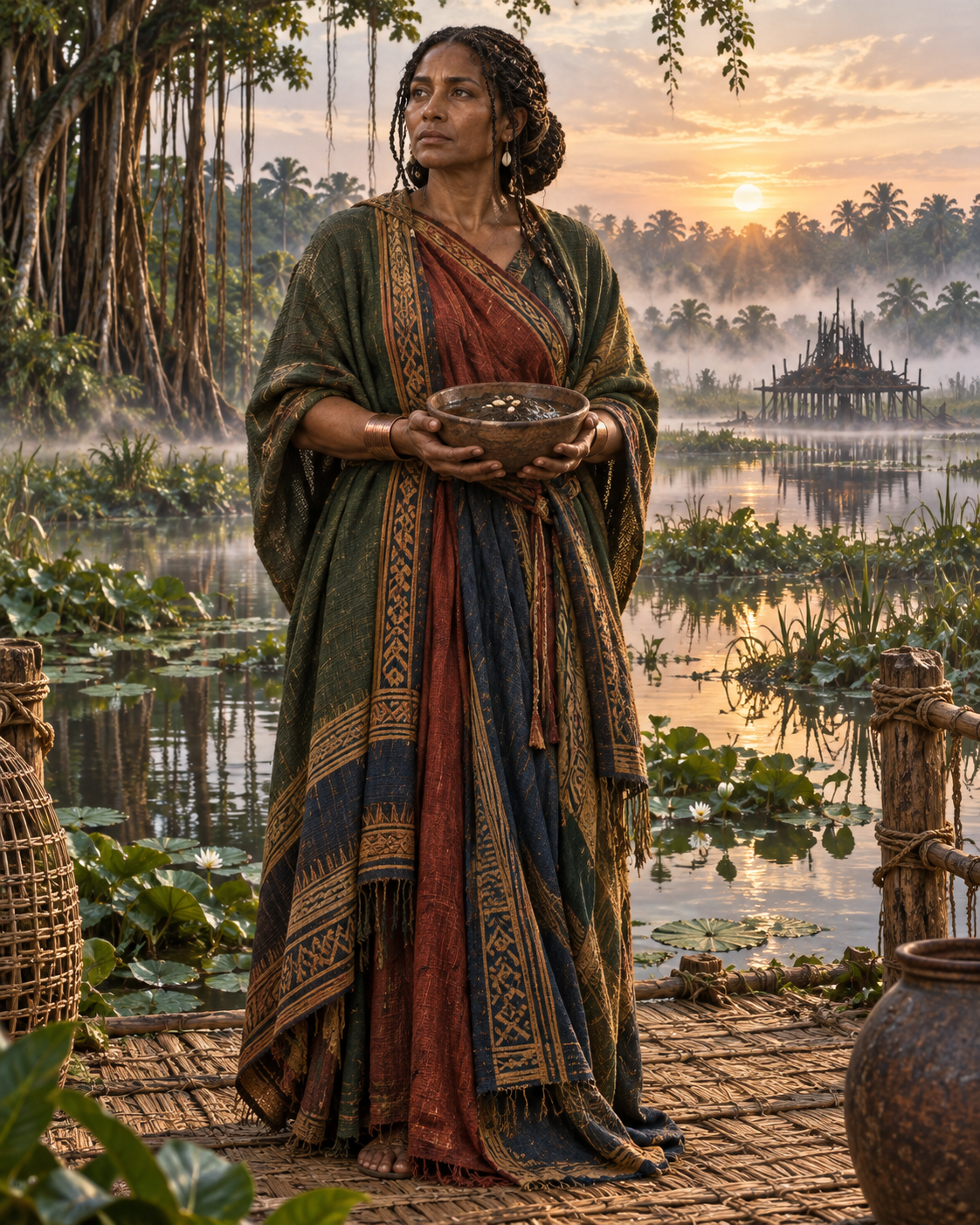
The approved hero is explicitly labeled Wran devotional interpretation: an exceptionally beautiful, dignified mature ancestral figure in the Wran wetlands, holding one earthen bowl of soil, ordinary seeds, and rainwater while a cold raised pyre remains distant.
Her exact apparent age, body, face, skin, eyes, hair, braids, palm-fiber cords, shell beads, clothing, copper cuffs, bowl, soil, seeds, water, banyan, palms, reed platform, wetland, pyre, pose, dawn, mist, and light are CVM editorial reconstruction. None is claimed as canonical anatomy, iconography, temple practice, miracle, or universal doctrine.
This exact devotional face, adult baseline, full grounded body, deep-umber complexion, copper-brown eyes, braided low coil, green/clay/indigo/palm-gold palette, bowl, and wetland visual language now govern Books 1 and 3 directories, profile hero, Tiamak’s funeral context, Wran religion 101, social metadata, and related cultural coverage.
Do not infer literal pregnancy or a baby from the title. Do not use Younger Mogahib’s corpse as the goddess’s identity image, and do not turn the bowl into a magical object or the distant funeral into proof of divine intervention.
On the Record
Books 1 and 3, one Wran creator-title, one fully witnessed funeral invocation
This is the one canonical, full-spoiler devotional profile for She Who Birthed Mankind.
Book 1’s owned-edition cultural record confirms the name among Wran legendary or devotional figures. Book 3 confirms Tiamak invokes her with She Who Waits to Take All Back and They Who Watch and Shape while burning Younger Mogahib on a raised pyre wrapped in oil-palm fronds.
The record also confirms Tiamak names goodness in the dead man and asks the company to answer, “Do not let him drift by.”
It does not confirm the goddess’s physical appearance, origin story, powers, precise domain beyond the birth-title, relationship to the co-invoked figures, clergy, temple, icon, funeral doctrine, answer, intervention, or literal manifestation.
Status is legendary/devotional; literal manifestation unresolved. The approved hero, featured image, cards, and social metadata use one clearly disclosed Wran devotional interpretation across both volume scopes, never a claim of witnessed anatomy.