SEVENTOEIGHT: Members, Music, History and 2026 Group Guide

Group profile and current lineup
Current members Chiwon, M, EXXI, Kyojun, Jagger and D’om Former pre-debut member Park Jinwoo Company TEN Entertainment Formation SCOOL Korean debut July 28, 2025 Current status Active six-member Taiwan–Malaysia group Fandom EECH Bottom line: SEVENTOEIGHT are a six-member Taiwan–Malaysia group promoting through the Korean idol system. Their story starts with SCOOL, includes a seven-person pre-debut lineup, and requires more careful filing than “foreign K-pop group” can provide.
Quick file
Company: TEN Entertainment. Current members: Chiwon, M, EXXI, Kyojun, Jagger and D’om. Korean debut: July 28, 2025. Formation program: SCOOL. Fandom: EECH. Current verified official catalog: the Korean single album SEVENTOEIGHT with “PDSR (Please Don’t Stop the Rain)” and “DRIP&DROP,” plus official pre-debut and program material.
The current six-member lineup
Chiwon, M, Kyojun, Jagger and D’om are Taiwanese; EXXI is Malaysian. The absence of a Korean member is not a novelty sentence to repeat and abandon. It changes the group’s daily labor: language study, Korean broadcast etiquette, training terminology, interview pacing and the need to maintain Mandarin-facing relationships while building a Korean stage identity.
The seven-person pre-debut chapter
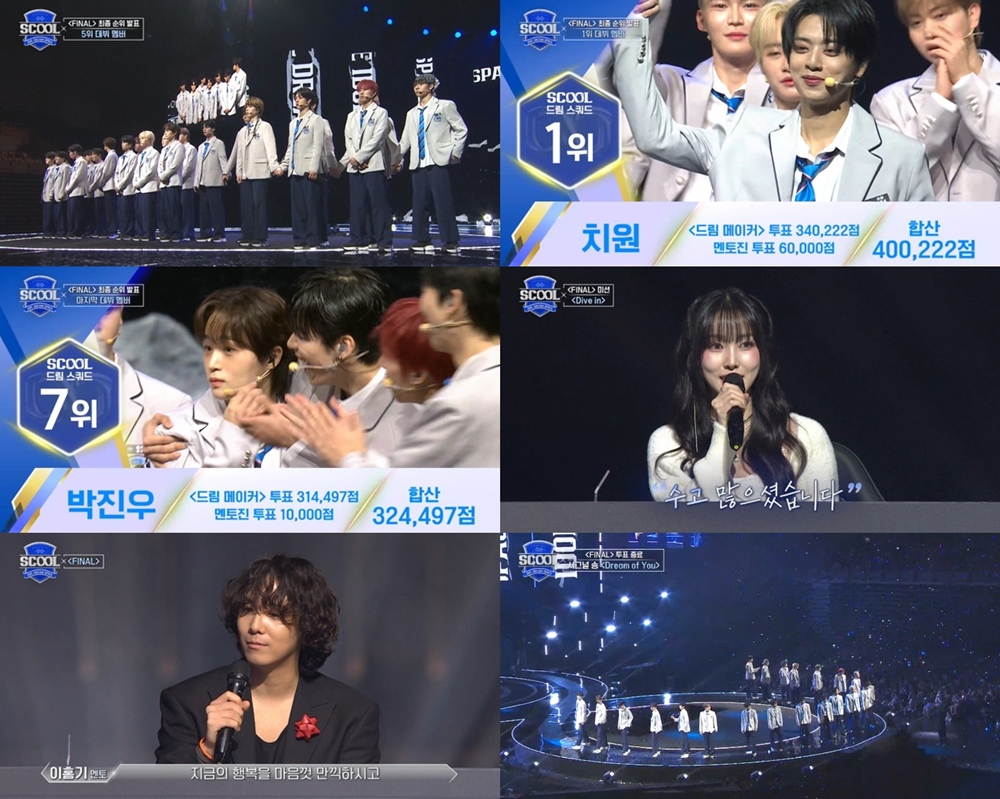
SCOOL ended with seven selected finalists. Park Jinwoo, the only Korean trainee in that winning lineup, ranked seventh and participated in the group’s early public chapter. His departure was announced June 20, 2025, before the Korean music debut. The correct history is seven selected, six debuted in Korea—not a retroactive claim that Jinwoo was never there.
What SCOOL built
SCOOL was a Korea–Taiwan collaboration broadcast through SBS M and Taiwanese platforms. The final ranking placed Chiwon first, D’om second, M third, Kyojun fourth, Jagger fifth, EXXI sixth and Jinwoo seventh. Rankings explain selection, not permanent group hierarchy. After the finale, the work shifted from winning missions to building a unit across languages and very different experience levels.
Why the name uses 728
TEN Entertainment describes the number combination as strength and determination carried toward global stages with fan support. Earlier group explanations also connected seven with luck and eight with infinity. The Korean debut landed on July 28, which is either excellent calendar discipline or proof somebody refused to let a branding opportunity escape.
EECH means together
The fandom name EECH plays on the sound of “together.” That idea fits a group whose operating map crosses Taiwan, Malaysia and Korea. A useful fandom file should keep the official meaning without turning it into a promise the company has already fulfilled. Togetherness is a direction; multilingual access and consistent communication are the work required to make it real.
Ninety days in Seoul
Taiwanese debut coverage described a roughly ninety-day Korean training period with long days devoted to vocals, dance, fitness, language and expression. That context matters because the finished debut can make adaptation look instantaneous. It was not. The members were learning material and the production culture around the material at the same time.
PDSR first
“PDSR (Please Don’t Stop the Rain)” introduced a softer guitar-led and pop-R&B side before the formal Korean debut. The song gives the vocal line more air and presents longing as a wish to preserve a shared moment. It was a smart first look because the later performance title could then prove range instead of forcing one track to carry every possible identity.
DRIP&DROP second
“DRIP&DROP” uses deep-house bass, compact percussion and level-heavy choreography to turn attraction into forward motion. The point move was nicknamed the chicken-claw dance in Taiwanese coverage, while the promotional story also emphasized demanding footwear and live-stage conditioning. The useful takeaway is not that pain proves commitment. It is that choreography and styling should never make avoidable injury part of the concept.
Two titles, one debut argument
The two-song single album is small but strategically legible. PDSR says the group can phrase and blend. DRIP&DROP says it can occupy a music-show stage. Neither track fully maps six personalities, so profiles, dance practices and behind material have to do the member-introduction work the videos cannot finish alone.
The formation problem
Six-member choreography has no single center slot in a symmetrical line, which makes transitions especially important. SEVENTOEIGHT use pairs, offset triangles and rotating focus to keep the formation from reading like five people around a permanent middle. Watch who carries the visual bridge between sections, not only who owns the obvious close-up.
What each member contributes
Chiwon brings leadership, main-vocal responsibility and prior debut experience. M carries lead vocal and dance duties with strong camera awareness. EXXI combines main-vocal and main-dance work with a substantial pre-show performance base. Kyojun brings athletic stamina, Jagger provides rap and theatrical projection, and D’om anchors choreography despite being the youngest.
Cross-border K-pop without a Korean member
K-pop is a production and promotion system as well as a nationality label. SEVENTOEIGHT release Korean-language music, train and promote in Korea, and work with Korean distribution while remaining a Taiwanese-led group with a Malaysian member. Treating them as “not really K-pop” ignores the infrastructure; treating them as simply Korean erases the people.
The language burden
Debut interviews openly acknowledged language difficulty. That honesty should not become a permanent storyline that freezes the members as outsiders. Korean improvement is part of the job, but so are vocals, dance, recording and audience building. The group deserves performance analysis, not endless applause for successfully ordering lunch in the company language.
The catalog integrity warning
Streaming services currently show a burst of generic 2026 singles attached to the SEVENTOEIGHT artist name, including titles not reflected on TEN Entertainment’s official group page or the official SEVENTOEIGHT YouTube channel. Until the company verifies those recordings, this guide excludes them from the group discography. Shared artist names and profile contamination are real catalog problems.
How to verify a new release
A valid update should appear through the official company or group accounts, match the known member identity, and carry label or distributor credits consistent with the project. A streaming tile alone is not enough when metadata can merge unrelated artists. Exact video IDs, official channel provenance and company notices remain the cleanest relationship evidence.
Former-member filing
Park Jinwoo belongs in the formation history and receives one former pre-debut member profile. He does not belong in the current six-member cards, the Korean debut performance credits or the DRIP&DROP relationship set. Accurate history means neither erasing him nor pretending he performed material released after his departure.
What the group still needs
One official Korean single album is not enough to prove a durable musical direction. The next verified release needs to expand the catalog, clarify individual vocal and rap colors, and show whether the group can maintain multilingual access without spreading a small team too thin. Longevity was their stated goal; consistency is how that sentence becomes evidence.
RaeRae’s read
SEVENTOEIGHT are interesting because the global framing is not a press-release accessory. It is visible in the lineup, the language work and the route from Taiwanese television to Korean music shows. DRIP&DROP proves they can arrive with force. The next challenge is less glamorous: verified releases, safer styling, clearer member storytelling and enough catalog to turn an experiment into a career.
Before SCOOL
The members did not begin as identical blank trainees. Chiwon had already debuted, M had passed through Atom Boyz, EXXI brought dance-crew and instrument experience, Kyojun came from competitive athletics, Jagger from theater, and D’om from teaching dance. SCOOL assembled those routes; it did not create every skill in one television season.
The Korean-debut distinction
The team existed publicly before July 2025, but the Korean idol debut is anchored to the single album and Seoul showcase on July 28. Keeping formation, pre-debut activity and Korean debut as separate dates prevents one milestone from swallowing the entire history. Different markets encountered the same group at different stages.
Why Chiwon leads
Chiwon finished first on SCOOL, is the oldest current member and arrived with prior group experience. Those facts support the leadership choice, but leadership is proved after selection through rehearsal habits, communication and how a team recovers when plans change. Jinwoo’s departure made that continuity work immediate.
Why D’om’s age changes the file
D’om was born in 2010 and debuted in Korea at fifteen. His dance expertise is real, but expertise does not make a minor responsible for unsafe conditions. The history should record demanding choreography without praising adults for making a teenager endure preventable risk. Skill and safeguarding are not competing claims.
EXXI’s Malaysian route
EXXI is the only current member from Malaysia, giving the lineup a third national context beyond Taiwan and Korean promotion. His main-vocal and main-dance positions make him central to recordings and choreography. That should be discussed as work, not reduced to a passport trivia answer.
PDSR as vocal evidence
The lighter track is the better first test for blend because guitar and pop-R&B space expose whether voices can hand emotion across short lines. Its rain metaphor is uncomplicated, but the arrangement lets listeners identify warmth, breath and sustained tone before DRIP&DROP pushes everyone into sharper rhythmic delivery.
DRIP&DROP as dance evidence
The performance title asks for grounded house rhythm, repeated drops and clean level changes. The group look prepared because transitions stay readable even when the camera cuts aggressively. That is not the same as perfect individuality; the video introduces a unit more efficiently than it teaches six names.
What the official channel proves
The official artist channel is the clean source for music videos, practices, teasers and member material. It confirms exact uploads but does not validate unrelated audio simply because a streaming platform merged it under the same English name. Cross-platform agreement is the minimum standard for suspicious catalog additions.
The streaming contamination problem
The 2026 titles attached to streaming use generic names, arrive in an implausible cluster and carry attribution that does not match the known TEN Entertainment rollout. That pattern is consistent with name collision or unauthorized metadata, not a hidden comeback. Exclusion is catalog hygiene pending confirmation.
Static cards and canonical images
Every current member and former pre-debut member has one canonical page and one local featured image reused consistently for hero, card, Open Graph and Twitter roles. The group hub uses the official six-member image. No card borrows another person’s portrait, and no derivative replaces the canonical attachment in metadata.
Why Jinwoo gets a page
A selected member who leaves before recorded debut can disappear between survival-show databases and active-roster sites. Jinwoo’s page prevents that gap. It records his seventh-place selection, Korean nationality, pre-debut participation and departure boundary without assigning him later songs or implying an active contract.
How future cards should work
A verified comeback receives a post with a unique local canonical image and an exact-video React where appropriate. That same attachment serves the post hero, featured image and static landing card. Member pages update their trackers without cloning identities or creating infinite-scroll shelves.
The next-comeback test
The next confirmed release should show whether the vocal line can carry more complex material, whether the rappers establish personal tone, and whether the company can promote across languages without giving one market only delayed summaries. A comeback is evidence about whether the operating model can last.
Sources over speed
Small groups are vulnerable to copied profile errors because one early fan page becomes the source for ten later pages. This hub prioritizes TEN Entertainment, exact uploads, KBS, iMBC and traceable Taiwanese reporting. When those sources do not confirm a claim, the page says so instead of laundering repetition into certainty.
A group is not a geography lesson
The national makeup matters because it changes the work, but it should not become the only headline. Once the music starts, listeners still deserve arrangement, vocal and choreography analysis. Global membership is infrastructure and perspective; it is not an exemption from artistic standards or a requirement that every interview explain borders again.
The debut-shoe lesson
Reports about three-kilogram performance shoes circulated because the detail is astonishing. It is also a warning about how easily hardship becomes promotion. Styling should support choreography, protect joints and survive repeated stages. If footwear makes the routine harder without improving the visual result, the correct response is not admiration; it is redesign.
The live-microphone claim
Debut reporting described conditioning while singing to prepare for open microphones. That effort gives useful context, but no article can prove every broadcast signal path or post-production choice. The responsible statement is that the group trained for live stability, while individual stages should be evaluated on the evidence available in each performance.
The member-introduction gap
DRIP&DROP makes the team look cohesive before it makes every member easy to identify. That is a reasonable debut tradeoff for a choreography-first video, but it creates work for the company. Profiles, subtitled behind footage and member-focused performance clips need to turn six silhouettes into six durable public identities.
The survival-show aftercare question
Contestants move from a ranked television environment into a team that must cooperate without weekly eliminations. Companies should help members reset those incentives, manage public comparison and develop roles that are not permanent echoes of final rank. Winning a place is not the same psychological task as living inside the group afterward.
The small-company reality
TEN Entertainment does not have a major-label promotional machine, so clarity matters more. Official channels must verify releases quickly, publish consistent English and Korean metadata, maintain image assets and prevent streaming-profile contamination from becoming the first thing international listeners see. Clean information is a form of promotion.
The archive standard
This hub separates confirmed fact, sourced reporting and RaeRae analysis. It keeps one canonical route per person, one canonical image per post and exact video IDs for official uploads. That structure is deliberately boring behind the scenes because readers should experience the cards as reliable, not as a scavenger hunt through duplicate pages.
A fair rookie verdict
SEVENTOEIGHT do not need to be declared the future of global K-pop to deserve attention. They need accurate profiles, safe working conditions, verified releases and room to develop. The debut shows competence and a memorable bass-driven performance. The rest of the career remains an open assignment rather than a conclusion written early.
What completion looks like
A complete ecosystem connects this hub to six current profiles, the former pre-debut file, the exact DRIP&DROP React, both official videos, local canonical images, metadata and sources. It also keeps suspicious releases out until verified. Completion is a connected evidence trail, not merely a long biography.
Why the group needs patient criticism
Rookie coverage often swings between prophecy and dismissal. Neither is useful. SEVENTOEIGHT have enough performance evidence for specific praise and enough unanswered questions for specific caution. Patient criticism means tracking verified work, noticing member development and refusing to turn one strong debut or one metadata problem into a permanent verdict about the entire career.
The international-following problem
Fans outside Taiwan and Korea need official English titles, subtitles, stable links and prompt corrections when platforms misfile music. Otherwise the most committed people become unpaid archivists cleaning a company’s data. The group’s global ambition should be matched by global information infrastructure, especially when the lineup itself already crosses borders.
The hub’s final assignment
Return after the next officially confirmed release and compare it with both debut titles. Look for stronger individual vocal identity, safer choreography, clearer rap tone and whether the company has corrected the streaming profile. A hub should make that comparison possible without rewriting history or pretending every new tile belongs to the group.
The final filing note
SEVENTOEIGHT remains a current six-member group. The seven-person SCOOL result is history, not the active roster; the suspicious streaming flood is unverified, not the official comeback. Those two boundaries keep every card, tracker and profile honest.
Current member profiles






Former pre-debut member
Official video tracker
PDSR (Please Don’t Stop the Rain)
DRIP&DROP
Official links, sources and receipts
- TEN Entertainment official group page
- KBS World debut report
- Marie Claire Taiwan member and debut guide
- iMBC SCOOL final ranking
- Official SEVENTOEIGHT YouTube channel
React image cards
Static cards route each exact official upload to its own in-depth React. Every card repeats that React’s featured and hero image so the archive stays visually traceable.