
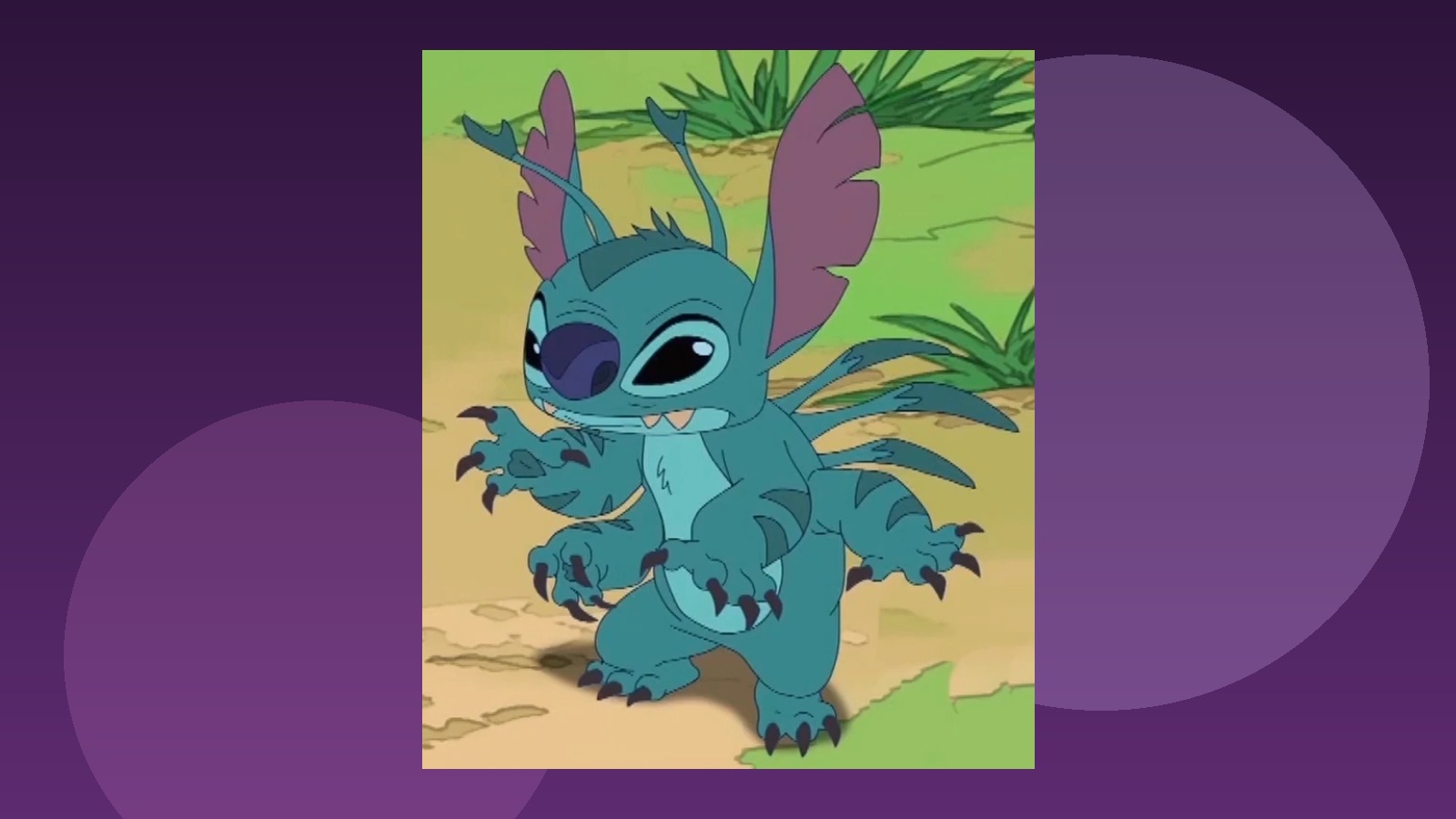
STITCH & AI CHARACTER PROFILE · MORPH CREATURE · FINALE ANTAGONIST
Scratch Character Profile: The Brother Stitch Wished For Was Built to Break Him
Scratch does not attack the family from outside. He enters through a wish, wears the silhouette of a cousin, and uses brotherhood as access to Stitch’s hidden code.
Profile record
Name: Scratch
Species: Alien morph creature, not one of Jumba’s experiments
Initial appearance: Stitch-like experimental form
Affiliation: Jaboodie operation
Abilities: Telekinesis, shapeshifting, object materialization, machine repair and transformation
Mission: Help activate Stitch’s metamorphosis program
Episodes: “Brothers” and “Monstrosity”
Verified voice credit: Not established from available production records
Who Scratch appears to be
Scratch enters “Brothers” in a form designed to read as familiar. Teal fur, large ears, claws, antennae, stripes, and a compact body make him look like another genetic experiment related to Stitch. The resemblance answers Stitch’s wish before anybody asks what made the answer possible. He appears to be the brother a lonely character can recognize immediately.
The appearance is a weapon because trust arrives before investigation. Scratch plays, laughs, performs excitement, joins the new group, and gives Stitch the pleasure of seeing himself reflected in somebody who seems built from the same language. The resemblance is not an accident of species. A Tetra-Tab samples Stitch’s DNA and gives the morph creature a body capable of entering the relationship.
He is not one of Jumba’s numbered experiments. He is an alien morph creature sent through the Jaboodie operation. The difference matters. Stitch’s cousins were created inside Jumba’s program and later redirected toward belonging. Scratch uses the appearance of that family structure as camouflage.
The Tetra-Tab turns a wish into access
Ai and Stitch wish for brothers and interact with the tetrahedron-shaped device Pleakley finds. The Tetra-Tab responds by producing Yong and Scratch. The device converts emotional need into a security vulnerability. Nobody has to force the household door. The targets invite the threat inside because the threat arrives shaped like an answer.
The mechanism fits the franchise’s repeated concern with programming. Stitch’s body contains abilities and dormant instructions other people want to activate. The Tetra-Tab samples biological information, manufactures a compatible presence, and uses play to get near the code. Technology does not merely overpower Stitch. Technology studies what he wants.
The plot is more disturbing than a standard evil-twin story. Scratch is not an alternate Stitch who chose cruelty. He is a purpose-built relationship interface. Every friendly gesture has operational value. The brother performance exists to lower resistance until the metamorphosis trigger can be reached.
Why the brother performance works
Stitch understands cousins, creators, captors, pets, and chosen family. A brother promises something different: similarity without requiring explanation. Scratch can mirror physical movement and destructive pleasure in ways Ai cannot. The bond appears to relieve Stitch from translating himself for a human household.
Group play strengthens the illusion. Ai receives Yong. Stitch receives Scratch. Meiying joins double Dutch. The arrangement looks balanced, social, and ordinary enough that suspicion would feel rude. Scratch does not need a long fabricated history because the wish supplies the missing biography.
The performance also exploits a franchise habit. New experiments often begin dangerous and become family after their purpose is redirected. Viewers are trained to believe a creature who resembles Stitch may be one rescue away from belonging. Scratch uses the audience’s expectation alongside the characters’ hope.
Abilities: creation, repair, transformation, and control
Scratch has telekinesis, shapeshifting, object materialization, and the ability to transform or upgrade machinery. His antennae can project a green ray that turns an idea into a physical object. He can repair damage quickly and redesign machines without ordinary labor. The ability set makes him useful before it becomes threatening.
Materialization fits the wish premise. Scratch appears inside a story about desire becoming form, then repeatedly demonstrates the power to make thought physical. The danger is not imagination itself. The danger is imagination detached from consent and consequence. A tool that can create anything can also alter a body or machine whose owner never agreed to the change.
His larger hybrid appearance reveals that the Stitch-like body was a presentation layer rather than the complete creature. The transformation should make every earlier expression feel unstable. Viewers never receive a fully developed true form or personal history. Scratch remains a function wearing identities.
Activating Stitch’s metamorphosis program
The Jaboodie mission requires Scratch and Yong to trigger hidden destructive programming inside Stitch. Scratch’s proximity and abilities make him the technical key. The plan confirms that Stitch’s past can still seize his body after years of chosen behavior. Family helped him build an identity. Enemies discover that old code can attack that identity from inside.
Scratch becomes the dark opposite of Ai’s relationship with Stitch. Ai learns the person through shared experience and uses that knowledge to reach him during transformation. Scratch studies the mechanism and uses resemblance to reach the program. Both characters get close. One recognizes agency. The other treats closeness as access.
The forced metamorphosis expands Stitch into a monstrous body with destructive extensions and damaged control. Scratch has not proven that Stitch was secretly evil. He has proven that a body can be violated through programming. Calling the result Stitch’s true nature would repeat the villain’s ownership claim.
Scratch and Yong are not morally interchangeable
Scratch and Yong arrive together and serve the same operation, but their roles diverge. Scratch remains closely tied to the mechanism and the morph-creature deception. Yong spends time with Ai in a human disguise, interferes during the finale, and eventually shows guilt. The series gives Yong a visible conflict that it does not grant Scratch.
That difference may reflect screen-time limits rather than an absolute absence of inner life. Scratch is capable of performance, planning, and adaptive behavior. The story never clarifies whether he experiences affection during play or merely simulates what the mission requires. A second season could have asked whether a being created for manipulation can redirect his own purpose.
Until evidence appears, sympathy should not be invented as fact. Scratch knowingly participates in violating Stitch’s body and weaponizing a family wish. His profile can identify the possibility of agency without turning possibility into a redemption arc the episodes never show.
Design and the counterfeit experiment silhouette
Scratch’s design begins with enough Stitch resemblance to pass emotional inspection and enough deviation to create unease. Teal coloration, curved antennae, sharper spines, stripes, and additional ear notches make the form recognizable without looking like a simple recolor. The body tells viewers that similarity has been manufactured around difference.
The larger form changes proportion and weight. A cute compact silhouette becomes heavier and more openly threatening. The move follows a familiar animation language where deception is exposed through bodily expansion. The design works because the earlier form was already slightly wrong. The reveal does not create the discomfort from nothing. It confirms what the visual details were whispering.
CVM Sekai uses the official experimental-form image for the profile hero because that is the face Scratch uses to enter the family. The image is not fan art and does not pretend the disguise is his complete biological truth. Metadata identifies the source and the editorial reason for choosing the form.
Voice credit and the silence in the record
A reliable English or Mandarin performer credit for Scratch has not been established in the production records available for this profile. The absence is important because the character’s vocal performance participates in the deception. A brother voice must sound playful and familiar enough to lower Stitch’s guard before the mission becomes visible.
Rather than attach a performer from a broad cast list, the profile keeps the role unassigned until episode credits or a licensed release record can verify it. The series has already suffered from fragmented distribution and incomplete cataloging. Guessing would add another layer of confusion.
When a verified credit appears, the analysis should compare the playful experimental form with the larger revealed form. A performance may change pitch, rhythm, or processing to mark the point when imitation gives way to command. That episode-level work deserves a named record.
What Scratch adds to the franchise
Scratch turns the idea of family resemblance into a threat. Stitch spent earlier stories finding cousins whose destructive purposes could be redirected. The Chinese finale presents a creature who borrows the cousin silhouette to enter the family and attack the person inside it. Recognition becomes dangerous when appearance is allowed to replace evidence.
He also changes the meaning of an evil double. Scratch does not simply show what Stitch might have become. He shows what an enemy can build after studying Stitch’s body and emotional needs. The frightening part is not that another creature looks similar. The frightening part is that somebody understood the desire for a brother well enough to manufacture consent.
His story remains incomplete. The Jaboodie operation, Tetra-Tab, morph-creature biology, and Scratch’s own capacity for independent choice all deserve continuation. The two-part finale uses him effectively as a trigger and leaves the character behind the function. A deep profile records both the damage he causes and the questions the season never stays to answer.
Keep exploring
Return to the Stitch & Ai hub, read the Episode 12 React, or continue to the finale React.
Scratch is introduced through a relationship somebody else designed
Scratch enters Stitch’s life carrying the promise of brotherhood, but the relationship is already contaminated by the people who built and deployed him. A family label becomes part of the weapon. That does not make every feeling Scratch develops false. It means viewers have to separate the role he was ordered to perform from the attachment that may emerge while performing it.
The distinction matters because manipulated intimacy can still produce real grief. Stitch may feel betrayed by somebody who was also coerced. Scratch may care about the person he was told to deceive and still be responsible for the harm he causes. Neither truth cancels the other. The ethical problem is large enough to hold two victims and two sets of choices.
Programming is pressure, not a complete moral biography
The franchise repeatedly creates experiments with installed functions and then proves those functions do not exhaust personhood. Scratch should receive the same analysis. A metamorphosis program, command sequence, or destructive design can narrow available choices and intensify impulses. It does not explain every decision forever.
Accountability must remain proportionate to control. Which actions were automated, which were ordered under threat, which were chosen with incomplete information, and which continued after Scratch understood the harm? The answers determine repair. Declaring him innocent because he was programmed erases victims. Declaring him evil because programming worked erases the person struggling inside it.
The fake-brother plan exploits Stitch’s unresolved abandonment
Stitch has experienced adoption, separation, replacement fears, and several franchise branches that relocate him without allowing the original family to remain emotionally present. A brother who appears to understand his origin can reach a need ordinary friendship does not touch. The villains are not only testing strength. They are targeting the fear that everybody else has a family category Stitch can never fully claim.
That makes the deception more intimate than a disguise. Scratch offers recognition as another created being and uses the access recognition provides. Stitch needs space to grieve the relationship even after the plan is exposed. Anger does not prove the bond was meaningless. It proves the promise mattered enough to wound him.
Scratch needs a name that belongs to him
An experiment designation can document origin without serving as the only identity. “Scratch” may begin as a label assigned by creators, enemies, or translators. The character should have the right to accept it, change it, or add a name that reflects who he becomes outside the operation.
Naming is not cosmetic in a franchise built around cataloged beings. Lilo’s practice of naming cousins helps convert inventory into relationship, though even benevolent naming should leave room for later consent. Scratch deserves that room. A chosen name would not erase what he did. It would establish who is responsible for the next decision.
Yong’s role cannot disappear behind the larger monster plot
Yong participates in the false-brother operation while developing his own discomfort and attachment. Scratch and Yong mirror each other imperfectly: one is a created body under programming pressure, and the other is a human participant navigating orders, fear, and guilt. Their relationship can reveal how coercive systems distribute tasks so nobody feels fully responsible.
A complete profile should ask what Scratch knows about Yong’s choices and what trust could exist afterward. Shared victimization does not create automatic forgiveness. They need accurate accounts, boundaries, and the possibility that cooperation begins before friendship. The finale moves quickly. The consequences should not.
Transformation horror should remain connected to consent
Scratch’s body becomes part of the plan, whether through metamorphosis, copied power, or a program designed to produce a monstrous outcome. Visual spectacle can hide the violation. A person loses control of how the body is used and then gets judged through the frightening result.
The aftermath should include medical evaluation, stabilization, explanation, and consent around any attempt to reverse the change. Jumba cannot treat another created being as an engineering puzzle without confronting the history that made the crisis possible. Scratch needs information about his own body and authority over future interventions.
Stitch can offer kinship without pretending nothing happened
Stitch is uniquely positioned to recognize programming, fear, and the desire to belong. He can advocate for Scratch’s personhood while refusing immediate closeness. Compassion does not require unsafe access. Brotherhood, if it develops at all, has to be chosen after the deception rather than inherited from the original lie.
That process may begin with practical solidarity: protection from the creators, help understanding experiment records, and testimony about coercion. Emotional reconciliation can remain uncertain. A family relationship becomes honest when either person can say no without the other treating refusal as proof of abandonment.
Repair starts with a complete operational record
Scratch should explain what he was told, what he knew, what he suspected, which actions he controlled, and who benefited. That record protects victims and prevents the organization from hiding behind his visible role. It also gives him a way to participate in accountability without collapsing into a confession designed only to earn sympathy.
The record should be corroborated where possible. Programming logs, communications, Jumba’s science, Yong’s testimony, and physical evidence can distinguish memory from command effects. The point is not a courtroom performance. It is making sure the smallest person in the chain does not absorb responsibility for a system that remains intact.
Created-person rights must include people who are difficult to love
Stitch earned affection through humor, cuteness, vulnerability, and a long relationship with Lilo. Scratch may not receive the same emotional advantage. Rights cannot depend on whether the audience finds a created person charming. Bodily autonomy, due process, medical care, and freedom from ownership have to apply before redemption is complete.
This is the test the franchise often avoids. It is easy to argue that Stitch is a person after he saves the family. Scratch must be treated as a person while the damage, fear, and uncertainty are still present. Legal and ethical protection is most meaningful before good behavior makes it popular.
The finale should not confuse defeat with rehabilitation
Stopping the immediate plan prevents more harm. It does not teach Scratch how to live without orders, manage abilities, understand ordinary relationships, or repair trust. Rehabilitation needs housing, education, trauma care, boundaries, and work that is not another assigned function disguised as purpose.
The placement model used for other experiments can help if consent remains central. Finding a useful job is not the same as finding a self. Scratch should be allowed to rest, learn, make friends, fail safely, and discover interests that have no strategic value. A person is more than the best task a community can assign.
Official images matter because this branch is poorly documented
A character profile for a less accessible series cannot use generated approximation and expect readers to know what belongs to canon. Scratch’s featured image should be an official local still, match the hero and landing card, and carry source metadata that identifies the episode or promotional material.
Visual accuracy is part of criticism. Body design, expression, transformation stages, and the way the camera frames Scratch affect how viewers interpret threat and vulnerability. The image should preserve that evidence rather than replacing it with a prettier version invented after the fact.
Profile verdict
Scratch is not compelling because the story reveals a secret brother and a larger monster. He is compelling because the plan tries to manufacture kinship, weaponize created biology, and make the person inside the operation disappear beneath the assigned role. His choices matter most after he understands what the role was built to do.
A complete future gives him safety without immunity, accountability without ownership, and relationships that can be refused or rebuilt slowly. Let him choose a name, learn the truth about his body, document the operation, repair specific harm, and discover a life that does not require being Stitch’s brother or enemy. That would make personhood more than a theme reserved for the franchise mascot.
The receipt that should follow him
Scratch’s lasting receipt is the moment he can obey the program, protect the new attachment, or ask for help without knowing which choice will preserve his place. Whatever he chooses, the story should remember the pressure rather than resetting him into a simple ally or villain.
The next appearance should begin from that evidence. Trust is damaged, coercion is documented, and a created person now knows the assigned identity was a weapon. Growth means what he does with that knowledge when nobody can promise forgiveness.
Explanation cannot become a coupon for forgiveness
Programming, threats, isolation, and false information explain why Scratch harms people. They do not require the harmed people to restore access before they feel safe. Explanation changes the response from simple punishment to protection, treatment, and proportionate accountability. It does not erase consequence.
Scratch should learn that distinction early. If every disclosure is rewarded with immediate comfort, honesty becomes another strategy for controlling the outcome. He can tell the truth because the record matters, accept boundaries he dislikes, and continue repair without knowing whether the relationship he wants will return.
The creator and the operator owe different forms of repair
Whoever designed Scratch’s body and programs carries responsibility for foreseeable capacities, safeguards, and the decision to create a person as a tool. Whoever deployed him carries responsibility for commands, deception, and operational harm. Scratch carries responsibility for choices he could meaningfully control. A complete account needs all three layers.
Collapsing the chain onto Scratch is convenient because he is visible. Collapsing everything onto the creator is also incomplete if Scratch made informed choices after control became possible. Justice becomes accurate when responsibility follows knowledge and power instead of landing on whichever participant is easiest to punish.
Trauma care should not look like another obedience program
Scratch may need help regulating fear, anger, transformation triggers, memory gaps, and attachment panic. Treatment cannot repeat the structure that harmed him by rewarding compliance and punishing difficult emotion. He needs informed consent, understandable goals, privacy, and the right to question the person providing care.
Safety plans can include limits without becoming ownership. Identify warning signs, safe locations, trusted contacts, and emergency interventions before crisis. Review each intervention afterward. The purpose is helping Scratch gain control over his life, not making him easier for everybody else to manage.
Brotherhood requires two ongoing yeses
Stitch may want the relationship after learning the deception, or he may want distance. Scratch may discover that being a brother still feels like an assigned job. Kinship should continue only if both people can revisit the choice without threats, guilt, or fear of losing all support.
That makes room for a relationship that changes form. They could become allies, cousins, occasional friends, or something neither existing label captures. The ethical victory is not forcing the original promise to become true. It is giving both created people authority over what the connection means now.
Future stories should give Scratch an ordinary problem
A profile can discuss personhood forever and still leave the person trapped inside trauma. Scratch needs an episode about a hobby, disagreement, job he dislikes, embarrassing mistake, or friendship that has nothing to do with the original operation. Ordinary stakes prove the character has entered life rather than remaining evidence from a case.
Those stories also test whether the community truly accepts him. It is easy to offer compassion during a dramatic rescue. Patience with boredom, irritation, bad taste, and inconvenient preferences is harder. Belonging becomes real when Scratch is allowed to be more than grateful.
Memory should remain uncertain where the series leaves gaps
Scratch may not know which memories formed naturally, which were planted, and which were altered by transformation. The profile should not fill those gaps with invented certainty. Uncertainty is part of the injury and part of the investigation.
A future story could let him build an archive from testimony, records, sensory fragments, and choices made after freedom. The archive would not produce a perfectly restored past. It would give him evidence he controls and a way to mark where the franchise still owes an answer.
The final standard
Scratch is ready for community life when safety no longer depends on pretending he cannot fail. He needs the same combination every other person needs: rights before perfection, boundaries after harm, and a future larger than the worst thing attached to his name.
That distinction still matters because context changes the judgment.