
EPISODE 12 · CHINESE TELEVISION BRANCH · BROTHERS · RAE RAE REACTS
Stitch & Ai Episode 12: Brothers
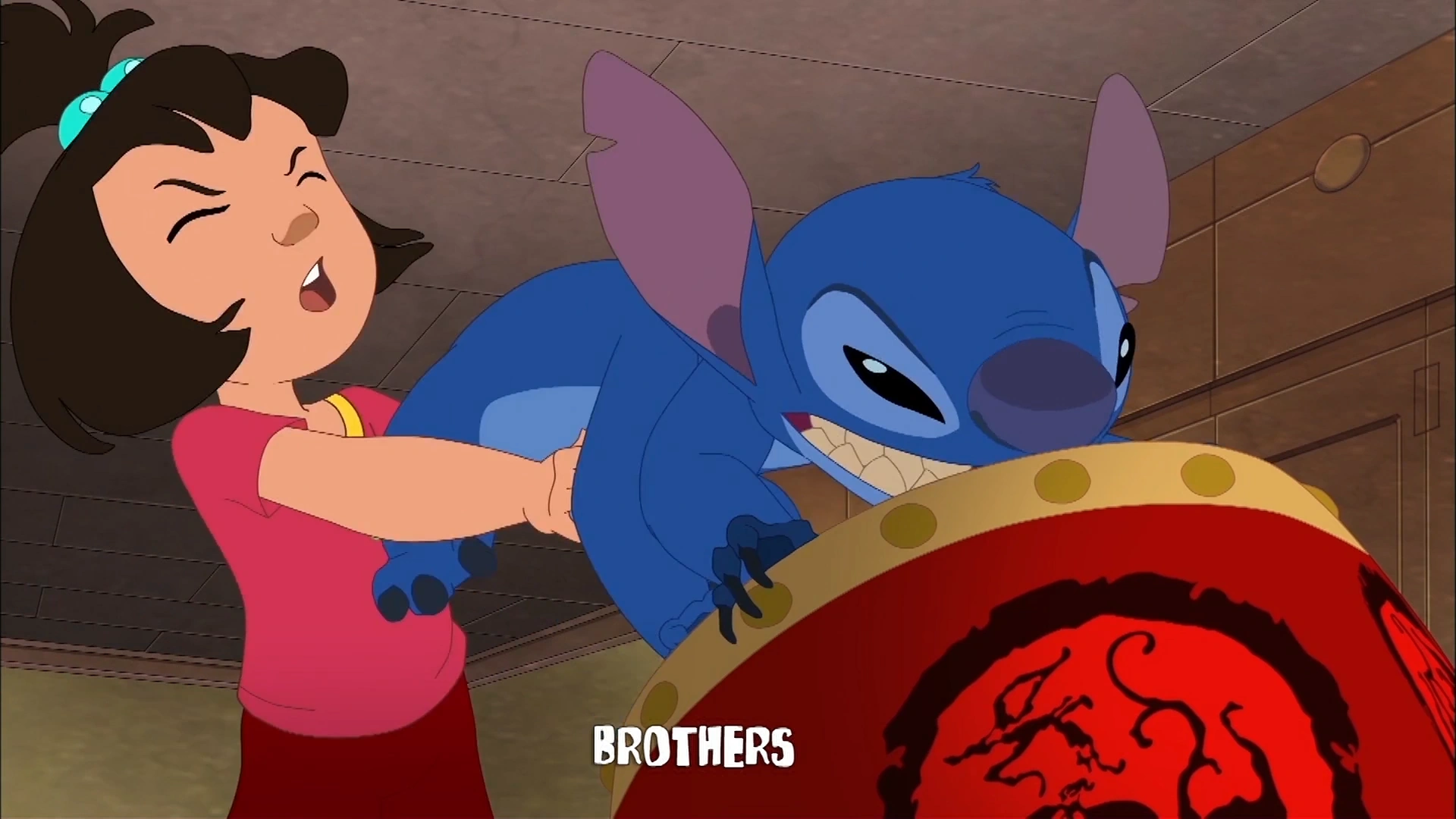
An alien cube gives Stitch and Ai instant brothers named Scratch and Yong. The joy lasts until Scratch sells destruction as sibling bonding and triggers the metamorphosis program Jumba somehow failed to mention.
Pleakley accepts an unknown cube into the household
“Brothers” begins when Pleakley receives an alien cube and the family interacts with it before establishing source, purpose, contents, or safety. Packages can carry technology, surveillance, weapons, organisms, tracking, or malware. An unfamiliar off-world object deserves quarantine, not a place beside children.
Pleakley is not foolish for being curious. The household lacks a secure intake process. The Federation should screen deliveries, verify senders, isolate unknown devices, and provide protective equipment before anybody activates them.
The cube produces relationships as if kinship were a feature
Scratch and Yong appear and are immediately described as brothers for Stitch and Ai. The label creates expectation before the new beings have names, histories, consent, or any independent understanding of one another. Family cannot be installed through packaging alone.
They may choose sibling relationships over time. They also need the freedom to define different bonds or none at all. Adults should not use “brother” to demand loyalty, affection, shared housing, or forgiveness.
Scratch and Yong are people before they are gifts
The cube’s arrival may be framed like children receiving companions. That language risks making the new beings property transferred to improve somebody else’s life. Scratch and Yong need advocates, medical examination, communication, legal identity, and the ability to refuse the household.
Nobody should return them to a sender like defective merchandise if the match goes badly. The adults owe care because they activated the cube, not because the new siblings perform happiness.
Instant closeness can feel wonderful and remain untested
Stitch, Ai, Scratch, and Yong play, explore, and accept the new group quickly. Shared novelty creates connection, but trust usually develops through repeated choices. The family should enjoy the moment without treating one joyful day as proof everyone is safe together unsupervised.
Boundaries, sleeping arrangements, personal property, school access, conflict rules, and emergency contacts need discussion before the household expands.
Yong’s bond with Ai deserves its own shape
If Yong becomes Ai’s brother counterpart, he should not exist merely to mirror Scratch and Stitch. His interests, fears, abilities, culture, and choices need development. Ai should not be assigned automatic emotional care because he arrived for her.
The strongest sibling stories allow closeness and difference. Yong can care about Ai without agreeing with her, copying her, or remaining permanently beside her.
Scratch studies Stitch’s vulnerability and calls it fun
Scratch encourages destruction by presenting it as freedom, play, or proof of belonging. He recognizes that Stitch carries an old identity built around chaos and may feel relief around someone who does not ask him to restrain it. Manipulation works best when it offers a real unmet need.
Stitch remains responsible for choices, but the family should understand why the invitation lands. Shame will make the destructive version of belonging more attractive.
Peer pressure is stronger when it arrives through family language
A stranger asking Stitch to destroy things can be rejected. A supposed brother can frame refusal as betrayal, cowardice, or proof that Stitch has forgotten who he is. The sibling label becomes leverage.
Healthy family never requires harm as an entrance test. Stitch needs permission to say no, leave, and ask Ai or an adult for help without being mocked for disloyalty.
Destruction begins with objects and reaches people quickly
Scratch may start with miniature buildings, machinery, or apparently empty construction areas. Property damage can injure workers, collapse structures, destroy livelihoods, expose utilities, and create hazards long after the exciting moment ends.
The family should not wait for a direct injury before intervening. Early harm is already evidence that supervision and containment failed.
A construction site is not an empty playground
Workers, equipment operators, engineers, security staff, nearby residents, pedestrians, and emergency responders depend on predictable machinery and structural stability. Stitch and Scratch entering controls or using a wrecking system creates deadly risk.
The site needs evacuation, power isolation, equipment lockout, and professional inspection before anyone returns. Damage should be documented and compensated by the responsible adults and Federation.
Scratch can materialize and transform objects without safety review
His abilities appear playful while allowing rapid alteration of the environment. Any power that changes scale, form, or material needs limits around people, buildings, vehicles, water, and public infrastructure. Surprise use should trigger immediate containment.
Jumba must assess Scratch without reducing him to a hazard profile. Understanding ability supports autonomy when paired with consent and training.
Stitch’s metamorphosis program is a buried design failure
Scratch’s influence triggers a program inside Stitch that changes his body and behavior. Jumba created or preserved a destructive contingency capable of overriding growth the family spent years supporting. That is not Stitch secretly revealing his true self. It is a dangerous mechanism embedded without consent.
Jumba owes full disclosure: trigger conditions, stages, reversal, pain, cognitive effects, and whether other dormant programs remain.
The family should have known the program existed
Stitch has lived with Lilo, Nani, Jumba, and Pleakley through repeated threats. Withholding a known metamorphosis risk prevents informed care and emergency planning. If Jumba forgot, his recordkeeping is as dangerous as secrecy.
The Federation should require a complete medical and design audit by an independent team. Stitch deserves access to his own records in language he understands.
Physical transformation does not erase Stitch’s personhood
As his body grows and aggression increases, adults may speak about him as a monster or target. He remains the person experiencing an imposed program. Safety may require distance and restraint, but force should be proportionate and focused on reversal.
Ai’s voice can help reach him without placing her directly in danger. Emotional connection supports the rescue; it does not make a child the only containment plan.
Scratch’s role may involve coercion beyond ordinary persuasion
If he knows about the program or was designed to activate it, his manipulation becomes part of a larger plan. The family needs to determine whether Scratch acts independently, under command, through implanted instruction, or from his own harmful choices.
Accountability depends on capacity and control. Investigation should avoid torture or automatic disposal while protecting everyone from another activation.
Yong may know more than he can safely reveal
The finale suggests Yong has a connection to the Jaboodies that Ai does not understand. He may be hiding identity, following orders, afraid of punishment, or trying to preserve a relationship built under false conditions.
Ai deserves truth, but interrogation by frightened family members could drive him deeper into the handler’s control. An independent advocate should help him disclose safely.
Ai’s joy in having a brother makes betrayal more painful
She opens space for Yong because the relationship answers loneliness and gives her someone positioned as family from the first moment. If he deceives her, the harm reaches beyond one lie. It changes her trust in the bond itself.
Adults should never tell Ai she was foolish for caring. Responsibility belongs to whoever designed or exploited the deception, along with Yong’s own choices where he had freedom.
The cube is evidence and a continuing security threat
Investigators should isolate it, preserve data, identify transmission paths, trace the sender, and check for remote communication or additional payloads. Destroying it immediately may remove danger while erasing evidence about the network behind Scratch and Yong.
Handling must protect privacy for the new beings. Technical analysis should not become permission to dissect their bodies or memories.
Jumba cannot solve the crisis by reprogramming everybody
He may be able to alter Scratch, Yong, or Stitch’s embedded systems. Consent and necessity still matter. Emergency intervention should stop imminent harm with the least permanent change possible, followed by independent review.
Erasing personality or memories because they complicate the household would repeat the control built into the cube.
The household needs admission rules for future “family” arrivals
No object or official can assign a permanent sibling without assessment and consent. New arrivals need quarantine, identity verification, medical support, separate space, gradual contact, and a review date. Children should participate without carrying final responsibility.
Family can remain open while refusing the idea that openness means unlimited access.
Stitch needs repair with workers and Ai after deactivation
Even if the program drove escalation, Stitch made earlier choices under Scratch’s influence and caused damage. He should learn what happened, apologize without accepting blame for Jumba’s hidden program, and contribute to restitution safely.
Ai may feel fear, anger, and grief. She should not be pressured to comfort Stitch immediately because he also suffered.
Scratch needs consequence and a route away from the handler
If he manipulated Stitch knowingly, separation and supervision are necessary. He also deserves evaluation for coercive programming, threats, unmet needs, and the possibility of change. Permanent isolation should not be the first or only answer.
A rehabilitation plan needs boundaries, repair, skill building, and contact based on the safety and consent of those harmed.
The episode ends before the family understands the size of the trap
“Brothers” moves directly into “Monstrosity,” so the metamorphosis is not a contained weekly problem. The cliffhanger preserves urgency but leaves emotional consequences suspended. A directory should present Episodes 12 and 13 as a connected two-part finale.
Viewers need the production order and a warning that Episode 12 ends during active transformation rather than with resolution.
Construction workers need more than an apology after the machinery stops
The site should remain closed until engineers inspect foundations, cranes, electrical systems, gas lines, temporary supports, and every structure Scratch or Stitch altered. Workers need paid time during the closure, medical evaluation, replacement tools, and a confidential route for reporting near misses.
Federation funds should cover damage and lost wages. The family must not pressure workers to stay silent about safety because the cause involved aliens. Confidentiality can protect identities without denying compensation or accurate records.
Yong needs a protected route to disclose the truth
If he is a Jaboodie agent, hybrid, or controlled participant, telling Ai may expose him to punishment from the faction and anger from the household. An independent advocate should separate him from handlers, secure communication devices, explain his rights, and let him disclose in stages.
Protection does not mean hiding ongoing danger from Ai. It means obtaining truthful information without forcing a frightened childlike being to choose between immediate retaliation and permanent deception.
Scratch’s handler may be using sibling attachment as remote control
The cube could have delivered Scratch with instructions designed around Stitch’s emotional history. Investigators should examine whether phrases, games, signals, or transmitted commands trigger his behavior. The manipulation may extend beyond Scratch’s conscious choices.
Finding coercion would change the rehabilitation plan while leaving space for accountability where he acted freely. The priority is breaking the handler’s access without erasing Scratch’s personality.
Stitch needs an independent audit of every dormant program
Jumba should provide source records, but another team must verify them. The audit should identify behavioral overrides, physical transformations, remote access, reproductive functions, memory changes, shutdown commands, tracking, and vulnerabilities that enemies could exploit.
Stitch must receive the results and participate in decisions about removal or containment. Altering his body without consent may be justified only during immediate danger, followed by review and long-term support. Every retained program needs a named safeguard, responsible adult, test schedule, and emergency response documented completely before Stitch returns home.
What I would keep
I would keep the cube arrival, instant sibling joy, Scratch and Stitch playing together, Yong bonding with Ai, Scratch escalating from fun to destruction, the construction-site chaos, and the metamorphosis trigger carrying directly into the finale.
I would also keep the betrayal underneath the family label. It gives the branch’s final story a sharper question about whether belonging can be manufactured or manipulated.
What I would repair
I would quarantine the cube, establish personhood before sibling labels, supervise early contact, intervene at the first property damage, disclose Stitch’s metamorphosis program, investigate Scratch’s control, protect Yong during truthful disclosure, and fund restitution for workers and residents.
I would give Ai support separate from Stitch’s recovery and make Jumba answer for every hidden program still inside him.
RaeRae’s verdict
“Brothers” gives Stitch and Ai the thing family stories make irresistible: siblings who arrive already wanting to play. Then it asks what happens when the label is part of the trap. Scratch offers Stitch freedom from being the responsible one and uses that relief to walk him back toward destruction. Yong offers Ai closeness while hiding a connection that may destroy trust.
My verdict: quarantine mystery cubes, stop assigning family through packaging, shut down the construction site, audit every line of Stitch’s code, and let brotherhood become something Scratch and Yong earn through choice. Shared origin can introduce people. It cannot guarantee safety.
Where to watch
Stitch & Ai is not currently available through its former United States DisneyNOW route. CVM Sekai records all thirteen produced episodes in original Chinese broadcast order. “Brothers” is the first half of the two-part finale and continues directly into Episode 13, “Monstrosity.”
Keep exploring
Return to the complete Stitch & Ai episode directory, return to the Stitch & Ai hub, or return to the full franchise hub.