
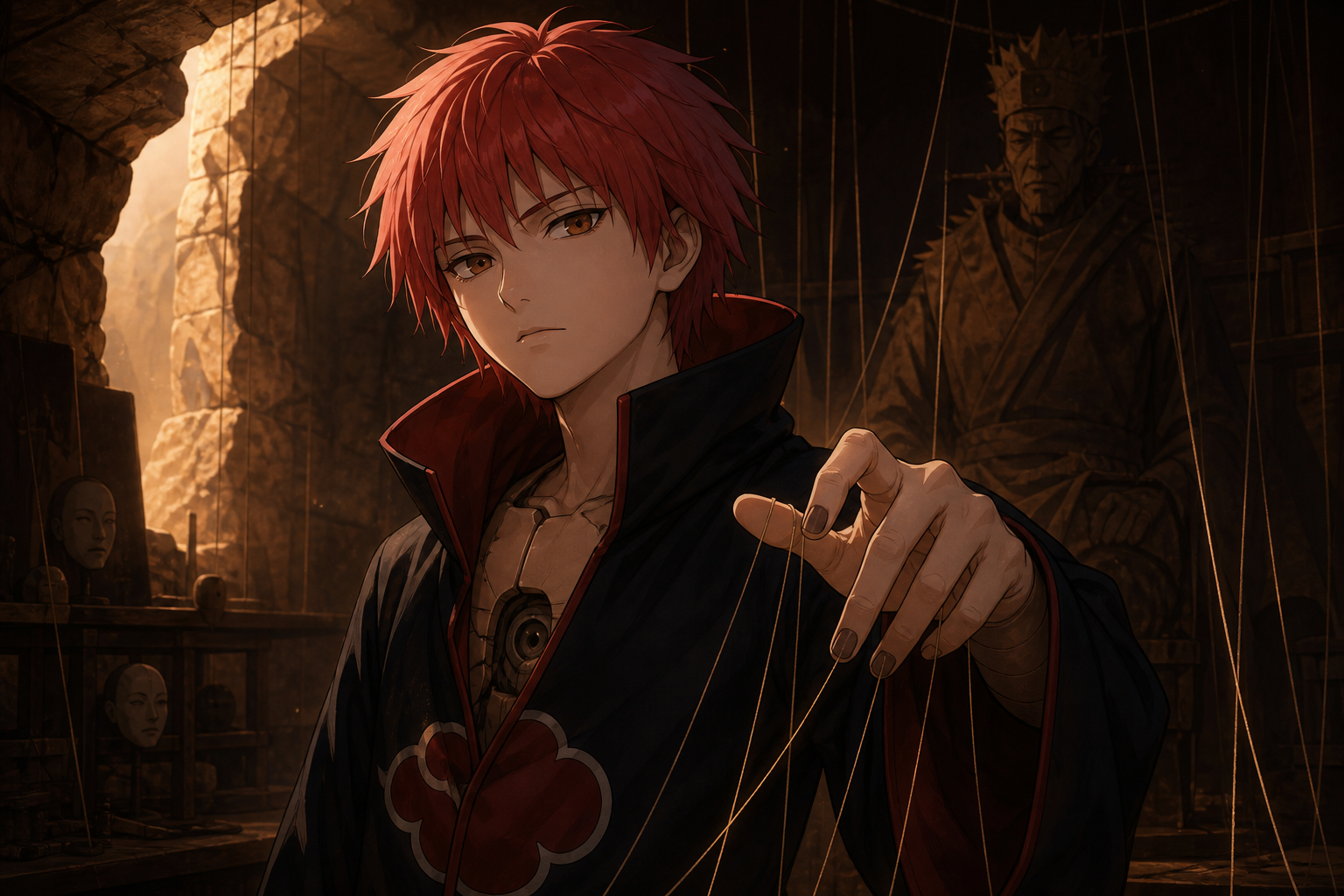
Sasori
Bottom line
Sasori of the Red Sand spends his life trying to build an object that cannot leave him, age without him, or die before he is ready. That object is supposed to be art. The first version is his mother. The second is his father. The final version is Sasori himself. The tragedy is easy to see. His parents die in war while he is a child. Chiyo teaches him puppetry, and he uses that craft to recreate the embrace he lost. The wooden parents can close their arms around him. They cannot produce warmth. Sasori learns the wrong lesson from the failure. Instead of accepting that a person cannot be replaced, he decides the material is the problem.
The crimes are equally easy to see. Sasori kills people, preserves their bodies, steals their techniques, poisons opponents, converts his own body into a weapon, and treats human lives as raw material for a private collection. Grief explains the direction of his obsession. Grief does not issue a permit.
Sasori Essential File
Identity. Sasori is a former Sunagakure puppeteer, S-rank missing-nin, Akatsuki member, poison specialist, craftsman and creator of human puppets. His title, Sasori of the Red Sand, connects his name, which means scorpion, to the blood associated with his battlefield reputation. Birthday and body. The official Naruto birthday retrospective gives November 8 as his birthday and notes that he does not need food. Reference material places him at thirty-five when he dies, although his preserved puppet body retains the face of a young man. That distinction matters. Sasori looks young because he has manufactured bodily stasis, not because the story quietly made him a teenager.
Affiliations. He begins in Sunagakure, leaves the village, and later operates in Akatsuki. His best-known Akatsuki partnership is with Deidara, whose belief in explosive, temporary beauty directly opposes Sasori’s faith in permanence. Original Japanese performances. Takahiro Sakurai performs Sasori’s true adult form. Yutaka Aoyama supplies the Hiruko shell voice, which lets the disguise sound like a different older body before the reveal. Akiko Yajima performs child Sasori. Those credits describe three presentation layers, not three separate characters.
A Child Learns That War Can Empty a House
Sasori’s parents die during wartime when he is young. Chiyo withholds or softens the truth for a time, but absence does not become less real because an adult avoids the sentence. The home is still missing two bodies. Later context ties their deaths to Sakumo Hatake, Kakashi’s father. The fact links Sasori’s private grief to the shinobi system’s celebrated mission history. One village’s hero can be another family’s permanent empty chair. Naruto repeatedly asks viewers to hold both records at once.
Sasori does not receive enough emotional language to process that contradiction. He receives a craft. Chiyo Gives Him Puppetry. Chiyo teaches Sasori the Puppet Technique. Teaching is an act of love, transmission and survival. Sunagakure’s puppet tradition turns engineering, chakra control, medicine, traps and tactics into a single discipline. Sasori proves brilliant at every layer.
He uses his new skill to create Mother and Father puppets modeled after his parents. He places himself between them and draws their arms around his body. The scene is devastating because the machine works. The embrace happens exactly as designed. The comfort does not. Chiyo can teach joints, strings and mechanisms. She cannot make wood generate the unpredictable warmth of a living person. Sasori experiences the limit as material failure rather than a boundary grief must respect.
Mother and Father: The First Impossible Commission
The parent puppets are often treated as a sentimental detail attached to a cool villain. They are the blueprint for everything that follows. Sasori wants fidelity without uncertainty. A puppet cannot choose another mission, age away from him, contradict him, or die in a way he did not authorize. The controller determines every motion. For a bereaved child, control can look like safety.
Control also kills relationship. A parent’s love matters because another person gives it. Sasori can reproduce the shape of an embrace, but the strings prove he is supplying both sides of the interaction. He is not being held. He is operating a memory.
From Puppet Maker to Human-Puppet Killer
Ordinary puppets eventually become insufficient. Sasori develops a process that turns human corpses into puppets while preserving the chakra pathways and abilities they possessed in life. His art no longer imitates a person. His art consumes one. This development is technically extraordinary and morally rotten. Human puppets let Sasori archive bloodline limits and unique techniques. The victim becomes a permanent weapons platform whose skill can be activated by somebody else.
Fandom sometimes celebrates the collection as proof of genius without stopping at the word collection. These were people. Sasori removes names, consent, burial and social memory, then catalogs what remains by combat value.
The Third Kazekage: A National Body in a Private Cabinet
Sasori’s favorite human puppet is the Third Kazekage, remembered in Suna as an exceptionally powerful leader. Sasori kills him and converts the body into a puppet capable of using Iron Sand. The crime does more than remove a fighter. A Kazekage’s disappearance destabilizes a village, interrupts succession and turns public uncertainty into political damage. Sasori privately possesses the answer while Suna lives with the wound.
Iron Sand gives the puppet enormous tactical range. Sasori can shape it into dense clouds, projectiles and crushing forms. The metallic particles can interfere with puppet joints and poison openings. The preserved magnetic technique makes the Third Kazekage useful long after death, which is exactly Sasori’s definition of beauty. The problem is that usefulness has replaced personhood. Sasori calls the puppet precious because the killing was difficult and the result is rare. Difficulty becomes value. A human life becomes provenance.
Leaving Sunagakure Without Leaving His Work Behind. Sasori abandons Suna, but his designs remain inside its military culture. Kankurō later fights with Crow, Black Ant and Salamander, puppets Sasori created before leaving. That inheritance creates one of the sharpest jokes in the Kazekage Rescue arc. Kankurō attacks Sasori using Sasori’s own designs. Sasori knows their compartments, attack patterns and construction weaknesses because he wrote the engineering language his younger opponent inherited.
The scene is not evidence that Kankurō lacks talent. That choice shows how dangerous institutional dependence on a gifted predecessor can become. Suna preserved the tools without controlling the person who understood them best. Hiruko: Armor, Disguise and a Body Between Bodies. Hiruko is a puppet shell Sasori wears around his true form. The hunched exterior functions as armor, weapon platform, false identity and physical buffer. Its tail, launchers and concealed mechanisms punish anyone who assumes the shell is only transportation.
Hiruko also lets Sasori avoid direct exposure. Before the shell breaks, viewers hear a different voice and see a body that looks older and heavier than the preserved figure inside. Sasori does not merely hide his face. He replaces public contact with an operated surface. That choice fits his psychology. A puppet body protects him from blades. A puppet persona protects him from being recognized as the abandoned child who built parents and received no warmth back.
Kankurō’s Defeat and Sakura’s Antidote. Sasori defeats Kankurō efficiently because he knows the puppets and because his poison creates a delayed death sentence. The victim does not simply lose a fight. The body continues failing after the opponent leaves. Sakura Haruno disrupts that certainty. Her medical training under Tsunade allows her to analyze the poison, keep Kankurō alive and produce a limited supply of antidote. Sasori’s proprietary weapon meets collaborative medical knowledge.
This is one of Sakura’s most important professional victories. She does not win because the story grants sudden immunity. She studies, diagnoses, compounds and accepts that only a few doses can be made in time. The answer has labor and scarcity.
The Kazekage Rescue Battle
Inside the Akatsuki hideout, Deidara escapes with Gaara’s body while Sasori remains to face Sakura and Chiyo. The separation pairs Naruto and Kakashi with pursuit while giving Sakura a battle built around medicine, physical control, trust and craft. Chiyo initially uses chakra strings to guide Sakura through Sasori’s attack patterns. Sakura agrees to become the moving body in a puppeteer’s system without surrendering her judgment. The arrangement is collaborative, not possession. As Sakura learns the rhythm, she increasingly moves on her own.
Sasori dismisses human feeling as weakness while relying on an art form that requires exquisite understanding of bodies. He knows joints, angles, pain, poison circulation and mechanical timing. His empathy is technical. He understands what a body does while refusing to honor who lives inside it. Iron Sand, Poison and the Limits of Perfect Control. The Third Kazekage puppet pushes Sakura and Chiyo into a fight where touching the wrong weapon can end the battle hours later. Iron Sand blocks routes, damages puppets and turns space itself hostile.
Sakura’s strength breaks what Sasori considers a masterpiece. Chiyo’s experience reads the controller behind the weapon. Their teamwork exposes a basic limit in Sasori’s worldview. A collection preserves known abilities. Living partners can improvise. His poison remains dangerous, but Sakura’s antidote creates a temporary window. Her preparation does not erase risk. Once the final dose is gone, every new cut matters again.
Sasori Turns Himself Into the Final Puppet
Sasori’s youthful body is another manufactured object. He has converted almost everything into puppet material while preserving a living core that produces chakra. That core is the remaining biological point the rest of the body must protect. The transformation grants modular weapons, replaceable parts, hidden mechanisms and freedom from ordinary aging. Damage that would disable a human body can be repaired or exchanged. He can shift his core into another puppet shell.
He is not immortal. The core remains vulnerable. His body still depends on chakra, control and intact mechanisms. “Eternal” is a sales pitch attached to a system with a critical component. Performance of a Hundred Puppets. Sasori’s Secret Red Technique lets him control a vast puppet army through chakra threads released from his body. He claims the force once destroyed a nation. The display demonstrates scale, multitasking and years of collection.
Chiyo answers with the ten puppets of Monzaemon, a smaller set she controls with precision. The battle contrasts accumulation with relationship to craft. Sasori overwhelms through quantity. Chiyo uses inherited masterpieces as a coordinated unit. More puppets do not make Sasori less lonely. The army is the logical end of replacing people with controllable objects. He can command a crowd and still receive no response he did not generate himself.
Why Sasori Allows the Final Strike
Mother and Father pierce Sasori’s core. Chiyo recognizes that he saw the attack and could have avoided it. The manga leaves room for interpretation, but the emotional structure is clear. His last position recreates the embrace he tried to manufacture as a child. This is not proof that murder becomes innocence. Sasori does not apologize to his victims. He does not dismantle Akatsuki. He does not restore the Third Kazekage’s life. A final hesitation reveals remaining humanity. That choice does not erase the collection built from human bodies.
The moment works because the contradiction survives. Sasori wants to become a complete puppet, yet the part capable of wanting that goal remains human enough to stop. The Spy Information and Orochimaru Thread. Before dying, Sasori gives Sakura information about a contact connected to Orochimaru. The meeting later draws Team Kakashi toward Tenchi Bridge and Kabuto Yakushi.
Sasori had used control and memory manipulation within his intelligence network. Orochimaru’s interference complicates that ownership. The spy plot reflects a larger Naruto pattern: powerful adults build secret chains through younger operatives, then call betrayal shocking when one controller loses access. Deidara and the Argument About Art. Sasori believes art should endure. Deidara believes art reaches perfection in an instant of destruction. Their arguments are funny because both men are deadly serious and neither has patience.
They also reveal different relationships to an audience. Deidara wants the explosion witnessed. Sasori wants the object preserved. One art disappears too quickly to control. The other controls so completely that living response disappears. Deidara respects Sasori’s craft and calls him master, but respect does not create intimacy. Akatsuki partnerships are work arrangements inside a violent organization. Shared aesthetic vocabulary cannot make the workplace safe.
Chiyo: Teacher, Grandmother and Failed Boundary. Chiyo loves Sasori and teaches him the craft that becomes his weapon. She also participates in the military system that normalizes puppet bodies, poison and child training. Her grief at his choices is real. Her place in the system is also real. Sasori’s crimes are his decisions. Chiyo’s responsibility is not identical to his. The profile becomes useless if every adult institution disappears so one villain can absorb all blame.
The final battle forces Chiyo to confront both the genius she nurtured and the child she could not reach. Her Mother and Father puppets deliver the fatal strike. Technique, family and consequence occupy the same frame. Sakura: The Living Body He Cannot Reduce. Sakura enters the fight as a medical specialist, physical powerhouse and willing collaborator. Sasori repeatedly tries to convert her body into a predictable target. She keeps making decisions.
Her success depends on Chiyo, antidotes, observation and trust. That dependence is not weakness. Sasori’s entire worldview says the ideal body obeys one controller. Sakura and Chiyo win by sharing control without erasing either person’s agency. The battle also gives Sakura a professional identity beyond romance and Team 7 anxiety. She saves Kankurō, reads poison, destroys the Third Kazekage puppet and survives an Akatsuki master. The receipts are sitting right there.
Kankurō and the Inheritance of Craft. Kankurō begins as the younger puppeteer defeated by his field’s most dangerous predecessor. During the Fourth Shinobi World War, the relationship changes. Kankurō commands a puppet unit, uses Sasori’s former puppet body, and confronts the reanimated artist. He tells Sasori that the true permanence of a puppeteer lies in the work and spirit passed forward, not in preserving the maker’s body. The argument reaches Sasori because Kankurō is living evidence. Sasori’s craft survived in Suna without requiring Sasori to control every future movement.
Reanimation and the Second Death
Kabuto reanimates Sasori during the war and places him among the surprise attack forces. The return removes the carefully engineered puppet body and gives Sasori a resurrected human form under another controller. The irony is vicious. The man who converted people into obedient bodies becomes an obedient body. He uses living fighters like puppets, but his own actions are constrained by Edo Tensei.
After Kankurō reframes artistic eternity as inheritance, Sasori releases his attachment and entrusts Mother and Father to him. His soul departs. The second death does not redeem every crime. That choice does show that his final understanding changes from possession to transmission.
Techniques and Equipment
Puppet Technique. Sasori uses chakra threads with exceptional range, precision and multitasking. Threads transmit movement. They do not make puppets autonomous or remove the controller’s need to read the battlefield. Human puppets. Preserved bodies retain chakra pathways and signature techniques. The process requires a corpse, making every human puppet evidence of a prior killing or stolen body.
Hiruko. Hiruko supplies armor, concealment, tail attacks, launchers and poisoned weapons. Destroying the shell reveals Sasori rather than ending the fight. Third Kazekage and Iron Sand. The puppet preserves Magnet Release and Iron Sand. Sasori uses the particles for broad control, dense shapes and attacks capable of disabling other puppets.
Poison. His poisons turn small wounds into delayed fatal threats. Sakura’s antidote proves the compounds can be analyzed and countered, but only with expertise, ingredients and time. Puppet body and core. Mechanical anatomy grants replaceable parts and concealed weapons. The living core remains the essential vulnerability and source of chakra. Hundred puppets. His final large-scale technique demonstrates extraordinary control but also divides attention across many bodies. Quantity creates pressure, not invincibility. What Sasori Cannot Do. Sasori cannot make a puppet love him. He cannot preserve a person by preserving their technique. He cannot remove every vulnerability from his core. He cannot predict every choice made by living collaborators. He cannot make permanence equal meaning by repeating the word art.
Power discussions often treat limitations as an insult. Limits are what make his design coherent. Sasori is dangerous because he has reduced many uncertainties. He loses because he cannot reduce all of them. Design and Visual Language. Hiruko gives Sasori a grotesque, armored silhouette. The true body reveals a calm red-haired young man whose apparent softness conflicts with the corpse collection. The contrast is deliberate. The monster is not hidden because the face looks frightening. The monster is hidden because the face looks untouched by time.
His chest core makes the philosophy visible. Almost everything has become replaceable except one small living center. The body announces victory over change while building the composition around the surviving proof that change and death still matter. The scorpion title appears in name, Hiruko’s tail and his patient ambush style. He waits, poisons, controls distance and lets the wound become inevitable.
Original Japanese Performance. Takahiro Sakurai voices Sasori’s true adult form. Yutaka Aoyama voices the Hiruko presentation, preserving the disguise before the shell breaks. Akiko Yajima voices Sasori as a child. The casting structure supports the body structure. Childhood, armored persona and preserved adult self sound distinct because Sasori has divided his life into constructed forms. This profile records the original Japanese performances without inventing claims about vocal technique that require a lawful scene-by-scene audio review.
Manga, Anime, Games and Canon Boundaries. The manga establishes Sasori’s core biography, puppet mechanics, Kazekage Rescue battle, death and war return. The anime adapts that spine and adds staging, childhood texture and expanded material. Added animation should be labeled when it supplies information the manga does not. Games make Sasori playable and often expand move sets for spectacle. A game animation is not automatic evidence that manga Sasori possesses a new canonical transformation. The same rule applies to team combinations and cinematic attacks created for balance or fan service. No substantial canonical movie storyline replaces his manga arc. Cameos and roster appearances belong in a media record, not in the central biography.
Consent, Art and the Ethics of Preservation
Sasori’s human puppets are a nightmare version of preservation culture. A body becomes valuable after the person loses the ability to refuse. Technique, rarity and condition replace name, relationship and burial. Museums, archives and fandom collections all face a softer version of the question: who controls the object, whose story is displayed, and what disappears when preservation becomes possession? Sasori answers with absolute ownership. Naruto makes the answer horrifying on purpose.
His art is not empty. The craft is real. The design is brilliant. Ethical criticism does not require pretending the work lacks skill. The uncomfortable truth is that skill can make exploitation more efficient. Confucian Duty and Broken Transmission. A Confucian reading emphasizes responsibility between generations. Chiyo passes down knowledge. Sasori inherits it. Kankurō later inherits the same tradition through the village’s surviving puppets.
Transmission fails when knowledge becomes private domination. Sasori treats mastery as the right to control bodies. Kankurō eventually offers a different model, where the maker’s spirit survives because later people use and reinterpret the work. The grandson rejects family warmth, but the family craft still reaches a future he cannot command. Buddhist Attachment and the Fantasy of No Change. Sasori fears impermanence so deeply that he tries to remove aging, decay and separation from the body. Buddhism treats attachment to permanence as a source of suffering. Sasori builds that suffering into machinery. His puppet form does not free him from attachment. He remains attached to his parents, his collection, his artistic superiority, the Third Kazekage and the idea that eternal form can solve loss. Release arrives during reanimation when he accepts that work can pass to another person without remaining under his control. He does not achieve permanence. He loosens possession.
Fandom Misreadings
“Sasori let himself die, so he was secretly good.” His hesitation reveals emotion. That choice does not erase murder, corpse conversion, poisoning or Akatsuki service. “Sakura only won because Chiyo controlled her.” Sakura agrees to the partnership, produces the antidote, reads attacks, moves independently and destroys key weapons. Collaboration is the point. “Chiyo alone caused Sasori.” Chiyo’s choices matter. War, Suna’s military culture and Sasori’s own decisions also matter. Responsibility is shared without becoming identical. “His puppet body makes him immortal.” The core remains vulnerable. Puppet parts can be replaced. The person can still die.
“Deidara and Sasori were best friends.” They are partners with artistic respect and constant disagreement. Canon does not require fandom intimacy labels. “The Third Kazekage puppet is just equipment.” The puppet is also a murdered village leader whose disappearance harmed Suna. “Sasori stopped caring about his parents.” His final position and later decision about Mother and Father prove the attachment survives beneath his doctrine. Essential Sasori Reading and Viewing Path. Begin with the Kazekage Rescue setup, Kankurō’s encounter and Sakura’s antidote work. Continue through the Hiruko reveal, Third Kazekage battle, Sasori’s puppet-body reveal, the ten-versus-hundred climax and his death between Mother and Father.
Then read or watch the Fourth Shinobi World War confrontation with Kankurō. That second meeting completes the argument about eternal art. Childhood expansions can add texture after the canonical spine is understood.
Consequence Ledger
Sasori’s parents die, leaving a child without warmth. Chiyo loses a grandson. The Third Kazekage dies and Suna loses a leader. Human victims lose bodies and burial. Kankurō nearly dies from poison. Sakura and Chiyo pay physically to stop him. Gaara’s rescue is delayed while Akatsuki treats his corpse as cargo. Sasori also leaves craft behind. Suna continues using his puppets. Kankurō grows beyond imitation. Mother and Father outlive their maker. Art survives, but not under the terms Sasori demanded.
Why Sasori Matters
Sasori matters because he turns a universal wish into a horror story. Almost everyone wants one lost person back. Sasori has enough genius to build the shape, control the arms and preserve the face. The result still cannot choose him. His art becomes monstrous when preservation replaces consent and control replaces relationship. His body becomes impressive when viewed as engineering and heartbreaking when viewed as a child refusing to age beyond the moment his family broke.
Kankurō gives him the answer too late. People do not become eternal by freezing themselves. They survive through what others carry forward, change and make their own. Sasori wanted art that would never move without him. His legacy begins when he finally lets go of the strings.
Sources and canon boundary
Manga chronology controls this profile. Anime staging, databook material, novels, films, games, and reanimation-era appearances are labeled instead of being blended into one false continuity.
Primary franchise references: Naruto Official and VIZ Media Naruto. CVM Sekai’s conclusions about grief, puppetry, human bodies as material, Chiyo, Sakura, poison, eternal art, death, and release are editorial analysis, not invented creator quotations.