
RaeRae Reacts · One Piece Episode 89
Wapol's Rule Ends
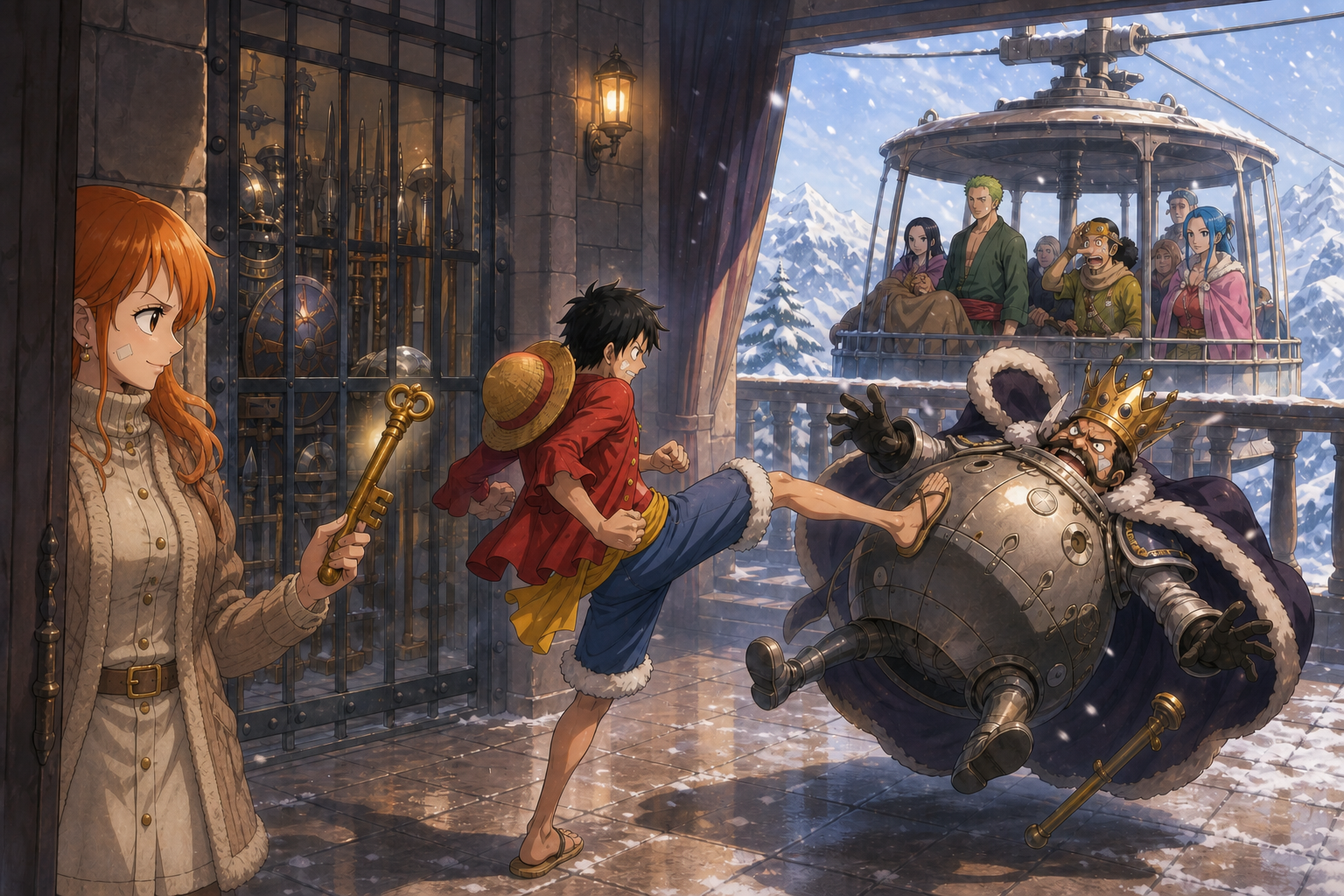
One Piece Episode 89 ends Wapol's control as Nami secures the armory key, Luffy corners the ruler, and Dalton returns with Drum's residents.
Quick reaction
One Piece Episode 89 ends Wapol’s rule by making every meaning of possession collapse around him. He believes the castle, doctors, weapons, country, and people belong to him because he returned and announced ownership. Nami steals the armory key from his reach. Luffy rejects his claim to the flag. Dalton returns with residents who have begun moving as citizens rather than frightened subjects.
The episode gives Luffy the final blow, but the political victory belongs to more than one punch. Chopper defended Hiriluk’s flag. Kureha kept practicing medicine outside royal permission. Dalton survived and returned. The people climbed toward the castle. Wapol loses because the country he treated as property no longer agrees to perform obedience.
RaeRae’s bottom line: sending Wapol flying removes the immediate ruler, not the system he built. Drum still has concentrated medicine, unsecured weapons, damaged public trust, incomplete records, recovering patients, and a population that deserves a voice in whatever comes next.
Wapol reaches the clinic and turns recovery into another battlefield
Wapol enters the castle while Nami and Sanji remain patients. The attack violates the one space that should stay protected during political conflict. Sick and injured people cannot evacuate or defend themselves like rested fighters, and medical staff cannot provide care while an armed ruler treats the clinic as his throne room.
Kureha needs clinical authority even when Luffy controls the fight. She should direct patient movement, identify safe rooms, and decide when Nami or Sanji can be moved. Combat priorities cannot replace medical priorities simply because the strongest person arrived to help.
The castle should have a lockdown plan separating treatment areas, medicine, records, and weapons. Wapol’s government deliberately blurred those functions because controlling doctors helped him control the country. Rebuilding begins by refusing to let a clinic serve as an armory and royal fortress again.
Nami is grabbed while recovering and still creates her own opening
Wapol grabs Nami during recovery, using her body as leverage while assuming illness has removed her agency. The assault adds physical danger to a patient already healing from infection and exhaustion. Rescue should restore her control rather than turn her into cargo passed between fighters.
Nami notices the armory key and takes advantage of Wapol’s arrogance. Her action changes the battle because she understands value, access, and timing. The moment is not proof that every patient should fight through illness. The moment proves that being medically vulnerable does not erase judgment.
After Luffy interrupts the assault, Nami should choose who touches or examines her. Chopper or Kureha needs to assess new pain, bruising, dizziness, and whether the struggle affected her recovery. A successful rescue does not automatically return her body to the condition before Wapol entered.
The armory key exposes how Wapol mixed public defense with private control
A royal armory may contain weapons intended for national defense, but Wapol treats access as an extension of his personal power. Nami holding the key removes his immediate advantage and reveals how much institutional danger sits behind one object.
The key should be secured without leaving Nami responsible for protecting the entire inventory. Kureha, Dalton, and trusted residents need a witnessed transfer, a temporary lock plan, and an inventory of what remains. One missing weapon could create violence long after Wapol leaves the island.
Unknown weapons should not be tested during a crowded battle. Ammunition, explosives, altered equipment, and anything affected by Wapol’s powers require containment. Curiosity becomes reckless when nobody knows range, trigger, structural damage, or whether the castle can survive use.
Wapol turns consumption into a politics of coercion
The Munch-Munch Fruit lets Wapol consume objects, weapons, and people, then reshape his body through what he takes. The ability matches his rule perfectly. He sees the kingdom as material available for personal use and calls the result leadership.
Consumption erases boundaries. Public resources become his body. Other people’s labor becomes his strength. Doctors become property. The castle becomes proof that anything inside his reach belongs to him. His Devil Fruit does not create that worldview, but gives the worldview a grotesquely literal form.
Luffy’s resistance protects more than a flag. He rejects the idea that strength establishes rightful ownership. Wapol can swallow weapons and still have no legitimate claim over the people who made, maintained, or suffered beneath them.
Luffy corners Wapol without inheriting the kingdom
Luffy fights because Wapol attacked his friends, endangered patients, and tried to destroy Hiriluk’s flag. He does not fight to become Drum’s replacement ruler. That boundary keeps intervention from becoming conquest.
Force should end when the active threat ends. Once Wapol can no longer attack, detain, or command followers, further punishment would serve anger rather than protection. Residents and a legitimate transitional authority should decide how to handle evidence, accountability, exile, or detention.
Luffy’s final blow creates physical separation between Wapol and the country he claims. The image is satisfying because his body leaves the frame of ownership he constructed. The harder work remains with the people standing behind.
Dalton returns by ropeway with a country moving behind him
Dalton’s arrival matters because he does not return alone. Residents travel toward the castle after years of learning that the ruler controlled movement, medicine, and safety. Their ascent transforms the ropeway from royal infrastructure into a public route.
A crowd is not automatically a safe medical escort. Dalton remains injured, and the ropeway needs load limits, operator control, weather assessment, and an emergency stop plan. Symbolic urgency should not recreate the bodily disregard associated with Wapol.
The residents are witnesses, not scenery decorating Dalton’s legitimacy. They saw abandonment, medical hoarding, violence, and the resistance that followed. Any transition should include their testimony and decisions rather than treating Dalton’s decency as enough public consent.
Zoro, Usopp, and Vivi bring separate knowledge to the ascent
Zoro and Usopp connect the castle battle to the people and crew members below. Their roles should include route security, communication, and helping injured residents rather than racing toward the final punch after Luffy already controls the confrontation.
Vivi understands the political stakes more sharply than most of the crew. She sees a kingdom moving from abusive rule toward uncertain reconstruction while her own country approaches civil war. Drum offers hope and warning at the same time.
Dalton’s presence carries authority because residents know his history and choices, but he should not receive power through the pirates’ endorsement. Vivi can recognize leadership potential without turning one royal observer into the source of Drum’s next government.
Chopper watches the rule that shaped his isolation finally end
Wapol’s medical monopoly helped create the conditions that left Chopper and Hiriluk outside safe care. The ruler treated doctors as possessions and sick people as leverage. Watching his defeat carries personal meaning beyond winning one battle.
Chopper still needs room for complicated emotion. Relief can exist beside grief for Hiriluk, fear about leaving Kureha, and uncertainty about the invitation from Luffy. Political change does not organize every private feeling into celebration.
The crew should not use Wapol’s defeat to pressure an immediate decision. Chopper deserves information about the voyage, his role, the risks, and his ability to remain connected with Drum. Freedom includes the right to choose after the cheering stops.
The flag survives because conviction cannot be swallowed or owned
Hiriluk’s flag remains standing after Wapol tries to destroy the meaning behind the symbol. Cloth can tear and poles can break, but the belief has already moved through Chopper, Kureha, and people who witnessed resistance. Luffy protects a symbol whose authority comes from memory rather than government.
The crew should understand why Chopper reacts so fiercely before treating the flag as another pirate banner. Luffy recognizes conviction without needing the full biography, but later care requires listening. Protecting the object matters most when protection includes the person whose grief gives the cloth its immediate meaning.
Preservation should respect that history. The flag needs documentation, stable storage or repair, and public context explaining Hiriluk’s work and failures honestly. Memorial care should not turn a complicated doctor into a polished national mascot.
The symbol belongs most directly to the people who carried the consequences. Chopper’s relationship must not be overwritten by officials using the flag to legitimize a new regime. Public remembrance works best when personal grief retains space.
Ending Wapol’s rule is the first condition of rebuilding
Drum needs accessible clinics, trained staff, medicine distribution, public records, food security, shelter repair, and mental-health support after sustained fear. One spectacular defeat cannot perform those jobs.
The Isshi-20 must explain their participation in Wapol’s monopoly. Some may have acted under coercion, some may have benefited, and some may have tried to protect patients inside an abusive system. Accountability requires evidence and individual assessment rather than collective praise or punishment.
Medicine cannot remain royal property. Training, supplies, triage, and transport need rules that apply beyond the castle. Kureha’s expertise can guide reform without making another single doctor the permanent gatekeeper for an entire country.
Records and weapons need protection before the transition becomes a scramble
Wapol’s administration may hold patient files, supply lists, detention records, tax documents, military orders, and evidence of disappeared resources. Those records should be secured before loyalists destroy them or opportunists remove names and assets.
Weapons require a separate civilian inventory with multiple witnesses. The armory key cannot pass quietly from one powerful hand to another. Access, storage, disposal, and emergency authority need public oversight.
Protecting evidence also supports people harmed by the regime. Compensation, family answers, medical follow-up, and fair accountability depend on records surviving the emotional hours after victory.
The production team closes the political argument through convergence
Michiru Shimada’s script brings Nami, Luffy, Wapol, Chopper, Kureha, Dalton, residents, and the armory into the same final movement. Each person approaches the end of rule through a different need rather than becoming an audience for Luffy.
Junichi Fujise’s direction keeps clinic danger, combat, ropeway movement, and public arrival legible. The episode expands outward as Wapol’s control contracts. More people enter the frame while his legitimate space disappears.
Kenji Yokoyama’s animation direction gives resistance different physical forms: Nami’s quick theft, Luffy’s force, Dalton’s endurance, and the crowd’s ascent. Tomoko Yoshida’s art contrasts Wapol’s claim of possession with spaces that begin looking inhabited and shared again.
What Episode 89 changes
Wapol loses control of the castle and kingdom, ending the immediate threat to Nami, Sanji, Chopper, Kureha, and Drum’s residents. The armory key leaves his possession, and his claim to rule no longer receives obedience.
Dalton returns with residents, placing a recognizable transitional leader beside a public constituency. Drum can begin rebuilding, but leadership, medicine, weapons, and records still require accountable systems.
Chopper sees Hiriluk’s flag survive and Wapol’s power collapse. The conditions that kept him hiding have changed, leaving his choice about Luffy’s invitation more open and more frightening.
Episode details
Japanese title: Oukoku no Shihai Owaru Toki! Shinnen no Hata wa Eien ni
English title: When the Kingdom’s Rule Ends! The Flag of Conviction Is Eternal
Japanese broadcast: November 25, 2001
Saga: Alabasta
Script: Michiru Shimada
Episode direction: Junichi Fujise
Animation direction: Kenji Yokoyama
Art: Tomoko Yoshida
The official One Piece episode guide supplies the title, broadcast record, and production credits. RaeRae’s analysis connects Nami’s armory intervention, Wapol’s consumption, Luffy’s boundary, Dalton’s public return, Chopper’s choice, Hiriluk’s flag, and Drum’s transition to the episode’s wider argument about possession and legitimate authority.
Final verdict
Episode 89 makes Wapol’s defeat feel complete without pretending Drum is repaired. Luffy removes the man who calls the kingdom property. Nami removes his access to weapons. Dalton and the residents reclaim movement toward the castle. Chopper sees that conviction survived.
The episode’s best political choice is keeping Luffy outside the succession. He can defend people and reject tyranny without becoming the source of their next government. Drum’s citizens must build that answer.
Victory also needs a reliable public account before rumor turns Wapol into either a martyr or a joke. Residents should know what happened at the clinic, who controlled the armory, how Dalton returned, and which immediate protections now exist. Clear facts give reconstruction firmer ground than celebration alone.
RaeRae rating: 9.4/10. Treat Nami and Sanji, inventory the armory, preserve records, hear the residents, examine the Isshi-20 honestly, and let the flag remain memory rather than propaganda. Wapol leaving is freedom’s opening, not freedom’s finished form.