
RaeRae Reacts · One Piece Episode 88
Chopper's Seven Forms
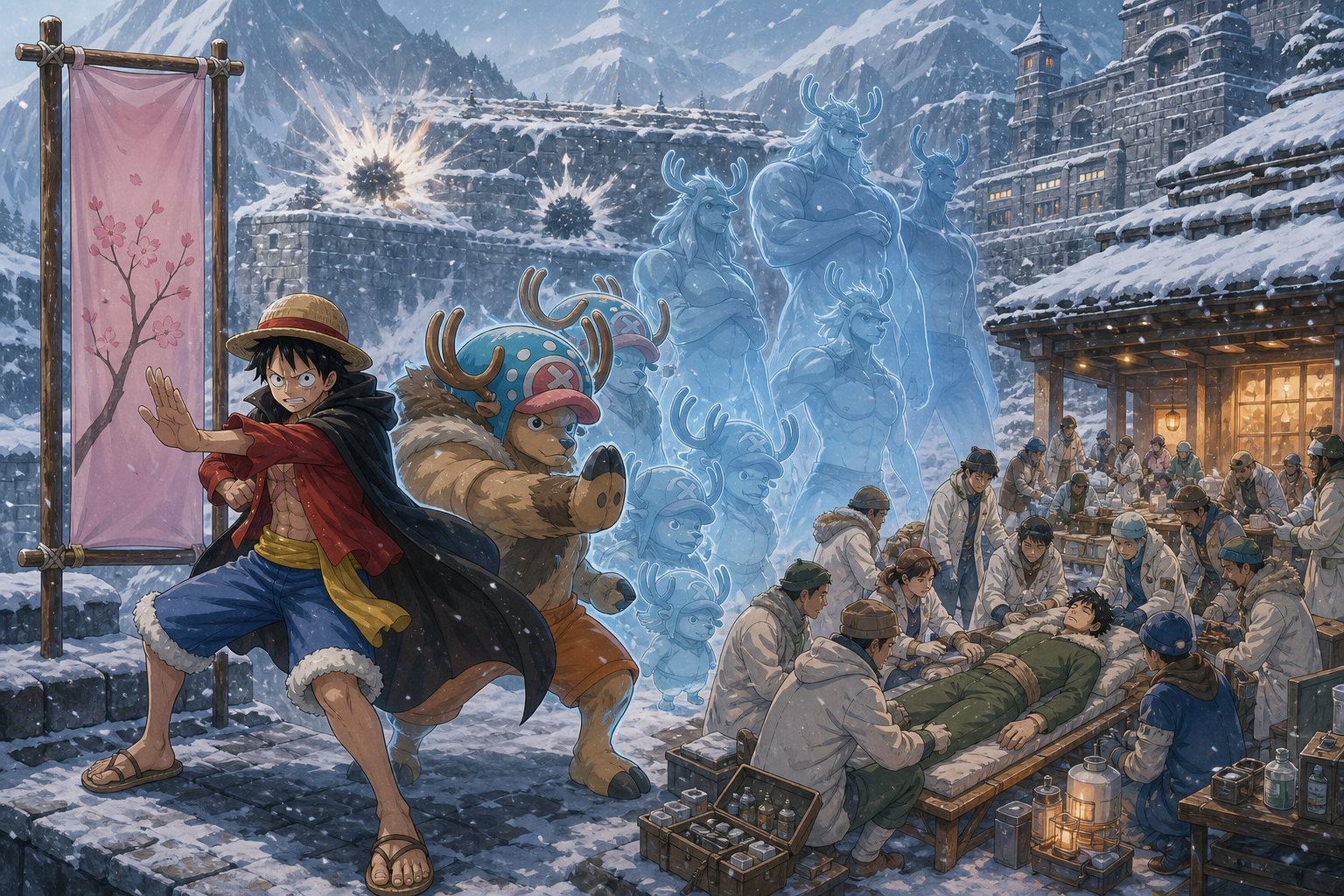
One Piece Episode 88 shows Luffy defending Hiriluk's memorial, Chopper's seven controlled forms, and the Isshi-20 using Wapol's monopolized medicine to save Dalton.
Quick reaction
One Piece Episode 88 shows Luffy and Chopper recognizing each other through action before either one knows how to name the relationship. Luffy protects Hiriluk’s flag because somebody’s conviction lives inside the symbol. Chopper reveals the forms he built through years of study because protecting the clinic now requires every part of the body he once learned to hate.
The episode also refuses to keep medicine outside politics. The Isshi-20 use expertise Wapol monopolized to save Dalton, the man who resisted him. Their care is necessary and morally complicated. Skill can survive inside a coercive institution without making the institution harmless or every practitioner equally responsible.
RaeRae’s bottom line: seven transformations do not make Chopper a combat gadget with a medical license. They reveal scientific discipline, bodily risk, and decision pressure. Luffy respects his courage. The crew still owes him a real choice about recruitment, combat, research, and how much of his history becomes public.
Luffy protects Hiriluk’s banner because he understands inherited will
Luffy does not need a complete account of Hiriluk’s medicine or Chopper’s grief before recognizing that Wapol wants to destroy something another person carried with conviction. He protects the flag because a symbol can hold a promise after the original person dies.
That instinct creates one of Luffy’s strongest forms of empathy. He rarely explains grief well, but he recognizes when power tries to humiliate the dead through the people who remember them. Defending the banner tells Chopper that his mentor’s dream is not ridiculous simply because Wapol laughs.
The symbol still should not cost a living person unnecessarily. Moving the flag, shielding the area, or stopping the cannons at their source would protect both memory and bodies. Conviction does not require standing in avoidable blast range when another option exists.
The cannon attack turns symbolic violence into physical danger
Wapol’s forces target the banner, but explosives do not distinguish cloth from lungs, hearing, eyes, snow stability, or nearby patients. Everyone near the castle needs distance, cover, and warning before the next shot. Medical staff should prepare for blast injury even when no visible wound appears.
Luffy’s durability makes his stand possible, not universally safe. The crew should assess hearing, breathing, burns, impact pain, and confusion after exposure. A hero remaining upright can hide injuries that become serious once adrenaline drops.
The best defensive choice disables ammunition, firing mechanisms, or operators without triggering stored explosives. Chopper’s transformations and Luffy’s strength should create access to the source rather than relying on bodies to absorb repeated fire.
Chopper sees respect before he hears another invitation
Luffy’s defense of Hiriluk’s flag reaches Chopper because the action protects a story Luffy barely understands. Chopper has spent years expecting people to fear his body or dismiss his attachments. Luffy responds to the meaning rather than the appearance.
One good act does not settle recruitment. Trust can begin quickly while consent takes more time. Chopper still needs to know where the crew travels, what danger they accept, what a ship’s doctor controls, and whether he can refuse combat without losing belonging.
Respect survives incomplete knowledge when people remain willing to learn. Luffy does not need to narrate Chopper’s identity for him. Chopper should control how he tells Hiriluk’s story, explains his body, and introduces the research behind his transformations.
Seven forms turn a Zoan body into a complex decision system
Most Zoan users move among a limited set of natural transformations. Chopper’s Rumble Ball research expands his options, giving him forms suited to jumping, defense, strength, speed, analysis, reach, or compact movement. The achievement comes from experimentation rather than destiny alone.
More options increase decision pressure. Chopper must read terrain, opponents, patients, allies, duration, and physical strain before choosing. A powerful form used in the wrong space can block evacuation, damage the clinic, or leave him unable to treat someone afterward.
Each form needs a purpose and a stopping rule. Transformation should remain away from fragile patients whenever possible. The team needs clear signals so allies know whether Chopper is creating cover, pursuing, analyzing, or preparing a strike.
Recovery time belongs in the decision too. A form that wins ten seconds but leaves Chopper weak for an hour may be the wrong choice when patients still need him. Combat planning should count the medical work waiting after the threat ends, not only the force required during the clash.
The Rumble Ball is medicine, research, and risk at once
Chopper altered his Devil Fruit response through a substance he developed himself. That work shows advanced observation and courage, but self-experimentation can hide danger when the researcher is also the only available subject and evaluator.
Dosage, timing, storage, interactions, side effects, and recovery need records. Physical effects may change with injury, illness, temperature, nutrition, or repeated use. A successful transformation during one battle does not prove every future dose is safe.
The crew should never take a Rumble Ball, pressure Chopper to use one, or treat the supply as an automatic answer to stronger enemies. Body autonomy includes refusing combat and refusing a transformation whose cost others do not have to carry.
Kureha should review the research before Chopper leaves, including failed trials and symptoms he may have normalized. A young researcher can mistake familiar suffering for acceptable risk. Independent review does not diminish his achievement. Good medicine becomes stronger when another expert can challenge the assumptions behind success.
Chopper uses force to defend a clinic rather than prove he belongs
Chopper’s combat matters because Wapol threatens patients, Kureha, the flag, and the medical space. He is not auditioning for the Straw Hats through violence. His right to join should not depend on winning or revealing the most impressive form.
Force should match the defensive goal. Create distance, stop weapons, protect evacuation, and end the attack. A form that incapacitates an opponent may serve better than one that causes maximum damage inside the castle.
Kureha remains the clinical lead. Chopper can fight at one boundary while she decides patient movement, supplies, and treatment. Protecting medicine means keeping medical authority visible even when combat dominates the frame.
The Isshi-20 save Dalton with knowledge Wapol kept behind a throne
Dalton reaches them with severe trauma, cold exposure, and prolonged physiological stress. Resuscitation requires coordinated assessment, warming, bleeding control, airway management, and careful handling of the embedded arrow. Removing the object too early could worsen bleeding.
Twenty doctors need one team structure rather than twenty simultaneous opinions. Assign airway, circulation, warming, medication, records, and communication. The strongest expertise becomes useful when responsibility is clear.
Dalton’s survival shows what Drum lost when Wapol restricted physicians to his own service. The same knowledge could have protected residents throughout the kingdom. Saving one resistance leader should become the beginning of public medicine, not an exception proving the old system worked.
Hypothermia changes what recovery can look like
Cold can suppress breathing, pulse, responsiveness, and normal signs of life. Dalton’s condition demands careful assessment before anyone declares the outcome. Rough movement or rapid heating of limbs can create further cardiovascular stress.
Warm the core, protect the airway, remove wet material when safe, and monitor rhythm and circulation. The arrow injury complicates every step because transport, warming, and bleeding control must happen together.
A crowd welcoming Dalton may provide hope, but a crowd cannot replace a medical escort. The route back needs stable transport, weather protection, space for the care team, and a destination capable of continued observation.
The Isshi-20 deserve scrutiny without automatic collective condemnation
The doctors served inside Wapol’s monopoly. Some may have enjoyed privilege, some may have complied to survive, and some may have tried to help residents within narrow limits. A uniform title does not prove identical choices.
Accountability requires records, testimony, and individual review. Coercion can explain conduct without erasing harm. Patients denied care deserve answers, while clinicians who resisted quietly deserve a path to help rebuild.
Wapol’s retaliation risk remains active while they treat Dalton. Protecting the team, medicines, and records allows care to continue. Public trust will grow through transparent service beyond the castle, not through one dramatic reversal.
The doctors also need protection from demands for instant redemption. Residents may be angry, frightened, and urgently sick. A structured process can prioritize care while separate investigators examine past conduct. Forcing clinicians to defend themselves during every bedside encounter would harm patients and produce poor accountability at the same time.
Dalton’s care can become a public turning point
Residents need accurate information about his condition without losing medical privacy. Rumors of death or miraculous recovery could move crowds, provoke loyalists, or create pressure on doctors to promise an outcome they cannot guarantee.
The clinic and village should establish one communication route. Updates can confirm that Dalton receives care, identify immediate needs, and prevent people from crowding treatment space. Hope becomes safer when hope travels with facts.
If Dalton recovers, his first political responsibility should include expanding medical access. His personal survival gives him direct evidence of what coordinated care can do and what Wapol denied to everyone outside the royal circle.
Nami and Sanji remain patients while the castle fight expands
Nami is recovering from infection, and Sanji still carries serious injury. Neither should enter combat because the flag, Chopper, or Luffy inspires them. Recovery can include fear and frustration without becoming permission to ignore medical limits.
They need a protected room, clear evacuation route, medication schedule, water, warmth, and someone who knows when Kureha or Chopper is available. The clinic cannot focus so completely on Dalton or Wapol that existing patients disappear.
The crew should share updates without bringing tactical noise into the treatment space. Patients deserve information, but constant alarms and visitors can interfere with rest and assessment.
A written care board outside the room can identify medication times, approved visitors, and the person carrying urgent messages. Simple coordination protects rest without leaving Nami or Sanji isolated from decisions affecting the ship.
The production team links inherited will to purposeful bodies
Michiru Shimada’s script connects Luffy’s flag defense, Chopper’s transformations, and the Isshi-20 treating Dalton through one question: what will a person do with knowledge or conviction inherited from someone else?
Hidehiko Kadota’s direction balances cannon spectacle, transformation reveals, and medical triage without making the doctors feel detached from the fight. Each space shows resistance through a different discipline.
Hideaki Maniwa’s animation direction gives every Chopper form a readable job rather than presenting a shapeless power montage. Miyuki Sato’s art lets Hiriluk’s pink symbol resist the gray-white winter and Wapol’s hard possession of the castle.
What Episode 88 changes
Luffy proves that he respects Hiriluk’s conviction before understanding Chopper’s entire history. That act deepens Chopper’s trust and makes the possibility of joining the crew emotionally credible.
Chopper reveals the scope of his Zoan research and seven controlled forms. His medical intelligence, combat ability, and bodily autonomy now belong inside the same portrait rather than separate versions of him.
The Isshi-20 begin using monopolized expertise for Dalton, creating a possible bridge from royal medicine toward public care. His survival gives Drum a leader and a medical system both facing accountability.
Episode details
Japanese title: Doubutsukei Akuma no Mi! Chopper Nanadan Henkei
English title: Zoan-Type Devil Fruit! Chopper’s Seven Transformations
Japanese broadcast: November 18, 2001
Saga: Alabasta
Script: Michiru Shimada
Episode direction: Hidehiko Kadota
Animation direction: Hideaki Maniwa
Art: Miyuki Sato
The official One Piece episode guide supplies the title, broadcast record, and production credits. RaeRae’s analysis connects Luffy’s flag defense, Chopper’s seven forms and Rumble Ball research, clinic protection, Dalton’s resuscitation, hypothermia, and the Isshi-20’s accountability to the episode’s wider argument about inherited skill and bodily choice.
Final verdict
Episode 88 gives Chopper a body that reads like autobiography. Every form carries years of isolation, study, mistakes, discipline, and the decision to use difference in service of other people. The achievement deserves wonder without becoming a demand for endless performance.
Luffy protects the flag because conviction matters. The Isshi-20 save Dalton because knowledge matters. Chopper stands between those truths, carrying Hiriluk’s dream and Kureha’s medicine toward a future he has not chosen yet.
RaeRae rating: 9.4/10. Stop the cannons, assess the blast, protect the clinic, document Rumble Ball risk, warm Dalton carefully, and make medicine public. Respect Chopper before asking what another transformation can do.