
RaeRae Reacts · One Piece Episode 90
Hiriluk's Cherry Blossoms
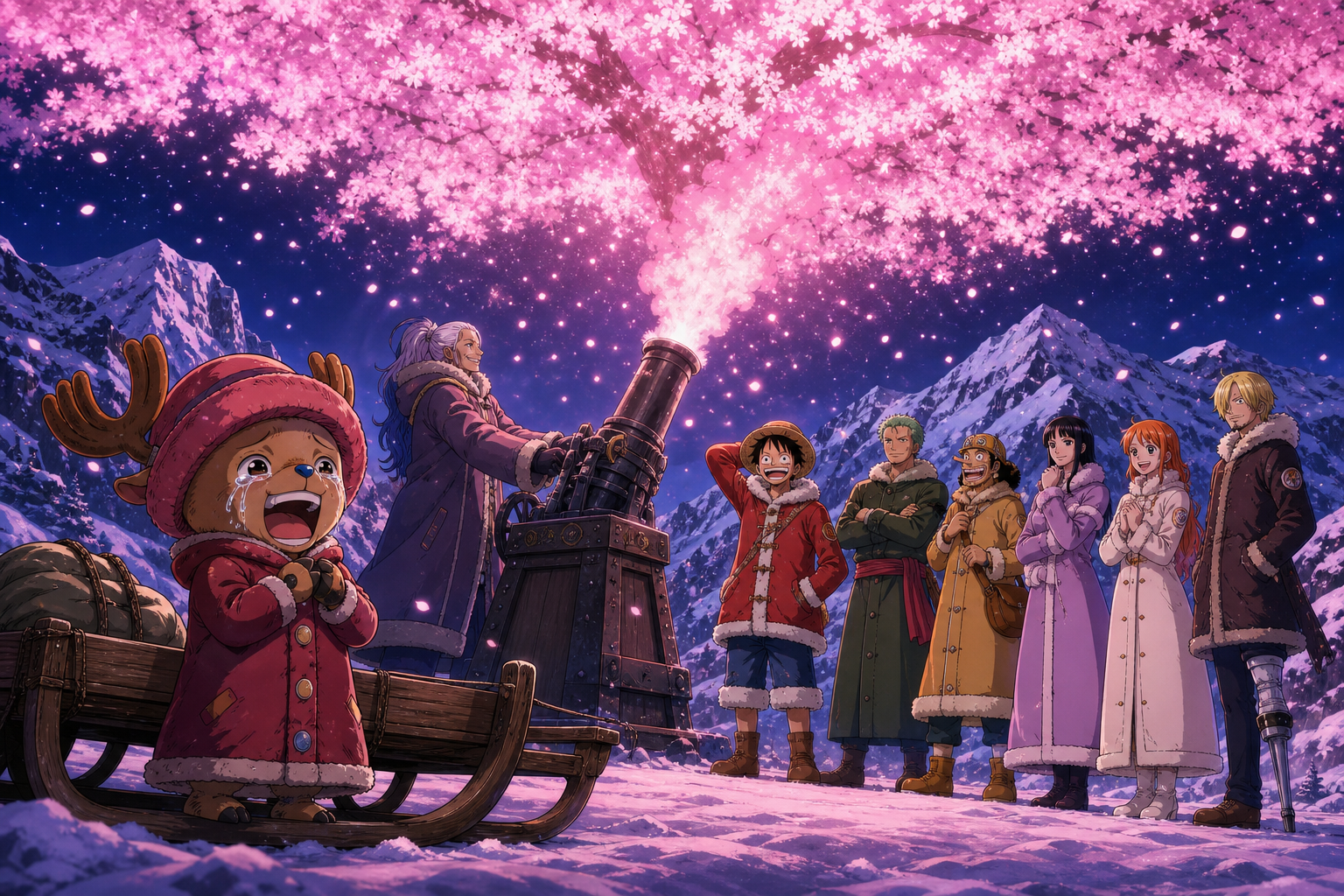
One Piece Episode 90 welcomes Chopper to the crew as Kureha fulfills Hiriluk's dream and covers the snowy Drum Rockies in miraculous pink blossoms.
Quick reaction
One Piece Episode 90 earns the tears because Chopper’s invitation and Hiriluk’s blossom answer different wounds. Luffy tells Chopper that the body he hates does not disqualify him from belonging. Kureha fills the mountains with pink light so Hiriluk’s impossible dream can reach the student who carried that dream alone.
The episode never makes leaving simple. Chopper wants the sea and fears rejection. Kureha wants his future and expresses that love through fury, pursuit, preparation, and one spectacular farewell. Their bond has never sounded gentle, but the work beneath her shouting is unmistakable.
RaeRae’s bottom line: the cherry blossom miracle matters because the country remains snowy. Hiriluk did not erase winter or repair Drum in one night. He changed what people could imagine inside that landscape. Chopper leaves because somebody finally showed him that an impossible image can become a direction.
Nami negotiates discharge inside a medical system learning new values
Nami is well enough to leave, but recovery should not become a contest between her urgency and Kureha’s authority. A proper discharge covers medication, hydration, warning signs, activity limits, infection follow-up, and what the crew should do if fever returns at sea.
Kureha’s enormous bill turns medicine, power, and comedy into the same negotiation. Canceling or reducing the debt can be ethical when the original amount reflects leverage over desperate travelers rather than care costs. The clinic still deserves support, but payment should not become captivity.
The armory key and public resources belong to Drum’s people, not to whoever holds the castle after Wapol. Nami can bargain brilliantly without treating institutional property as private currency. Dalton and the Isshi-20 need a transparent inventory before rebuilding begins.
Luffy asks Chopper to join without demanding a polished answer
Luffy sees a person he wants beside him and states the invitation directly. He does not request a medical résumé, proof of bravery, or a normal-looking body. That simplicity cuts through every reason Chopper has learned to use against himself.
Chopper wants connection and fears that the crew will eventually repeat the rejection he already knows. His self-refusal protects him from hearing another person say no, but protection also keeps him inside the loneliness Hiriluk wanted him to escape.
Luffy refuses the premise that Chopper must become less strange before belonging. The answer is not an argument about social acceptance. The answer is an opening: come with us as the person standing here.
Joining the Straw Hats is a choice, not repayment for rescue
Chopper helped save Nami and fought beside the crew, but he does not owe them his labor. Luffy’s invitation should remain separate from medical debt, gratitude, or the idea that the ship has earned a doctor by surviving Drum.
Consent requires a real option to stay. Chopper has ties to Kureha, a clinic, research, patients, and the only home he remembers. Choosing the sea carries loss even when the choice is right. The crew should not minimize what he gives up.
Once aboard, his place cannot depend on perfect care. Doctors make mistakes, need rest, disagree with patients, and become sick themselves. Chosen family begins when usefulness stops being the condition for keeping a seat at the table.
The crew should also name what Chopper receives from them. He gains protection, transportation, shared food, help gathering ingredients, people willing to carry patients, and companions who can defend a clinic during danger. Mutual care prevents the doctor role from becoming a one-way promise where everybody takes treatment and calls that friendship.
A shipboard doctor needs authority and support at the same time
Recruiting Chopper changes how the crew handles health. He needs authority to stop unsafe activity, isolate infection, protect medicine, and tell Luffy that determination cannot substitute for treatment. A captain who invites a doctor must accept answers he dislikes.
Chopper also needs supervision and consultation while his experience grows. Kureha’s training is substantial, but the sea will bring unfamiliar diseases, climates, injuries, and species. Competence includes recognizing when research or another expert is necessary.
The crew needs emergency roles, a clean examination area, private records, and basic first-aid training. Making Chopper responsible for every medical task would leave everyone helpless if he becomes the patient.
Privacy must survive the ship’s cramped layout. Crewmates should knock, keep diagnoses out of jokes, and avoid reading notes merely because a chart sits nearby. Trust in the doctor depends on knowing that one vulnerable conversation will not become dinner-table entertainment.
Kureha opposes the departure loudly because quiet release is not her language
Kureha chases Chopper and performs anger while making his departure possible. Her behavior can frighten and confuse, especially after a battle, but the emotional contradiction fits a guardian who refuses sentimental exposure even when grief is obvious.
The crew should not romanticize danger inside the farewell. Weapons, explosives, steep snow routes, and panic can injure the person she wants to release. Love does not become more authentic when the goodbye creates avoidable physical risk.
What saves the moment is the preparation beneath the noise. Kureha has already gathered medical tools and Hiriluk’s research. Her actions say that she expects Chopper to leave, expects him to practice medicine, and expects his dream to outgrow Drum.
The sled carries a future that needs practical preparation
Chopper’s rush toward the ship gives the farewell movement, but cold-to-sea transition requires planning. Dry clothing, blankets, measured food, hydration, and protection from wind should travel with him. Emotional adrenaline can hide exhaustion until the body reaches a warmer, quieter space.
Medical cases need secure loading before the Going Merry leaves rough water. Instruments, medicines, notes, and Rumble Balls cannot slide across the deck or freeze inside exposed luggage. Somebody should confirm every case rather than assuming Kureha’s packing makes the transfer complete.
Chopper also needs personal belongings that have no clinical purpose. A new crewmate is more than professional equipment. Choosing what to carry from home helps him preserve identity while entering a life where almost every room, routine, and relationship will be unfamiliar.
Hiriluk’s research becomes a farewell Kureha can finish
Kureha retrieves the work behind Hiriluk’s dream and turns the Drum Rockies pink. The act is collaboration across death. Hiriluk imagined the cure, Chopper protected the memory, and Kureha supplied the knowledge and execution needed to make the vision visible.
The powder does not resurrect Hiriluk or erase the harm caused by his medical errors. The blossom honors the part of his belief that understood hope as a physical intervention. A changed view can alter what frightened or defeated people believe remains possible.
Kureha’s completion also releases Chopper from being the only keeper of the dream. He no longer has to stay beside the castle to prove Hiriluk mattered. The whole country can witness the image while Chopper takes the lesson somewhere new.
Pink powder fills the sky without making environmental questions disappear
The blast and airborne material create a breathtaking spectacle, but scale brings responsibility. Residents need warning, safe viewing distance, protection from debris, and information about respiratory or ecological effects. Wonder should not require uninformed exposure.
The powder’s composition and dispersal should be documented, especially if Drum plans to repeat the display. Wildlife, water, snowpack, crops, and people with breathing conditions may respond differently from healthy viewers seeing one brief event.
Cleanup belongs in the plan as well. Containers, ignition materials, launch equipment, and residue should not remain across public paths after the crowd leaves. The same residents inspired by the blossom should not have to discover hidden debris during ordinary work the next morning.
Those questions do not cancel the emotional miracle. Responsible celebration protects the community that gives the symbol meaning. Hiriluk wanted a country’s spirit to change, not a beautiful image produced at the cost of bodies nobody checked.
The cherry blossoms belong to Chopper’s memory without belonging only to him
Chopper sees Hiriluk’s promise appear across the mountains at the moment he leaves. The timing tells him that departure is not betrayal. Kureha and Drum can carry the memory while he follows the sea route Hiriluk encouraged him to imagine.
Residents witness the same landscape become something new. Their meanings will differ. Some remember dictatorship and illness. Some may know Hiriluk as a reckless doctor. Others see a future no ruler designed. Public memory can hold disagreement without reducing the blossom to one approved interpretation.
The strongest symbol does not tell Drum that suffering ended. Pink light shows that winter is not the only story the mountains can hold. That difference gives people emotional room to begin political and medical rebuilding.
Drum needs more than one spectacular night
Wapol’s defeat removes the ruler who hoarded doctors, but the country’s health system still requires repair. The Isshi-20 can restore clinics, train practitioners, distribute medicine, rebuild trust, and establish care that does not depend on loyalty to one leader.
Dalton should lead without becoming another benevolent exception above public oversight. Residents need transparent decisions, shared authority, records, and a way to challenge abuse. Personal decency helps a transition; institutions protect the future.
Kureha should not become the single replacement for the medical monopoly she opposed. Her knowledge is essential, but durable reform requires apprentices, stocked regional clinics, transport for remote patients, and rules that keep medicine available after one extraordinary doctor can no longer carry the system.
Nami’s discharge becomes an early test. Foreign pirates should not receive care through a special bargain while residents remain excluded. The new Drum must decide that medicine belongs to people because they are sick, not because a ruler finds them useful.
The production team turns acceptance into movement
Michiru Shimada’s script makes Chopper’s acceptance the climax while allowing Kureha, Nami, Dalton, the Isshi-20, and Hiriluk’s research to carry separate consequences. The invitation changes one life, but the episode refuses to stop the country around him.
Munehisa Sakai’s direction moves Chopper physically away from the castle as the blossom expands behind him. Release becomes motion rather than a conversation held safely in one room. The growing distance makes every look backward matter.
Masayuki Takagi’s animation direction lets joy remain complicated across Chopper’s body and face. Kunihiro Senda transforms the established snowy landscape without abandoning its shape. Drum becomes recognizable and impossible at the same time.
What Episode 90 changes
Chopper accepts Luffy’s invitation and chooses the Going Merry, giving the Straw Hats their doctor and giving himself a future beyond hiding. His decision does not erase Kureha or Drum. The bond becomes something capable of surviving distance.
Kureha fulfills Hiriluk’s dream through the cherry blossom display, transferring the symbol from private memory into public possibility. Chopper can leave without remaining the sole person responsible for proving his mentor existed.
Drum enters a rebuilding phase under Dalton and the Isshi-20. Wapol’s defeat becomes the beginning of reform rather than the entire cure. Vivi witnesses a peaceful transition while preparing to return to a kingdom approaching civil war.
Episode details
Japanese title: Hiruruku no Sakura! Doramu Rokkii no Kiseki
English title: Hiriluk’s Cherry Blossoms! Miracle in the Drum Rockies
Japanese broadcast: December 2, 2001
Saga: Alabasta
Script: Michiru Shimada
Episode direction: Munehisa Sakai
Animation direction: Masayuki Takagi
Art: Kunihiro Senda
The official One Piece episode guide supplies the title, broadcast record, and production credits. RaeRae’s analysis connects Nami’s discharge, Luffy’s invitation, Chopper’s consent, Kureha’s preparation, Hiriluk’s research, the blossom’s environmental scale, and Drum’s rebuilding to the episode’s wider argument about belonging and release.
Final verdict
Episode 90 gives Chopper an answer to the question beneath his whole life. He does not need to become human enough, ordinary enough, brave enough, or useful enough before somebody wants him. Luffy wants him now, antlers and fear included.
Kureha’s blossom answers the other fear: leaving does not abandon Hiriluk. The dream can remain in Drum, grow across the mountains, and travel inside Chopper at the same time. Love survives because nobody has to own the whole memory.
RaeRae rating: 9.8/10. Give Chopper a real choice, pack the clinic, protect the crowd, rebuild public medicine, and let the pink sky mean possibility rather than instant cure. This farewell earns every tear.