
RaeRae Reacts · One Piece Episode 77
Farewell to Little Garden
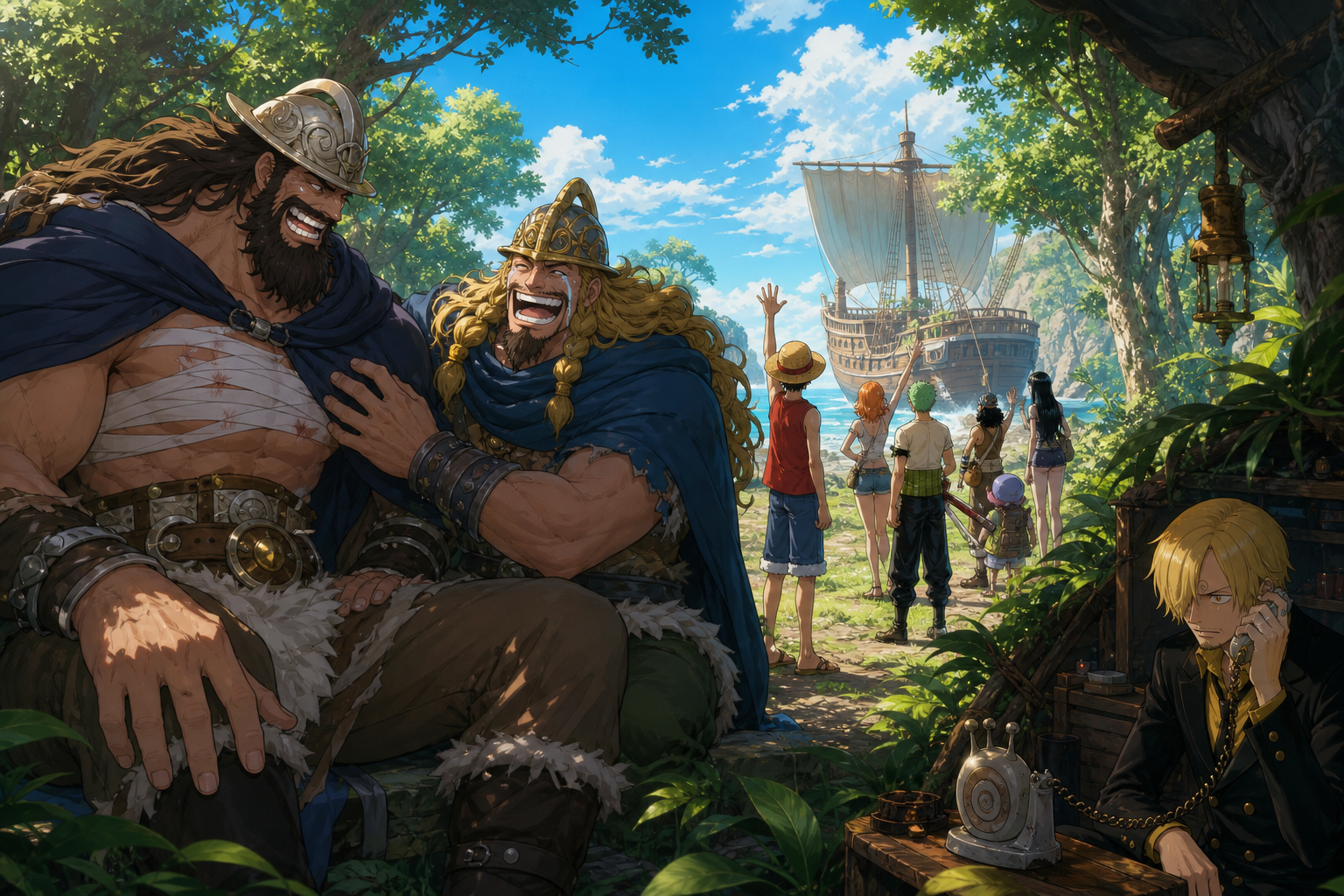
One Piece Episode 77 brings relief when Dorry survives, gives Little Garden an emotional farewell, and lets Sanji answer a dangerous call from the mysterious Mr. 0.
Episode information
Japanese title: Saraba Kyojin no Shima! Arabasta o Mezase
English title: Farewell, Giant Island! Head for Alabasta
Japanese broadcast: August 19, 2001
Saga: Alabasta
Script: Junki Takegami
Episode direction: Yuji Endo
Animation direction: Kazuya Hisada
Art: Fumihiro Uchikawa
The clearing finally grows quiet
Episode 77 begins after the wax trap, the Colors Trap, and the fight with Mr. 3 have been broken. Quiet does not mean the emergency is over. Fire, hot wax, smoke, injuries, contaminated pigment, and scattered agents all require a final sweep before anyone relaxes.
The crew needs to count every person and animal, confirm the Baroque Works threat is contained, and keep a clean route back to the Going Merry.
Brogy mourns Dorry again
The official episode summary returns to Brogy’s grief over Dorry. His relief at surviving the rescue cannot erase the loss he believes he has suffered. The episode gives that grief room before changing what the crew knows.
Do not hurry him toward celebration or departure. A hundred-year bond deserves privacy, companionship, hydration, and someone willing to remain present without forcing words.
Dorry rises
Dorry standing again changes the emotional temperature of the island. Dorry’s return also calls for immediate medical restraint. Regaining consciousness or movement after a major injury does not prove that a person is stable.
Ask Dorry to remain seated, assess breathing and orientation, inspect the wound, and establish what he remembers. His scale makes ordinary treatment difficult, but the same priorities still apply.
The wound was shallower than first appearances suggested. The official explanation is that Brogy’s battle axe had weakened across a century of combat, limiting the depth of the strike. That is welcome information, not a reason to dismiss the injury.
A shallow wound can still involve bleeding, contamination, pain, shock, and damage hidden beneath clothing. Clean evaluation matters more than assumptions based on Dorry’s strength.
Equipment fatigue saved a life. The weakened axe is a striking reversal. Tool degradation usually increases danger, yet the damage reduces the force delivered. The outcome should not be treated as proof that worn weapons are safe.
Both giants need to inspect handles, heads, bindings, edges, and balance before another duel. Any damaged weapon should be retired or repaired away from other people.
A century of duels leaves cumulative harm
Dorry and Brogy have fought repeatedly for one hundred years. Even if this wound is survivable, cumulative concussions, joint damage, hearing loss, scar tissue, and exhaustion deserve attention.
The crew cannot conduct a complete giant-scale medical program, but they can document symptoms, share supplies, and encourage a genuine recovery period before combat resumes.
Relief can arrive as another shock. Brogy moves from certainty about Dorry’s death to seeing him alive. That emotional reversal can produce crying, shaking, confusion, laughter, anger, or collapse. None of those responses are wrong.
Give both giants space to reconnect. The crew should avoid crowding them for answers or turning the reunion into entertainment.
Dorry needs informed consent before treatment
Explain what the crew observed, what interventions occurred, and why further checks are recommended. Ask permission before touching the wound or removing damaged clothing.
If Dorry declines a step while alert and informed, offer alternatives and explain risks. His size and status do not reduce his right to make decisions about his body.
Brogy needs support too. Care often focuses on the visibly injured person, while the witness is expected to recover alone. Brogy experienced poisoning, battle, captivity, and the belief that he killed his closest companion.
Check his physical condition and ask what support he wants. Reuniting with Dorry does not erase the trauma that came before the reunion.
The crew should correct the incident record. Any earlier report that Dorry died must be amended, not silently discarded. Record his recovery, the weakened axe, the actual wound, and remaining concerns.
Accurate correction prevents rumors and helps everyone understand how Baroque Works manipulated the duel. The correction also respects Dorry as a living participant rather than a dramatic misunderstanding.
Baroque Works exploited trust
The agents did not merely attack two giants. They used poison, disguise, misinformation, and a ritual duel to make friends harm one another. That method deserves specific accountability.
Evidence should connect each action to its operator without collapsing everyone into one accusation. Preserve the drink container, wax samples, pigments, communications tools, and witness accounts separately.
The island needs a safety handoff. Before leaving, the crew should explain where hazards remain: cooled wax, fuel residue, damaged supports, disturbed ground, and any unaccounted agent equipment. Dorry and Brogy need the map because they will stay.
Mark contaminated areas visibly without leaving loose material that wildlife might swallow or become trapped in.
Karoo deserves post-operation care. Karoo carried the oil-soaked rope through a fire plan. Check feathers, feet, eyes, breathing, and harness contact points. Remove oil residue with an appropriate gentle method and prevent him from preening contaminated feathers.
Offer water and rest in shade. He should not be loaded with departure gear until his condition is clear.
Luffy needs a Colors Trap debrief. The team should review how Miss Goldenweek altered Luffy’s decisions, how Usopp recognized the change, and how Fire Star removed the mark. Keep the conversation factual and private.
Agree on a code phrase for future suspected influence and identify who can temporarily take rescue leadership while an affected member is reassessed.
Usopp deserves full operational credit. Usopp restored Luffy’s agency, designed the rope plan, coordinated Karoo, and helped release the captives. Calling the outcome luck would erase observation, preparation, and courage.
The crew should document what worked and ask Usopp to teach the method’s safety limits. Recognition strengthens future teamwork when strength alone is insufficient.
Nami, Vivi, and Zoro require follow-up. Release from wax is not the end of care. Check skin temperature, circulation, numbness, breathing, balance, pain, smoke exposure, and contaminated clothing. Each person chooses who helps with cleaning or examination.
They should not be rushed into sailing duties merely because the immediate device is gone.
Sanji notices the absence. The official summary shifts to Sanji, who returned to the Going Merry alone and realizes that something has happened to his companions. That awareness shows how a missing check-in can become an operational signal.
A crew moving through hostile territory needs expected return times, rally points, and a protocol for investigating silence without sending every remaining person into danger.
Sanji conducts a separate search
Sanji follows the situation toward Mr. 3’s hideout rather than wandering randomly. A solo search still needs discipline: observe tracks, protect the ship, mark the route, and avoid destroying evidence.
If possible, leave a message at the Merry explaining direction and estimated return. The ship should never become an unmarked empty base.
Mr. 3’s hideout is an evidence scene. The hideout may contain records, supplies, maps, codes, personal effects, weapons, and communication equipment. Sanji should first check for people and immediate hazards, then preserve the arrangement.
Do not eat, smoke near unknown chemicals, or casually handle containers. Photograph or sketch the room before moving objects whenever time allows.
The Den Den Mushi is still active
Sanji finds a transponder snail, establishing a live connection to the larger Baroque Works network. The device is both a communication opportunity and a risk. The caller may gather voice, location, timing, or status information.
Sanji should avoid giving names, crew numbers, destination, injuries, or confirmation that Mr. 3 has failed.
Mr. 0 is on the line
The official summary reveals that the caller is Mr. 0. Sanji does not yet have the complete identity behind that code, but he can infer senior authority from the context and the direct communication.
This is an intelligence contact, not a casual conversation. Every word should serve a defined objective while revealing as little as possible.
Impersonation creates leverage and risk. If Sanji allows the caller to believe he belongs in the hideout, he may learn expectations, deadlines, targets, or reporting structure. A wrong detail can expose him and trigger retaliation elsewhere.
Use short answers, mirror the caller’s terminology, and never invent more biography than necessary. Silence can be safer than an elaborate lie.
Record exact language. After the call, Sanji should write down the greeting, code names, instructions, background noises, emotional tone, and any implied schedule. Memory changes quickly under adrenaline.
Separate direct statements from interpretation. The crew can analyze whether the caller knew Mr. 3’s location, expected a report, or planned a follow-up.
Do not trace the call by damaging the device. The Den Den Mushi is a living communication creature, not disposable machinery. Treat the Den Den Mushi gently, provide appropriate care, and avoid experiments that cause distress.
Observe its markings and behavior, but do not force repeated connections. Animal welfare applies even when the creature is part of hostile infrastructure.
Sanji should not reveal the rescue outcome. Mr. 0 may not know that Dorry survived, the Straw Hats escaped, or the agents were defeated. Preserving that uncertainty can protect the crew’s departure.
Any false report should be limited to what is necessary and later documented for the group. Hidden unilateral deception becomes dangerous if crewmates plan from different assumptions.
The call may contain a trap. The caller could demand a code phrase, request visual proof, dispatch agents, or instruct the recipient to trigger something in the hideout. Sanji should not activate equipment or open sealed storage while connected.
If the conversation turns suspicious, ending the call safely is better than extending a compromised cover story.
The crew needs to reunite before sailing
No one should leave Little Garden until Sanji, the rescue group, Karoo, and all supplies are accounted for. Establish visual and verbal identity checks because disguise and influence have already been used.
Share urgent information first: injuries, hostile movement, the Mr. 0 call, ship condition, and departure route.
Departure is a medical decision. Heading for Alabasta quickly matters, especially for Vivi’s mission, but the crew must know whether anyone can safely travel. Seasickness, smoke exposure, burns, wax injury, exhaustion, and poison can worsen offshore.
Prepare water, food, bandages, shade, and watch rotations before raising sail. Urgency does not eliminate basic care.
The giants’ farewell carries responsibility
Dorry and Brogy can offer guidance through the waters ahead, but the Straw Hats should not treat their help as repayment owed for rescue. Ask what assistance they freely choose to give.
Thank them directly, return any borrowed tools, and leave the island in safer condition than the agents found the island.
Respect the giants’ continuing relationship. The crew may disagree with a century-long duel, yet the farewell is not the moment to ridicule the giants’ culture. They can express concern about injury while listening to what the ritual means to Dorry and Brogy.
Respect does not require endorsing preventable harm. Respect requires honest conversation without humiliation.
Alabasta becomes the next shared objective
The title points the crew toward Alabasta, where Vivi’s country faces a larger crisis. Before departure, everyone should understand the immediate goal, known threats, and what information remains uncertain.
Vivi should lead the briefing on geography and political context without carrying sole responsibility for every decision.
Update the navigation plan. Little Garden’s unusual climate and wildlife may have affected the Log Pose and supplies. Nami should confirm heading, weather, water, food, hull condition, and escape options before committing the ship.
A secondary plan is essential if illness or pursuit forces a stop before Alabasta.
The Going Merry needs inspection. A ship left during a hostile operation may have been entered, damaged, marked, or observed. Inspect deck, cabins, stores, rudder, sails, anchor, and hidden spaces before loading everyone aboard.
Look for unfamiliar paint, wax, communication devices, footprints, or displaced items. Do not assume absence of visible damage means the ship is secure.
Separate intelligence from rumor. Sanji’s call, Vivi’s knowledge, and captured materials will produce theories about Mr. 0. Label each statement as confirmed, reported, inferred, or unknown.
This prevents the crew from building a dangerous plan around a confident guess. Revisit the assessment when new evidence arrives.
Use a short departure briefing. Before sailing, name the destination, route, watch assignments, medical concerns, hostile contacts, communication rules, and emergency rally point. Keep the briefing short enough that everyone can repeat the plan.
Ask each member to state their role. Questions now are safer than assumptions during the first crisis at sea.
Protect Vivi’s identity in communications. Mr. 0’s network is specifically interested in Alabasta and may recognize details about Vivi. Do not mention her name, title, location, or condition over the transponder snail.
If the device travels with the crew as evidence, isolate the device and monitor any incoming call without letting sound reveal who is nearby.
Care and intelligence must meet. The episode places Dorry’s recovery and Sanji’s covert call side by side. One thread is emotional and medical; the other is strategic. The crew needs both.
Information that arrives during crisis should inform safe movement, while care ensures the people making those decisions can actually sustain the journey.
Junki Takegami lets relief open a larger threat
Takegami resolves the apparent death without making the prior grief meaningless. Dorry’s survival offers real relief, then the Mr. 0 call widens the story beyond Little Garden.
The structure makes departure feel earned but not safe. The crew has won locally while stepping deeper into an organized system.
Yuji Endo balances reunion and suspense. Endo’s direction must let Brogy’s reaction breathe before cutting to Sanji’s quieter discovery. The contrast works because neither scene is rushed.
Open daylight around the giants communicates release, while the enclosed hideout and close communication device create a different kind of pressure.
Kazuya Hisada makes recovery visible. Animation direction can show Dorry’s weight, hesitation, and pain as he rises rather than presenting an instant reset. Brogy’s posture carries the accumulated grief before recognition changes his stance.
Sanji’s smaller movements at the transponder snail communicate thought, caution, and controlled improvisation.
Fumihiro Uchikawa gives the island a farewell. The art can transform the clearing from a trap site into a place of reunion without hiding damaged wax and disturbed ground. Paths toward the shore visually prepare the transition to Alabasta.
The hideout remains distinct through tighter shadows, stored equipment, and the unsettling presence of a live connection.
RaeRae’s real-time reaction
Dorry standing up is the breath I needed, but please do not let two giants decide that consciousness equals medical clearance. Sit down, clean the wound, inspect that exhausted axe, and give Brogy a minute to process the fact that his person is alive.
Meanwhile, Sanji has answered the most dangerous phone call on the island. Say less, remember everything, and do not give Mr. 0 one useful detail about Vivi.
The moment that lands. Brogy crying for Dorry and then seeing him rise turns a victory over Baroque Works into something personal. The weakened axe explains survival, but the reunion works because the grief was treated as real.
Sanji lifting the receiver ensures the relief cannot become complacency. The next threat is already speaking.
What should happen immediately. Stabilize Dorry, assess Brogy, complete post-wax care, check Karoo, secure pigments and weapons, document the hideout, protect the Den Den Mushi, record Mr. 0’s words, inspect the Merry, count everyone, and conduct a short departure briefing.
Do not sail until the crew has shared the call and confirmed medical readiness.
What accountability requires. Correct the record of Dorry’s condition, document the weakened axe, preserve evidence of poisoning and entrapment, record each agent’s role, and distinguish Sanji’s direct observations from inference. Include animal welfare and environmental cleanup.
Leave Dorry and Brogy with hazard information and a way to recognize any returning Baroque Works activity.
Bottom line
Episode 77 releases the grief Little Garden has been holding. Dorry survives because Brogy’s century-worn axe could not deliver the expected wound, and the giants can finally share a living farewell with the Straw Hats. At the same time, Sanji finds Mr. 3’s hideout and answers a call from Mr. 0.
RaeRae rating: 9.2/10. Treat Dorry’s survival as the start of care, not the end of treatment. Give Brogy room, credit Usopp and Karoo, preserve the hideout, protect Vivi’s identity, and let Sanji’s careful listening prepare the crew for the system waiting in Alabasta.