
RaeRae Reacts · One Piece Episode 78
Nami’s Fever Changes Course
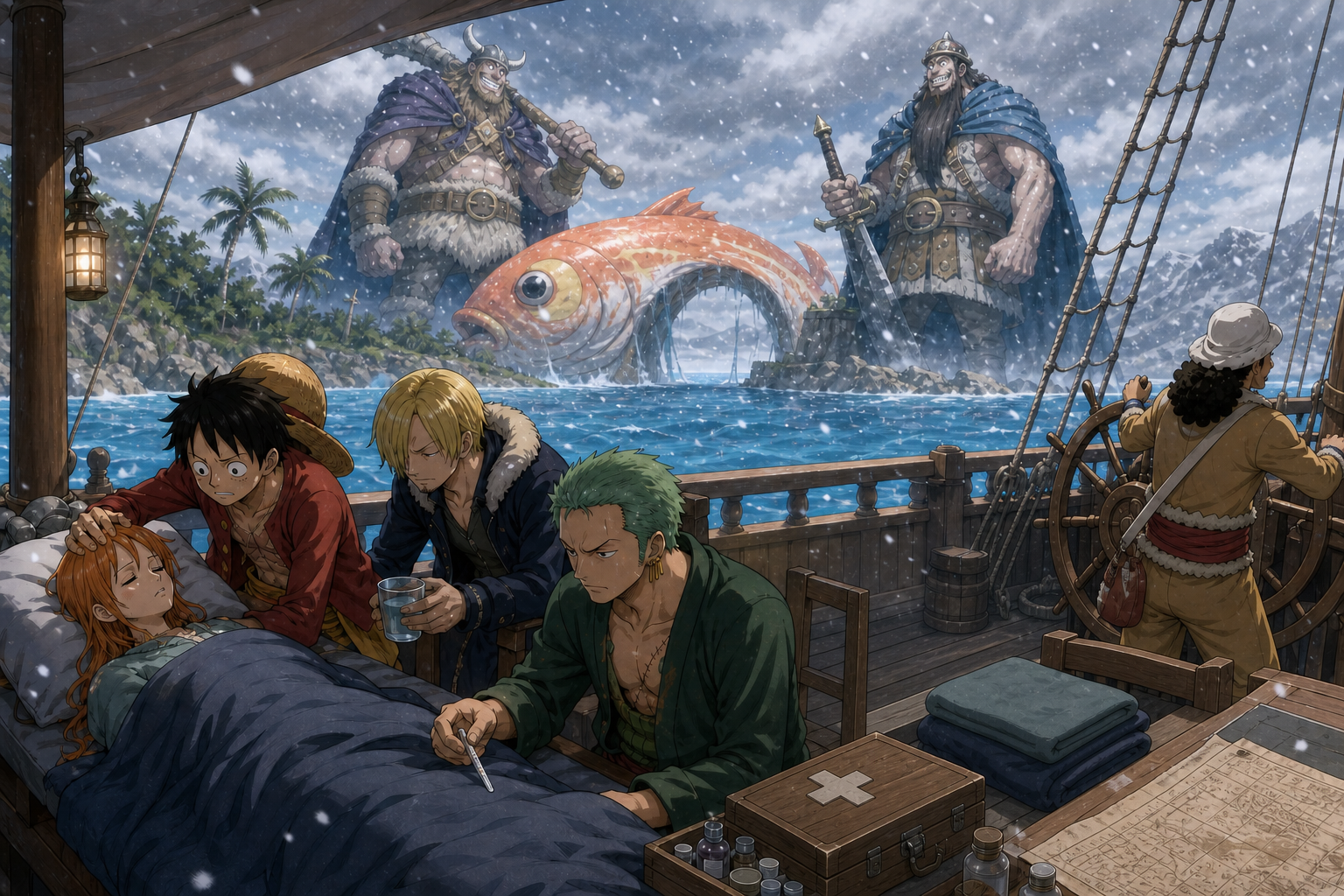
One Piece Episode 78 closes Little Garden with the giants’ farewell, then makes Nami’s high fever the emergency that forces the Going Merry to change course for a doctor.
Episode information
Japanese title: Nami ga Byoki? Umi ni Furu Yuki no Mukou ni!
English title: Nami’s Sick? Beyond the Snow Falling on the Ocean!
Japanese broadcast: August 26, 2001
Saga: Alabasta
Script: Junki Takegami
Episode direction: Yoshihiro Ueda
Animation direction: Noboru Koizumi
Art: Yuri Sanami
Little Garden has one final obstacle
Episode 78 does not let the Going Merry leave quietly. A colossal goldfish called Island Eater blocks the route, turning the giants’ farewell into one more immediate survival problem.
The crew should secure everyone aboard, reduce loose gear, protect Nami from sudden motion, and follow Dorry and Brogy’s instructions. This is not the moment for five competing plans.
Dorry and Brogy open the passage
The official summary says the two giants create a path through Island Eater. Their intervention is a freely chosen act of support, not a debt the crew can demand.
The Merry needs to hold a steady course and wait for a confirmed opening. Moving too early could place the ship inside the giants’ attack line or among falling debris.
Scale changes the safety zone. A strike large enough to stop a creature that can swallow islands creates pressure, waves, spray, and displaced material far beyond the visible point of contact. Everyone should brace away from rails and protect eyes and hearing.
Sanji secures galley heat, Usopp checks rigging, Zoro stabilizes cargo, and Luffy stays available for an unexpected obstruction.
Do not romanticize wildlife harm. Island Eater threatens the ship, so immediate defense is necessary. The response should still be limited to creating escape rather than prolonging harm for spectacle.
Once the passage exists, the crew leaves. They do not return for trophies, photographs, or another test of strength. Survival does not require celebration of injury.
The giants’ contest began with a hunt
The episode explains that Dorry and Brogy’s hundred-year duel grew from a dispute over whose catch was larger. A small disagreement became a century of repeated risk because neither accepted a different way to resolve the dispute.
The history is funny on the surface and deeply costly underneath. Tradition deserves context, but duration does not make harm inevitable or wise.
A farewell should include honest concern. The Straw Hats can respect the giants while still saying that friendship should not require endless injury. Dorry and Brogy deserve the freedom to reconsider their ritual without losing dignity.
Concern works best as an invitation, not a lecture delivered while sailing away. Their choices remain their own after informed reflection.
The Merry clears the island
After the passage opens, Nami must confirm heading, currents, weather, and the Log Pose. The crew has spent supplies and energy during Little Garden, so departure includes a complete inventory.
Water, food, medicine, clean cloth, fuel, rope, sail condition, and hull damage should all be recorded before the island disappears behind them.
Mr. 2 receives an assassination order
The official account introduces Mr. 2 Bon Clay receiving instructions to eliminate Mr. 3. Baroque Works treats company agents as disposable when they fail, revealing a structure built on fear and secrecy.
This threat does not excuse Mr. 3’s actions. The order adds another layer of coercion and shows why captured agents may fear truthful cooperation.
Internal punishment can destroy evidence. If Bon Clay reaches Little Garden, he may silence witnesses, remove records, or create a misleading scene. The crew cannot control events after departure, but their notes and preserved samples now matter more.
Dorry and Brogy should be warned that another agent may arrive and should avoid unknown visitors, gifts, drinks, or claims of official authority.
Bon Clay’s assignment expands the risk. The threat is no longer limited to the agents already encountered. A new operative knows Mr. 3’s failure and has permission to use lethal force.
Sanji’s earlier call may have affected what headquarters believes. The crew needs to compare the timeline and decide whether their own route could be inferred.
Nami develops a high fever
The episode’s central emergency arrives when Nami suddenly collapses with fever. A rapid change after Little Garden can signal infection, environmental exposure, poison, dehydration, or another serious illness.
The crew should stop treating this as fatigue. Fever plus collapse requires immediate assessment, supportive care, frequent monitoring, and a plan to reach qualified medical help.
Confirm temperature and responsiveness. Use the most reliable thermometer available, note the time and method, and repeat measurements consistently. Check whether Nami knows her name, location, date, and what happened.
Record pulse, breathing, skin appearance, pain, vomiting, rash, stiffness, weakness, and any change in speech. The trend matters as much as one number.
Protect her airway. If Nami becomes very drowsy or vomits, position her safely on her side while protecting the neck and maintaining breathing. Do not force water into someone who cannot swallow normally.
Assign one person to remain within sight and sound at all times. A patient with altered consciousness should never be left alone below deck.
Move her out of direct weather. The crew sails into falling snow, so Nami needs a dry, ventilated space protected from wind and spray. Use layers that can be adjusted rather than piling on heavy coverings without checking temperature.
Keep wet clothing away from her skin and preserve privacy during any change. Avoid overheating a person who already has a high fever.
Hydration needs judgment. If Nami is awake and swallowing safely, offer small, frequent amounts of clean water or an appropriate rehydration drink. Do not make her drink large amounts quickly.
Track intake, urine, vomiting, and diarrhea. Reduced urine, severe dizziness, dry mouth, or inability to keep fluids down increases urgency.
Do not guess with random medicine. The ship does not have a doctor, and unfamiliar drugs can cause allergy, overdose, interaction, or mask worsening symptoms. Check labels, dose, timing, and prior reactions before giving anything.
Do not use antibiotics left from another illness or medication intended for a different person. Supportive care does not replace diagnosis.
Ask about the full exposure history. When Nami can answer, ask about insect bites, scratches, food, water, smoke, wax, pigment contact, plants, animals, and the first moment she felt unwell. Check her clothing and skin respectfully for marks.
Vivi, Usopp, and Sanji may remember exposures Nami overlooked. Record observations without deciding the cause prematurely.
Little Garden may have unfamiliar disease
A prehistoric island can carry organisms the crew has never encountered. That possibility argues for medical expertise, not panic or stigma.
Use gloves or clean barriers for body fluids, wash hands, avoid sharing cups, and clean common surfaces while keeping Nami socially supported. Isolation should never become abandonment.
Protect the rest of the crew. Assign one or two consistent caregivers rather than having everyone enter the sick area. Track symptoms among the crew and keep food preparation separate from waste handling.
If more than one person develops fever, cough, rash, vomiting, or confusion, update the route and prepare to signal for urgent help.
The crew needs a medical log
Write temperature, pulse, breathing, fluids, medications, symptoms, mental status, sleep, and events with times. A future doctor will need the sequence.
Use plain observations such as slept for twenty minutes or answered slowly instead of vague entries like better or worse. Name who made each observation.
Nami cannot navigate through collapse. The crew relies heavily on Nami’s expertise, but dependence does not justify pressuring her to work while ill. She may provide one concise piece of guidance if she chooses and remains fully alert.
After that, another person follows the written chart and keeps her informed without making her responsible for every correction.
Vivi must help choose the diversion. Reaching Alabasta remains urgent, yet continuing without a doctor may kill Nami. Vivi understands the stakes in her country and can participate in the decision without being asked to sacrifice a crewmate alone.
The crew should state options, travel times, medical risks, and uncertainty openly. Shared responsibility protects Vivi from carrying impossible blame.
The Merry changes course for a doctor
The official summary says the ship turns to seek medical help. This is the correct priority. A destination matters only if the crew can arrive alive and capable.
Record the new heading, estimated time, weather, remaining supplies, and conditions that would trigger a distress signal or another diversion.
Navigation needs redundancy. Nami’s illness exposes a single point of failure. The crew should begin cross-training basic chart reading, compass use, weather observation, sail management, and position logging.
Redundancy is not a challenge to her expertise. Redundancy protects her right to be sick without the entire ship becoming helpless.
Snow at sea changes priorities
Falling snow suggests a rapid climate transition. Ice can make deck, ropes, and ladders dangerous; cold can worsen exhaustion; visibility may fall quickly.
Clear walkways, rig safety lines, rotate lookouts, protect exposed skin, and keep dry layers available. The caregiver should not leave Nami unattended to solve deck problems.
Cold weather complicates fever care. Shivering may come from fever, cold exposure, or both. Monitor Nami’s measured temperature and comfort rather than judging by touch alone.
Use dry blankets and moderate cabin warmth, but maintain ventilation. Sudden aggressive cooling or heating can cause distress and obscure whether her condition is changing.
Sanji manages nutrition carefully. If Nami is awake and not vomiting, offer simple food in small portions according to tolerance. Do not pressure her to eat a full meal.
Sanji should protect clean preparation space, note what she consumes, and avoid rich or unfamiliar ingredients. Hydration usually matters more during the first urgent hours.
Usopp can organize the care station. Usopp’s practical skills can create a stable cot, secure bottles, improve ventilation, and keep medical supplies reachable in rough seas. He can also maintain the written log.
His job is not to invent a cure. His job is to reduce preventable harm while the ship reaches someone qualified.
Zoro can protect the route. Zoro can keep the deck clear, manage heavy gear, and take an extended watch so caregivers rest. He should receive precise navigation instructions because direction is not his strength.
Assigning him a role that fits his abilities keeps the emergency organized without asking him to make medical decisions.
Luffy must accept a changed mission. Luffy’s instinct may be to rush directly toward Alabasta, but captaincy means responding when a crewmate’s life changes the plan. His visible support can stop Nami from feeling guilty for the diversion.
He should reinforce that seeking a doctor is the mission now and that no one is to blame for the delay.
Karoo also needs cold protection. Karoo recently completed a strenuous rescue and now faces snow at sea. Provide dry shelter, foot checks, food, water, and appropriate warmth.
Do not use him as an emergency scout until recovery is confirmed. An animal companion cannot consent to unlimited risk because the humans feel desperate.
Prepare a medical handoff
Before reaching land, assemble the log, exposure history, medications, allergies, symptom onset, vital trends, and contact details. Keep Nami’s belongings together and preserve her privacy.
One crewmate speaks to the doctor while another stays with her. Accurate handoff saves time and prevents contradictory stories.
Signal before entering an unknown port. The crew may be treated as pirates or outsiders, so approaching without warning could delay care. Use a visible medical distress signal where possible and keep weapons secured.
Vivi can help explain that they are seeking urgent treatment. The crew should cooperate with reasonable safety procedures without surrendering Nami’s dignity.
Bon Clay and the fever create parallel clocks
While a new Baroque Works agent moves to erase failure, Nami’s condition forces the Straw Hats onto a different route. Both pressures punish delay, but only one can be addressed directly from the Merry.
The crew should prioritize medical care while preserving enough security and intelligence discipline to avoid walking into another trap.
Do not let urgency erase consent. When Nami is alert, explain each intervention and ask permission. If her capacity changes, act only as needed to protect life and document why.
Keep her covered, limit unnecessary observers, and speak to her directly rather than discussing her as though she is absent.
Document the decision to divert. Record Nami’s condition, the alternatives considered, who participated, and why medical care outweighed the original route. This protects the crew from later rewriting the decision through guilt.
A transparent record also helps them improve emergency planning for future voyages.
Junki Takegami changes the scale of danger
Takegami opens with an island-sized creature and two giant warriors, then makes a fever the threat that truly changes the voyage. Strength can clear a physical passage, but strength cannot diagnose Nami.
The contrast makes medical dependence visible and moves the story naturally toward the next island.
Yoshihiro Ueda directs a tonal turn. Ueda must carry the giants’ enormous farewell into the quieter alarm of Nami collapsing. The transition works when the crew’s celebration stops immediately and practical concern takes over.
Snow beyond warm tropical water visually signals that the journey has entered unfamiliar conditions before anyone knows what waits ahead.
Noboru Koizumi makes illness legible without spectacle. Animation direction can show Nami’s loss of balance, flushed exhaustion, slower response, and the crew’s coordinated movement without exploiting her body. Small changes carry the urgency.
The same episode gives the giants broad, powerful motion and the sickroom careful stillness, making different kinds of danger readable.
Yuri Sanami turns weather into warning. The art shifts from Little Garden’s saturated heat to gray-blue sea and falling white snow. That palette makes Nami’s sheltered space feel both vulnerable and cared for.
Clear deck geography shows who is steering, who is monitoring, and where dry supplies are kept as conditions worsen.
RaeRae’s real-time reaction
Dorry and Brogy just opened the biggest exit imaginable, and somehow the real emergency is Nami quietly falling over. Get a temperature, start a written log, protect her airway, offer small sips only if she can swallow, and stop handing her the entire ship’s navigation problem.
Turn for a doctor. Alabasta matters, but arriving without Nami is not an acceptable version of success.
The moment that lands. The ship changing course is the episode’s clearest act of loyalty. The crew does not debate whether Nami has earned care or whether the schedule matters more. Her condition changes the plan.
That decision is stronger than a speech because changing course costs time and still happens immediately.
What should happen immediately. Confirm temperature and consciousness, protect airway, move Nami to a dry ventilated space, start a medical log, offer safe fluids, review exposures, assign caregivers, cross-train navigation, secure the snowy deck, and head for qualified medical help.
Warn the crew about Bon Clay and preserve operational security without delaying care.
What accountability requires. Document Nami’s onset and treatment, the diversion decision, Island Eater’s obstruction, the giants’ intervention, Bon Clay’s order, Little Garden exposures, animal welfare, and supplies used. Preserve uncertainty about the diagnosis.
Review why the ship lacked medical redundancy and build a better emergency kit after a doctor assesses her.
Bottom line
Episode 78 closes Little Garden with Dorry and Brogy opening a path through Island Eater, then shifts the voyage around Nami’s sudden high fever. As Bon Clay receives an order to eliminate Mr. 3, the Going Merry turns away from its direct route to find a doctor.
RaeRae rating: 9.5/10. The correct heroic choice is not another attack. Heroism means believing the patient, sharing the navigation burden, documenting symptoms, protecting dignity, and changing course before a treatable emergency becomes irreversible.