
RaeRae Reacts · One Piece Episode 76
Usopp’s Fire Star Counterattack
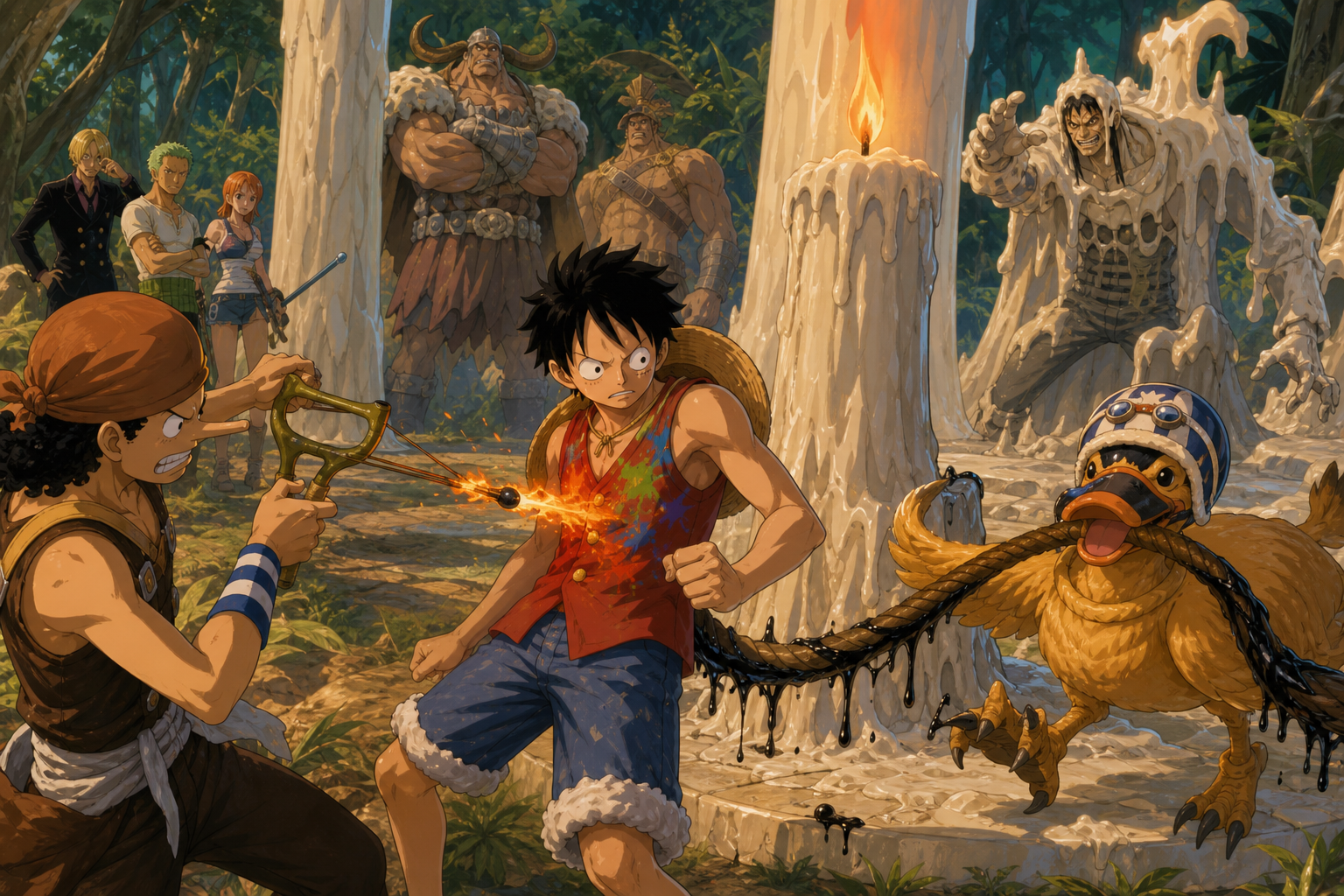
One Piece Episode 76 gives Usopp and Karoo the rescue spotlight as Fire Star breaks the Colors Trap and an oil-soaked rope turns controlled flame against Mr. 3’s candle.
Episode information
Japanese title: Iza Hangeki! Usopp no Kiten to Kaen Boshi!
English title: Time to Fight Back! Usopp’s Quick Thinking and Fire Star!
Japanese broadcast: August 19, 2001
Saga: Alabasta
Script: Junki Takegami
Episode direction: Harume Kosaka
Animation direction: Masayuki Takagi
Art: Tomoko Yoshida
Usopp turns retreat into a plan
Episode 76 immediately proves that Usopp and Karoo did not abandon anyone. The pair used distance to see the whole trap, identify the trap’s weak points, and return with a method. That distinction matters. A retreat made to preserve the last mobile rescuers is not cowardice. That choice is disciplined survival under pressure.
Usopp’s advantage is not physical strength. He notices materials, range, timing, and the way separate hazards interact. Those skills become more valuable than another direct punch against Mr. 3’s wax.
Fire Star breaks the Colors Trap
The official episode summary says Usopp burns the painted mark on Luffy’s clothes with a Fire Star. He targets the mechanism rather than the affected person. That precision restores Luffy’s agency without treating his altered behavior as a moral failure.
The shot also validates the crew’s earlier reality check. Luffy’s sudden refusal was not a sincere change of heart. Once the mark is removed, the rescue mission can continue with everyone understanding what happened.
Use the smallest effective flame. Fire near clothing, wax, oil, and restrained people can turn one rescue into several emergencies. Usopp needs the smallest flame that can destroy the pigment, a clear line of fire, and extinguishing water ready before he shoots.
Luffy should turn his face away, close his eyes, and hold still. A second crewmate watches for sparks while another confirms that the altered behavior ends.
Luffy’s recovery needs confirmation
Removing the color mark does not automatically prove that every effect has ended. Ask Luffy to identify the danger, repeat the rescue objective, and describe what he remembers. Check for confusion, headache, lingering compulsion, or missing time.
The goal is not to challenge his authority. The check establishes that he has regained informed control before placing him beside open flame and unstable wax.
Do not turn manipulation into a joke. The crew may feel relief when Luffy returns to himself, but his loss of agency should not become a recurring punch line. He was targeted by an unfamiliar psychological technique while trying to save friends.
A useful debrief records the trigger, the behavior change, the successful countermeasure, and the grounding cues that helped. A debrief does not shame him for something imposed from outside.
Mr. 3 returns in wax armor
The official summary identifies Mr. 3’s next form as the Candle Champion. The armor changes his protection and reach, but the design also commits more wax to one moving structure. That creates heat sensitivity, visibility limits, weight, and balance problems.
Luffy should keep the armored opponent away from the captives and away from Usopp’s fire line. The fight and the rescue need separate zones.
Wax armor is still a heat hazard. Heating the Candle Champion may soften the armor, but uncontrolled melting can splash skin, spread flame, or create slick footing. Nobody should stand downhill from molten material. Karoo should remain outside the likely runoff path.
Use brief, directed heat and observe changes before escalating. If the armor begins shedding large pieces, shift from attack to containment and cooling.
Luffy’s role is containment. Luffy can keep Mr. 3 occupied, draw him away from the candle structure, and prevent interference with Usopp’s rescue setup. Winning quickly is less important than controlling where the fight happens.
He should avoid blows that send the armored opponent through the captives or into the giant candle. A clean lane gives the rescue team time and reduces unpredictable debris.
Usopp designs a larger countermeasure
The rescue requires more than freeing Luffy from a color mark. Nami, Vivi, Zoro, and the giants remain threatened by a huge wax mechanism. Usopp combines rope, oil, Karoo’s speed, and a controlled ignition to distribute heat around the structure.
This is engineering under pressure. Each component has a purpose, and the sequence matters as much as the materials.
Karoo carries the special rope
The official account says Usopp gives Karoo an oil-soaked special rope to wrap around the giant candle and Brogy. Karoo becomes the mobile link in the plan, but he is still an animal partner whose welfare requires active protection.
Check his breathing, feet, vision, harness fit, and escape route before the run. Keep fire away until he is fully clear.
Oil demands strict handling. An oil-soaked rope can carry flame along a planned path, yet drips may create secondary fires. Use only enough oil for continuity, keep the container capped, and remove excess from the route.
No one should pour more fuel once ignition begins. Water, sand, blankets, and cutting tools must be placed where rescuers can reach them without crossing the flame.
Map Karoo’s route before release. The route should circle the target without crossing wax runoff, enemy reach, loose roots, or the captives’ escape lane. Usopp needs to show Karoo the full path and the point where he must drop or release the rope.
A second route provides an exit if Mr. 3 changes position. Karoo should never be forced between the Candle Champion and Luffy.
Rope tension controls placement. Too much slack can snag Karoo’s legs or touch people. Too much tension can pull him off balance or shift a weakened support. Usopp should feed the line steadily and keep coils organized behind cover.
Someone must be ready to cut the rope immediately if the rope catches on Karoo, a captive, or an unstable section.
The ignition must wait for clearance
The most important command is not fire. The word is clear. Usopp needs visual confirmation that Karoo has exited, Luffy is outside the heat path, and captives know where to move once wax releases.
Only one person should give the ignition order. Everyone else repeats the signal so a misunderstood shout does not start the burn early.
Fire changes the air. Burning oil and heated wax can produce smoke and irritating fumes. Position people upwind, cover mouths and noses with clean cloth, and monitor speech, coughing, dizziness, and eye irritation.
Nami can read airflow through leaves and smoke. If wind turns toward the captives, pause or extinguish rather than hoping the exposure remains tolerable.
Nami and Vivi emerge from the flames
The official summary describes Nami and Vivi coming out of the fire. The image is triumphant, but their first need is a protected exit lane, not celebration. Heated wax can remain on clothing and skin after the visible flame passes.
Guide them to clean ground, smother any burning fabric, cool affected areas with clean water, and let each person consent to hands-on assistance.
Do not pull hot wax from skin. Fresh wax can retain heat and adhere tightly. Pulling hardened material away may damage skin. Cool the wax gradually, remove jewelry near swelling, and seek proper medical evaluation for burns, numbness, blistering, or restricted movement.
Do not use ice directly or apply unknown ointments. Preserve privacy while damaged clothing is assessed.
Zoro needs a separate release check. Zoro’s position, swords, and willingness to endure pain can hide injury. Confirm his airway, circulation, sensation, and balance before asking him to cut anything. His weapons may be hot or fouled with wax.
Confidence is not medical clearance. Give him stable footing and a defined cutting lane before he joins the fight.
Vivi carries operational knowledge. Vivi understands Baroque Works methods and may recognize what Mr. 3 will do next. Once she can breathe and move safely, she can identify likely retreat signals, backup agents, and concealed tools.
She should not be pushed into command while injured. Ask short questions, record the answers, and protect her identity from any distant observer.
Nami can coordinate the clearing. Nami is well placed to track wind, fire spread, routes, and team positions after release. A quick map in the dirt can separate the fight zone, cooling station, evidence area, and escape route.
That coordination prevents everyone from converging on the most dramatic threat while smoke, wax, or another agent approaches from behind.
Brogy’s scale changes the burn
Wrapping rope around Brogy and the candle involves a far larger surface than freeing one human captive. Heat will rise unevenly, and wax may release in heavy sections. Ground teams must stay outside the fall radius.
Brogy should receive clear instructions about when to move. Sudden force from a giant can turn softened supports into dangerous projectiles.
Dorry still needs monitoring. The attention around the candle must not erase Dorry’s earlier injuries and poisoning concerns. Assign someone to check breathing, consciousness, pain, bleeding, and any change during the fire.
The crew should not assume a giant can safely wait because his body is larger. Scale changes treatment logistics, not the duty of care.
Miss Goldenweek remains an active risk. Removing one painted mark does not neutralize every color or tool. Keep her separated from paint supplies and block her line of sight to the rescue team without using unnecessary force.
Collect each pigment separately, photograph marks before covering them, and record which behavior was associated with which exposure. Evidence may prevent another manipulation.
Mr. 5 and Miss Valentine require watch. While Luffy engages Mr. 3, other Baroque Works agents may attack rescuers, target evidence, or escape to report. Security should be assigned independently from firefighting and medical care.
Do not send every mobile fighter after one opponent. The clearing needs observation in all directions and a clear alarm signal.
The rescue needs named roles
One person directs ignition, one controls rope, one watches Karoo, one monitors wind, one manages extinguishing tools, one receives released captives, and one watches hostile agents. Luffy contains Mr. 3 away from them.
Named roles reduce duplicated effort and make omissions visible. If someone becomes affected or injured, the backup takes over immediately.
Communication must survive noise. Cracking wax, shouting giants, combat, and fire can drown out spoken commands. Agree on visible hand signals for stop, clear, ignite, extinguish, and evacuate before the run begins.
Signals should be large and distinct. Nobody should invent a new gesture during the critical sequence and assume everyone understands the signal.
Set an extinguishing threshold. The team should stop the burn if smoke moves toward captives, Karoo reenters the route, oil spreads beyond the rope, a support shifts unexpectedly, or anyone loses communication. A predetermined threshold makes stopping easier under adrenaline.
Success is safe release, not proving the original plan can continue after conditions change.
Preserve an escape corridor. The path from the candle to clean ground must stay free of rope, fuel, weapons, and spectators. Mark the corridor before ignition and keep the exit wider than the largest expected group.
Nami and Vivi may be disoriented. A rescuer at the far end can guide them without entering the heat zone.
Account for secondary ignition. Clothing fibers, dry leaves, oil droplets, and wax residue can reignite after the main flame passes. Continue watching the area and each released person after visible fire is gone.
Turn over smoldering ground with tools, not bare hands, and keep Karoo away until the site is cool.
Evidence should survive the rescue
Safety comes first, but the crew can preserve samples of wax, pigment, oil placement, and damaged mechanisms once conditions allow. Photographs and a simple scene map support later accountability.
Keep medical waste and firefighting debris separate from agent tools so nobody mistakes rescue material for evidence of the original attack.
Usopp’s fear improves the design
Usopp imagines what can go wrong because danger feels real to Usopp. In this episode, that awareness helps him plan from range, give Karoo a defined task, and target mechanisms rather than bodies.
Courage is not the absence of fear. Courage means using fear as information while still acting for people who cannot escape alone.
Karoo deserves recognition and recovery. Karoo’s speed makes the rope plan possible, but success does not erase exertion. After the run, check feet for burns or cuts, offer water in controlled amounts, cool him gradually, and remove contaminated tack.
He should receive rest before another chase. Praise should be paired with practical care rather than immediate reuse.
Luffy and Usopp work as complementary rescuers. Luffy creates space by confronting the Candle Champion. Usopp changes the conditions that made brute force ineffective. Neither contribution replaces the other.
The episode works because leadership becomes distributed. The captain accepts a correction, the sharpshooter designs the countermeasure, and Karoo carries out the movement none of the humans could match.
Junki Takegami gives ingenuity the victory
Takegami’s script follows Episode 75’s cognitive trap with a practical answer. Usopp first restores Luffy’s agency, then scales the same fire principle into a rescue system. The progression feels earned because observation leads directly to action.
Mr. 3’s larger armor raises spectacle while keeping the real problem centered on captive release.
Harume Kosaka directs simultaneous pressure. Kosaka has to keep the audience oriented while combat, rope placement, ignition, and escape happen in the same clearing. Clear geography is essential. We need to understand where Karoo runs, where Luffy holds Mr. 3, and where the captives can emerge.
The direction turns parallel actions into teamwork rather than visual noise.
Masayuki Takagi makes materials readable. Animation direction distinguishes rigid wax, softening surfaces, live flame, oily rope, and Karoo’s rapid movement. Those material differences explain the plan without requiring long exposition.
Small reactions matter too: Luffy’s focus returning, Usopp checking his aim, and released captives adjusting balance give the action human stakes.
Tomoko Yoshida shapes a dangerous clearing. Art direction can use pale wax against deep jungle green so heat paths, silhouettes, and exits remain visible. Warm firelight should signal controlled danger without turning the rescue into horror.
Clear background routes also show why Karoo’s speed is useful and where a secondary threat could enter.
RaeRae’s real-time reaction
Usopp just solved two different traps with one principle and succeeded without pretending he was suddenly the strongest person here. Burn the color off Luffy, keep the captain on Mr. 3, give Karoo a route, and use the rope to put heat where the captives actually need heat.
I still want an extinguisher team, an upwind medical point, and somebody watching every other agent. Fire is a tool, not permission to stop planning.
The moment that lands. Nami and Vivi emerging from the flames turns Usopp’s improvised plan into visible proof that careful teamwork can beat an elaborate execution device. The scene belongs to the people who observed, communicated, and trusted one another under pressure.
Karoo’s run is not comic decoration. Karoo’s run is a central rescue action that deserves the same seriousness as Luffy’s fight.
What should happen immediately. Confirm Luffy’s recovery, isolate Miss Goldenweek’s pigments, keep Mr. 3 away from the captives, map Karoo’s route, stage extinguishing supplies, check wind, assign roles, and ignite only after every person and animal is clear.
Receive Nami and Vivi in a clean cooling area, then reassess Zoro, Brogy, and Dorry.
What accountability requires. Document the Colors Trap exposure, the Fire Star countermeasure, the Candle Champion, the rope and oil plan, captive conditions, smoke exposure, burns, animal welfare, and each Baroque Works agent’s conduct. Preserve samples without delaying care.
Review why the first rescue attempt failed and why Usopp’s tactical retreat succeeded.
Bottom line
Episode 76 is Usopp’s rescue episode. He burns away the mark controlling Luffy, then combines Karoo’s speed, an oil-soaked rope, and precisely placed fire to challenge Mr. 3’s giant candle while Luffy contains the Candle Champion. Nami and Vivi’s escape shows that the plan is working.
RaeRae rating: 9.4/10. The victory comes from observation, distributed leadership, and respect for different strengths. Keep the flame controlled, protect Karoo, monitor smoke and hot wax, receive every captive safely, and give Usopp full credit for turning retreat into the counterattack.