
RaeRae Reacts · One Piece Episode 75
Colors Trap Controls Luffy
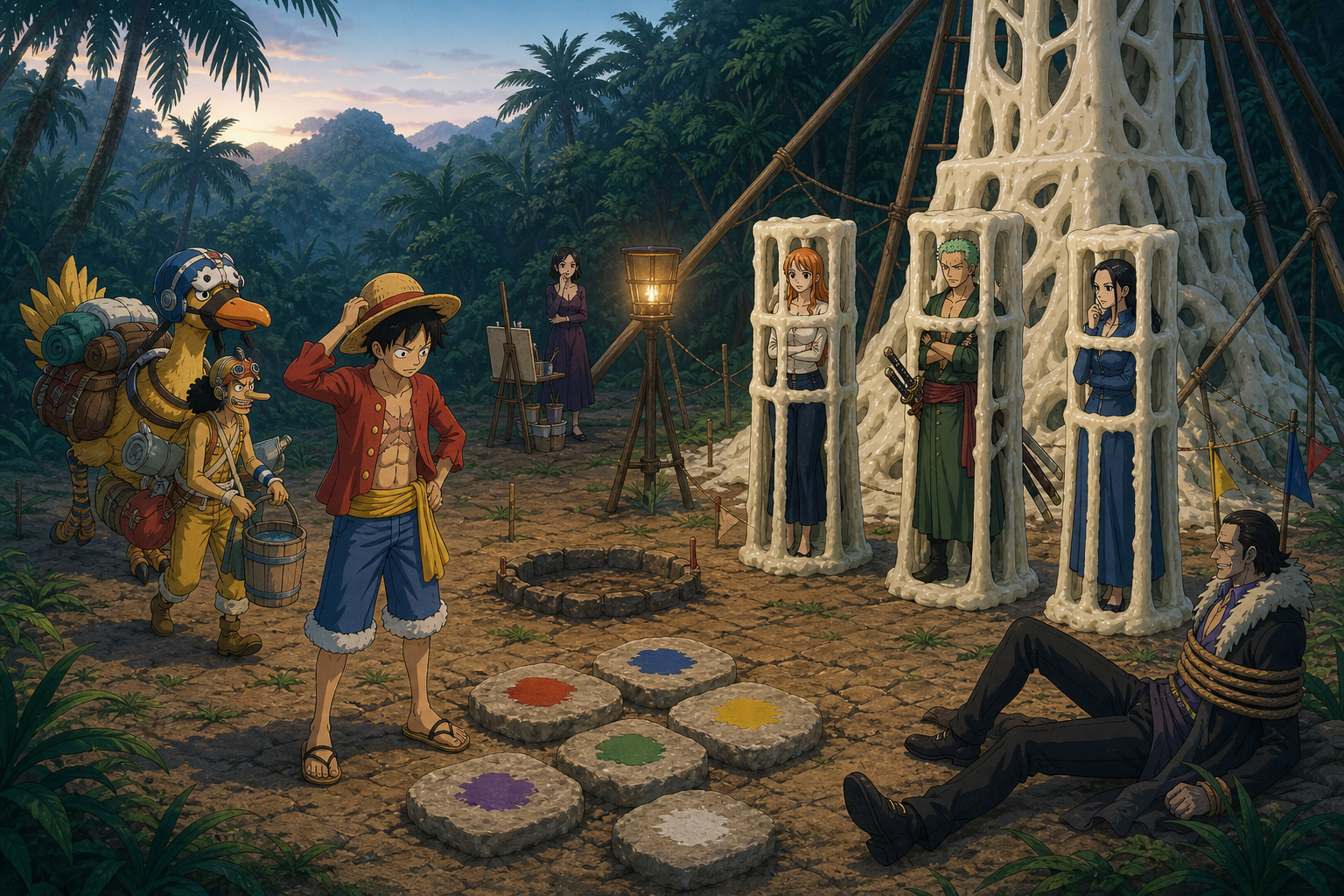
One Piece Episode 75 turns the wax rescue into a cognitive safety crisis when Miss Goldenweek’s Colors Trap makes Luffy refuse to help and forces Usopp and Karoo to regroup.
Episode information
Japanese title: Luffy o Osou Maryoku! Colors Trap
English title: A Mysterious Power Attacks Luffy! Colors Trap
Japanese broadcast: August 12, 2001
Saga: Alabasta
Script: Junki Takegami
Episode direction: Junichi Fujise
Animation direction: Kenji Yokoyama
Art: Miyuki Sato
Luffy attacks the wax structure
Episode 75 begins with direct force against Mr. 3’s giant candle. Breaking a visible section seems like the fastest rescue.
The structure is engineered, so damage can transfer load, increase flow, or accelerate the process harming the captives.
The first rescue attempt makes danger worse
The official summary says Luffy’s action speeds the wax transformation affecting Zoro, Nami, and Vivi. Good intent does not protect a method from consequences.
The team needs to stop, reassess, and listen to captives before striking again.
Rescue plans need a test area. Use a remote wax sample to observe impact, heat, water, cold, solvent, and mechanical pressure. Record changes before applying them near bodies.
A controlled test can prevent another irreversible acceleration.
Map the load paths. Identify which wax sections support captives, hold machinery, channel material, or trigger movement. Mark safe and unsafe cut zones.
Zoro’s position and swords add weight that may shift suddenly.
Captives provide structural information
Nami, Zoro, and Vivi can report heat, pressure, cracks, vibration, airflow, and whether wax is rising. Their observations should guide rescue.
They are participants in the plan, not silent objects.
Airway remains the first priority. Wax covering mouth, nose, neck, or chest creates immediate danger. Keep faces clear and monitor speech.
Freeing weapons or feet comes after breathing unless structural collapse changes triage.
Luffy confronts Mr. 3
The official account says rubber power overcomes wax power and Luffy defeats the operator. Removing active control may stop new construction.
Defeating Mr. 3 does not automatically reverse existing restraints or reveal every trigger.
Secure the operator safely. Restrain Mr. 3 away from controls, search for release tools, and ask clear questions about mechanisms. Provide medical care and protect him from retaliation.
Coercion can produce false instructions, so verify any answer on a sample.
Do not destroy the only release knowledge. Knocking out an operator before learning controls can delay rescue. Another agent may hold information too.
Preserve tools, notes, containers, and machinery in place.
Luffy suddenly refuses to rescue his friends
The official summary marks a dramatic behavioral change after Mr. 3’s defeat. The refusal conflicts with his prior values and immediate goal.
Abrupt inconsistency should be treated as possible external influence, injury, or altered cognition.
Do not moralize an altered decision. Calling Luffy selfish or disloyal misses the sudden onset and environmental trigger. The team should assess capacity before treating the statement as informed choice.
Protect him and others while the cause is investigated.
Miss Goldenweek’s Colors Trap is active
The official account identifies the technique as the reason for Luffy’s refusal. Color marks influence emotion or behavior without ordinary physical restraint.
This makes visual environment part of the hazard map.
Remove exposure carefully. Block line of sight, move affected people away from marked surfaces, cover colors with neutral material, and avoid staring while documenting.
Do not touch unknown pigment without gloves.
Colors may carry different effects. Each mark could influence mood, motivation, trust, or action differently. Record color, shape, placement, time, and behavior without assuming a universal response.
Use neutral language rather than suggestive labels when testing reality.
Use a baseline reminder. Ask Luffy what he intended before seeing the mark, who is in danger, and what changed. A familiar person can state facts calmly.
Do not argue aggressively, which may deepen resistance or panic.
Capacity can return. Altered behavior does not define permanent preference. Once exposure ends, reassess understanding and choice.
Do not hold manipulated statements against him later as though they were freely made.
Team reality checks are essential. Any crewmate noticing abrupt change should name the change and request a pause. A second person confirms observations.
This protocol protects against future psychological techniques and misinformation.
Miss Goldenweek should be separated from paint tools. Secure materials without humiliating or injuring her. Observe whether existing marks remain active after distance.
Investigate her role, authority, age, and coercion individually rather than assuming equality with Mr. 3.
Appearance does not reduce accountability. A quiet or youthful presentation can conceal meaningful operational power. At the same time, appearance should not invite excessive force.
Evidence and behavior determine response.
Usopp and Karoo retreat
The official summary says they escape temporarily. Retreat preserves mobility when the captain is influenced and captives remain under controlled mechanisms.
Leaving the immediate zone can be a rescue step rather than abandonment.
Retreat needs a regroup point. Choose cover with sight lines, clean air, water, tools, and a route to the Merry. Establish a time and signal for return.
Do not run without tracking agent positions or captive status.
Usopp can design the next method
He understands distance, projectiles, materials, wind, and improvised tools. The wax problem rewards engineering more than brute force.
His fear can keep him attentive to failure modes others ignore.
Karoo carries supplies, not responsibility. The bird may transport water, blankets, tools, or messages after a welfare check. He should not be pushed into combat or hot wax.
Rest, hydration, feet, breathing, and restraint effects come first.
Use distance against paint influence. Usopp can cover marks, disrupt line of sight, or move tools from range without approaching the agent. Any projectile should avoid captives and hazardous wax supports.
Neutral cloth or water may be tested on remote pigment.
Wind direction matters twice. Airflow affects wax fumes and any powdered pigment. Position rescuers upwind and protect eyes and breathing.
Nami’s earlier observations can guide flags or smoke tests.
Controlled heat remains an option. After structural mapping, gradual warmth may soften selected wax. Use barriers, thermometers if available, extinguishing water, and continuous captive feedback.
Stop at pain, breathing change, or support movement.
Water may cool or spread hazards. Water can suppress fire and cool wax, but runoff may carry pigment or make footing unsafe. Test drainage and containment.
Do not flood around restrained feet without an exit.
Mechanical leverage can protect skin. Insert supports between wax and body only where visible and safe. Crack outward from seams while holding removed weight.
Padding reduces sharp fracture injury.
Zoro’s swords can become tools later. Once arms and sight lines are free, precise cuts may help. He should not swing through hidden supports or near Nami and Vivi.
A rescue leader calls sequence rather than everyone acting independently.
Nami can coordinate from restraint
She can track wind, timing, structure changes, and agent movement. Her information remains operationally valuable.
Rescuers should establish yes-no signals if speech becomes difficult.
Vivi recognizes Baroque Works patterns. She may anticipate backup, retreat plans, and code relationships. Ask concise questions while conserving breath.
Keep her identity shielded from distant observers.
Mr. 3’s defeat may trigger retaliation
Mr. 5, Miss Valentine, or hidden agents could attack captives or flee with evidence. Assign security separate from rescue.
Do not let pursuit remove every mobile defender.
Brogy and Dorry still need care. The giants remain part of the same incident. Maintain medical monitoring, restraint release, and communication.
Do not abandon them because the candle creates more visible urgency.
Psychological influence needs documentation
Record Luffy’s baseline, exposure, behavior change, duration, recovery, and memory. This helps future recognition without shaming him.
Miss Goldenweek’s materials should be sealed separately.
Consent after influence requires reassessment. Once Luffy is free of the trap, explain what occurred and confirm understanding before assigning a high-risk task. He may feel anger or embarrassment.
Support should not become punishment for being affected.
The crew needs an influence code word. Choose a neutral phrase meaning someone suspects altered judgment. Hearing the phrase triggers distance from stimuli and a reality check.
Any member can call the code without rank penalty.
Rescue leadership should rotate if affected. No plan should depend entirely on Luffy, Nami, or Usopp remaining capable. Share map, sequence, signals, and next lead.
Redundancy protects the team from targeted manipulation.
Evidence includes failed rescue effects. Document how breaking the structure accelerated wax transformation. That behavior reveals the mechanism and can prevent repeat harm.
Mistakes recorded honestly become safety knowledge.
Do not hide the failed attempt. Luffy’s intention was protective, but captives deserve acknowledgment that the action increased danger. Accountability does not require blame under manipulation.
The team should revise procedure publicly.
Junki Takegami shifts the threat into cognition
Takegami’s script lets Luffy defeat the visible operator and then removes his motivation through a quieter agent. Physical dominance does not solve a system built on different kinds of control.
Usopp and Karoo become essential because they remain mobile and observant.
Junichi Fujise makes behavior change legible. Fujise’s direction must establish Luffy’s rescue urgency before the Colors Trap so refusal feels immediately wrong. Visual placement of marks and glances provides evidence.
The retreat reads as tactical rather than cowardly.
Kenji Yokoyama contrasts force and precision. Animation direction shows the wax structure reacting badly to impact, then focuses on small changes in posture under influence. Different hazards require different motion.
Captives remain expressive without body horror.
Miyuki Sato turns color into environmental danger. Muted jungle and ivory wax make small pigment marks conspicuous. Airflow flags, supports, and routes can visually map the safer plan.
The environment communicates manipulation without words.
RaeRae’s real-time reaction
Luffy breaking part of the candle and accelerating the wax is why rescue cannot be one big punch. Stop, map the supports, and listen to the people inside the structure.
When he suddenly refuses to help, that is not a personality debate. Block the colors, move him away, reality-check him, and let Usopp and Karoo retreat long enough to build a plan that does not melt anyone.
The moment that lands. Luffy defeats Mr. 3 and still cannot save his friends because Miss Goldenweek changes what he wants. The strongest person in the clearing loses agency without being physically restrained.
Usopp’s retreat preserves the possibility of rescue.
What should happen immediately. Block pigment exposure, reassess Luffy, preserve airway and structure data, move Usopp and Karoo to a safe regroup point, secure Mr. 3, separate Miss Goldenweek from tools, assign security, and test wax methods remotely.
Use controlled heat only after mapping supports.
What accountability requires. Document the failed impact, Colors Trap exposure, operator roles, captive conditions, animal welfare, wax mechanism, and recovery. Reassess manipulated consent, protect surrendered agents, and create a team protocol for abrupt behavioral change.
Do not shame anyone for being influenced or retreating.
Paint evidence needs contamination control
Photograph each mark in place, note lighting and viewing distance, then cover the mark with neutral material before collecting residue. Use separate tools and containers for every color so mixtures do not destroy evidence about distinct effects.
Anyone handling pigment should protect skin, eyes, and breathing and should not remain alone in case exposure changes judgment.
Luffy needs a recovery debrief. After the influence clears, explain what the crew observed, ask what he remembers, and check whether he feels headache, confusion, shame, anger, or lingering compulsion. Give him time before returning to command.
The debrief should identify warning signs and useful grounding cues, not turn his vulnerability into a joke told at future meals.
The captives need post-release autonomy. Nami, Zoro, and Vivi may experience pain, numbness, temperature changes, panic, or frustration after the wax is removed. Each should choose who assists with cleaning, examination, clothing, and rest.
No one should demand an immediate strategy meeting merely because they are conscious and mobile.
Usopp’s retreat deserves formal recognition. He preserved one capable rescuer, protected Karoo, and created distance from an influence technique the team did not understand. Recording that decision as sound judgment helps the crew distinguish tactical withdrawal from abandonment.
Future protocols should explicitly authorize retreat when remaining would remove the last independent decision-maker.
Bottom line
Episode 75 proves that defeating Mr. 3 does not end the candle crisis. Luffy’s first strike accelerates the danger, and Miss Goldenweek’s Colors Trap then removes his willingness to rescue Vivi, Zoro, and Nami. Usopp and Karoo preserve the mission by retreating to regroup.
RaeRae rating: 9.3/10. This is a rescue engineering and cognitive safety problem, not a strength contest. Block the colors, restore Luffy’s agency, trust Usopp’s tactical retreat, protect Karoo, and dismantle the wax through tested structure, airflow, and heat controls.