
RaeRae Reacts · One Piece Episode 65
Zoro vs. Baroque Works
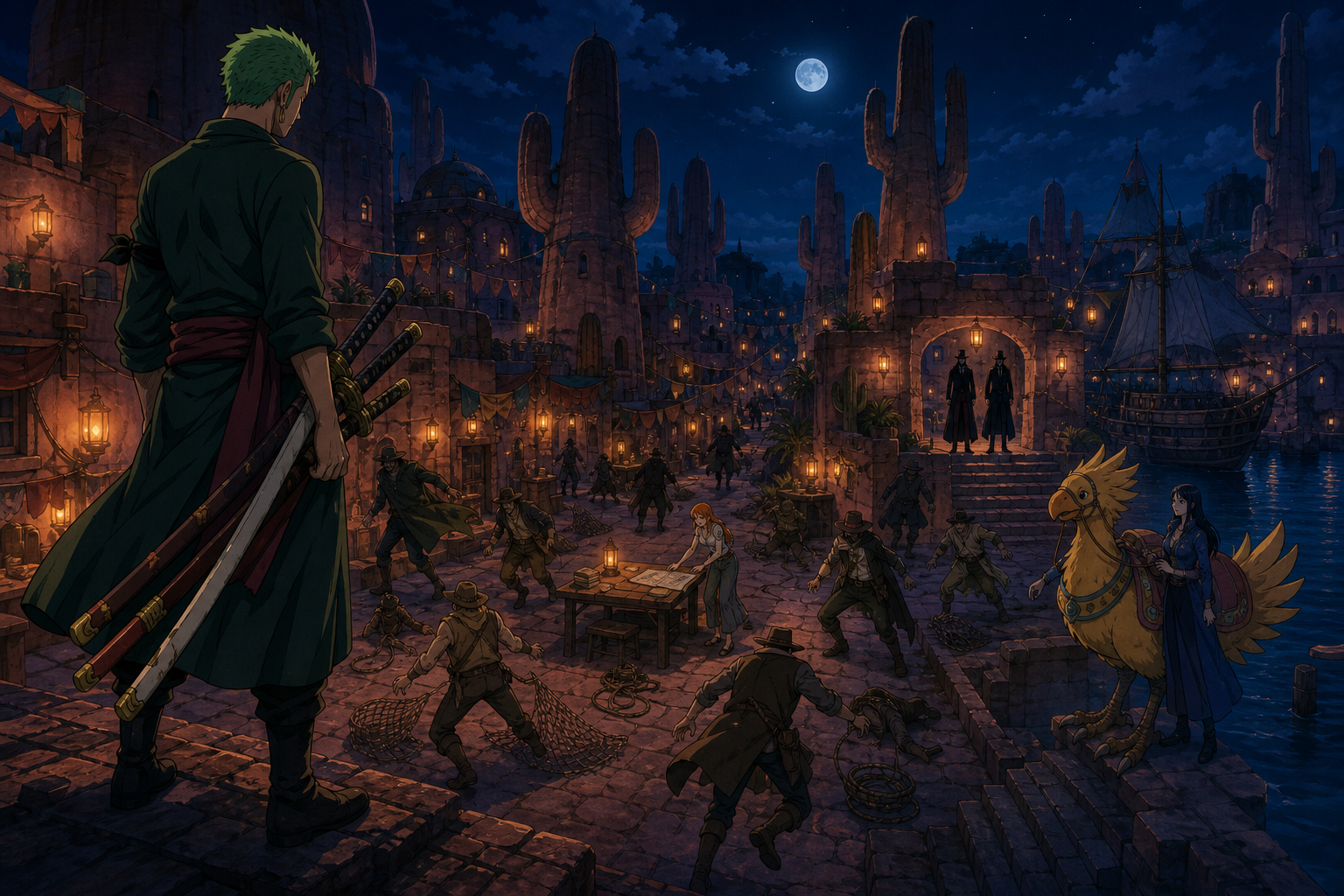
One Piece Episode 65 has Zoro dismantle Whiskey Peak’s bounty trap as Nami finds its records and Mr. 5 and Miss Valentine expose a deeper Baroque Works command structure.
Episode information
Japanese title: Sakuretsu Santoryu! Zoro vs. Baroque Works (1 Jikan SP Kouhen)
English title: Explosion of the Three-Sword Style! Zoro vs. Baroque Works
Japanese broadcast: April 15, 2001
Saga: Alabasta
Script: Michiru Shimada
Episode direction: Yoshihiro Ueda
Animation direction: Naoyoshi Yamamuro
Art: Yuri Sanami
The welcome reveals its purpose
Episode 65 confirms that Whiskey Peak’s festival was an organized capture operation. The bounty hunters waited for exhaustion, food, drink, and lowered attention before moving against the guests.
The trap works through social trust before the operation uses weapons, which makes the town’s hospitality part of the evidence.
Zoro remained alert
Zoro recognizes the threat while most of the crew is asleep or impaired. His awareness prevents the attackers from controlling every person at once.
That success supports the need for a sober watch, but one person’s vigilance should never become the permanent safety plan.
A single defender faces a coordinated town
Numbers, rooftops, alleys, nets, ranged weapons, and local knowledge give Baroque Works structural advantages. Zoro needs movement, concealment, and narrow engagement points more than dramatic direct confrontation.
The goal is preserving crew safety and an escape route, not proving he can defeat every resident.
He hides his position. The official summary emphasizes Zoro cutting through the bounty hunters while concealing himself. Uncertainty forces attackers to divide attention and reduces their ability to surround him.
Concealment should protect sleepers and civilians rather than lure conflict toward occupied buildings.
Nonlethal restraint remains the better objective. A sword can disable weapons, cut nets, block access, and force retreat without targeting vital areas. The episode’s stylized action should not erase the real risk of blades in a crowded town.
Once an attacker drops a weapon or withdraws, pursuit for punishment is unnecessary.
Identify who is actively participating. Not every person in Whiskey Peak may share the same role. Some could be organizers, paid hunters, coerced residents, service workers, or people unaware of the full plan.
Zoro should respond to observable threats instead of treating the whole population as one enemy category.
The sleepers need protection. Luffy, Usopp, Sanji, and anyone impaired cannot give meaningful consent or defend themselves reliably. Move them away from doors, keep airways clear, monitor breathing, and prevent attackers from taking them as leverage.
Do not shame them for being deceived while the emergency is active.
Food or drink exposure needs assessment. If sedation involved substances beyond ordinary alcohol or overeating, samples should be preserved and symptoms documented. Confusion, vomiting, slowed breathing, or inability to wake requires medical response.
Sanji can later help identify ingredients, but he should not be expected to assess himself while impaired.
Nami wakes with another priority
The official summary says Nami begins searching for treasure. Her response reflects survival habits, awareness of the town’s financial purpose, and her own interest in assets.
Taking valuables still needs ethical limits, even when those valuables belong to an organization that planned to traffic the crew.
Evidence is not automatically treasure. Ledgers, bounty records, payment lists, code names, maps, and communication devices may prove Baroque Works operations. Selling or scattering them could harm future accountability.
Nami should separate money or stolen property from documents needed to identify victims and organizers.
Victim property should be returned. Goods taken from captured travelers may belong to people who never reached safety. Inventory marks, names, and route information can support restitution.
The Straw Hats should not inherit everything merely because they defeated the current holders.
Zoro tests Yubashiri
The Loguetown sword enters real use against an organized threat. Testing a new blade should mean understanding balance, draw, control, and safe stopping distance rather than maximizing injury.
A weapon’s quality is measured by precision as much as force.
Sandai Kitetsu demands discipline
The cursed sword’s reputation can encourage fatalistic thinking, as though future harm belongs to the blade rather than the wielder. Zoro remains responsible for every choice.
Skill includes refusing unnecessary escalation even when a weapon feels powerful or unpredictable.
Three-sword style creates spatial risk. Multiple blades widen the movement envelope and reduce safe space around allies. In alleys or rooms, walls, lamps, ropes, and bystanders constrain technique.
Zoro must choose positions where his style does not endanger the people he is protecting.
Festival infrastructure becomes hazardous. Lanterns, fabric, tables, glass, cooking fires, and crowded balconies can turn one strike into fire or collapse. Extinguishing open flame and clearing civilians reduces secondary harm.
Baroque Works chose the terrain, so the crew should not assume the town is structurally safe.
Miss Monday enters the fight
Her strength and confidence make her a significant opponent, but her identity as a woman should not change the standards for necessary force. Zoro should use the least harm that ends the immediate threat.
Gendered mockery or sexualization has no place in evaluating her combat role.
Strength does not erase personhood. Miss Monday can be physically formidable and still exist inside an organization with coercion, hierarchy, and punishment. Defeat should lead to disarmament and questions, not humiliation.
Her knowledge may clarify how Whiskey Peak recruits and controls agents.
Zoro defeats Miss Monday
The official summary marks her defeat as part of his advance toward the town’s leadership. Once she cannot continue, the priority shifts to medical assessment and secure separation.
Do not use an unconscious or injured person as bait for other agents.
Igarappoi is Mr. 8
The mayor identity was a cover within Baroque Works. Public office, hospitality, and code-name authority were layered to make the operation appear civic rather than criminal.
Residents deserve to know whether their local government was entirely fabricated or captured by the organization.
A false mayor corrupts consent. People following Igarappoi may believe they are obeying legitimate local authority. Others may know the bounty operation well.
Investigation needs individual evidence instead of assuming every resident had equal power and information.
Zoro approaches Mr. 8. Reaching the organizer creates an opportunity to stop orders, locate captives, and uncover records. The approach also raises the risk that Mr. 8 will destroy evidence or use subordinates as cover.
Zoro should demand surrender and secure communication routes before escalating.
Miss Wednesday calls Karoo
The large riding bird is a living participant, not equipment. Calling Karoo may be an escape plan, message route, or protective response.
No one should target the animal merely to prevent human movement when safer interception exists.
Karoo needs a safe route. Lanterns, weapons, crowds, stairs, and harbor edges can cause panic or injury. Clear space and avoid loud attacks near the bird.
A rider’s urgency does not justify pushing an animal beyond safe footing.
Miss Wednesday’s role remains uncertain. She brought the crew to Whiskey Peak and now acts within the Baroque Works scene, but motive and freedom are not fully established. Her code name confirms affiliation, not the complete story.
Observe whom she protects, fears, obeys, and tries to contact before deciding what she intended.
Mr. 5 and Miss Valentine arrive
Their entrance signals authority beyond the local bounty hunters. They may represent internal discipline, mission correction, or elimination of compromised agents.
The threat structure is becoming vertical, not merely a town full of independent hunters.
Internal enforcement changes the risk. Organizations built on secrecy often punish members who fail, defect, or know too much. Mr. 8 and Miss Wednesday may face danger from their own colleagues even if they helped trap the Straw Hats.
Protection and accountability can coexist. A person can answer for harm while being shielded from execution.
Mr. 5’s abilities require distance. Unknown agents should be treated as capable of ranged or area effects until observed. Crowding him or surrounding him with civilians increases casualties.
Use cover, clear the plaza, and avoid assumptions based on ordinary weapons.
Miss Valentine controls vertical space. Her appearance should prompt attention to rooftops, open sky, falling objects, and rapid movement. A threat above can bypass street defenses.
Lookouts need assigned sectors rather than everyone staring at the same agent.
Nami’s information may become more valuable than money. Ledgers can reveal code names, targets, payments, and routes connecting Whiskey Peak to a larger network. That knowledge may protect the crew from future traps.
She should secure copies and keep originals from fire, water, or retaliating agents.
The crew needs to wake safely
Do not throw water, strike, or startle heavily impaired people near weapons. Use voice, positioning, airway checks, and gradual stimulation.
Once awake, give a concise status update before assigning tasks.
Luffy should not enter without context. If he wakes to see Zoro amid fallen townspeople, incomplete information may create conflict within the crew. Nami or another witness should explain the trap and evidence immediately.
Internal misunderstanding is exactly what Baroque Works can exploit.
Communication needs shared facts. Who attacked, what was served, where passengers went, who holds records, and which threats remain should be stated plainly. Avoid accusations unsupported by observation.
A two-minute briefing can prevent ten minutes of dangerous confusion.
Secure the Merry before the town. The ship is the crew’s exit, home, supplies, and only stable transport. Check moorings, hull, stowaways, sabotage, and access to the Log Pose.
Winning the plaza means little if Baroque Works controls the vessel.
Whiskey Peak may contain captives. A bounty hub needs holding areas, records, and transport routes. Search for people only after immediate threats are controlled, using pairs and marking cleared locations.
Provide medical aid and avoid demanding testimony before survivors are safe.
Michiru Shimada expands the conspiracy
Shimada’s script begins with a local ambush and ends with a larger organization’s enforcement agents. Zoro’s tactical success exposes more danger rather than resolving the conspiracy.
Nami’s search and Miss Wednesday’s actions keep information moving alongside combat.
Yoshihiro Ueda uses Whiskey Peak’s geography. Ueda’s direction turns rooftops, alleys, lanterns, stairways, and cactus towers into a tactical map. Zoro disappears and reappears while attackers lose the advantage of numbers.
The environment stays readable without making the action a simple line of opponents.
Naoyoshi Yamamuro distinguishes the swords. Animation direction can show weight, draw speed, reach, and recovery so Yubashiri and Sandai Kitetsu feel different without fetishizing injury. Zoro’s control matters more than impact.
Miss Monday and the bounty hunters retain physical presence rather than becoming targets on a counter.
Yuri Sanami reveals the town after the party. Warm festival color gives way to moonlit stone, discarded decorations, and watchful heights. The same streets become evidence of planning.
Whiskey Peak’s beauty and corruption remain visible together.
RaeRae’s real-time reaction
Zoro staying sober saved everybody, but I refuse to turn that into a rule where one man carries the whole crew’s safety while everyone else gets drugged or drunk. They need a real watch system.
Nami, take the ledgers before the money. Mr. 5 and Miss Valentine arriving tells me Baroque Works is more afraid of information escaping than of one failed bounty night.
The moment that lands. Zoro moves through a town that believed numbers and hospitality had already won, only to reach the fake mayor as two higher agents appear. The local trap collapses and exposes a deeper chain of command.
Victory opens the door to conspiracy.
What should happen immediately. Wake and assess the crew safely, secure the Merry and Log Pose, disarm active attackers, protect Karoo, preserve ledgers, clear civilians, and establish distance from the new agents.
Offer surrender and medical care where possible.
What accountability requires. Identify Baroque Works leadership, recruitment, coercion, bounty payments, captured travelers, false government roles, substances used at the feast, and internal punishment practices.
Return victim property and distinguish organizers from residents acting under threat. The crew should preserve ledgers, room assignments, kitchen records, weapon stores, prisoner spaces, and Den Den Mushi contacts before frightened agents scatter or senior officers destroy the trail. Witness interviews need privacy and protection from retaliation. Whiskey Peak cannot recover through one spectacular defeat; residents need a documented path out of the bounty system and a way to return stolen property without exposing victims again.
Bottom line
Episode 65 detonates Whiskey Peak’s welcome trap by showing Zoro outmaneuver the bounty hunters, test Yubashiri and Sandai Kitetsu, defeat Miss Monday, and confront the mayor revealed as Mr. 8. Nami searches the operation’s assets while Miss Wednesday calls Karoo and Mr. 5 and Miss Valentine arrive from higher in Baroque Works.
RaeRae rating: 9.3/10. The sword work is satisfying because the fight exposes structure. Preserve the evidence, protect the impaired crew and Karoo, stop treating every resident as equally guilty, and recognize that the agents entering last may be there to punish their own people as much as the Straw Hats.