
RaeRae Reacts · One Piece Episode 64
Whiskey Peak’s Welcome Trap
One Piece Episode 64 drives the Merry through chaotic Grand Line weather into Whiskey Peak, where Baroque Works turns lavish pirate hospitality into a coordinated trap.
Episode information
Japanese title: Kaizoku Kangei no Machi? Whiskey Peak Jouriku (1 Jikan SP Zenpen)
English title: A Town That Welcomes Pirates? Landing at Whiskey Peak
Japanese broadcast: April 15, 2001
Saga: Alabasta
Script: Michiru Shimada
Episode direction: Yoko Ikeda
Animation direction: Kazuo Takigawa
Art: Miyuki Sato
The Merry leaves the Twin Capes
Episode 64 sends the crew away from Crocus and Laboon with its first active Grand Line route. The emotional promise remains behind them, but navigation becomes an immediate operational problem.
Nami must translate the Log Pose and Crocus’s instructions into a shared plan before unfamiliar conditions begin changing faster than the crew can react.
Mr. 9 and Miss Wednesday come aboard
The two passengers ask for transport to Whiskey Peak. Bringing strangers onto a small ship creates questions about identity, destination, weapons, medical needs, and agreed boundaries.
Rescue or passage does not require suspicion without evidence, but passage requires basic safety procedures.
Names may be code identities. Numbered and weekday names sound deliberately impersonal. The crew should note the pattern without demanding disclosure under threat.
A safe passage agreement can specify behavior, restricted areas, and departure point even when full biographies remain private.
Passenger consent and crew consent both matter. Mr. 9 and Miss Wednesday need to know the route and risks, while every crewmate needs to understand who is aboard. One captain’s welcome affects shared sleeping, food, watch, and emergency space.
Clear expectations prevent hospitality from becoming resentment or exploitation.
The Grand Line rejects ordinary seasons
The official summary describes seasons, weather, current, and wind direction changing without familiar order. A route can move from heat to cold, calm to storm, and favorable wind to dangerous cross-current in minutes.
Past East Blue experience remains useful, but its timing assumptions are no longer reliable.
Nami needs continuous observation
Barometer, clouds, temperature, swell, current color, compass behavior, wind shift, and visibility all need logging. A written pattern may reveal local transitions even when the wider sea looks chaotic.
Someone else should record while she steers so no warning is lost.
The Log Pose is not a complete navigator. The Log Pose points toward a magnetic destination but does not choose a safe sail plan. Nami must still interpret weather, water, ship condition, and crew ability.
Treating one instrument as authority would make the voyage fragile when conditions interfere.
The crew needs storm stations. Zoro handles heavy lines, Sanji secures galley and supplies, Usopp watches rigging and repair points, Luffy follows a defined strength task, and passengers remain in assigned safe areas unless asked to help.
Roles should change only through clear calls.
Rapid heat changes create health risk. Layered clothing, shade, hydration, dry storage, and warm blankets need to remain accessible. Sweating into sudden cold can worsen exposure.
The crew should check one another for confusion, shivering, dizziness, and fatigue rather than waiting for collapse.
Changing seas strain the Merry. Wood expands, contracts, twists, and takes repeated shock under shifting temperature and wave direction. The damaged bow from Laboon makes inspection more urgent.
Usopp should track leaks, joints, mast movement, and repair material after every severe transition.
Cargo must stay low and secured. Barrels, tools, cookware, and spare timber become projectiles when the ship rolls. Moving weight can also alter steering at the worst moment.
Grand Line readiness begins below deck, not only at the helm.
The passengers may know local patterns. Mr. 9 and Miss Wednesday have traveled the route or at least know Whiskey Peak. Their information can help, but the crew should verify passenger information against conditions.
Local knowledge is valuable without becoming unquestioned command.
Information asymmetry creates vulnerability. The passengers know the destination and likely know the island’s people, while the Straw Hats know almost nothing. That imbalance is not proof of a trap, but the imbalance should shape risk management.
Nami can ask about harbor depth, local authority, supplies, medical care, customs, and known hazards before arrival.
The Merry survives the chaotic route
Reaching the island shows the crew can coordinate under Grand Line conditions. Survival should lead to inspection and rest, not immediate confidence that every future passage will work the same way.
Record what succeeded while details remain fresh.
Whiskey Peak appears cautious
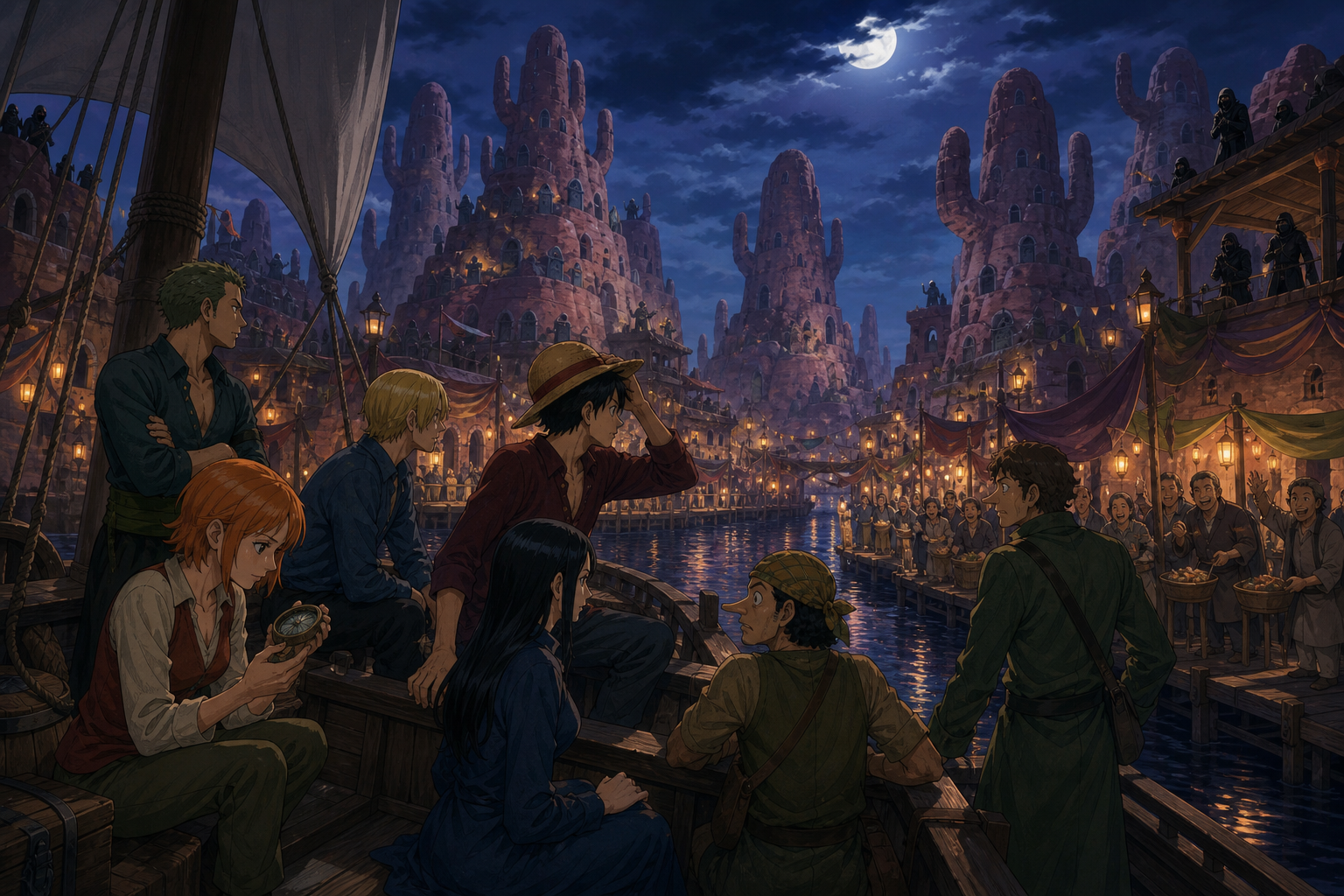
The crew approaches expecting danger because the sea itself has been unpredictable. A harbor surrounded by cactus-shaped rock formations and unfamiliar structures deserves careful entry.
Depth soundings, lookout positions, exit route, and tide should be established before docking.
The island offers an enormous welcome
Mayor Igarappoi and residents greet the Straw Hats with celebration, food, and praise. Hospitality can be genuine, strategic, coerced, or mixed.
The safest response accepts kindness without surrendering all situational awareness.
A welcome should not demand intoxication. Food and drink may be part of local custom, but guests need ingredient information and the freedom to decline. At least one crewmate should remain sober and alert.
No contest, toast, or insult should override bodily autonomy.
Food safety matters after a hard passage. Exhausted people may eat too quickly, miss allergies, or fail to notice contamination. Sanji can observe preparation, storage, water, and serving practices without accusing hosts publicly.
Shared meals should not bypass ordinary caution.
The crew needs a watch rotation. A lavish party creates the exact conditions where everyone may assume someone else is watching the ship. Assign named shifts before the first plate or drink.
Check mooring lines, access points, cargo, and the Log Pose.
The Merry must remain departure-ready. Do not unload essential supplies, remove steering parts, or allow unknown workers to begin repairs without supervision. Keep a clear route from celebration to ship.
A friendly port can become unsafe faster than an anchored vessel can be reorganized.
Igarappoi controls the public tone
A mayor leading universal enthusiasm may indicate real civic welcome or coordinated performance. The crew should note whether residents speak freely, repeat identical claims, or watch the mayor before responding.
Leadership should not be confused with independent community consent.
Flattery can be operational. Praising pirates may lower defenses, encourage drinking, and make questions feel rude. Luffy enjoys direct affection, while Usopp may respond strongly to admiration.
Nami should preserve room for skepticism without humiliating her crewmates.
Exhaustion changes judgment. Rapid weather, emergency sailing, and emotional events at the Twin Capes reduce attention. Even experienced people become more suggestible and impulsive when hungry or tired.
Rest should happen in secure pairs or shifts, not as a whole-crew collapse.
The town’s population needs scrutiny. A port able to mount a sudden festival may have unusual resources or organization. Count boats, exits, uniforms, communication signals, and who carries concealed equipment.
Observation is not permission to search residents or homes without cause.
Baroque Works has built a trap
The official summary confirms the celebration is coordinated by Baroque Works. The welcome is therefore a tactic designed to lower resistance and isolate targets.
That deception implicates organizers, but individual residents may have different levels of choice or knowledge.
A bounty operation treats people as inventory. If the town profits by capturing pirates, guests become financial units rather than people. Criminal histories can be investigated through lawful process, but ambush for payment creates its own abuses.
The Straw Hats’ bounties do not erase their right to bodily safety.
Do not assume every pirate is harmless. Critiquing the trap does not require pretending all arriving crews are safe. A legitimate port needs transparent rules, trained defense, and accountable detention procedures.
Poisoning, deceptive celebration, and collective attack are not substitutes for justice.
Mr. 9 and Miss Wednesday require new assessment
Their connection to Whiskey Peak may explain why they requested transport. The crew should determine whether they knowingly guided the Merry into danger, acted under orders, or had limited alternatives.
Question actions and evidence rather than assigning guilt from code names alone.
Nami may notice the inconsistencies first
She understands incentives, watches resources, and has survived hospitality used as control. Her caution should not be dismissed as greed or negativity.
A crew that values navigation must also value her reading of people and risk.
Zoro’s discipline becomes critical
He can tolerate celebration without losing all awareness and may recognize concealed hostility. His role is not to start a fight but to preserve a path out.
Weapons stay available yet controlled until a direct threat is confirmed.
Sanji should separate care from performance. Generous hosts can earn appreciation, but care should not create debt that prevents refusal. Sanji can respect cooks while checking whether guests are being pressured.
He must apply the same caution regardless of a host’s gender.
Usopp is vulnerable to staged admiration. Stories and praise can make him feel seen after frightening travel. That emotional need is human, not foolish.
The crew should support him without allowing strangers to isolate him or extract operational details.
Luffy reads sincerity differently. He often trusts direct emotional signals and may embrace a celebration quickly. His instincts can be insightful, but organized deception is designed to imitate sincerity.
A captain can enjoy the welcome while respecting a crewmate’s request for precautions.
The trap depends on social rules. Guests are taught not to question gifts, reject food, inspect exits, or remain armed. Baroque Works uses politeness to make self-protection seem insulting.
Healthy hospitality allows boundaries without punishment.
A safe crew challenge phrase could help. Before entering unknown ports, the Straw Hats can choose a neutral phrase meaning regroup at the ship. The phrase should not reveal suspicion or require explanation in public.
Everyone needs to know who can call the phrase and that compliance is immediate.
Evidence should be preserved. If the plot becomes visible, record substances, weapons, identities, payment documents, signals, and witness accounts. Do not contaminate food or destroy records unnecessarily.
Evidence can distinguish organizers from coerced workers later.
Michiru Shimada makes hospitality the hazard
Shimada’s script moves from openly chaotic weather into a town that appears perfectly accommodating. The sea announces danger honestly, while Whiskey Peak hides danger behind celebration.
The contrast teaches that calm conditions are not the same as safety.
Yoko Ikeda balances travel and suspicion. Ikeda’s direction gives the Grand Line enough unpredictability to exhaust the crew before slowing into lanterns, smiles, and food. Small looks and repeated gestures can seed unease without breaking the welcome too early.
The audience reads more than the tired guests do.
Kazuo Takigawa tracks physical fatigue. Animation direction shows wet clothes, bracing bodies, quick weather responses, and the release of tension on land. That fatigue explains vulnerability without making the crew incompetent.
Celebration becomes physically tempting after sustained strain.
Miyuki Sato gives Whiskey Peak two faces. Warm harbor lights and festival color sit beneath cactus-shaped stone and watchful silhouettes. The island can look welcoming and predatory in the same frame.
The environment carries the warning before dialogue confirms the threat.
RaeRae’s real-time reaction
A whole town throwing a perfect pirate welcome the minute strangers arrive is not relaxing me. I need somebody sober, somebody at the Merry, and Nami holding the Log Pose where no smiling mayor can borrow the instrument.
Mr. 9 and Miss Wednesday know more than they have said, but that still does not excuse deciding their guilt before we know what choices Baroque Works gave them.
The moment that lands. The Straw Hats survive weather with no rules and reach a town where every smile follows one plan. The Grand Line’s first island threat is not a monster or storm.
The threat is a welcome designed to make caution feel rude.
What should happen immediately. Assign a sober watch, secure the Merry and Log Pose, inspect food and drink discreetly, keep pairs together, map exits, and agree on a regroup signal.
Accept hospitality only within boundaries that leave every crewmate free to decline.
What accountability requires. Identify Baroque Works organizers, financial incentives, coercion, substances used, intended treatment of captives, and the roles of Mr. 9, Miss Wednesday, and Igarappoi. Protect residents who were forced to participate.
A bounty does not authorize trafficking or abuse.
Bottom line
Episode 64 throws the Merry through chaotic Grand Line weather with Mr. 9 and Miss Wednesday aboard, then delivers the exhausted crew to Whiskey Peak. Mayor Igarappoi and the town offer a spectacular welcome, but the hospitality is a Baroque Works trap built to convert relief into vulnerability.
RaeRae rating: 9.1/10. The island works because nothing looks wrong enough to justify panic. Keep one watch sober, protect the ship and Log Pose, respect Nami’s caution, and remember that real hospitality never punishes a guest for maintaining boundaries.