
RaeRae Reacts · One Piece Episode 66
Luffy vs. Zoro
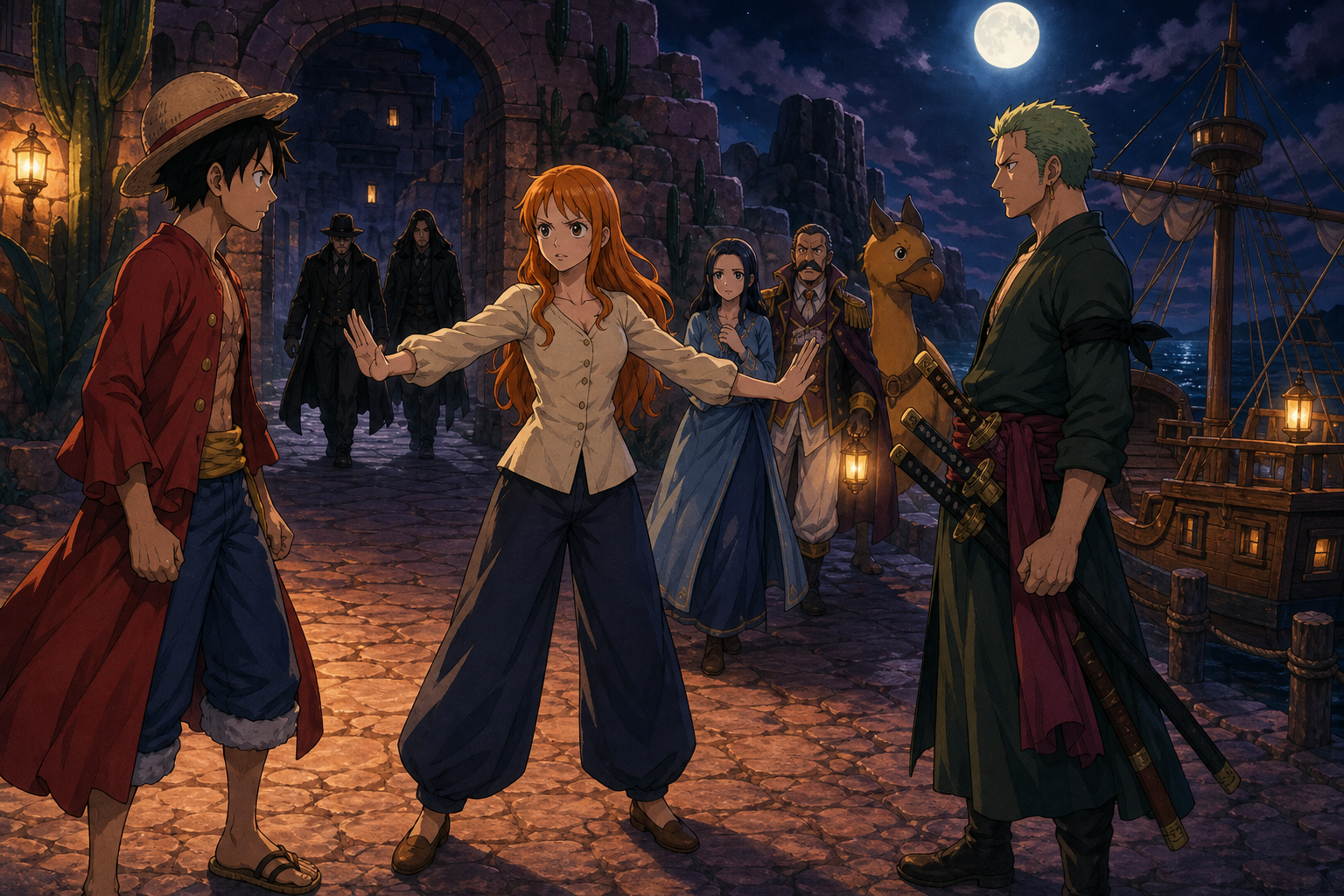
One Piece Episode 66 turns Luffy’s misunderstanding into a dangerous duel with Zoro while Igaram hires the crew to protect Vivi from Baroque Works enforcement.
Episode information
Japanese title: Shinken Shobu! Luffy vs. Zoro Nazo no Daiketto!
English title: A Serious Match! Luffy vs. Zoro in a Mysterious Duel
Japanese broadcast: April 22, 2001
Saga: Alabasta
Script: Michiru Shimada
Episode direction: Hidehiko Kadota
Animation direction: Yuji Hakamada
Art: Kunihiro Senda
Mr. 8 is Igaram
Episode 66 reveals that the false mayor is actually Igaram, captain of Alabasta’s royal guard. His Baroque Works identity placed him inside Whiskey Peak’s bounty operation while serving a different protective mission.
The reveal explains some choices, but undercover purpose does not erase harm done to travelers during the operation.
Undercover work creates divided accountability
Igaram may have infiltrated Baroque Works to protect his country and princess, yet he held authority in a town that drugged and captured pirates. Investigators need to distinguish what he ordered, tolerated, resisted, and documented.
A noble objective cannot become blanket immunity for predictable victims.
Miss Wednesday is Vivi
The young agent’s true identity connects the conflict to Alabasta’s royal family. She is not merely a passenger who knew the town. She entered a dangerous organization to uncover a threat to her country.
That context changes her risk without making every deception harmless.
Vivi needs immediate protection. Mr. 5 and Miss Valentine appear to know enough to target her and Igaram. Move Vivi away from open plazas, keep multiple exits available, and prevent public discussion of her route.
Protection should include her choices rather than placing her under new custody without consent.
Mr. 9 stands with Vivi
The official summary identifies Mr. 9 as another person who protects her. His decision may represent loyalty, conscience, friendship, or resistance to Baroque Works discipline.
He deserves evaluation based on actions, including both participation in the Whiskey Peak trap and the risk he now accepts.
Miss Monday also resists the senior agents
After fighting Zoro, she becomes part of the effort to shield Vivi. A changed choice does not undo prior harm, but the changed choice can prevent further violence and provide evidence of coercive hierarchy.
Medical care and safe surrender should remain available to her.
Baroque Works punishes compromised agents
Mr. 5 and Miss Valentine do not arrive simply to repair a failed bounty capture. Their presence suggests enforcement against people whose identities, loyalties, or information threaten the organization.
Internal execution or retaliation is abuse even when the target previously worked for the same network.
Protection and accountability can coexist. Vivi, Igaram, Mr. 9, and Miss Monday can be protected from immediate attack while their Whiskey Peak roles are investigated later. Safety is not a declaration of innocence.
This distinction prevents Baroque Works from using past complicity to justify killing defectors.
Igaram asks Zoro for an escort
The guard captain wants Vivi delivered safely to Alabasta. Zoro has demonstrated vigilance and combat ability, but an escort agreement affects the whole crew, their ship, route, supplies, and exposure.
He cannot responsibly commit everyone without collective discussion.
Nami negotiates the contract
The official summary says Nami accepts the arrangement. Her negotiation recognizes the cost and danger of transporting a royal target across the Grand Line.
Payment terms should not override the princess’s consent or turn her safety into property purchased from Igaram.
Vivi should be party to the agreement. She needs to understand route options, risks, confidentiality, authority aboard the Merry, and conditions for ending or changing the escort. An adult guard cannot make every decision for her.
Her political position increases the need for informed choice rather than reducing informed choice.
The crew needs a full threat briefing. Before departure, Igaram and Vivi should explain what Baroque Works is, how code names work, who may pursue them, and why Alabasta is in danger. Withholding key facts prevents informed consent.
Operational details can be shared without forcing Vivi to disclose trauma publicly.
Zoro honors the accepted contract. Once Nami commits the crew, Zoro places himself between Vivi and the senior agents. His action protects the immediate objective while buying time for evacuation.
The best defense creates distance and a route, not a prolonged contest in the same crowded square.
Mr. 5 and Miss Valentine remain high-risk
Their abilities can affect space, movement, and bystanders in ways ordinary weapons cannot. Clear civilians, avoid clustering, and observe triggers before committing to close combat.
Unknown power should lead to caution rather than panic.
Miss Monday is defeated again. The official summary notes the senior agents overcome her as they approach Vivi. Her loss demonstrates the power gap inside Baroque Works and the cost of defection.
Once down, she requires protection from further attack and medical evaluation.
Do not use a fallen ally as a shield. Zoro should move the fight away from Miss Monday and other injured people. Carrying someone through active danger may worsen injuries unless the current location is more dangerous.
Assign a separate evacuation role where possible.
Luffy wakes into incomplete evidence
He sees townspeople harmed and Zoro standing among the aftermath without knowing the welcome was a trap. His anger begins from a genuine belief that hospitality was betrayed.
The moral instinct matters, but acting before asking witnesses creates another emergency.
Gratitude does not cancel investigation. Luffy believes the town fed them, so attacking residents appears unforgivable. Food and warmth can be real experiences even when offered as tools of capture.
He needs to hold both facts: the meal happened, and the operation intended harm.
Luffy confronts Zoro
The title centers a serious duel between captain and swordsman. Internal violence consumes attention while the actual agents remain near Vivi.
A crew conflict should trigger separation and briefing, not escalation based on loyalty tests.
Zoro deserves a chance to explain. He stayed alert, protected sleeping crewmates, and uncovered the bounty operation. The captain should ask what happened before treating visible aftermath as proof of betrayal.
Trust is not blind agreement, but trust requires hearing a crewmate’s account.
Zoro should also de-escalate. Being right about the trap does not make every response to Luffy safe. He can lower weapons, name the threat, point to evidence, and request Nami’s corroboration.
Mockery or counterattack makes misunderstanding harder to resolve.
Weapons must remain controlled. Three swords, elastic force, damaged buildings, injured people, and active agents create unacceptable crossfire. Both men should disengage as soon as a crew mediator reaches them.
No personal dispute justifies abandoning the escort perimeter.
Nami has the clearest shared picture
She knows the town was a trap, searched its records, negotiated with Igaram, and understands the escort. Her information can resolve Luffy’s mistaken premise quickly.
The men need to stop long enough to listen.
Intervention is leadership. Nami stepping between captain and swordsman is not comic nagging. She is protecting the crew, Vivi, and mission from two powerful allies whose conflict benefits Baroque Works.
Authority in a crisis should follow accurate information and practical control.
Use a concise corrective briefing. State that the feast was a bounty trap, Zoro defended the crew, Igaram and Vivi were undercover, senior agents are attacking, and the ship must leave. Details can follow after immediate safety.
Short shared facts are more effective than arguing motives during combat.
Luffy needs to acknowledge the mistake. Stopping the duel is necessary but not sufficient. A captain who attacks a crewmate on false assumptions should apologize and identify how decisions will change.
Accountability strengthens authority because an apology shows that rank does not erase responsibility.
Zoro may need space after the apology. Trust can be injured even when physical harm is limited. He should be allowed anger and boundaries without being pressured to laugh the conflict away immediately.
Repair includes changed behavior, not only a quick return to normal.
The crew needs an evidence-first conflict rule. When one member accuses another during an external threat, pause, separate, identify witnesses, and state immediate facts before force. Any crewmate should be able to call the protocol.
This prevents enemies from exploiting staged scenes or misinformation later.
Baroque Works benefits from internal fracture. A secret organization does not need to defeat every Straw Hat if misunderstanding divides them. The duel draws two strongest defenders away from Vivi and the ship.
Information security and crew trust are therefore defensive capabilities.
The Merry needs departure preparation
Check moorings, hull, stores, Log Pose, stowaways, sabotage, and every crewmate’s condition. Whiskey Peak remains hostile even if the plaza fight pauses.
Vivi and Karoo need safe boarding positions with room for the animal.
Karoo is part of the evacuation plan. The riding bird can move quickly but should not be overloaded or forced through active explosions. Provide water, footing, and a calm handler.
Transport capacity should account for Karoo as a living passenger.
Igaram’s alternative plan needs scrutiny. A decoy route may reduce risk to Vivi, but anyone acting as decoy deserves informed consent and realistic support. Sacrifice should not be treated as the automatic duty of a guard captain.
Communication and rendezvous plans matter if the group separates.
Alabasta’s crisis is larger than one escort. A criminal network capable of infiltrating towns and pursuing royalty likely has financial, political, and military reach. Delivering Vivi home may expose the crew to a national conflict.
The Straw Hats need honest scope before accepting further missions.
Vivi carries country-level pressure. She may feel responsible for preventing civil harm, protecting Igaram, managing the crew’s risk, and proving her worth. That burden can suppress fear or exhaustion.
Give her privacy, rest, and choices not framed as tests of loyalty.
Mr. 9 and Miss Monday deserve witness protection. If they survive and cooperate, their knowledge can expose Baroque Works methods. They also face retaliation.
Secure identities and testimony without promising immunity the crew cannot grant.
Michiru Shimada builds conflict from partial truth
Shimada’s script lets Luffy’s gratitude, Zoro’s defense, Igaram’s cover, Vivi’s mission, and the agents’ enforcement collide. Each person holds part of the situation.
The danger comes from acting as though one visible fact is the whole truth.
Hidehiko Kadota keeps two battles distinct. Kadota’s direction must track Vivi’s protection and the Luffy-Zoro misunderstanding without making the senior agents disappear from the audience’s mind. Cross-cutting shows how internal conflict opens space for external danger.
The plaza becomes both escort route and failed communication zone.
Yuji Hakamada emphasizes restraint under power. Animation direction gives Luffy and Zoro enough force to make their duel alarming while avoiding graphic injury. Nami’s interruption needs equal clarity because stopping motion is the decisive action.
Vivi and the defenders remain people, not scenery behind the stars.
Kunihiro Senda gives the night political depth. Whiskey Peak’s lanterns now illuminate code identities, royal duty, and internal enforcement. Decorative celebration becomes a covert battlefield.
Shadowed arches and open routes help viewers read who is exposed and who is closing in.
RaeRae’s real-time reaction
Luffy, you do not get to attack your own crewmate because the people who fed you looked friendly. Ask one question. Look at one ledger. Listen to Nami for thirty seconds.
Zoro protecting Vivi under the contract matters, but everybody needs to stop treating Igaram’s willingness to sacrifice himself as the only honorable plan.
The moment that lands. The crew’s captain and swordsman fight while a princess, an undercover guard, defecting agents, and a criminal enforcement team stand in the same square. The duel is powerful because the duel is avoidable.
The real test is whether the crew can correct itself before Baroque Works uses the gap.
What should happen immediately. Separate Luffy and Zoro, deliver the concise briefing, protect Vivi and injured defectors, clear civilians, secure Karoo, preserve evidence, and prepare the Merry for departure.
Keep distance from Mr. 5 and Miss Valentine while observing their abilities.
What repair requires. Luffy should acknowledge the false assumption and harm, Zoro should describe his actions, Nami should share evidence, and the crew should adopt a conflict pause protocol. Do not turn the incident into a joke before trust is addressed.
Changed procedure is part of the apology.
Bottom line
Episode 66 reveals Igaram and Vivi’s Alabasta mission, shows Mr. 9 and Miss Monday risk themselves against Baroque Works enforcement, and has Nami accept an escort contract that Zoro immediately honors. Luffy wakes with partial information and turns righteous gratitude into a dangerous duel with his own crewmate.
RaeRae rating: 8.8/10. The misunderstanding is frustrating because one question could stop the fight. Protect Vivi, hear Zoro, let Nami brief the captain, and build a crew rule that prevents staged evidence from turning allies against each other again.