
RaeRae Reacts · One Piece Episode 53
The Legend Has Begun
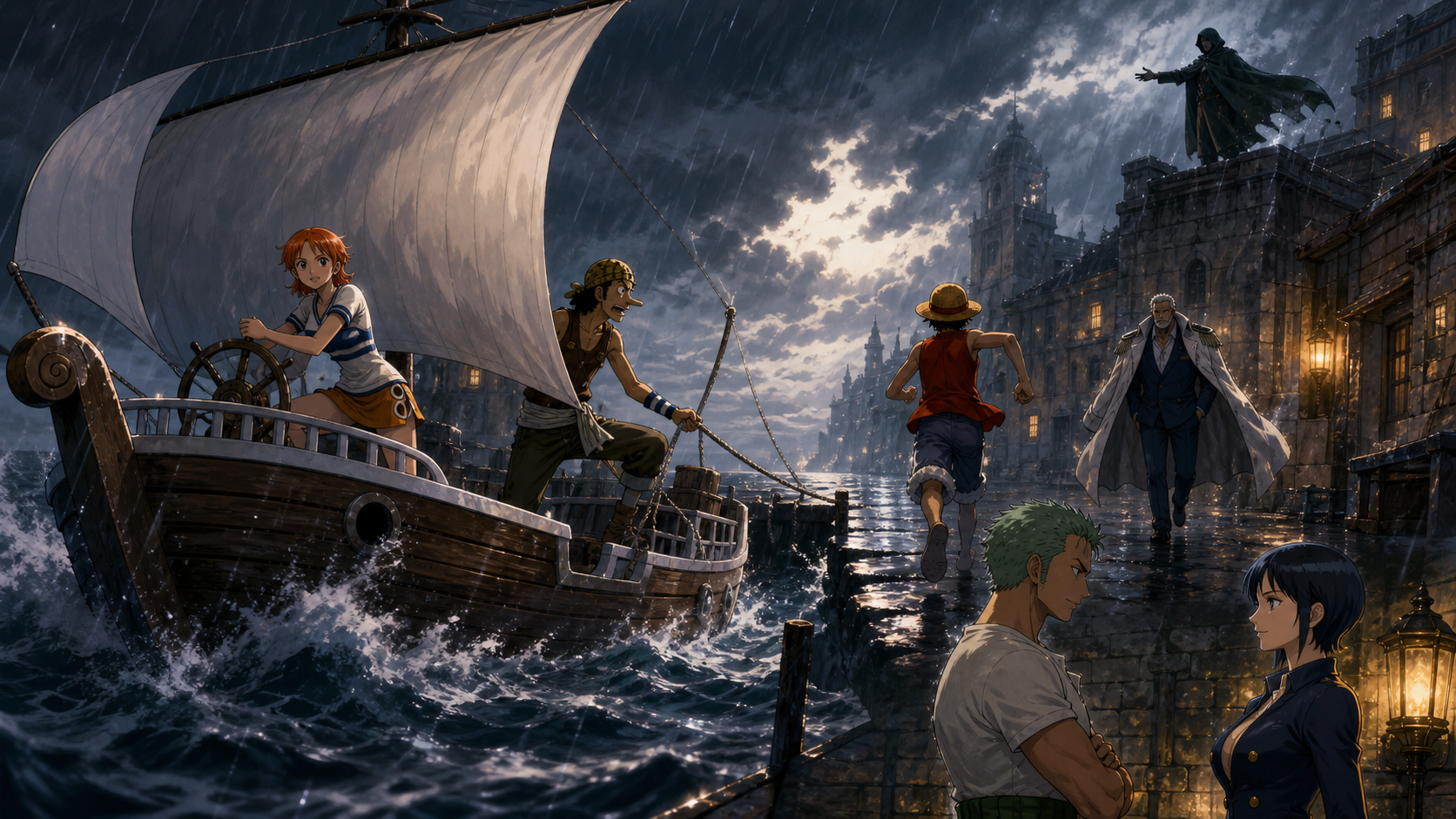
The Going Merry escapes stormy Loguetown as the crew regroups, Smoker pursues Luffy, and a hooded stranger redirects the wind
Episode information
Japanese title: Densetsu wa Hajimatta! Mezase Grand Line
English title: The Legend Has Begun! Head for the Grand Line
Japanese broadcast: January 10, 2001
Saga: East Blue
Script: Michiru Shimada
Episode direction: Yoshihiro Ueda and Masaru Koyama
Animation direction: Hideaki Maniwa
Art: Kunihiro Chida
The storm turns Loguetown into an evacuation zone
Episode 53 begins after lightning interrupted Buggy’s attempt to kill Luffy. Rain, wind, damaged structures, wet streets, scattered crews, and Marine operations now create overlapping emergencies.
Escape, arrest, rescue, and public safety cannot be managed as though the weather were decorative background.
Nami anticipated the storm
Her earlier concern about changing conditions becomes decisive. She reads the environment before most people treat the threat as urgent and returns to the Going Merry with enough time to prepare movement.
Navigation expertise includes weather judgment, and the crew needs to follow that judgment before visible danger confirms every warning.
Forecast authority should be explicit. On future voyages, Nami should have clear authority to recall shore teams, shift berth, reef sails, delay departure, or order emergency readiness when weather crosses agreed thresholds.
A warning loses value if every crewmate waits to conduct an independent test.
Usopp helps move the Going Merry
He and Nami begin getting the ship away from the harbor while other crewmates remain ashore. Launching early reduces seizure risk and positions the vessel for pickup.
An early launch also creates a dangerous separation if communication and rendezvous points are unclear.
A moving extraction platform needs defined pickup points. The ship cannot wait indefinitely in a storm or approach every section of quay safely. Shore members should know primary and alternate boarding locations, visual signals, and the last safe departure time.
Nami must be empowered to leave a collapsing berth even if the emotional pressure to wait is intense.
Buggy and Alvida are captured quickly
The lightning and storm disrupt their control, allowing Marines to contain the pirate group. Their detention removes one immediate threat to Luffy and civilians.
Capture still requires safe restraint, medical assessment after the strike, individual identification, evidence preservation, and documented custody.
Fast capture should not become rough collective punishment. Buggy, Alvida, Cabaji, Mohji, and other crew members performed different acts. Authorities should record who restrained Luffy, who raised a weapon, who assisted, and who followed or withdrew.
Affiliation informs risk without replacing individual evidence.
Smoker prioritizes Luffy
With other pirates contained, he pursues the highest-profile target moving toward escape. The decision fits the bounty and his interpretation of Luffy’s significance.
Command still needs enough personnel left behind for detainee care, storm response, and civilian safety.
A commander should not turn pursuit into personal fixation. Luffy’s smile and resemblance to Roger affect Smoker’s understanding. Those reactions may sharpen attention while distorting priorities.
Professional judgment needs explicit objectives and review when symbolism begins driving operational choices.
Tashigi confronts Zoro
She now knows the swordsman she met and helped is a pirate associated with Luffy. The discovery can feel like deception and professional failure.
Her decision to challenge him belongs to her values, not to Kuina’s memory or Zoro’s interpretation of resemblance.
Tashigi is not Kuina’s substitute. Zoro’s emotional reaction may make him hesitate or alter how he fights. Treating Tashigi differently because she resembles Kuina denies her equal recognition as an opponent and officer.
He must respond to her actual conduct while managing grief separately.
Refusing a finishing blow needs the right explanation. Not killing a defeated opponent is ethically preferable. If Zoro frames restraint as something he does because she looks like a girl from his past, Tashigi may hear condescension rather than respect.
He should state that the immediate threat is over and withdrawal is necessary, not imply that she is incapable because of gender or resemblance.
Tashigi’s anger contains legitimate concerns. She may believe Zoro stole trust, carries valuable swords unlawfully, or refuses to take her seriously. Those concerns deserve direct acknowledgment.
Anger does not make continued combat safe on a wet street during an evacuation.
Both swordspeople need a disengagement condition. Once one person can no longer continue safely, the duel should end. The victor should not use the moment for humiliation, property seizure, or personal interrogation.
A later encounter can address sword custody and legal disagreement under less chaotic conditions.
Sanji struggles against Marine numbers
His close-range skill can interrupt pursuers, but multiple officers in narrow wet streets create restraint, visibility, and civilian risks. Defeating one person does not open the entire path.
The goal is extraction, not winning control of Loguetown.
Usopp leaves the ship to assist. Returning to help Sanji shows solidarity and growing courage. The choice also reduces the crew available to support Nami at the vessel during a storm.
Before leaving, Usopp should confirm that ship handling remains safe and define exactly what intervention will allow him to return.
Distance support fits Usopp’s role. He can create distraction, protect a retreat lane, signal the ship, or disrupt obstacles without entering Sanji’s close-combat space. Clear target identification is essential around Marines and civilians.
His contribution is strongest when the intervention solves the extraction problem rather than imitates Sanji.
Smoker’s weapon neutralizes Luffy. The officer’s seastone-tipped jitte can weaken a Devil Fruit user on contact. Luffy’s usual elasticity does not solve the encounter, and the weapon gives Smoker a specialized control advantage.
Use should remain proportionate. Neutralization is not permission for unnecessary injury once resistance stops.
Luffy cannot improvise past every constraint. His earlier escapes relied on mobility, surprise, resilience, or extraordinary interruption. Smoker brings preparation built specifically around Devil Fruit capabilities.
The crew needs to learn that category-specific countermeasures exist and plan rescue methods that do not depend on Luffy’s powers functioning.
Smoker gains physical control. Once Luffy is pinned or unable to move effectively, the immediate situation becomes custody rather than an equal fight. Airway, circulation, weather exposure, and safe transfer matter.
Officers should communicate arrest grounds and avoid pressure beyond what containment requires.
A hooded stranger intervenes
An unidentified figure stops Smoker from completing the capture and appears connected to the extraordinary wind that follows. At this point, observed action is stronger evidence than any full explanation of identity or power.
The crew benefits without having requested, understood, or agreed to the intervention.
Assistance from an unknown person creates uncertainty. The stranger may share an objective, oppose Smoker, protect Luffy, exploit the storm, or pursue a separate plan. Help in one moment does not establish trust or future allegiance.
Luffy should accept the escape opportunity without disclosing unnecessary crew information.
Smoker recognizes the intervention. His response suggests knowledge or significance beyond an anonymous civilian. That reaction is evidence about Smoker’s awareness, not a complete public explanation.
Later retellings should distinguish what witnesses saw from what specific people may know.
The wind changes the operational map
Strong crosswinds disrupt lines, visibility, balance, projectiles, sails, and communication. The same force that opens an escape path can capsize small craft or injure people on roofs and piers.
Nami must decide how to use the wind without surrendering control of the ship.
Sail handling becomes life safety. Too much canvas can overpower the Going Merry, while too little may leave the ship trapped near structures. Lines, rigging, mast load, heading, and crew position need constant adjustment.
Everyone aboard should clip or brace safely and keep hands clear of loaded rope.
The crew boards under pressure
Extraction is not complete when a person reaches the quay. Timing the approach, securing lines, crossing a gap, checking injuries, and clearing the harbor all matter.
No one should jump blindly because dramatic departure music has started.
A head count is mandatory. Nami, Usopp, Sanji, Zoro, and Luffy must all be physically confirmed. Provisions, swords, tools, and food come after people.
If someone is missing, the captain and navigator need an agreed decision process that does not destroy the ship and remaining crew in an impossible rescue.
Loguetown leaves several unresolved obligations. Tashigi’s glasses and encounter with Zoro, shop purchases, Marine records, platform damage, contest cleanup, and civilian impacts do not vanish because the pirates escape.
The crew should record outstanding obligations and what risks may follow into later ports.
Departure is not proof that every choice was good. They survive the platform, Smoker, storm, and fragmented errands. Extraordinary luck and outside help cover several planning failures.
A successful escape should trigger a serious debrief rather than validate the process.
The barrel ritual brings the crew back together
Once at sea, each member places a foot on a barrel and states the dream guiding the voyage. The gesture creates a shared record of individual purpose.
The crew is not united because everyone wants the same outcome. They commit to protecting different futures inside one journey.
Luffy names the Pirate King goal
His dream sets the voyage’s scale and exposes everyone to public conflict. Luffy’s dream should not automatically outrank the others because he is captain.
Leadership means creating conditions where crew dreams can survive alongside his.
Zoro names the world’s greatest swordsman
His promise carries Kuina’s memory and his own chosen path. The encounter with Tashigi shows that grief, gender, weapons, and professional rivals will complicate that pursuit.
Greatness should include judgment about when not to fight.
Nami names mapping the world
Her dream reclaims cartography from Arlong’s coercion. The maps ahead can now emerge through chosen travel, authorship, and shared safety.
The crew should respect ownership, storage, copying, and credit for her work.
Usopp names becoming a brave warrior of the sea
His Loguetown encounter with Daddy showed that bravery is not a bounty claim or inherited reputation. Bravery grows through honest action while fear remains present.
The dream can guide practice without demanding constant reckless proof.
Sanji names finding the All Blue
His culinary dream connects geography, ecosystems, ingredients, feeding people, and professional craft. Episode 51 showed that competition is only one part of that identity.
Provisioning the crew keeps the dream grounded in daily responsibility.
The ritual needs practical follow-through. Dreams should shape route priorities, training, resource allocation, rest, safety thresholds, and conflict decisions. Repeating them without operational support would turn commitment into decoration.
The crew can revisit the agreement when circumstances or goals change.
The Grand Line transition changes risk categories. Weather, navigation, currents, opponents, institutions, supplies, and communication may operate beyond East Blue expectations. Prior success is not a reliable model for every new condition.
Preparation should include humility about unknowns.
Michiru Shimada closes East Blue through distributed action. Shimada’s script gives Nami, Usopp, Sanji, Zoro, Luffy, Tashigi, Smoker, Marines, detained pirates, and the stranger active roles. Escape belongs to no single finishing move.
The barrel scene then converts scattered survival into shared direction.
Yoshihiro Ueda and Masaru Koyama maintain multiple routes. The direction tracks ship, quay, streets, duels, pursuit, rooftop, and harbor without losing the extraction objective. Characters repeatedly change roles as conditions shift.
The storm links separate spaces into one emergency system.
Hideaki Maniwa gives wind physical consequence. Clothing, rain, ropes, bodies, mist, sails, and debris respond differently to the same force. The intervention feels powerful because the wind alters every surface.
Character movement remains readable inside the weather.
Kunihiro Chida makes departure feel earned. Dark stone, harbor lights, moving water, city scale, and open sea contrast the enclosed pursuit with the route ahead. Loguetown remains a real place after the ship clears the harbor.
The horizon offers possibility without pretending the storm is over everywhere.
RaeRae’s real-time reaction. Nami was right about the weather, and this is why the navigator needs recall authority before the rest of the crew can personally see the storm. She and Usopp getting Merry into position save minutes nobody ashore has.
The hooded stranger helps Luffy, but I am not turning one intervention into instant trust or a complete theory. Take the opening, remember what happened, and keep moving.
The moment that lands. Five feet meet on one barrel and five dreams are spoken after a day when the crew could barely find one another. The ritual is simple because the meaning has already been earned through distinct choices.
They enter the next sea together without becoming interchangeable.
What the crew should do after clearing the harbor. Conduct a head-to-toe injury check, dry and secure equipment, inspect sails and rigging, inventory provisions, document the unknown intervention, and record all Marine contacts. Rest before making complex navigation decisions when possible.
Debrief the split-up plan, platform capture, storm recall, ship extraction, and boarding. Assign concrete changes before the next port.
What the Marines should review. Detention care, platform access, lightning response, civilian evacuation, Smoker’s pursuit priorities, Tashigi’s contact, the stranger’s intervention, and storm-related injuries all need documentation.
An unsuccessful capture does not excuse abandoning transparent review.
Bottom line
Episode 53 turns Loguetown’s storm into the crew’s final East Blue test. Nami launches the Merry, Usopp divides ship and shore duties, Sanji clears pursuit, Zoro faces Tashigi, Smoker neutralizes Luffy, and an unidentified hooded figure opens an escape route through wind.
RaeRae rating: 9.7/10. The legend begins through distributed work, outside help, and a barrel carrying five distinct dreams. Reaching the Grand Line is not proof that the crew is ready. The declaration is their commitment to become ready together.