
RaeRae Reacts · One Piece Episode 52
The Man Who Smiles at the Platform
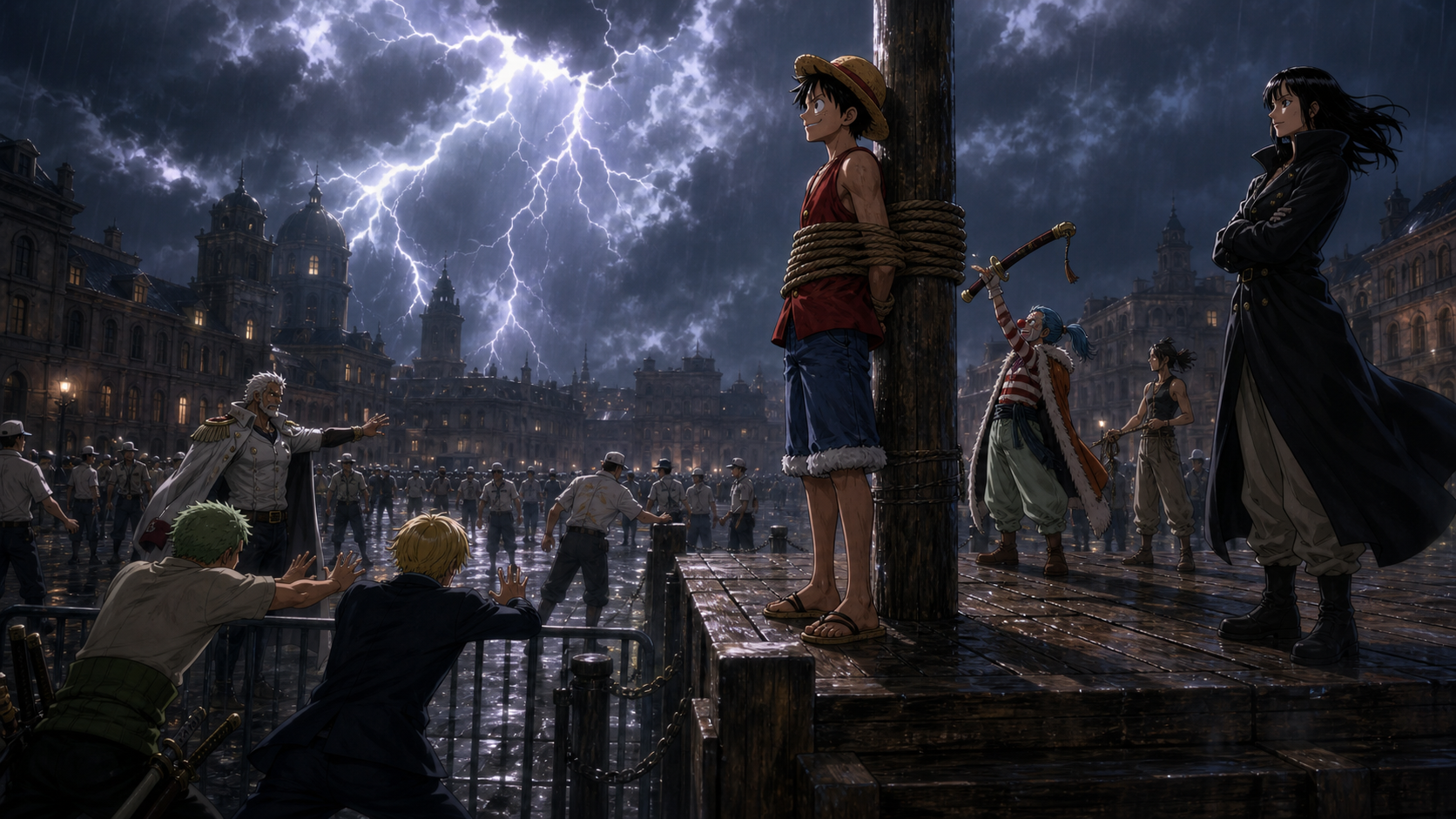
Luffy smiles while restrained on Loguetown’s platform as Buggy raises a sword, rescuers arrive, and lightning fills the sky
Episode information
Japanese title: Buggy no Revenge! Shokeidai de Warau Otoko!
English title: Buggy’s Revenge! The Man Who Smiles on the Execution Platform!
Japanese broadcast: December 13, 2000
Saga: East Blue
Script: Michiru Shimada
Episode direction: Munehisa Sakai
Animation direction: Kazuya Hisada
Art: Miyuki Sato
Luffy finally reaches Roger’s last view
Episode 52 places Luffy on the execution platform he sought across Loguetown. He looks over the square from the position where Gold Roger faced death and sees the city through a deliberately historical frame.
The visit gives him emotional proximity to a predecessor, but the exposed landmark also leaves him vulnerable while his bounty circulates.
The platform converts visibility into vulnerability. Height makes Luffy easy to identify, isolates him from exits, and concentrates attention below. Once opponents control the stairs and structure, the symbolic destination becomes a trap.
Historical sites can shape behavior in the present, especially when visitors mistake meaning for safety.
Buggy and Alvida arrive through a revenge alliance
Both pirates connect Luffy to prior defeat and humiliation. Their shared target allows rapid cooperation without evidence that their goals, command styles, or crew obligations align beyond the moment.
A common enemy can coordinate action while hiding conflicts that will emerge later.
Revenge does not create lawful authority. Buggy may believe Luffy harmed him and deserves punishment. He has no legitimate process for detention, evidence, defense, judgment, or appeal.
Taking control of a public execution platform does not transform private retaliation into justice.
Alvida’s participation should remain her own conduct. Her alliance with Buggy cannot be explained only through appearance changes or attachment to Luffy. She chooses to assist an armed seizure and attempted killing.
Accountability should focus on those actions without sexualized framing or assumptions that a woman ally is decorative.
Cabaji restrains Luffy
Physical restraint removes Luffy’s ability to leave, defend himself, or meaningfully negotiate. The rope and platform position create a serious airway, circulation, fall, and panic risk even before any weapon is used.
Someone should monitor breathing and avoid compression around the neck or chest. Buggy’s crew shows no such care because harm is the objective.
Restraint is not consent
Luffy may stop struggling or accept that escape appears impossible. Neither calm nor resignation grants permission to kill him.
Consent must be voluntary, informed, specific, and revocable. A captive’s demeanor cannot legalize an attack.
Buggy turns a historical death into personal theater. He wants to repeat the platform’s purpose with himself as the person controlling the spectacle. The act borrows Roger’s symbolic weight to make revenge feel larger.
Public performance does not reduce responsibility for attempted killing. The spectacle increases risk by attracting a crowd and encouraging imitation.
The square becomes a hostage environment
Residents, shoppers, travelers, Marines, and pirates gather around an unstable confrontation under worsening weather. Every extra observer complicates rescue and evacuation.
The first public-safety step is moving civilians away, not preserving a good view.
Smoker surrounds the pirates
The Marine plan appears to allow the rival crews to gather before containment. Waiting can reduce scattered pursuit, but the delay also permits Luffy’s immediate danger to escalate.
Commanders must continually reassess whether a broader capture objective remains acceptable when a person faces imminent death.
Police containment does not justify delayed rescue. Luffy is wanted, yet Marines still have a duty to prevent an unlawful killing when intervention is feasible. Saving him does not dismiss the warrant.
Custody can follow rescue. Death cannot be reversed for later processing.
Smoker needs simultaneous teams. One unit should evacuate civilians, one secure platform access, one negotiate or interrupt the execution, one contain surrounding pirates, and one preserve medical access.
A single ring around the square cannot perform every function well.
Weather changes the tactical plan
Rain, wind, lightning, slick wood, poor visibility, metal equipment, and crowd panic create hazards independent of the pirates. An elevated wooden structure becomes especially dangerous during a storm.
Continuing a static perimeter without weather adaptation exposes Marines and civilians to preventable harm.
The platform should have been closed. Once lightning risk becomes visible, authorities should clear elevated structures and open squares. Historic value does not outweigh immediate life safety.
Emergency closure could also have prevented Luffy’s initial climb and Buggy’s occupation.
Zoro and Sanji move toward Luffy
They recognize the immediate threat and attempt a direct rescue. Their commitment is not in question, but distance, barriers, opponents, and timing limit what effort can accomplish.
Care without access still needs coordination and alternate methods.
Running toward the platform can worsen congestion. If both crewmates choose the same blocked route, they may create one rescue attempt with no backup. One could seek an alternate ascent, distract Cabaji, coordinate with Marines, or secure an extraction path.
Parallel roles improve the chance that one action changes the situation.
Zoro’s new swords increase crowd risk. Drawing blades in a packed, wet square can injure bystanders even if every attack targets an opponent. He needs space, control, and awareness of the barrier around him.
New equipment does not remove the obligation to choose where each blade is used.
Sanji can support rescue without reaching Buggy. He may clear an access point, catch a falling person, move civilians, or disrupt the platform structure only if collapse can be controlled. Reaching the blade is not the sole meaningful task.
Rescue success depends on the whole path from release to safe ground.
Luffy smiles when escape appears impossible
His expression shocks people because the smile resembles accounts of Roger’s final composure. Luffy does not beg, perform regret, or abandon his dream in the last visible second.
The smile communicates relationship to fear and choice, not a desire to die.
Acceptance is different from suicidality. A person can recognize an immediate threat, remain calm, and still want rescue. Observers should not use serenity as a reason to stop intervening.
Afterward, the crew should ask Luffy what he experienced rather than assign one psychological meaning to his face.
Smoker recognizes the Roger parallel
The expression connects present pursuit to the city’s defining historical memory. For Smoker, that resemblance may signal dangerous charisma, unusual resolve, or a pattern he does not fully understand.
Symbolic recognition should not replace evidence about Luffy’s actual conduct.
Witnesses may mythologize the moment immediately. A crowd can transform a near death into stories about destiny, fearlessness, divine selection, or Pirate King succession. Each retelling may omit restraint, rescue failure, Marine delay, and weather hazards.
Accurate documentation should preserve what people saw and what remains uncertain.
Buggy raises the weapon
The final motion makes intent unmistakable. This is not an ambiguous threat meant only to frighten Luffy. Buggy attempts to complete the killing in public.
Intervention thresholds are fully met. Waiting for further proof would be indefensible.
The lightning interrupts the execution
A strike hits at the critical moment, preventing the blade from completing its path and damaging the platform. The timing is extraordinary.
Survival does not prove why the lightning occurred. Weather, chance, narrative symbolism, or forces not yet understood remain possible interpretations.
Do not convert coincidence into a safety plan. The crew cannot assume storms will rescue Luffy from future traps. The lesson should be that route planning, communication, and earlier intervention failed.
Miraculous timing is not an operational control.
Lightning creates its own medical emergency
Anyone near the strike needs assessment for burns, cardiac effects, hearing injury, confusion, falls, and secondary trauma even if no wound is obvious.
Metal weapons and wet surfaces should not be handled until the area is safe.
Damaged wood may collapse after the strike. Fire, splinters, loosened joints, and electrical effects can compromise the platform. Rescuers should not crowd the structure or assume one stable-looking beam can carry multiple people.
Controlled descent and fire suppression matter immediately.
Luffy still needs release. Preventing the killing does not automatically remove restraints or secure an escape route. Cabaji, Buggy, Alvida, Marines, and structural hazards remain nearby.
The rescue objective must continue until Luffy reaches safe ground and receives assessment.
Buggy also needs medical care and custody. The lightning interruption does not authorize the crowd or Marines to ignore injuries because he caused the crisis. Care can occur under secure guard.
Humane treatment strengthens accountability by preserving the suspect and evidence for process.
Alvida and the crew need individual assessment. Presence at the platform supports investigation, but each person’s actions, intent, weapons, restraint role, and response to commands should be documented separately.
Collective affiliation should not erase individual evidence.
The Marines need an after-action review
Why was the platform accessible? When was Luffy identified? Who authorized delayed intervention? How was the storm monitored? Why did the rescue threshold not trigger sooner?
The goal is to improve future response, not assign all blame to the nearest junior officer.
The city needs crowd communication. Residents should receive clear evacuation directions, shelter locations, hazard boundaries, and later factual updates. Silence invites rumor and return to an unstable site.
Officials should separate confirmed events from claims about fate or motive.
The crew needs to review its split-up plan. Three episodes of errands left Luffy isolated at the city’s most predictable target. The fallback plan did not produce timely support.
Future shore visits need check-in times, communication tools, buddy assignments for high-risk members, and authority to abandon errands when threat levels rise.
Luffy needs accountability without victim blame. He chose to climb and made himself easy to locate. Buggy, Alvida, Cabaji, and others remain responsible for capture and attempted killing.
Risky conduct can be discussed without suggesting the victim caused another person’s violence.
Zoro and Sanji need space to process failure. They tried to reach Luffy and believed they would not arrive in time. Relief after the interruption may coexist with guilt, anger, or fear.
A useful debrief identifies barriers and new roles rather than demanding that they prove loyalty through harsher self-judgment.
Michiru Shimada builds a public ritual of danger. Shimada’s script layers Roger’s memory, Luffy’s smile, Buggy’s revenge, Marine containment, crew rescue, and weather into one square. Every group assigns the platform a different purpose.
The climax works because symbolic repetition and immediate logistics remain inseparable.
Munehisa Sakai uses vertical distance as suspense. Sakai’s direction keeps Luffy above the people trying to reach him. The height makes each second of blocked movement visible.
Storm clouds and the raised weapon create converging lines without showing graphic impact.
Kazuya Hisada makes stillness compete with panic. The animation direction contrasts Luffy’s smile with Zoro and Sanji’s urgent movement, Buggy’s theatrical force, and the Marine perimeter. Calm becomes visually louder because everything around Luffy accelerates.
The lightning breaks that pattern in one overwhelming change.
Miyuki Sato turns weather into civic scale. Wet stone, dark architecture, open square, elevated wood, and distributed responders make the storm feel larger than one duel. The entire city is exposed.
The platform’s history does not protect the structure from material danger.
RaeRae’s real-time reaction
Luffy smiling when he thinks he is out of time lands because he does not let Buggy control the meaning of his final expression. That still does not mean anyone gets to stop trying to save him.
Smoker waiting to close the net while a captive is seconds from being killed is the operational problem I cannot ignore. Arrest him after you stop the unlawful execution.
The moment that lands
The blade begins to descend, Zoro and Sanji know they are late, Luffy smiles, and lightning tears through the scene. Several explanations rush in at once.
The honest response is to preserve the wonder and the uncertainty. Survival happened; causation is not yet settled.
What should happen immediately. Stop the attack, release Luffy, clear the platform, establish a lightning-safe exclusion zone, assess everyone near the strike, extinguish fire, and stabilize damaged structure.
Separate suspects, preserve ropes and weapons as evidence, identify witnesses, and maintain medical access. Keep civilians under shelter until the storm and arrest operation are controlled.
What the Straw Hats should do next. Regroup, count everyone, share Marine sightings, check injuries, secure provisions and new equipment, and decide whether the ship can depart safely. Luffy should describe the capture sequence while memory is fresh.
Revise shore protocols before the next port. Do not let relief erase the preventable failures that preceded the lightning.
Bottom line
Episode 52 turns Roger’s execution platform into the site of Buggy’s unlawful revenge spectacle. Cabaji restrains Luffy, Alvida supports the alliance, Marines surround the square, and Zoro and Sanji cannot reach their captain before the weapon falls. Luffy’s smile echoes Roger, while lightning interrupts the killing without explaining itself.
RaeRae rating: 9.8/10. The moment feels like fate, but survival still exposes human decisions. Calm is not consent, a bounty does not suspend rescue duties, and extraordinary luck must never become the crew’s next safety plan.