
RaeRae Reacts · One Piece Episode 54
The Mysterious Girl Apis
One Piece Episode 54 begins the Warship Island detour through Apis’s escape, child-safe rescue, privacy, cautious trust, and a verified plan to return her home.
Episode information
Japanese title: Aratanaru Bouken no Yokan! Nazo no Shoujo Apis
English title: A New Adventure Begins! The Mysterious Girl Apis
Japanese broadcast: January 17, 2001
Saga: East Blue
Script: Junki Takegami
Episode direction: Kounosuke Uda
Animation direction: Kenji Yokoyama
Art: Tomoko Yoshida
Apis uses the storm to escape Marine custody
Episode 54 begins by showing that the Loguetown storm affected more than the Straw Hats. A young girl named Apis takes advantage of the chaos to flee a Marine ship.
Her decision suggests that remaining aboard felt more dangerous than entering severe weather. That context should trigger concern about custody conditions without forcing an immediate conclusion about every Marine involved.
A child fleeing custody needs independent safeguarding
The first questions are whether Apis was lawfully held, who authorized the detention, whether a guardian knew, what treatment occurred, and what immediate danger she feared. The people who detained her should not be the only source of answers.
An independent advocate or trusted local adult would help protect her interests during any later process.
Escape does not make the sea safe. Storm cover may reduce pursuit while creating drowning, exposure, debris, lightning, and navigation hazards. Apis appears to accept those risks because she sees no safer option.
That does not make her responsible for institutional failures that placed her in the choice.
The weather clears for the Straw Hats. After the Loguetown crisis, calm water creates a sharp emotional reset. The crew can assess damage, dry supplies, treat injuries, and orient toward the Grand Line.
Clear skies should not lead them to assume that every person carried by the storm reached safety.
Usopp sees the flock first
His attention to distant movement identifies a large group of birds. Observation is one of his strongest practical skills, especially when unusual wildlife can signal fish, land, weather, or a person in distress.
The sighting should be reported before anyone acts on an assumption about what lies beneath the flock.
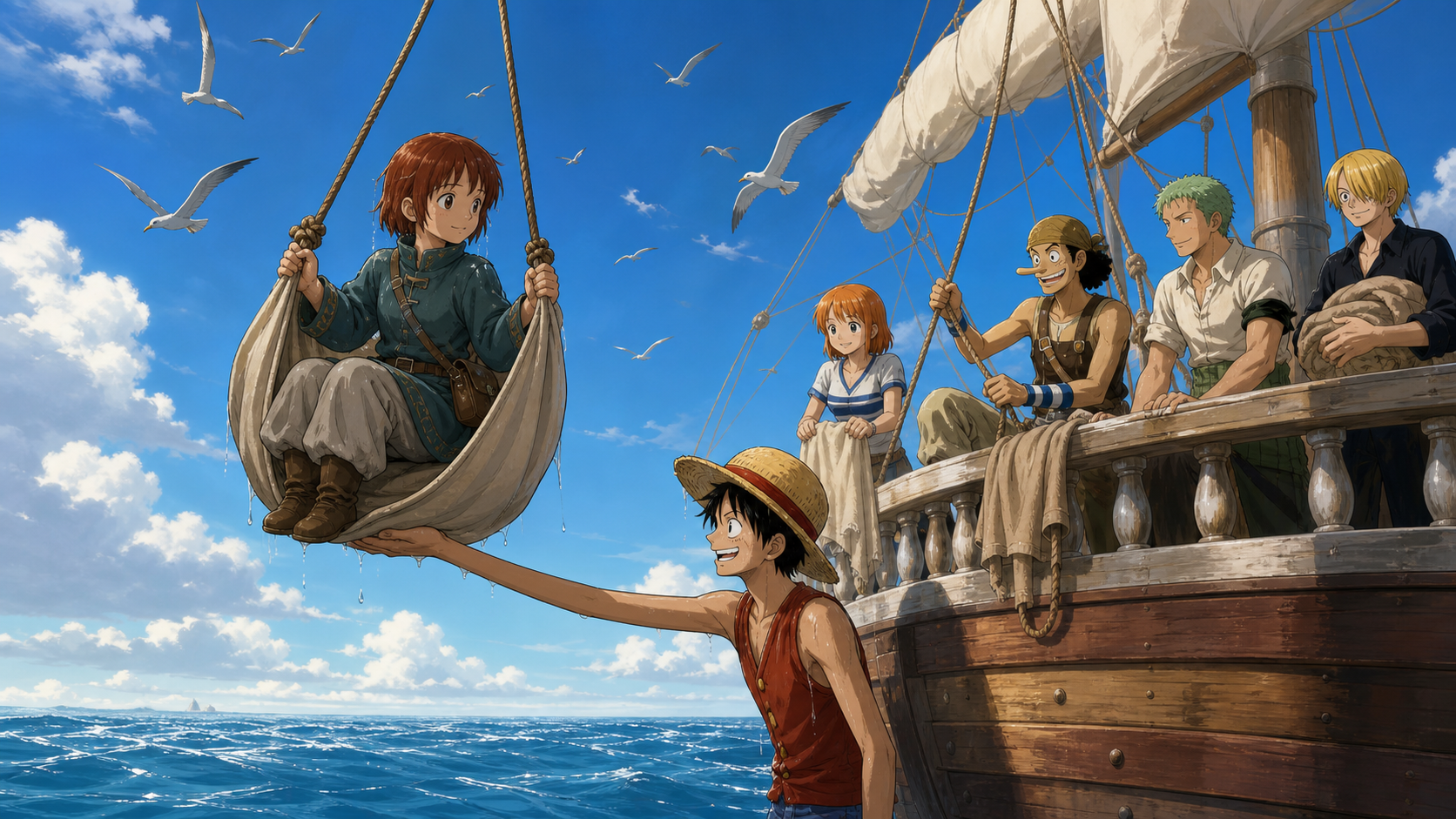
Luffy expects fish and reaches out
His appetite turns the flock into a promise of food. Extending an arm toward an uncertain target is fast, but the reach bypasses identification and safe lifting.
What he catches is Apis, proving how easily a rescue can begin as a mistaken action rather than a planned response.
A person is not cargo
Once Luffy realizes he has a child rather than fish, support needs to shift immediately from grasping to safe recovery. A sling, line, coordinated lift, and clear landing area reduce falls and compression.
Rescuers should announce what they are doing and ask for cooperation when the person can respond.
The flock may have been supporting Apis. The birds’ proximity could indicate unusual trust, guidance, communication, or simple environmental coincidence. The crew should observe without chasing, grabbing, or frightening them.
Wildlife behavior is evidence to document, not a license to capture animals for explanation.
Apis needs a medical assessment. Storm exposure and time at sea create risks of hypothermia, dehydration, salt ingestion, exhaustion, bruising, and delayed breathing problems. A child may minimize symptoms because she fears being returned.
Warm dry clothing, blankets, fluids, food, rest, and privacy should come before interrogation.
Wet clothing requires privacy and consent. If garments need changing, Apis should receive a private enclosed space, dry options, and control over who assists. No crew member should remain present unnecessarily.
The rescue must avoid turning vulnerability into spectacle.
Food should be offered carefully. After exposure, small portions, water, and information about ingredients are safer than pressuring Apis into a large meal. Ask about allergies, restrictions, illness, and nausea.
Sanji can provide care without making acceptance of food a condition for trust.
Apis initially fears pirates
Her hesitation is reasonable. She has escaped one armed institution and been lifted onto an unfamiliar pirate ship whose captain has a bounty.
The crew should not demand gratitude or treat fear as an insult after rescue.
Trust should grow through predictable conduct. Explain names, ship roles, location, immediate plan, available food, sleeping space, and who will respect her privacy. Follow through on small promises.
A child is more likely to feel safe when adults behave consistently than when they insist they are good people.
Luffy’s informality can reduce pressure. He does not conduct an official interrogation or present rescue as a debt. His direct acceptance may help Apis relax.
Informality still needs boundaries. Curiosity about her escape cannot override the right to pause, rest, or decline details.
Nami should lead safeguarding logistics. As navigator and an adult woman who survived childhood coercion, Nami may be best positioned to offer privacy and explain options. That history does not obligate her to absorb all emotional labor.
The whole crew shares responsibility for safe conduct.
No one should question Apis alone behind a closed door. Important disclosures should occur with a support person she chooses, clear notes, and no threats or promises that cannot be kept. Repeated retelling can increase stress and distort memory.
Ask only what is necessary for immediate safety and route planning.
The crew needs to know whether pursuit continues. A Marine ship may be searching for Apis. That possibility affects the Going Merry, nearby vessels, and any island they approach.
Operational questions can be asked gently: what ship, how long ago, what direction, visible markings, and whether anyone mentioned a destination.
Information should be compartmentalized. Not every crew member needs every personal detail. Navigation facts, medical needs, custody concerns, and private disclosures can be separated.
Limiting unnecessary sharing protects Apis if someone is later captured or questioned.
Apis asks to return to Warship Island
Home may offer family, familiar adults, language, shelter, and community. Her request deserves serious weight.
Returning a child to a named place is not automatically safe. The crew should ask who she expects there, whether the Marines know the location, and what danger may follow.
Home and safety are related but not identical. A child can love home while threats exist there. Conversely, withholding return because adults feel uncertain can reproduce the loss of control she escaped.
The task is to gather enough information to support her choice without pretending perfect certainty is available.
Verify the island route
Nami should confirm bearings, currents, charts, weather, fuel, provisions, and alternate shelters. Apis may know local landmarks while lacking formal navigation knowledge.
Her directions should be treated as valuable evidence and cross-checked for safety, not dismissed because of age.
The detour affects every crewmate
Changing course delays the Grand Line and may expose the ship to pursuit. Luffy can make an urgent rescue decision as captain, but he should hear Nami’s risk assessment and crew concerns.
Shared risk deserves shared information even when the moral reason to help is strong.
Helping is not ownership of the outcome. Delivering Apis home does not give the crew authority over her future, community, belongings, knowledge, or relationships. They are transport and temporary caregivers.
Any further mission should require new information and renewed consent.
The crew should not publicize Apis. Her name, route, image, abilities, and home could help pursuers. Stories about rescuing a mysterious girl may sound heroic while exposing her.
No one should use the encounter to enhance Luffy’s reputation or Usopp’s legends.
Usopp’s storytelling needs a boundary. He may want to frame the birds, storm, and rescue as a grand adventure. Apis’s experience belongs to her, especially details about custody or fear.
He can describe his own actions without claiming or embellishing her private history.
Sanji must keep care age-appropriate. Hospitality should focus on food, warmth, and safety. Compliments, service, and conversation need to remain appropriate for a child.
The project image and editorial framing should never sexualize Apis or use wet clothing as visual spectacle.
Zoro should secure weapons. A frightened child moving around an unfamiliar ship should not encounter loose swords. Zoro’s three blades need stable storage that remains inaccessible without supervision.
Safety around weapons is part of creating a predictable environment.
The ship needs a private sleeping arrangement
Apis should have a secure area with a door or screen, dry bedding, easy access to sanitation, and a way to call for help. Crew members should knock and announce themselves.
Watch schedules must not leave her alone with someone she does not trust.
A safeguarding plan needs one accountable lead
The crew can designate a primary contact and a backup, with Apis able to request a change. Everyone should know rules about privacy, touching, questioning, photographs, and disclosure.
Good intentions become safer when translated into shared behavior.
Marine custody requires careful interpretation
The institution contains people with different motives and standards. Apis’s escape suggests a serious problem in this case without proving every Marine is part of the detention.
If approached, the crew should request identification, custody authority, reason for detention, destination, guardian notification, and independent review before any transfer.
Do not hand a child over at gunpoint without verification. Immediate force can make resistance dangerous, but compliance should not be treated as automatic safeguarding. The crew needs a plan for witnesses, documentation, delay, and alternate authority.
If no safe option exists, preserving life may require temporary compliance while recording everything possible.
The flock is another potential privacy signal. If Apis has an unusual relationship with animals, public knowledge may explain why authorities want her. The crew should avoid testing or displaying any ability.
Her difference does not make her a resource for navigation, research, military use, or entertainment.
Apis controls disclosure about unusual abilities
She may choose to explain when safety and trust allow. Adults should not trick her into demonstrating, threaten animals, or frame secrecy as disloyalty.
Consent is especially important when a child’s capability attracts powerful interests.
The Grand Line can wait for a bounded rescue. The crew’s dreams matter, yet responding to a person in immediate need is consistent with the relationships they claimed on the barrel. A short detour can express those values.
Boundaries remain necessary so an open-ended mission does not consume every resource without review.
Define the handoff criteria. Before reaching Warship Island, ask Apis to identify trusted people and safe signals. Approach cautiously, observe the harbor, verify identities, and keep the ship ready to leave.
Do not announce her presence until she confirms the correct contact.
Plan for a failed handoff. If Marines occupy the island, trusted adults are missing, or Apis says conditions changed, the crew needs alternate shelter and a decision process. Forcing the original plan because the trip was inconvenient would be unsafe.
Her consent should be checked again at arrival.
Junki Takegami begins a new arc through rescue
Takegami’s script moves from the scale of Loguetown to one child suspended between birds, sea, Marines, and home. The mystery grows from safeguarding questions rather than a villain speech.
The route changes because relationship precedes explanation.
Kounosuke Uda contrasts storm memory with clear water. Uda’s direction lets calm daylight make Apis’s appearance feel surprising. The birds draw attention before the crew understands why they are gathered.
The visual softness does not erase the danger she just survived.
Kenji Yokoyama keeps the rescue non-gory. The animation direction uses Luffy’s elasticity for reach while preserving Apis as a coherent, unharmed person rather than a comic object. Crew reactions shift from appetite to concern.
Physical comedy yields once identity becomes clear.
Tomoko Yoshida gives the sea open uncertainty. Sky, birds, blank horizon, rope, sail, and small bodies make rescue feel both hopeful and precarious. No island is visible enough to confirm the route immediately.
The setting supports the need for Nami’s verification.
RaeRae’s real-time reaction
Luffy expecting fish and finding a child is funny for one second, then the entire crew needs to switch into rescue mode. Blanket, water, privacy, medical check, and no interrogation while she is still deciding whether pirates are safer than Marines.
Apis asking for Warship Island should carry real weight. I still want Nami to verify the route and the crew to confirm who is waiting before announcing that they found her.
The moment that lands. Apis slowly stops shrinking away from the word pirate because the crew’s behavior contradicts the danger she expected. Trust changes through repeated evidence, not one speech.
The detour becomes credible when helping her does not require owning her story.
What the crew should do before changing course. Complete a health check, provide dry clothing and rest, document only necessary route facts, assess pursuit, verify charts, set a review time, and agree on handoff criteria. Assign a safeguarding lead and backup.
Tell Apis what the crew knows, what remains uncertain, and what options exist if Warship Island is unsafe.
What Apis should control. Who hears her story, who assists with care, what belongings are handled, whether unusual abilities are discussed, when she rests, and which trusted person receives her at home.
Adults can set essential ship-safety rules without taking control of every personal decision.
Bottom line
Episode 54 opens the next adventure by finding Apis beneath a flock of birds after she escapes Marine custody in the storm. Luffy’s mistaken reach becomes a rescue, the girl’s fear of pirates changes through conduct, and the crew agrees to alter course toward Warship Island.
RaeRae rating: 9.1/10. Mystery should never outweigh safeguarding. Apis is not cargo, evidence, or a magical resource. She is a child asking for home, and responsible help means protecting her choices while verifying the safest way to get there.