
RaeRae Reacts · One Piece Episode 160
Satori Reads the Punch Before Luffy Throws It
One Piece Episode 160 makes the harmless-looking Ball Ordeal lethal when Satori predicts attacks with Mantra and strikes through an Impact Dial.
Robin finds soil where a sky island should have clouds
Episode 160 opens with Robin stopping Nami and Zoro over the ground beneath their feet. Upper Yard contains actual soil, not the manufactured island cloud surrounding ordinary Skypiea settlements.
That fact changes the site’s history. Soil holds plants, minerals, ruins, and evidence that could not originate from routine cloud construction.
Robin should sample only loose material, record depth and location, and compare vegetation with Blue Sea species. Removing artifacts or digging blindly could destroy context.
Nami needs to map the boundary between cloud and earth. Zoro needs to stop walking ahead long enough for the two people with navigation and archaeology skills to work.
Upper Yard offers research while Chopper guards the problem
Robin calls the island worth investigating, and she is right. A thousand-year-old altar sitting on unexplained earth could connect directly to the history she crossed the Grand Line to find.
The expedition still leaves Chopper alone with the Merry. Every minute spent studying soil extends his unsupported guard shift.
A responsible survey needs a return time, marked route, and signal. Nami can map, Robin can document, and Zoro can defend, but nobody can respond quickly if Chopper faces a priest.
History matters. So does the living doctor they assigned six jobs and one whistle.
The four priests wait because the gate already chose the battlefield
Gedatsu, Shura, Satori, and Ohm wait for the intruders to select an ordeal. They do not search the forest because the gate system channels targets toward prepared terrain.
Each priest controls different tools, creatures, and environmental advantages. The accused arrives without equivalent information.
Calling the process a choice hides that every route belongs to Enel’s agents. A survival rate printed beside a door does not create informed consent.
The priests should be treated as trained officials operating a coordinated punishment network, not isolated fighters who happened to occupy the woods.
Usopp performs risk analysis with names and nightmares
At the four gates, Usopp imagines what each ordeal might contain. String sounds like strangulation, iron sounds like crushing force, swamp sounds like drowning, and balls sound ridiculous enough to survive.
His analysis lacks data but correctly recognizes that labels can signal mechanisms. The problem is that Enel controls the labels and may use harmless wording to encourage selection.
Usopp should inspect damage around each entrance, listen for activity, track currents, and look for prior survivors or abandoned equipment.
Luffy hears “balls” and supplies the final vote through instinct. Democracy has had stronger mornings.
The 10 percent number arrives without a denominator
The Ball Ordeal advertises a 10 percent survival rate. Nobody explains how many people entered, over what period, under which conditions, or what counts as survival.
A rate without source data functions as intimidation, marketing, or both. The priest wants entrants afraid before combat begins.
Usopp should not dismiss the number, but he should avoid treating official propaganda as precise probability. The trio’s abilities differ from unknown prior entrants.
The practical response is to identify hazards, preserve Crow, and keep the group together rather than surrendering to a percentage.
White cloud balls make the ordeal look like a playground
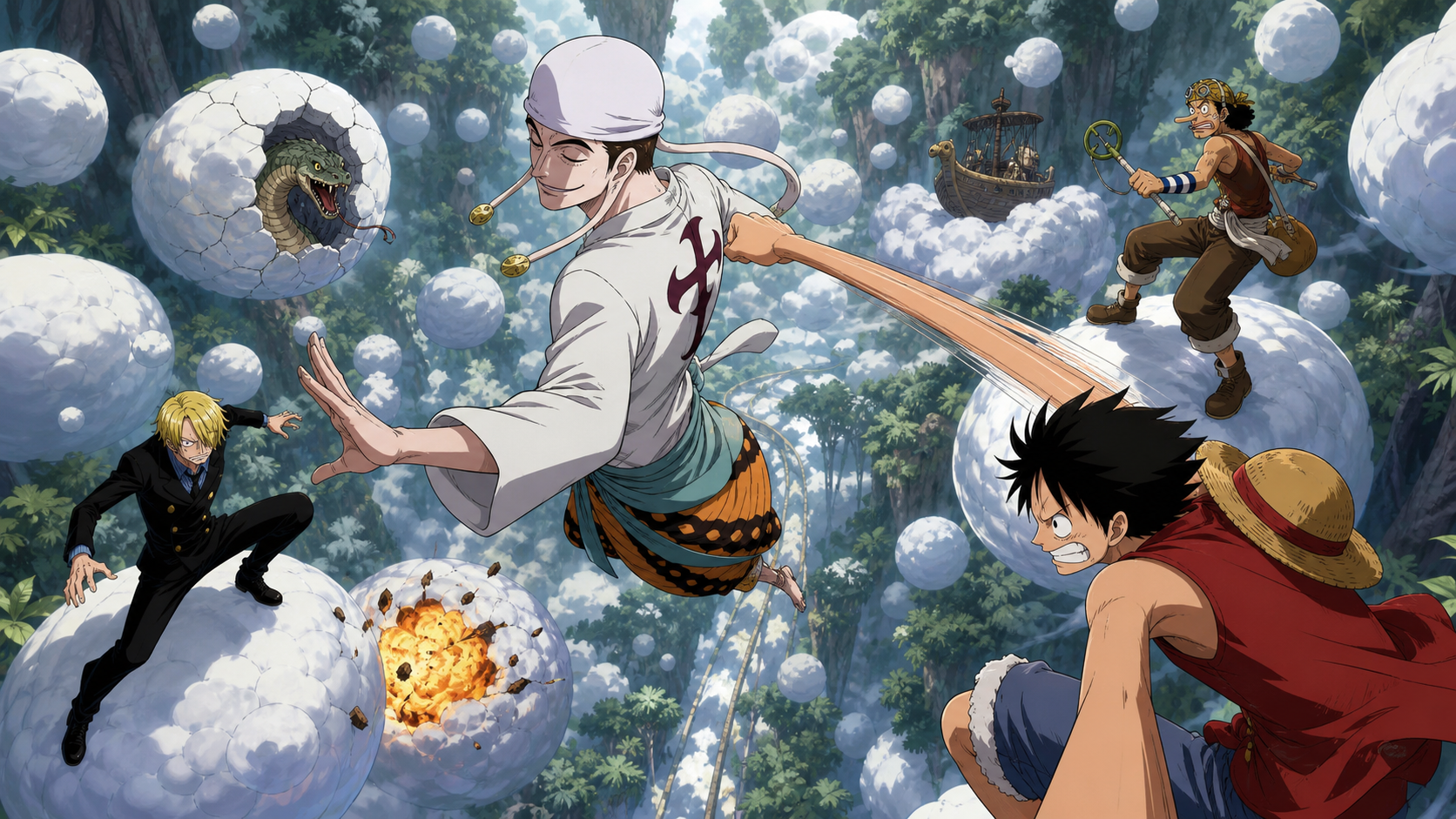
The chosen route contains countless floating island-cloud spheres. The soft shapes appear harmless after giant scythes and spear volleys.
That visual contrast lowers the crew’s guard. Enel’s designers understand that survivors of obvious violence relax around absurdity.
No ball should be touched until the team observes movement, weight, sound, seams, and reactions to remote disturbance.
Usopp can test from range. Luffy should avoid poking mystery clouds because curiosity has already placed him inside one death course.
Surprise clouds turn uncertainty into ammunition
The balls hide snakes, explosions, blades, and other threats. Identical exteriors prevent the crew from distinguishing safety from danger before contact.
Randomized-looking hazards exhaust attention. Even an empty ball consumes caution because the next object may detonate.
The trio should mark tested spheres and observe whether positions change. A moving maze can erase progress and separate Crow from its passengers.
The system rewards the priest, who knows the inventory or can predict reactions, while entrants spend every second gathering basic facts.
Usopp can build a basic classification without touching the spheres. First, he should fire low-force projectiles from cover and note whether a ball rebounds, ruptures, moves, or emits sound. Second, he should record distance between activation and effect. Third, he should watch whether Satori steers the group toward specific clusters.
Sanji can protect the testing position and kick hazards away from Crow only after activation reveals their path. Luffy can use stretched limbs to redirect empty shells, but grabbing an untested ball would place the trigger beside his body.
The team also needs to distinguish a triggered hazard from a spent hazard. An explosion may conceal a second mechanism, and a released snake may leave a cloud shell capable of trapping a passenger.
Wind, current, and combat impacts can move untested balls into cleared space. Marking position alone will fail unless Usopp also marks the object with visible pigment or a tied strip that cannot be confused with natural cloud texture.
Most importantly, the trio must preserve a lane around Crow. Solving the maze while losing the vessel would exchange immediate survival for isolation deeper inside the ordeal.
Satori arrives with a smile built for customer complaints
Priest Satori introduces himself inside the cloud maze with cheerful confidence. His rounded appearance and playful delivery clash with the survival rate attached to his workplace.
The performance makes cruelty feel whimsical. Victims become contestants, hidden weapons become surprises, and attempted execution becomes entertainment.
The crew should ignore the tone and record the role. Satori administers the course, controls information, and possesses combat technology.
Sanji recognizes a threat, Luffy sees somebody to punch, and Usopp sees every nightmare behind every ball at once.
Mantra lets Satori move before the attack finishes becoming a decision
Luffy attacks, but Satori avoids the strike as though he heard the plan before the body moved. Repeated evasions establish a predictive ability called Mantra.
The trio does not yet know whether Mantra reads muscles, intent, sound, presence, or another signal. Naming a power does not explain the mechanism.
They should test limits with feints, simultaneous movement, delayed attacks, environmental hazards, and actions chosen at the last possible moment.
Repeating straightforward punches only gives Satori more clean predictions and teaches the crew nothing new.
Usopp should count each successful prediction and each miss. A written sequence can expose whether distance, distraction, or simultaneous intent reduces accuracy.
Prediction does not equal speed, strength, or invulnerability
Satori’s evasions create the impression that nobody can touch him. That conclusion extends beyond the evidence.
Knowing an attack is coming does not guarantee enough space, balance, or time to escape. Multiple threats can reduce available routes.
Sanji and Luffy should coordinate angles rather than taking turns. Usopp can constrain movement with ranged pressure while protecting Crow.
The team must also avoid telegraphing a shared plan through long shouted instructions. Mantra may hear intent more clearly than words, but silence still reduces ordinary information.
Satori attacks the boat because rescue depends on movement
Satori’s first disruption sends Crow drifting away. The trio’s only known transport through the ordeal becomes a separate emergency.
Destroying or losing the vessel can trap survivors even if they defeat the priest. Enel’s course measures escape, not merely combat victory.
Luffy orders Sanji and Usopp to secure Crow while he holds Satori. The division correctly protects the mission asset.
Usopp should board and regain steering while Sanji guards the recovery. Both need a return signal in case Luffy disappears deeper into the ball maze.
Luffy volunteers for the duel before understanding the rules
Luffy tells the others he will defeat Satori. The choice buys time and keeps the priest focused away from Crow.
Solo pressure also gives Mantra a simpler stream of intent to read. Luffy’s direct fighting style becomes especially predictable.
He needs to use terrain, rebound angles, obscured lines, and attacks whose final path changes after commitment.
The captain’s role is not proving individual superiority. Success means restoring the team, preserving the boat, and reaching the altar.
The Impact Dial bypasses the joke and attacks inside the body
Satori uses an Impact Dial to deliver force that damages beyond the visible point of contact. The strike can injure organs without the dramatic external wound fighters expect.
Sanji and Usopp have seen dials as transportation, cooking, music, and weapons, but this device stores and releases heavy impact.
Blocking with arms may transfer dangerous force through the body. Distance, deflection, and avoiding palm contact become safer than conventional guard positions.
After any hit, the crew should check breathing, balance, pain, confusion, and delayed collapse. Chopper remains elsewhere, which makes prevention more important.
Repeated Impact attacks test durability rather than tactics
Satori lands multiple Impact strikes on Luffy because Mantra keeps the priest ahead of direct counters. Luffy absorbs punishment through exceptional durability.
Surviving damage does not solve the information problem. Each exchange should test a hypothesis about range, activation, recharge, or Satori’s preferred hand.
Luffy can force Satori to choose between avoiding an attack and protecting access to Crow. Objectives create openings that pure duels may not.
Sanji and Usopp should report what they observe from outside the exchange instead of assuming Luffy can analyze while being hit internally.
Luffy gets his head stuck because rubber still needs a destination
One failed attack leaves Luffy’s head lodged in a tree. The image is funny, humiliating, and tactically disastrous.
His stretched body creates long paths that Satori can read and redirect. Environmental obstacles turn elasticity into temporary restraint.
Luffy should retract carefully, protect his neck, and avoid pulling against unknown branches or hidden cloud traps.
Sanji may need to free him, but abandoning Crow would restore the transport crisis Satori created on purpose.
Satori calls Luffy tough because the priest expected statistics to win
Satori acknowledges Luffy’s durability after the attacks fail to end the fight. The comment exposes a gap between prediction and finishing power.
The 10 percent survival figure depends on entrants who cannot endure the first sequence. Luffy already disrupts the expected outcome by remaining active.
Satori may become less precise if surprise, frustration, or divided attention affects Mantra. The crew should observe emotional changes rather than treating calm as permanent.
A priest who believes the course guarantees victory may reveal information when a target refuses to follow the normal pattern.
Chopper remains the missing safety system in every Impact hit
While the duel escalates, the crew’s doctor remains alone at the altar. Nobody in the Ball Ordeal can properly assess internal trauma.
Sanji has practical first-aid experience, but Impact injuries may hide behind normal skin and stubborn behavior.
The trio should minimize unnecessary hits, preserve consciousness, and prioritize reunion after escaping. Luffy saying he feels fine cannot become the entire medical protocol.
The split keeps creating costs that raw fighting strength cannot erase.
Episode 160 introduces a power by making confidence useless
Episode 160 gives the Straw Hats a priest who avoids attacks before they land and a course where harmless cloud balls may explode. Familiar instincts stop producing reliable answers.
The operational checklist is direct. Luffy must vary timing and paths while protecting the rescue objective. Sanji must recover Crow, observe Satori’s blind angles, and monitor Luffy for internal injury. Usopp must steer, test clouds remotely, track known hazards, and look for Mantra limits. Robin, Nami, and Zoro must return to Chopper on schedule. Chopper must maintain the Merry and preserve Gan Fall’s whistle.
The crew should document Mantra without pretending to understand the full power. Observed facts include repeated prediction, early movement, and effective evasion. Unknowns include range, sensory basis, duration, emotional limits, and whether multiple targets overload attention.
RaeRae’s verdict: keep this one. Satori looks like a floating dumpling running a deadly children’s party, then his palm punches damage inside Luffy’s body.
The Ball Ordeal advertises 10 percent survival. Luffy’s real problem is not the number. His real problem is landing one punch on a man who keeps reading the sentence before Luffy finishes thinking the period.