
RaeRae Reacts · One Piece Episode 161
Chopper Uses the Whistle Before Shura Strikes
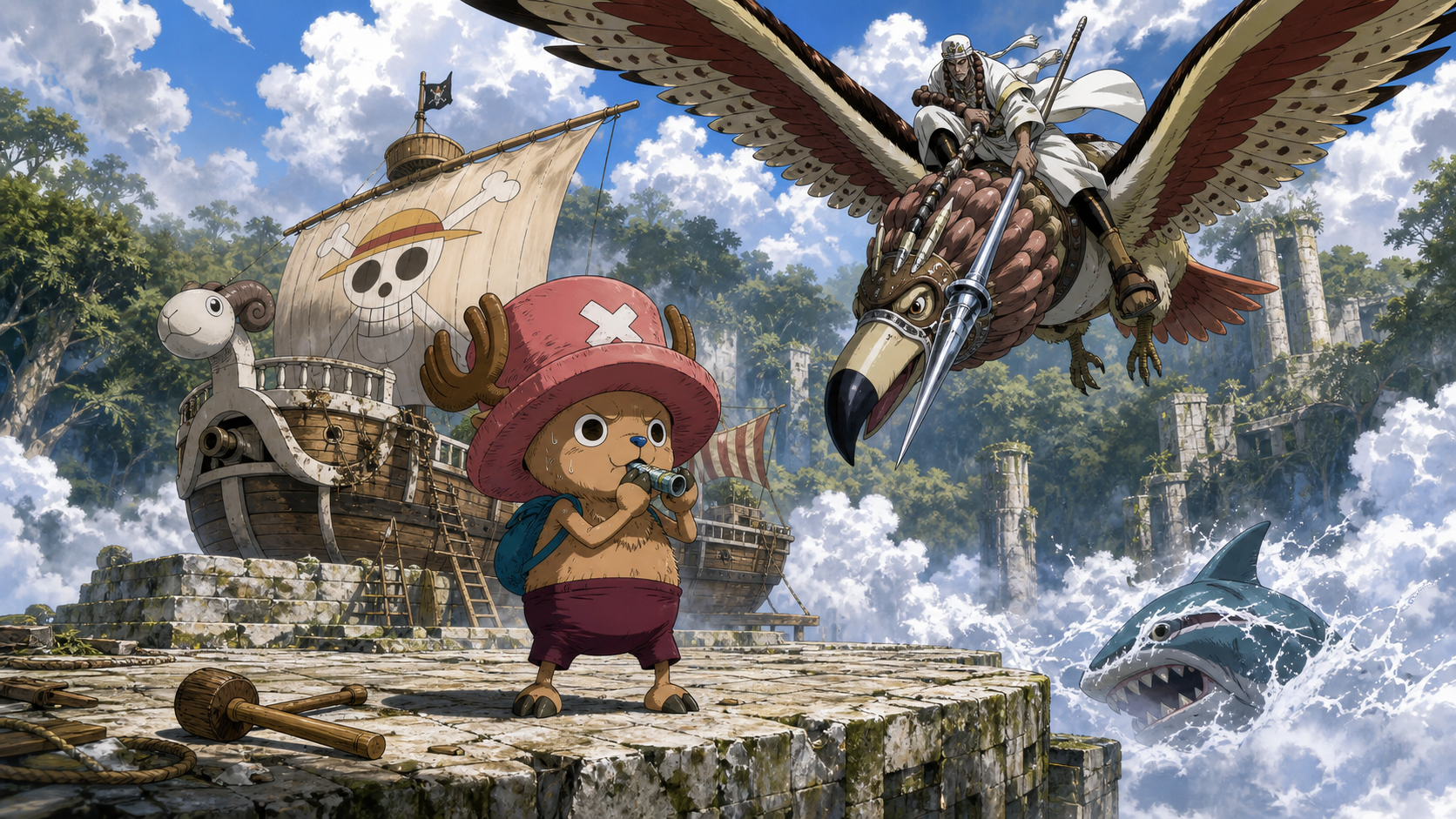
One Piece Episode 161 overwhelms the Satori team while isolated Chopper correctly uses Gan Fall’s whistle when Priest Shura reaches the altar.
Satori keeps the advantage because the crew keeps changing objectives
Episode 161 resumes with Luffy, Sanji, and Usopp trapped between Priest Satori, the surprise-cloud maze, and the drifting Crow. Every person wants to solve a different emergency first.
Luffy wants the priest. Usopp wants the boat. Sanji wants both men to stop improvising separate disasters.
Satori benefits from divided attention because Mantra becomes harder to counter when his opponents announce isolated intentions through obvious movement.
The team needs one sequence: stabilize immediate injury, prevent permanent loss of Crow, then create coordinated pressure on Satori. Simultaneous panic is not coordination.
Usopp tests a new rope weapon during the worst possible field trial
Usopp fires a new grappling-style tool toward Crow as the vessel drifts deeper into the forest. The device partly works by reaching the target.
The rope then refuses to disconnect cleanly, turning recovery equipment into another restraint. A prototype can save lives, but untested release mechanisms create secondary danger.
Usopp should have checked anchor strength, line length, trigger reset, manual release, and load tolerance before Upper Yard. The crew never received that luxury after McKinley’s escalation.
He now needs to secure the line, avoid wrapping limbs, and cut free if the boat pulls him toward a worse hazard.
Crow becomes bait because the route controls every exit
Satori lets the boat drift where the trio can see the loss happening. The tactic forces them to choose transport over defense.
Crow is not sentimental cargo. Without the vessel, reaching the altar or leaving the ordeal may become impossible.
The priest understands that mission assets can control strong opponents more effectively than direct threats. He does not need to overpower Luffy if Luffy keeps chasing the wrong emergency.
The crew should secure Crow to a stable point outside the cloud-ball cluster, then fight within a known recovery radius.
Sanji delivers the team meeting with his shoes
Sanji loses patience and comically beats Luffy and Usopp for letting the boat dominate their attention. The method lacks workplace polish, but the message is correct.
They cannot recover Crow while Satori predicts every attempt and attacks whoever turns away. Neutralizing the priest must become the shared objective.
Sanji should assign roles instead of relying on pain-based leadership. Luffy pressures Satori, Usopp restricts movement, and Sanji protects both while steering toward the exit.
A thirty-second plan would outperform three people repeatedly discovering that Satori can hit distracted targets.
Satori hears the plan and punishes the person who made sense
Satori responds to Sanji’s call for teamwork with an Impact attack. The strike removes the person trying to organize the group.
That targeting suggests tactical judgment alongside Mantra. Satori identifies leadership and disrupts coordination before the plan takes shape.
Luffy and Usopp should protect Sanji from follow-up contact, check breathing, and determine whether he can move.
Impact injuries may remain invisible. Assuming Sanji merely got knocked down could delay care for internal trauma.
Sanji loses consciousness and the rescue loses structure
Satori’s strike leaves Sanji unconscious. Luffy and Usopp now face the priest, the maze, the boat, and an injured teammate with fewer options.
Their first duty is preventing another Impact hit on Sanji. Luffy can draw attention while Usopp moves Sanji behind a tested cloud or stable tree.
Usopp should note pulse, breathing, responsiveness, and any worsening pain when Sanji wakes. Chopper needs those details later.
Carrying Sanji may restrict escape, but abandoning him would turn the Ball Ordeal into exactly the sacrifice system Enel designed.
Luffy and Usopp cannot brute-force a prediction problem
Satori continues overwhelming both men because they attack through readable patterns. Luffy commits with visible body movement, while Usopp’s projectiles travel through clear lines.
They need interference rather than stronger repetition. Smoke, moving cloud balls, ricochets, delayed triggers, and attacks from outside Satori’s view may limit usable predictions.
Usopp can fire where Satori must move rather than where Satori currently floats. Luffy can turn forced movement into a collision path.
The goal is not hiding all intent. The goal is denying Satori a safe response even when he knows an attack is coming.
Surprise Ball Drop turns the whole maze into artillery
Satori activates a technique that sends surprise clouds bursting around the fighters. Hidden hazards stop functioning as isolated traps and become an area attack.
One sphere may explode while another releases a creature or blade. The crew cannot use identical appearance to predict effect.
Luffy should redirect balls without gripping them. Usopp should mark spent shells and preserve a clean lane toward Sanji and Crow.
Satori may know each payload or simply use Mantra to avoid the consequences. Either advantage belongs to the course administrator, not divine luck.
Aisa gathers soil because Upper Yard means home to somebody else
A young Shandian girl named Aisa runs through the forest and collects soil from inside a tree opening. Her presence introduces another relationship to Upper Yard.
Robin sees archaeological evidence, Enel sees sacred territory, priests see an execution course, and Aisa sees earth worth carrying.
Her collection may preserve memory, identity, ceremony, or proof of a claim. Outsiders should not assume treasure rules apply to material another community values.
Aisa needs protection from priests and explorers alike. A child gathering soil in a militarized forest should never become a source to interrogate under pressure.
Aisa hides when footsteps turn research into risk
Aisa hears people approaching and conceals herself. The reaction shows she expects danger from movement through Upper Yard.
Robin, Nami, and Zoro may be the approaching expedition, but Aisa cannot know their intentions. Hiding is reasonable.
The adults should announce presence without surrounding the hiding place, lower weapons, and allow the child to leave.
If contact occurs, Robin can ask about the soil and ruins only after safety and consent. Historical urgency does not erase boundaries.
Chopper repairs the Merry and loses a fight with the hammer
At the altar, Chopper works alone and hits his own fingers with a repair hammer. The gag highlights how many roles he carries at once.
He is doctor, ship guard, repair worker, lookout, wildlife defense, and emergency communicator. Fatigue and anxiety make simple mistakes more likely.
Chopper should secure tools with short lines, work away from the altar edge, and stop repairs whenever visibility drops.
A dropped hammer is replaceable. Falling into cloud water beside a damaged ship is not.
Retrieving one tool puts Chopper beside a Sky Shark
Chopper reaches for the hammer near the edge when a Sky Shark charges. The predator exploits the exact moment his attention narrows.
Tool recovery should never outrank personal safety. Chopper can replace or improvise a hammer after checking the water and creating a tether.
The shark throws him through a chaotic sequence that somehow returns him toward the Merry.
Luck saves the doctor this time, but the encounter proves that the altar’s geography functions as active confinement.
Chopper lands beside the whistle and receives a clear decision
Chopper comes down near Gan Fall’s one-use whistle. The placement forces him to reconsider whether the current danger meets the emergency threshold.
A Sky Shark alone may be manageable through transformation and retreat. A priest arriving while Chopper remains isolated changes the calculation.
Emergency tools exist to prevent irreversible harm, not to reward endurance after harm occurs.
Chopper should define the trigger before fear or pride takes control: hostile priest, ship attack, incapacitating injury, or blocked escape.
Saving the whistle for later almost misunderstands the word emergency
Chopper initially decides to use the whistle only as a final resort. The instinct reflects responsibility because Gan Fall promised one free rescue.
Waiting too long could leave Chopper unable to blow. A signal requiring breath must be used before injury, restraint, or unconsciousness removes that option.
He should keep the whistle physically accessible, face away from hazards long enough to sound the call, and prepare cover until help arrives.
Conserving a rescue charge has no value after the person carrying the charge can no longer activate the device.
The whistle also needs a custody rule. If Chopper becomes injured, another crew member must know where the signal rests and what promise Gan Fall attached to the sound. Emergency equipment hidden in one person’s pocket stops serving the crew when that person falls.
Chopper should blow a full, unmistakable call rather than several uncertain bursts. A weak signal could waste the single request while failing to identify direction through the forest.
After signaling, he needs to move. Shura can hear the whistle too, and the sound reveals Chopper’s exact position. Remaining beside the activation point allows the priest to strike before Gan Fall reaches the altar.
The Merry provides partial cover but also represents the asset Chopper must protect. Drawing Shura onto the deck could damage rigging, mast, stored supplies, and the hull already weakened by the journey.
A better waiting position uses the altar’s stone blocks as cover while keeping the ship visible. Chopper can shift between forms to avoid a straight aerial attack and still monitor whether Shura targets the Merry.
He should also prepare a visual signal for Gan Fall. The whistle gives an initial location, but movement after the call could make the rescuer search the wrong edge of the platform.
Chopper can place a bright cloth or reflective tool above his new cover, then remove the marker if Shura starts using the signal for targeting. Rescue visibility and enemy visibility remain the same physical problem.
None of these precautions guarantee safety. They give Gan Fall a better chance to find a living caller instead of arriving at an abandoned whistle.
Shura arrives and complains about receiving one sacrifice
Priest Shura descends on the giant bird Fuza and questions why Chopper is the only target. The complaint treats a living person as disappointing inventory.
His arrival confirms that priests monitor altar conditions or receive assignments. Chopper’s isolation was visible to the punishment system.
Shura carries aerial mobility and a long weapon, while Fuza adds speed, reach, and another thinking creature to the fight.
Chopper should remain near cover, protect the whistle, and avoid standing between the priest and the Merry.
Chopper blows the whistle before pride can kill him
Faced with Shura, Chopper uses Gan Fall’s whistle. The choice is not cowardice. The choice is correct emergency judgment.
He cannot protect the ship, fight an unknown priest, monitor Fuza, and treat himself after injury at the same time.
The signal also creates a timeline. Chopper must survive until Gan Fall arrives without assuming rescue will be instantaneous.
He should move behind solid stone, keep the Merry out of Shura’s direct line, and use transformations for mobility rather than proving strength.
Both battlefields punish the crew for separating expertise
The Ball Ordeal group needs Chopper after Sanji’s Impact injury. Chopper needs combat backup after Shura arrives. Separation places the right skills in the wrong locations.
Robin, Nami, and Zoro remain between those emergencies while exploring ruins. Their return plan now matters more than treasure or soil analysis.
The crew needs shared signals that travel farther than shouting. Dials, flares, whistles, marked cloud trails, and scheduled check-ins could reduce isolation.
Strength keeps individuals alive for minutes. Coordination determines whether the crew reunites.
Episode 161 turns every useful object into a decision test
Usopp’s rope weapon half-works, Crow drifts, surprise balls hide payloads, Chopper drops a hammer, and Gan Fall’s whistle carries one rescue. Equipment matters only when judgment matches the moment.
The operational checklist remains divided. Luffy and Usopp must protect unconscious Sanji, constrain Satori, recover Crow, and preserve a path out. Chopper must survive Shura, shield the Merry, and signal location after blowing the whistle. Robin, Nami, and Zoro must notice Aisa without endangering her and return to the altar on schedule. Gan Fall must reach Chopper before Shura disables the caller.
Usopp should document the failed rope release instead of hiding embarrassment. Chopper should record exactly why the whistle threshold was met. Both lessons can improve later emergency equipment.
RaeRae’s verdict: keep this one. Sanji tries to organize the team and gets his organs rung like a bell, while Chopper finally chooses rescue before martyrdom.
Satori keeps reading attacks. Shura arrives for one sacrifice. The Straw Hats need fewer speeches about courage and more tools that release when somebody pulls the correct lever.