
RaeRae Reacts · One Piece Episode 159
Upper Yard Weaponizes the Road
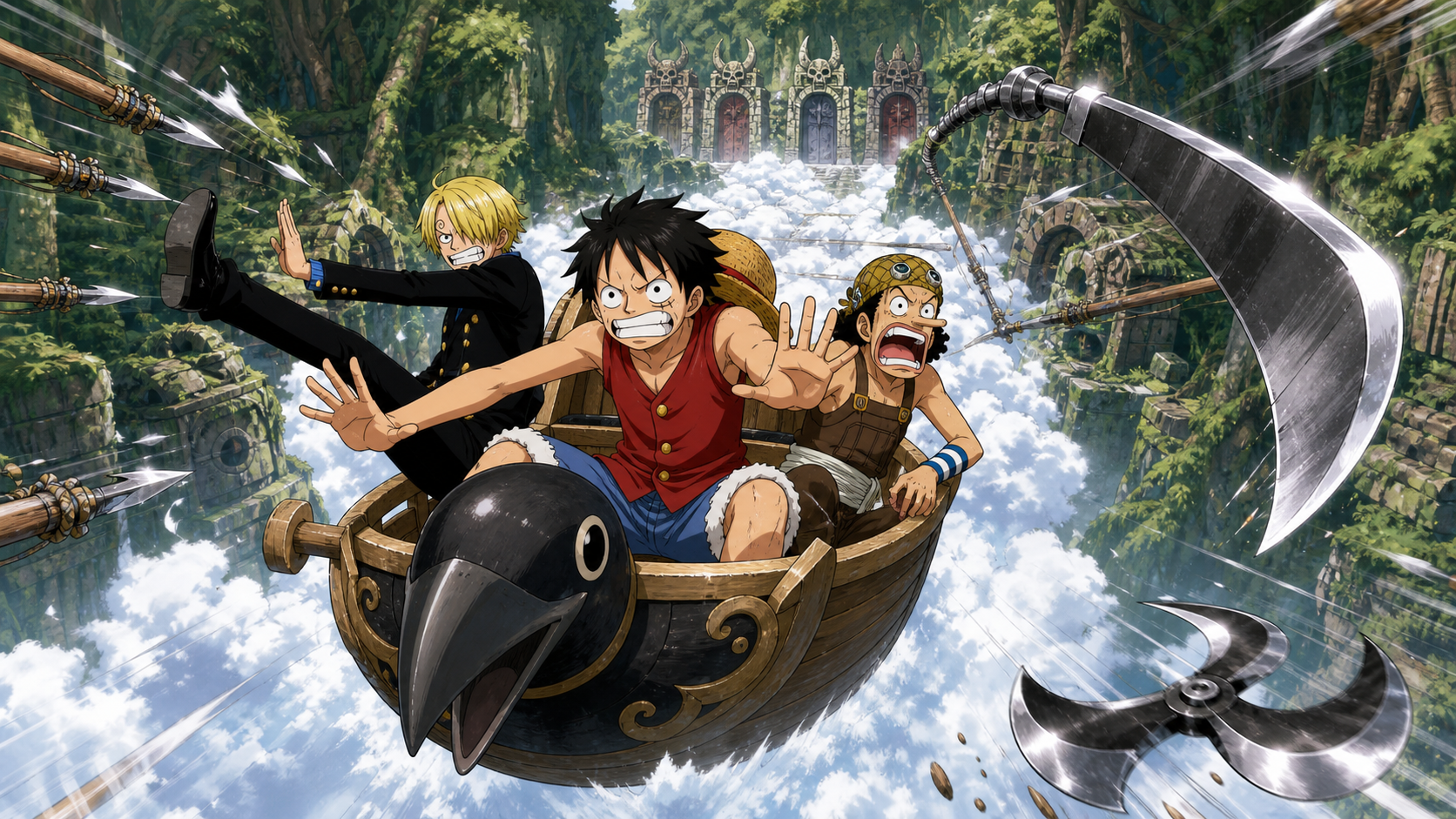
One Piece Episode 159 sends Crow through Upper Yard’s weaponized Milky Road while the altar crew leaves Chopper alone with the Going Merry.
Usopp asks about Conis before Upper Yard swallows the boat
Episode 159 begins with Usopp worrying about Conis after Enel’s strike. That question matters because the rescue party left Lovely Street before confirming her safety, medical condition, or protection from McKinley.
Luffy trusts Gan Fall to handle the aftermath, while Sanji keeps the Crow moving toward their captured friends. Delegation makes sense, but nobody established a communication plan.
Gan Fall may save Conis from one lightning blast and still miss retaliation against Pagaya. The crew needs a later rendezvous, signal, or return route.
Usopp’s concern does not slow the mission. His fear keeps the human cost visible while Luffy converts every emergency into forward motion.
Upper Yard looks huge because the danger needs room
The Crow enters Upper Yard through a forest so massive that the crew loses any easy sense of scale. Ancient trees rise above a bright Milky Road while ruins disappear into foliage.
A large environment creates navigation problems beyond simple direction. Distance, current speed, visibility, canopy cover, and hidden elevation all affect rescue timing.
Usopp should mark the entrance and measure travel time between landmarks. Sanji should track supplies. Luffy should resist leaving the boat because something shiny exists between two lethal trees.
The jungle also proves that sacred ground contains a functioning ecosystem and human history, not an empty arena created for Enel’s ordeals.
The first scythe turns a route into a weapon
A gigantic moving scythe swings across the Milky Road almost immediately. The trap uses the path itself to direct travelers into a timed blade.
Luffy reacts with Gum-Gum Bazooka and knocks the group out of the cutting line. His power saves all three, but the emergency maneuver risks flipping Crow or ejecting a passenger.
The team should look for trigger lines, pressure changes, hidden operators, and repeating patterns before advancing. A missed swing can return.
Enel’s system calls this an ordeal, but the mechanism offers no test of character. A person survives through combat ability, luck, or prior knowledge.
Wooden spears arrive before the crew resets
A volley of wooden spears follows the scythe while Crow remains committed to the current. Sanji and Luffy kick the projectiles away before the hull or Usopp takes a hit.
Sequential traps punish recovery time. The architects expect survivors to focus on the last threat while the next attack begins.
Usopp should watch behind and above because Luffy and Sanji naturally defend the forward arc. Three people can create overlapping observation instead of three simultaneous panic reactions.
Recovered spear fragments could reveal materials, poison, manufacturing marks, or direction of launch, but collecting evidence during active fire would be foolish.
Luffy uses Windmill because steering has left the conversation
Luffy spins his body and sends Crow past another hazard with Gum-Gum Windmill. The solution works through force rather than navigation.
Crow survives because One Piece boats have a spiritual commitment to tolerating nonsense. A real inspection afterward should check joints, propulsion, steering, and hull seams.
Sanji needs to keep balance and protect Usopp from Luffy’s improvised acceleration. Usopp needs both hands on the vessel instead of narrating his expected death.
Every emergency move consumes control. The crew may avoid a blade and still enter the next trap at the wrong angle or speed.
The razor boomerang proves retreat is not automatically safe
A huge razor boomerang circles through the route, which means danger can attack from ahead, behind, and the side. Turning around would not return them through a cleared corridor.
Boomerang geometry rewards tracking rather than blocking. Sanji should watch the return path, Luffy should redirect without grabbing a sharp edge, and Usopp should predict the arc.
The weapon also suggests deliberate maintenance. Somebody built, placed, and keeps these devices functional inside the forest.
Enel’s priests benefit from calling mechanical murder divine. Sacred branding hides engineering decisions and the people responsible for them.
The Speedy Shrimp deposits the Merry and abandons the captives
Across Upper Yard, the Super-Express Speedy Shrimp leaves the Going Merry at a stone platform surrounded by dangerous cloud water. Robin identifies the location as a sacrificial altar.
The transport ends without guards because geography performs the detention. The altar isolates the ship while hostile wildlife and sacred restrictions control movement.
Nami, Zoro, Robin, and Chopper should first inspect hull damage, count supplies, establish lookout shifts, and test whether the Merry can leave.
Instead, survival decisions immediately compete with curiosity, pride, treasure, and the belief that the rescue team will arrive.
The altar uses isolation as a guard nobody has to pay
The stone platform stands above hostile cloud water with the forest pressing around every visible route. Enel does not need chains when terrain can hold captives in place.
The crew should identify every way onto and off the platform before exploring. That survey includes bridges, vines, current depth, climbable stone, animal access, and any route the Speedy Shrimp used.
Nami can sketch the perimeter and mark wind. Robin can inspect construction seams and older access points. Zoro can clear immediate threats without cutting historical structures. Chopper can prepare the Merry for emergency departure.
They also need a signal code. One whistle could mean return, two could mean attack, and repeated blasts could authorize abandoning the platform. Shouting names through a dense forest gives enemies the same information.
Food, medical supplies, repair tools, maps, and Gan Fall’s whistle should not all travel with one expedition group. Dividing critical resources prevents one ambush from stripping the ship of every option.
The altar’s age suggests that isolation may predate Enel, but current use remains a deliberate government choice. Reusing ancient infrastructure does not remove responsibility for modern sacrifice.
Zoro defeats a Sky Shark and treats the result like permission
A Sky Shark attacks near the altar, and Zoro defeats the creature. Removing the immediate threat protects everyone, but one shark does not make the surrounding water safe.
The attack shows that cloud-water predators can reach the platform and ship. Chopper needs to identify wounds, species behavior, and whether blood attracts more animals.
Zoro responds by deciding to explore the forest. Winning one fight becomes proof that leaving the defensive position sounds reasonable.
The crew should establish rescue timing and a fallback point before anyone disappears among thousand-year-old ruins.
Nami asks for respect and Zoro gives her theology by sword
Nami warns that Upper Yard belongs to Enel and his priests, then tells Zoro to respect God. She is arguing for caution after witnessing a fleeing man erased by lightning.
Zoro says he has never prayed to God for a single day. The answer sounds cool because fear has not purchased his obedience.
Chopper admires the line immediately. He hears independence, not a full survival strategy.
Respect for danger does not require belief in divine legitimacy. Zoro can reject Enel’s title while still mapping threats, protecting the ship, and avoiding reckless separation.
Sky Lampreys turn the Milky Road into a feeding lane
Back on Crow, large Sky Lampreys attack from the cloud current. Sanji and Luffy defeat the creatures without losing momentum.
The route combines installed weapons with natural predators, and travelers cannot easily tell where one category ends. Priests may direct animals, exploit habitats, or merely select a road where attacks already occur.
Usopp should watch water movement before each strike. Surface disturbances, shadows, and repeated attack zones can provide warning.
Killing every creature is neither necessary nor sustainable. The crew needs avoidance whenever Crow can outmaneuver a predator safely.
Robin reads the altar before anybody asks what the writing says
Robin studies inscriptions and estimates that the altar is roughly one thousand years old. The structure predates Enel’s current rule by an enormous margin.
That age complicates the claim that Upper Yard belongs naturally to the present government. Ruins preserve earlier builders, languages, rituals, and ownership.
Robin should photograph or copy inscriptions, record orientation, document damage, and avoid removing artifacts from context.
Historical evidence may explain why sacred ground carries such political value. Enel controls access to the past while using the site as a punishment arena.
Robin says valuables and Nami suddenly supports archaeology
Robin’s excitement about history barely moves Nami. One mention of possible valuables turns caution into expedition planning.
The joke lands because both women want something from the ruins, just under different labels. Robin wants knowledge and Nami wants treasure.
Neither objective should outrank ship security or rescue coordination. Taking objects from an ancient site can destroy context and create new conflict with rightful owners.
If exploration proceeds, the crew should document finds, leave structural artifacts in place, and distinguish abandoned material from cultural property.
Zoro enters the forest without direction because tradition demands chaos
Zoro moves into Upper Yard as though a forest can defeat his legendary ability to get lost. The joke stopped being hypothetical several islands ago.
He should carry a marked line, compass substitute, route sketch, or paired guide. Nami joining improves navigation, but following Zoro before setting a bearing still wastes time.
Robin can read ruins and track historical patterns, while Nami can map terrain. Together they form a strong exploration team if nobody lets Zoro choose turns.
The group also needs a return deadline. Chopper cannot know whether silence means discovery, combat, capture, or ordinary Zoro navigation.
Three adults leave the youngest crew member alone with the ship
Nami, Robin, and Zoro assign Chopper to guard the Merry while they explore. The decision protects the vessel with a doctor who can transform and defend himself.
The assignment still leaves one person responsible for lookout, repairs, wildlife, first aid, signaling, and any priest who arrives.
Chopper should receive a retreat threshold, whistle, alarm method, expected return time, and permission to abandon the altar if staying becomes suicidal.
“Guard the ship” is not a plan when the ship sits on a sacrificial platform inside enemy territory.
Chopper realizes the danger after everybody disappears
Chopper initially admires Zoro and accepts the assignment. Once the expedition vanishes, he recognizes that being alone may make him the most exposed crew member.
That delayed realization captures Chopper perfectly. He wants the adults to see him as capable, then discovers that capability can become an excuse for adults to hand him a terrible shift.
He should repair the Merry only from protected positions, establish noise alarms, monitor cloud water, and keep medical supplies ready.
Most importantly, Chopper should not chase every sound into the forest. Isolation makes false signals effective.
The four Ordeal gates turn choice into another trap
Luffy, Sanji, and Usopp finally reach four entrances leading to separate ordeals. The gates present danger as a menu, which creates an illusion of control.
The crew lacks reliable information about survival rates, priests, terrain, duration, or which route approaches the altar. Choosing blindly serves the gate designers.
Usopp should inspect tracks, damage, signage, airflow, sound, and current direction. Sanji should compare routes against Conis’s instructions. Luffy should refrain from selecting the funniest name.
A visible choice does not become fair when every option belongs to the executioner.
Episode 159 splits responsibility faster than the crew splits bodies
Both teams enter Upper Yard and immediately divide attention. Crow’s team fights the route, while the altar team chooses exploration over consolidated defense.
The practical checklist now spans two locations. Luffy must choose an ordeal based on rescue value. Sanji must protect the boat and ration supplies. Usopp must map traps and preserve an exit. Nami must map the altar area. Robin must document inscriptions without stripping the ruins. Zoro must defend the expedition and follow directions. Chopper must guard, repair, signal, and retreat when necessary.
Gan Fall and Conis remain outside this episode’s main action, but their information could prevent blind gate selection. The rescue party needs a method to reconnect with local allies instead of treating every separation as permanent.
RaeRae’s verdict: keep this one. Crow dodging a scythe, spear storm, boomerang, and lampreys delivers ridiculous motion, while Chopper’s delayed panic exposes the crew’s real weakness.
The Straw Hats can defeat almost any monster. Asking one person to guard the ship with a complete plan remains their rarest superpower.