
RaeRae Reacts · One Piece Episode 158
Conis Confesses Under Enel’s Lightning
One Piece Episode 158 turns Conis from a coerced guide into a witness when she confesses the trap and Enel answers with Heaven’s Judgment.
The rescue starts with a map too old to rescue anybody
Episode 158 opens with Luffy, Sanji, and Usopp ready to reach the Sacrificial Altar, except their Skypiea map belongs in a museum. The routes no longer match the streets, and urgency cannot turn outdated information into navigation.
Usopp should compare the map against visible landmarks, current signs, and Pagaya’s directions before the trio leaves Angel Island. A wrong gate could send them toward another ordeal or away from the Merry entirely.
Luffy treats direction as somebody else’s department because Nami usually carries that burden. Nami is currently being hauled toward Upper Yard by a government shrimp, so delegation has officially failed.
The trio needs a local guide, but accepting help can expose another resident to Enel’s punishment. Every practical solution inside Skypiea arrives with a human cost.
Conis returns because Pagaya refuses to let guests walk blind
Conis offers to guide the Straw Hats to a vessel that can reach Upper Yard. She says Pagaya asked her to help, which fits the family’s habit of extending care even after McKinley threatened them.
Her return solves the route problem while creating a larger safety problem for Conis. She now assists declared Class Two criminals in public after authorities warned that help would bring punishment.
Sanji sees kindness and trusts the offer. Usopp notices tension. Luffy accepts the guide but keeps watching her body language.
The trio should ask whether Conis chose this mission freely, whether Pagaya remains safe, and whether another route exists. Good intentions do not remove coercion from the room.
McKinley watches the rescue party and smiles at the destination
Captain McKinley follows from a distance with White Berets and celebrates when the group heads toward Upper Yard. His reaction confirms that the government wants the accused to proceed.
A genuine law-enforcement officer seeking arrest would intercept the crew, secure the scene, and state charges. McKinley prefers guided movement toward a killing ground.
The patrol uses Conis as an unofficial transport mechanism because the Straw Hats trust her. That arrangement reduces enforcement risk and shifts moral injury onto a civilian.
Usopp should detect the surveillance, mark patrol numbers, and find alternate exits. Sanji should stay close enough to protect Conis without making her look like a hostage. Luffy needs to remember that a smiling McKinley means the route serves Enel.
Lovely Street keeps the name while losing every trace of lovely
The party enters a busy market filled with cloud architecture, dials, gondolas, and everyday life. Lovely Street should feel welcoming after the chaos on Angel Beach.
Instead, residents step away from the branded criminals. Conversations stop, bodies turn, and open space forms around the visitors before anybody explains why.
The reaction shows how quickly official labels reorganize a community. The Straw Hats have not attacked these shoppers, but Class Two status makes proximity dangerous.
Fear can look like hostility from the outside. The residents may judge the crew, fear Enel’s lightning, or both. Nobody has enough freedom to clarify the difference.
Luffy shops through a manhunt because shiny dials exist
Luffy handles market goods while the rescue clock keeps running. Of course he does. A street full of strange shell technology can derail the man who found amusement in a pirate ship moving backward.
The gag also exposes how normal Lovely Street appears under authoritarian control. Vendors sell useful objects, families travel, and gondolas move while divine punishment remains one confession away.
Usopp has a legitimate reason to study the dials because new tools could help the rescue. He should ask permission, record functions, and avoid taking equipment from frightened vendors.
Sanji needs to move the group forward without treating Conis like hired staff. She has been trembling since the house, and the market only increases that pressure.
The townspeople relax when they think the danger will leave
Residents realize the Straw Hats are heading out and show visible relief. Their reaction hurts because departure means the city’s punishment risk may travel with the accused.
Enel has engineered a system where self-preservation requires strangers to enter Upper Yard. A neighbor does not need to hate the visitors to want them gone.
Collective danger destroys ordinary hospitality. Anybody who warns an outsider, hides an accused person, or questions the route may draw Heaven’s Judgment onto a wider area.
The Straw Hats should not read relief as proof that every resident supports Enel. Survival behavior under immediate lethal threat cannot be treated as free political consent.
Luffy chooses the wrong gondola with perfect confidence
At the port, Luffy becomes fascinated by a gondola and bull while Conis directs the trio toward a crow-shaped boat. He refuses to move until Sanji knocks the argument out of him and forces an apology.
The comedy releases pressure without changing the stakes. Their friends remain captive, Conis remains terrified, and McKinley’s patrol remains close.
Sanji is right to prioritize the assigned vessel, but hitting Luffy does not replace a launch check. The crow needs fuel or power, steering instructions, capacity limits, emergency gear, and a known route.
Usopp should inspect the hull and propulsion. A boat provided by a frightened city under Enel’s rule could contain tracking, traps, or limitations nobody disclosed.
Gate Two sounds like a route and behaves like a funnel
Conis instructs them to enter Gate Two and follow the Milky Road toward Upper Yard. The directions sound clean enough for even Luffy to follow.
McKinley’s satisfaction makes the gate suspicious. A controlled entrance lets priests predict arrival, choose terrain, and separate challengers from escape routes.
The trio should identify Gate One, service paths, nearby docks, and any current that returns toward Angel Island. A rescue team entering a funnel needs an exit before the first obstacle appears.
Conis may know only the official route because residents are forbidden from entering sacred ground. Her knowledge can be sincere and incomplete at the same time.
Luffy notices trembling that Sanji explains away
Luffy asks why Conis has shaken since leaving home. His social instincts often look absent until a lie threatens someone he cares about, then the foolishness drops out of his face.
Sanji assumes she worries about the rescue party. That explanation flatters his preferred story because Conis becomes a kind guide concerned for brave pirates.
Usopp reads the mismatch between her behavior and the town’s avoidance. If residents want distance while Conis leads the targets, she may be carrying an obligation nobody wants.
The correct response is not accusation. Luffy gives Conis room to answer while making clear that the group already knows fear is shaping the route.
Conis admits the city has a duty to betray outsiders
Conis reveals the rule Skypieans must follow when outsiders become criminals. Residents have to direct the accused toward Upper Yard or face punishment themselves.
That disclosure changes the moral frame. Conis did not design Enel’s system, control McKinley’s classifications, or possess a safe refusal option.
Coercion does not erase the harm caused to Nami, Zoro, Robin, and Chopper, but accountability belongs first with the authority threatening an entire population.
The crew should separate confession from condemnation. They need facts about who ordered the act, how signals work, where captives go, what citizens risk, and what choices remained available.
Pagaya hoped the pirates would surrender their dream and leave
A flashback shows Pagaya expecting Sea Dwellers to retreat from Upper Yard. He judged withdrawal as the safest outcome because Enel’s machinery punishes persistence.
That belief helps explain the family’s earlier warmth and later secrecy. They could host travelers, teach them about clouds, and quietly hope danger pushed them home.
Luffy destroys that prediction by treating impossible warnings as invitations. Pagaya could not plan around a captain who climbed a Knock Up Stream specifically because nobody believed Sky Island was reachable.
Residents need a safer disclosure process than hoping outsiders interpret terror correctly. Enel prevents that process because clear warnings weaken his control.
Conis says she summoned the shrimp and accepts the ugliest sentence
Conis admits calling the Super-Express Speedy Shrimp that seized the Merry. The confession directly connects her action to the crew’s capture.
She says the words in public while McKinley, residents, and Enel’s unseen surveillance surround her. That choice carries more courage than a quiet apology after everyone survives.
Luffy could answer with anger, but rage would confirm the city’s fear that Sea Dwellers punish coerced messengers. He listens long enough to understand the trap.
The immediate need is operational: learn the signal used to summon the shrimp, whether another signal can redirect the creature, and how much time remains before the Merry reaches the altar.
The whole street backs away before the sky answers
Residents retreat when Conis exposes the rule. Their movement signals that punishment will not target only private guilt or formal defendants.
Everybody knows Heaven’s Judgment can arrive instantly. Nobody asks for evidence because the population has already learned that Enel hears prohibited speech.
McKinley does not protect Conis, evacuate the market, or challenge the sentence. His role is to maintain the conditions that make divine violence effective.
Sanji and Usopp need to move civilians away from the likely strike zone while Luffy stays with Conis. The absence of visible clouds or artillery does not make the threat less physical.
Enel punishes confession as though truth were treason
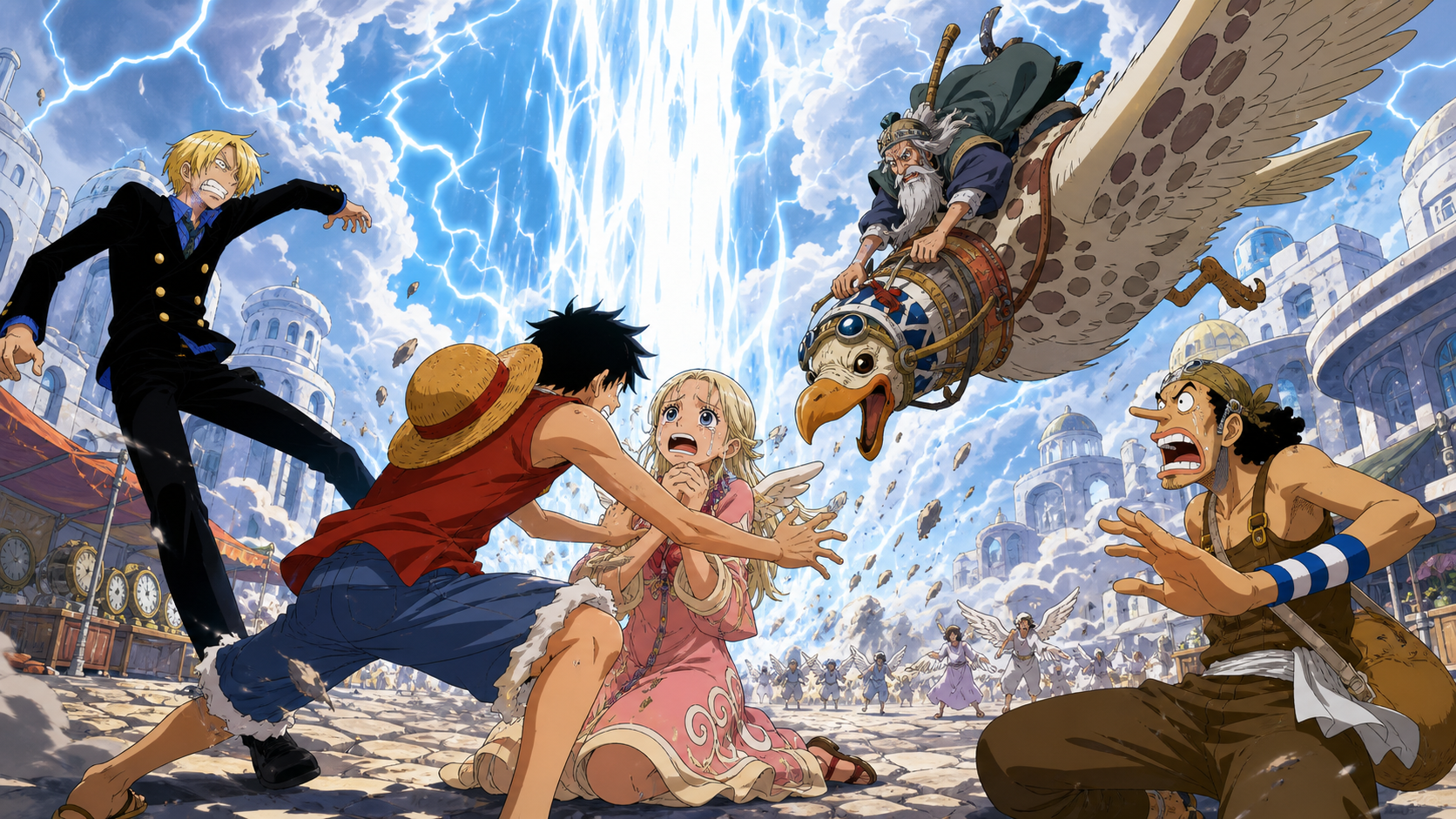
A massive lightning column descends on Lovely Street the moment Conis finishes. Enel answers speech from far away without appearing, investigating, or warning anyone nearby.
The strike proves that his claimed omniscience functions as surveillance backed by immediate execution. Residents cannot know the range, trigger, or limits of the listening power.
Calling the attack Heaven’s Judgment launders murder through sacred language. No divine title can turn retaliation against a coerced civilian into justice.
The city needs strike shelters, grounding systems, dispersal procedures, and ways to communicate without exposing speakers. Those protections may be difficult against Enel’s power, but helplessness should never become policy.
Luffy moves toward Conis when everybody else moves away
Luffy throws himself into the danger to protect Conis. He does not pause to calculate whether the person who betrayed his crew deserves rescue.
That response delivers the moral answer Enel’s system cannot understand. Coerced harm does not cancel a person’s right to live, and confession should not become a death warrant.
Luffy’s rubber body creates an unknown factor around lightning, but neither he nor the audience has a complete explanation yet. His choice comes before tactical certainty.
Sanji and Usopp must protect the surrounding people, secure the crow, and prepare for impact injuries. One heroic move cannot cover an entire harbor.
Gan Fall and Pierre break Enel’s closed circuit
Gan Fall dives into the strike zone on Pierre and pulls Conis and Luffy out of immediate danger. The former God intervenes where the current ruler expects unquestioned punishment.
His rescue confirms that Enel’s authority has opposition with local knowledge, mobility, and enough courage to act publicly.
Pierre’s flight gives the team a way to cross cloud terrain faster than ordinary boats, but Gan Fall cannot carry every person or solve every ordeal alone.
The group should check Conis and Luffy for burns, shock, breathing problems, and delayed injury. Chopper is absent, so basic triage must begin with whoever remains conscious.
Conis changes from guide to witness against the whole system
Before the confession, Conis could still be framed as a resident following rules. After speaking, she becomes a direct witness to coercion, forced transport, surveillance, and attempted execution.
Her testimony can explain how outsiders are selected, how citizens receive duties, how the shrimp is summoned, and what punishment follows refusal.
Protecting her now matters beyond gratitude. Enel will want silence, McKinley will want control, and frightened residents may want distance from the next strike.
Conis should choose whether to remain with Gan Fall, return for Pagaya, or assist the rescue. Nobody should replace Enel’s coercion with pirate coercion just because the pirates mean well.
Episode 158 makes Lovely Street the first real battlefield
No priest swings a weapon in Episode 158, yet the conflict becomes unmistakable. Enel controls routes, labels, animals, officers, neighbors, and the fear surrounding ordinary speech.
The rescue checklist now has sharper priorities. Luffy must keep Conis alive and reach the altar. Sanji must secure supplies, civilians, and the launch vessel. Usopp must inspect the crow, preserve the route, and record the confession. Gan Fall must explain Enel’s sensing range and the safest approach to Upper Yard. Conis must identify the shrimp signal and any way to help the captive crew.
Pagaya also needs immediate protection. Punishing Conis may be only the first retaliation, and McKinley knows where the family lives. Somebody should warn him without leading the patrol straight home.
RaeRae’s verdict: keep this one. Conis admitting the trap in front of the whole street matters more than another clean fight. She chooses truth while everyone around her knows truth can call down lightning.
Lovely Street looked safe because every resident understood when to stay silent. Conis speaks, Enel strikes, and Luffy finally sees the god he needs to punch without Enel ever entering the frame.