
RaeRae Reacts · One Piece Episode 150
Bellamy Steals Ten Years of Proof
One Piece Episode 150 turns Bellamy’s contempt into robbery, leaves the Saruyama Alliance injured, and sends Luffy back to Mock Town before dawn.
The forest answers pursuit with coordinated chaos
Episode 150 returns to the Straw Hats chasing the South Bird through a nighttime forest. The bird uses giant insects and terrain as defenses while the crew struggles to keep the expedition organized.
Mantises, beetles, burrowing creatures, webs, and swarming insects turn one capture attempt into several simultaneous hazards. No search team maintains a reliable view of every member.
The crew should stop treating each animal as a separate opponent. Their movement through the habitat created a shared disturbance, and the safest response is a controlled retreat to a known clearing.
Chopper needs to check stings, bites, breathing, and falls before anyone celebrates a capture. Adrenaline can hide injury until the group reaches the shoreline.
The bird does not overpower the Straw Hats through size alone. Local knowledge lets the animal choose branches, nests, mud, and insect colonies that punish direct pursuit.
Luffy keeps reaching because determination usually closes distance. In a forest, the same strategy can deepen confusion and pull rescuers away from the planned route.
Robin and Chopper should lead observation while the others create a quiet perimeter. Fewer moving bodies would reduce panic and preserve the bird’s normal directional behavior.
Capture remains a temporary necessity rather than a victory over wildlife. The crew owes the animal safe restraint, food, water, monitoring, and release near the original habitat.
Bellamy arrives after the strongest visitors leave
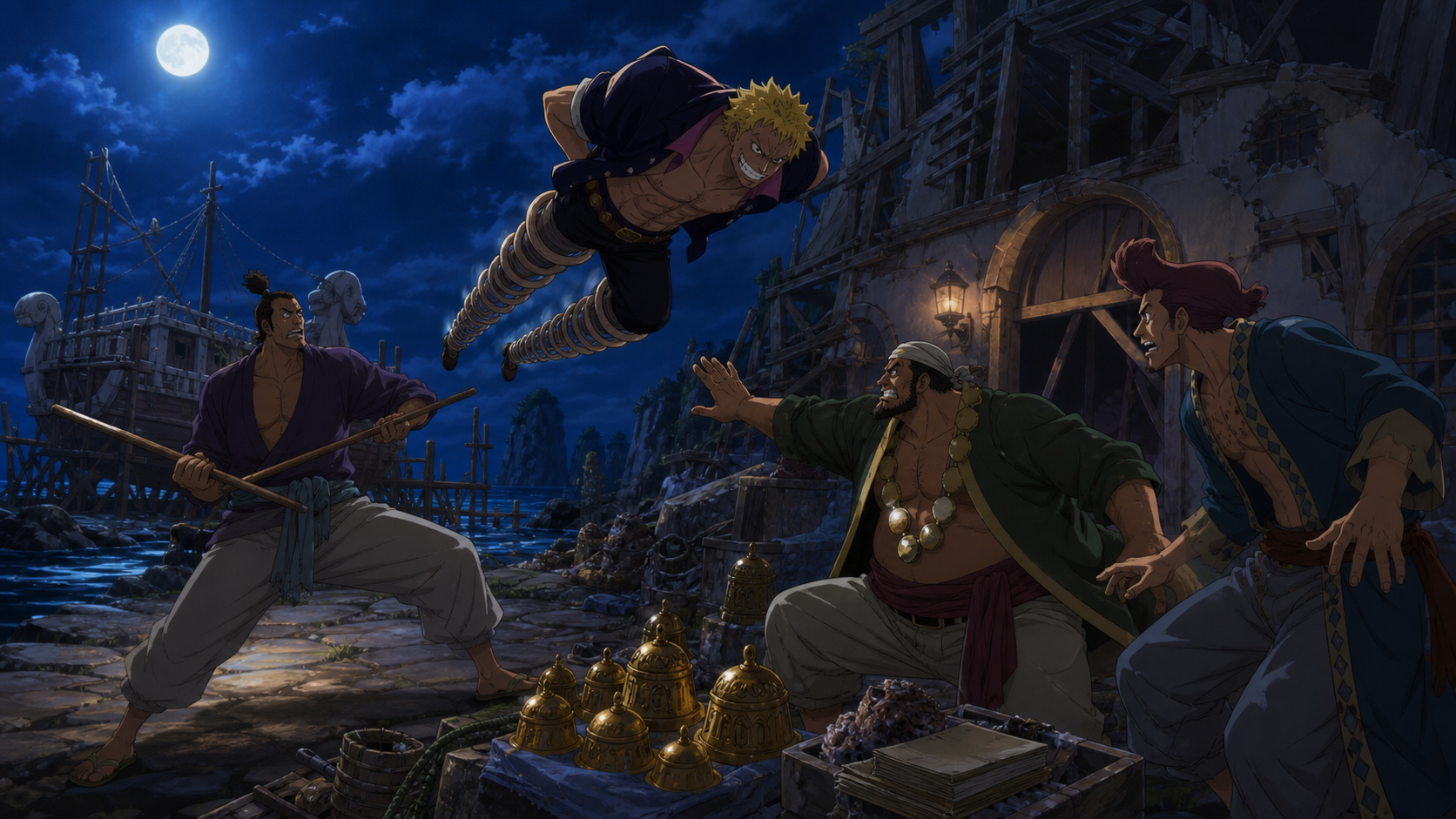
At Cricket’s home, Bellamy’s crew demands the gold while the Straw Hats search the forest. The raid depends on timing, public gossip, and the assumption that dreamers make easy targets.
Bellamy does not discover an abandoned treasure. He enters an occupied home, threatens residents, and attempts to take artifacts produced by ten years of hazardous salvage.
The alliance should sound an alarm before engaging, move Cricket and the logbook, and send a runner toward the search teams. Protecting evidence cannot require everyone to stand inside one attack zone.
A deadline for the Knock Up Stream increases vulnerability. Bellamy knows that Cricket must either defend the property or preserve the launch work.
The Saruyama crews repel the first attackers
Masira, Shoujou, and their people initially defeat Sarquiss and the other raiders. Their coordination shows that the alliance is more than comic salvage crews gathered around Cricket.
Defense works while opponents arrive through predictable angles and rely on ordinary weapons. The advantage changes when Bellamy enters with an unfamiliar ability.
The alliance needs a fallback line rather than crowding around a successful first exchange. Early success can hide the fact that no one has assessed the captain’s capability.
Cricket should remain away from the front because decompression illness and recent collapse reduce his safety margin. Leadership can direct evacuation without becoming the first body Bellamy reaches.
Bellamy turns his legs into loaded springs
Bellamy reveals the Spring-Spring Fruit, compressing his limbs and releasing stored force across the shoreline. His movement converts walls, ground, and distance into launch surfaces.
The first duty is observation: identify compression posture, likely trajectory, rebound surfaces, and recovery time. Charging directly into an unknown power gives him every advantage.
People near buildings should move away from rigid surfaces that let Bellamy ricochet. Loose teams with clear sight lines can reduce the chance that one strike hits several defenders.
Shoujou’s sonar also becomes dangerous around wounded allies and a repaired ship. A powerful response without a controlled field could finish Bellamy’s destruction for him.
Speed makes humiliation part of the assault
Bellamy moves faster than Cricket, Masira, and Shoujou can track. He wants more than access to gold; he wants the alliance to experience their own strength as meaningless.
That performance mirrors the Mock Town beating. Bellamy uses public domination to prove a philosophy in which visible power establishes ownership and defines reality.
Witnesses should document sequence, injuries, stolen objects, marks, and statements rather than repeating his insults as the central story. The crime is not a debate about dreams.
Survivors need protection from shame. Being surprised by an unknown ability does not create consent, cowardice, or responsibility for the attack.
Cricket’s medical vulnerability becomes an attack surface
Cricket fights despite recent decompression symptoms and years of punishing dives. Bellamy exploits a body already carrying occupational damage.
Cricket’s refusal to step aside comes from responsibility for the others and for evidence tied to his family name. Those stakes do not make another collapse less dangerous.
Masira and Shoujou should move him toward cover and preserve breathing position after impact. Chopper will need a timeline of unconsciousness, chest pain, weakness, and new neurological symptoms.
Bellamy’s knowledge of the gold may be incomplete, but he recognizes devotion. He targets whatever Cricket values because injury becomes more satisfying when attached to meaning.
The stolen gold represents ten years of bodily cost
Bellamy takes the artifacts Cricket recovered from the seabed. Usopp later names the labor clearly: a decade of diving, illness, isolation, and repeated risk produced those pieces.
Market value cannot describe the loss. The gold supports Noland’s report, records a vanished civilization, and gives Cricket a material answer to inherited ridicule.
Every recovered item should have a catalog, sketch, weight, location, photograph, and duplicate record stored elsewhere. Evidence concentrated in one home can disappear during one raid.
Return of the objects matters, but return alone cannot repair injury, interrupted launch work, damaged property, or the new knowledge that Bellamy can reach Cricket whenever he chooses.
Bellamy lets his crew continue after the robbery succeeds
The raiders keep attacking after the gold is secured. Continued violence proves that acquisition was never the only objective.
Bellamy wants punishment for Cricket’s claim that the crew has no right to touch the artifacts. Resistance becomes an insult to his authority rather than a boundary he must respect.
Once attackers begin violence beyond any claimed operational goal, defenders should prioritize evacuation and evidence preservation. No negotiation can rely on the thieves leaving after receiving property.
Medical documentation should distinguish injuries caused during entry, resistance, theft, and post-theft assault. Sequence establishes deliberate escalation.
The Straw Hats return with the mission completed and the home destroyed
The crew emerges from the forest with a South Bird and finds Cricket’s group beaten, the gold gone, and the shoreline marked by violence.
Success in one task does not protect the project when another team receives no warning. Their divided plan lacked a communication route between forest and shore.
Chopper should immediately triage Cricket, Masira, Shoujou, and their crews. The bird needs a quiet holding space away from blood, shouting, and damaged equipment.
Nami should assess whether the Merry remains launch-ready. Bellamy may have damaged reinforcement work, navigation gear, rigging, or the hull while everyone focused on injured people.
Cricket still prioritizes getting the crew to the sky
Even while injured, Cricket reminds the alliance that their duty is to prepare the Straw Hats for the Knock Up Stream. He refuses to let Bellamy choose the expedition’s ending.
That determination is generous and dangerous. A wounded leader may minimize symptoms because the deadline gives pain no convenient place in the schedule.
Chopper must hold medical authority over Cricket’s participation. Masira and Shoujou can continue work only after confirming their own capacity and assigning replacements for injured crew.
The launch should not depend on people proving loyalty through untreated labor. Preserving the dream requires preserving the workers who make the route possible.
Bellamy’s symbol on the Merry turns suspicion into attribution
Zoro notices Bellamy’s mark on the ship. The symbol connects the shoreline attack to the same crew that assaulted Luffy and Zoro in Mock Town.
A mark left by an attacker can function as evidence, intimidation, or both. Usopp should photograph and trace the placement before cleaning or repair.
The crew should still corroborate the symbol with witness accounts, missing inventory, footprints, and descriptions. Bellamy wants recognition, but a responsible record does not depend on his vanity alone.
Marking the Merry also expands the target. Bellamy violated the Straw Hats’ vessel while attacking people who had offered them help.
Luffy chooses recovery instead of accepting Cricket’s sacrifice
Luffy decides to return to Mock Town and reclaim the gold. His response recognizes that Cricket’s evidence and labor matter even when Cricket says the launch should come first.
The decision differs from fighting Bellamy over ridicule. Luffy refused a status contest in the bar and now responds to robbery, assault, and harm against people who trusted his crew.
Recovery still needs a scope. Luffy should retrieve the artifacts, stop immediate danger, and return before dawn rather than turning Mock Town into collective punishment.
He should also avoid promising that violence can restore every loss. Cricket’s injuries and compromised sense of safety remain after the gold comes home.
Zoro offers help and accepts Luffy’s boundary
Zoro asks whether Luffy needs support. Luffy says no, and Zoro recognizes that the confrontation belongs to his captain’s chosen responsibility.
A solo route creates risk because Bellamy has a crew and an unknown spring ability. Zoro should establish a return deadline and follow only if Luffy misses the agreed window.
The others need protection at the shore. Leaving every fighter for revenge would expose injured allies, the bird, and the Merry to a second attack.
Respecting Luffy’s answer works because Zoro remains available without competing for the fight. Support does not require sharing every strike.
Nami names the three-hour cost
Nami warns that only three hours remain before departure preparations become critical. The Knock Up Stream will not delay because Bellamy created an emergency.
Her objection is not indifference to Cricket. She protects the narrow route that Cricket harmed himself to make possible.
Luffy should give a hard return time, carry a reliable bearing, and avoid any route that depends on searching Mock Town building by building.
Nami needs authority to launch or cancel if he does not return. Waiting beyond safe conditions could turn loyalty to one crewmate into danger for everyone.
Cricket cannot talk Luffy out of honoring the stolen work
Cricket tries to stop Luffy with words because the expedition matters more to him than retaliation. Zoro offers a sword as the only force likely to delay their captain.
The moment is humorous, but the choice remains serious. Cricket does not own Luffy’s response merely because the theft harmed Cricket most directly.
Luffy says he will return by dawn. A promise creates an operational commitment that the crew can measure rather than an open-ended declaration of anger.
Cricket should focus on treatment and evidence inventory while the others complete repairs. Recovery work continues even when one person pursues the thieves.
The new bounties dismantle Mock Town’s convenient story
A drunken customer finds wanted posters and recognizes Luffy and Zoro. Their new bounties exceed Bellamy’s and contradict the crowd’s assumption that the men in the bar were harmless frauds.
Bounty size does not establish moral worth, yet Mock Town uses the government’s numbers as the only evidence strong enough to interrupt ridicule.
The crowd begins explaining away the earlier beating rather than reconsidering how eagerly they joined humiliation. Bellamy claims pirates can manipulate reputations to frighten opponents.
His denial protects the worldview that made him powerful. Any evidence becomes fake when truth would require admitting that restraint was a choice.
Luffy returns without asking the crowd to believe him
Luffy enters Mock Town and calls Bellamy’s name. He does not present the bounty poster, defend Sky Island, or request a revised public opinion.
The demand concerns Cricket’s stolen gold. Bellamy’s philosophy, the crowd’s laughter, and the new bounty remain context rather than the object Luffy came to recover.
Witnesses now have another chance to intervene, leave, document, or repeat their earlier role as an audience. Silence will again help Bellamy turn violence into entertainment.
Luffy’s deadline keeps the confrontation tied to a larger promise. He must return to people preparing a ship for the sky.
Episode 150 separates wounded pride from accountable action
The episode answers Mock Town’s first assault by changing the reason for resistance. Luffy would not fight for status, but he will act after Bellamy raids a home and brutalizes allies.
Cricket’s gold carries evidence, labor, illness, and family history. Calling the objects treasure is accurate only when every layer remains visible.
RaeRae’s verdict: keep this one. Episode 150 turns Bellamy’s cynicism into material harm and makes Luffy’s return about responsibility rather than a bruised ego.
The South Bird is secured, the launch clock is running, and Bellamy has the gold. Dawn now measures whether Luffy can protect another person’s dream without abandoning the journey built around that dream.