
RaeRae Reacts · One Piece Episode 149
The South Bird Refuses the Job
One Piece Episode 149 turns the Knock Up Stream plan into a deadline, a ship repair, and a risky search for a living compass while Bellamy closes in.
Cricket turns a dream into a launch window
Episode 149 begins where belief must become operations. Cricket says Sky Island may sit above the dense cloud that turned midday dark, and the next Knock Up Stream should erupt the following day.
The crew no longer has unlimited time for wonder. They need a launch point, a repaired ship, a directional reference, supplies, and a plan for falling back if any assumption fails.
Cricket presents a theory rather than a guarantee. That honesty matters because Luffy is prepared to treat possibility as permission for immediate departure.
Nami should own the final navigation decision. A captain can choose the destination, but the navigator must be able to stop a launch when weather, position, or vessel condition breaks the plan.
The Imperial Cumulus explains darkness without making the route safe
Cricket connects the enormous cloud bank to the false night the crew experienced offshore. A cloud thick enough to block daylight may support the Sky Island theory, but density alone does not reveal a landing surface.
The Straw Hats have observations from shadows, falling wreckage, skyfish, Noland’s logbook, and the upward Log Pose. Each clue supports investigation without proving every stage of travel.
Nami should separate known conditions from inferred ones on the chart. The cloud location, prevailing current, predicted eruption zone, and visibility window belong in different layers.
Weather can move faster than a damaged ship. The crew needs continuous bearings rather than assuming yesterday’s cloud will remain above tomorrow’s current.
The Knock Up Stream offers one violent route and no promised landing
Cricket explains that a ship can ride a massive vertical current toward the sky. The same force that creates access can destroy a hull or throw passengers clear.
Reaching altitude does not complete the journey. If the crew misses a stable surface above, gravity returns the ship and everyone aboard toward the sea.
A reasonable launch plan needs secure lines, protected storage, assigned positions, injury kits, sail controls, hull reinforcement, and a signal for abandoning the attempt before entry.
Luffy hears a path. Usopp hears the risk. Both reactions belong in the briefing, because courage without engineering and fear without information cannot guide the Merry.
A next-day eruption compresses every safety decision
Cricket predicts the stream for the following day, leaving a narrow preparation window. Urgency can clarify priorities, but urgency also encourages skipped inspections and silent assumptions.
The group should divide work explicitly: Saruyama crews on hull modification, Straw Hats on navigation equipment, Chopper on medical readiness, and Nami on launch criteria.
Every team needs a deadline earlier than departure. Last-minute work should stop soon enough for inspection, rest, food, and a full crew briefing.
No one should enter the forest or repair rigging without a return time. Bellamy’s interest in Cricket creates a security risk beyond weather and mechanics.
Noland’s bell record gives sound a historical address
Cricket continues reading Noland’s logbook and describes a bell heard during the explorer’s journey. The note gives the lost civilization another sensory trace beyond gold.
A bell can mark worship, warning, time, assembly, mourning, or celebration. The record should preserve what Noland heard without assigning a purpose unsupported by the entry.
Sound may travel across water and cloud in unusual ways. Nami and Robin should copy the date, location, weather, and exact wording before the original logbook returns to storage.
The episode treats archival detail as navigation. A sentence written four centuries earlier can shape a modern route because Cricket kept the source available.
Three gold ingots support civilization without proving a city in the sky
Cricket shows bell-shaped gold pieces recovered through his dives. Their worked form indicates human craft and supports Noland’s claim that a wealthy settlement once existed.
Artifact context matters as much as material. Depth, seabed position, nearby debris, tool marks, and recovery date can distinguish a settlement trace from later cargo.
Nami’s excitement about gold should not turn the pieces into travel funding. Cricket recovered them through dangerous labor and holds them as evidence in a family dispute.
The crew can photograph, sketch, measure, and record with permission. Ownership remains with Cricket unless he makes a separate, informed agreement.
The golden bird links archaeology to a living compass
A recovered sculpture depicts a bird whose head points south. Cricket identifies the South Bird as a living directional guide found in Jaya’s forest.
The sculpture connects past residents to local ecology. Someone observed the bird’s behavior closely enough to turn anatomy into symbol and navigation knowledge.
A cultural object should not become a scavenger-hunt clue stripped of context. Robin needs to record the sculpture alongside Noland’s log rather than treating both as disposable instructions.
The crew now has a concrete task, but success depends on handling an animal safely and learning whether the directional behavior remains reliable under stress.
The South Bird is equipment only in the crew’s language
Cricket says the bird always faces south, making the animal useful where the Log Pose cannot provide a bearing. Utility does not erase the bird’s status as a living creature.
Capture should use the least harmful method, avoid broken wings or neck injury, provide ventilation and water, and limit restraint to the shortest necessary period.
The crew also needs a release plan near the original habitat. Carrying the bird into the sky or abandoning the animal at sea would turn navigation into permanent removal.
Chopper can watch breathing, posture, vocalization, and panic. A terrified animal may injure itself and may not display normal directional behavior.
The search party enters without a shared field plan
The Straw Hats split into groups and move through the forest while Cricket, Masira, and Shoujou work on the Merry. The division saves time but weakens coordination.
Each team needs a map sector, whistle code, meeting point, return deadline, first-aid supplies, and a rule against pursuing wildlife beyond the assigned area.
Nami should retain a visible marker for camp direction. The forest contains mud, dense vegetation, insects, and an animal whose call can pull searchers deeper.
Robin’s observation skills and Chopper’s animal knowledge should shape the method. Random chasing wastes daylight and increases habitat disturbance.
Nami, Usopp, and Sanji enter a web-filled section
Nami, Usopp, and Sanji find themselves among large spiders and dense webs. Panic makes footing, communication, and visibility worse.
They should stop swinging blindly, identify a clear retreat line, protect faces, and avoid burning vegetation in a dry or enclosed area.
Sanji’s instinct to shield Nami cannot require Usopp to become bait. A safety plan assigns roles by ability and position rather than affection.
Spiders occupy the forest rather than invading the crew’s route. The goal is passage with minimal contact, not punishment of animals for being frightening.
Zoro ignores the warning and enters the quagmire
Zoro steps where he was told not to step and sinks into unstable ground. Physical strength offers little advantage when struggling increases suction and exhaustion.
He should spread weight, stop sudden movement, discard nonessential load, and call for a rope rather than treating self-rescue as proof of competence.
A search team needs paired movement so one person can test footing while another remains anchored. Zoro wandering alone converts a small navigation error into an unobserved emergency.
The joke works because his confidence remains intact while the terrain rejects his plan. The risk remains real even when the episode keeps the tone light.
Luffy values a beetle enough to forget the mission
Luffy becomes fascinated by a large beetle and briefly weighs the discovery against the treasure he has spent years pursuing. Chopper joins the excitement instead of restoring focus.
Wonder is not the problem. The missing step is time control. They have one night to find a directional bird before a rare current erupts.
The pair should record the beetle, leave the animal in place, and continue the assigned search. Collecting wildlife for amusement adds handling risk without helping navigation.
A mission can make room for delight when someone tracks deadlines. Without that role, every interesting creature becomes a reason to lose the route home.
The South Bird understands pursuit better than the hunters do
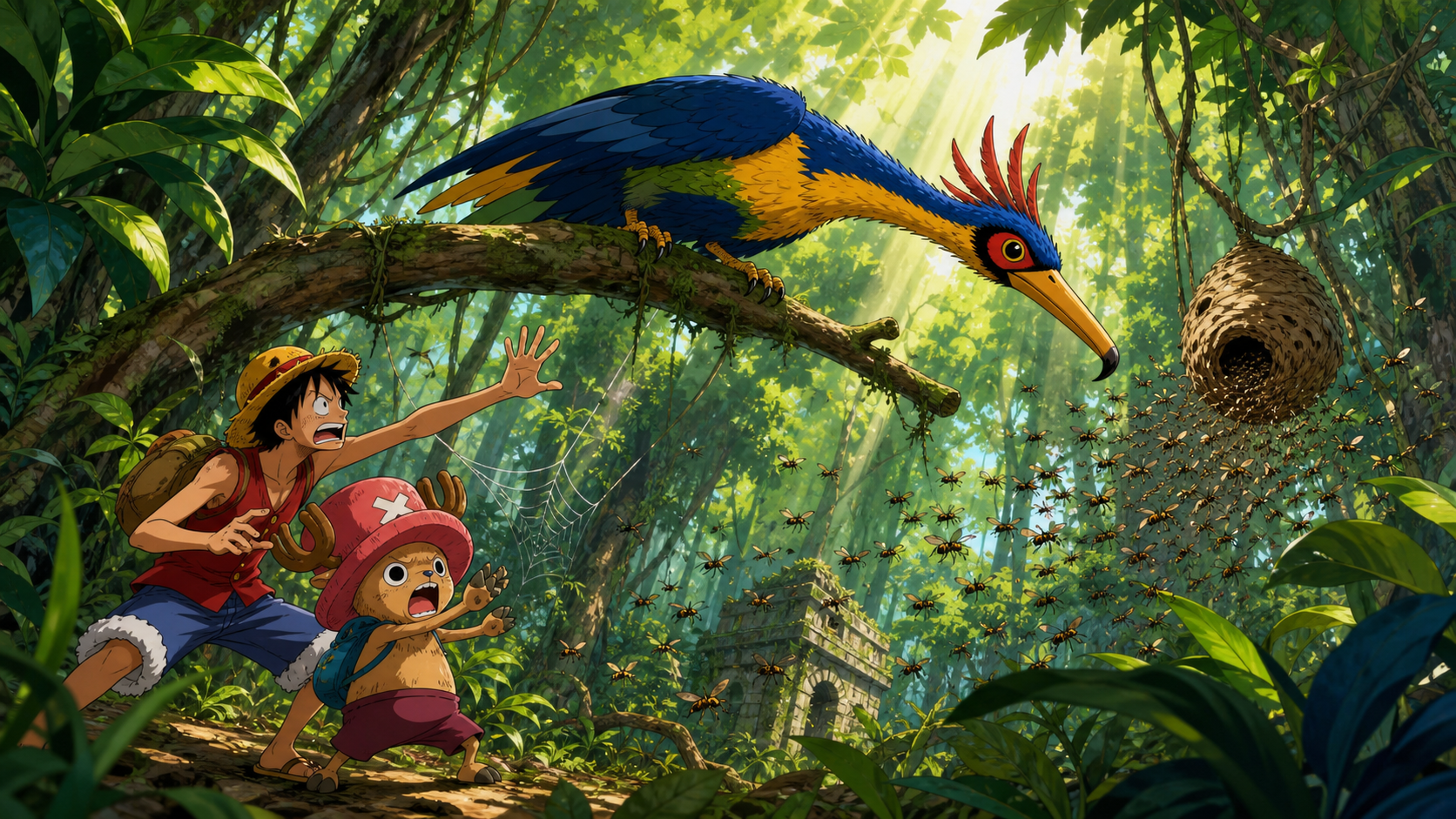
Luffy and Chopper locate a South Bird, but the animal controls the encounter. The bird watches, evades, and uses the forest around them instead of waiting to become a compass.
Direct pursuit teaches the bird exactly where danger approaches. A quieter plan would observe a feeding area, establish a soft enclosure, and reduce the number of moving people.
Chopper may be able to communicate, but shared language does not guarantee consent. The crew should explain the temporary need and offer safe release without assuming cooperation.
The bird’s intelligence changes the ethical calculation. Capture becomes a negotiation problem as much as a tracking problem.
A dropped nest turns one target into a swarm
The South Bird drops or disturbs a nest near Luffy, and insects chase Luffy and Chopper through the forest. Their pursuit creates a larger hazard than the original search.
Running without direction can lead toward cliffs, mud, other teams, or the repair site. They need a predetermined escape bearing and a signal that warns others away.
Swatting wildly may increase stings. Chopper should watch for breathing difficulty, facial swelling, dizziness, and rapid symptom changes after the chase.
The bird uses local ecology as defense. The moment reveals why knowledge of habitat matters more than strength when humans enter another creature’s territory.
Cricket’s crew modifies the Merry while her owners are absent
Cricket, Masira, and Shoujou work on the ship for vertical travel. Their salvage experience provides skills the Straw Hats lack, but modification still needs informed approval and documentation.
Usopp should receive a clear account of every brace, fastener, sail change, and altered load. He remains responsible for repairs after the alliance ends.
The builders should test attachment points and preserve access to emergency controls. A dramatic exterior cannot interfere with steering, lookout lines, or crew movement.
Because the ship carries emotional history, consultation matters beyond mechanics. Repairing for flight should not treat Usopp’s attachment as an obstacle to efficiency.
Bellamy chooses the exact moment the home is divided
Bellamy’s pirates approach Cricket’s property while the Straw Hats search and the Saruyama alliance focuses on repairs. The timing exploits distributed attention and a fixed deadline.
Mock Town gossip already revealed Cricket’s location and alleged gold. The raid demonstrates how casual disclosure becomes operational intelligence for violent people.
Cricket should have a lookout, protected evidence storage, evacuation route, and alarm signal reaching the forest teams. Gold should never be kept where one attack can erase the archive.
The Straw Hats also need a plan for returning to a compromised camp. Walking into an active fight with captured wildlife and no formation would multiply harm.
Masira and Shoujou prepare to defend more than treasure
The brothers stand between Bellamy and Cricket’s home. Their defense covers a person, a family archive, a ship under repair, and years of recovered evidence.
They should prioritize moving Cricket and the logbook before protecting gold. Objects can support truth, but no artifact justifies leaving an injured diver exposed.
Defensive force needs communication and an exit path. Shoujou’s broad sonar attack would endanger allies, the Merry, and fragile records at close range.
Bellamy wants wealth and humiliation. Refusing his framing means protecting people and evidence rather than performing strength for his audience.
Episode 149 makes preparation part of believing
The episode takes Sky Island seriously by refusing to make faith sufficient. The route requires archived evidence, ecological knowledge, engineering, timing, navigation, and cooperation across crews.
Every preparation also creates responsibility. The bird deserves safe handling, the Merry deserves honest inspection, Cricket deserves protection, and each search team deserves a return plan.
RaeRae’s verdict: keep this one. Episode 149 balances expedition comedy with a sharp lesson about how quickly urgency can excuse trespass, animal harm, and unsafe work.
The strongest preparation would end with one spoken checklist before dawn: crew count, bird condition, launch bearing, stream timing, hull status, secured cargo, medical assignments, and the exact point where Nami cancels departure. Cricket should name which claims come from observation and which remain theory. Usopp should confirm every modification he understands and identify every repair he does not trust. Chopper should check both people and the captured animal. Luffy should repeat the abort signal so no one can later claim that excitement drowned out the rule. A dream treated with care gains structure without losing wonder.
The South Bird remains uncaptured and Bellamy reaches the shore. The crew’s path upward now depends on whether preparation can survive a predator who waited for everyone to look elsewhere.