
RaeRae Reacts · One Piece Episode 151
One Punch Makes Luffy a Target
One Piece Episode 151 recovers Cricket’s proof, reveals the global response to Luffy’s bounty, and turns the 100-million man into Blackbeard’s target.
Bellamy still thinks the first beating settled the question
Episode 151 opens with Bellamy laughing at Luffy’s demand for Cricket’s gold. He treats the earlier bar assault as permanent proof that Luffy cannot fight.
Bellamy cannot imagine restraint as a choice because his worldview recognizes only domination and fear. Anyone who refuses his contest must be weak, dishonest, or irrelevant.
Sarquiss dismisses the new 100-million bounty as false rather than reconsidering what he witnessed. Evidence becomes unacceptable when evidence threatens the group’s hierarchy.
Luffy does not argue for his reputation. He names the stolen property and keeps the confrontation attached to Cricket’s harm.
Mock Town gathers to watch Bellamy attack again. Spectators treat violence as entertainment and assume the result before the first exchange finishes.
The crowd had a full day to consider Luffy and Zoro’s restraint, the bounty posters, and Bellamy’s raid. Most people choose a familiar story over accountability.
Workers should clear the boardwalk, protect bystanders, and record the stolen gold. A town that provides an audience also provides cover for escalation.
Bellamy needs laughter because public approval converts cruelty into status. Removing the audience would not stop him, but spectators do not have to strengthen the performance.
Spring Hopper turns the town into a weapon
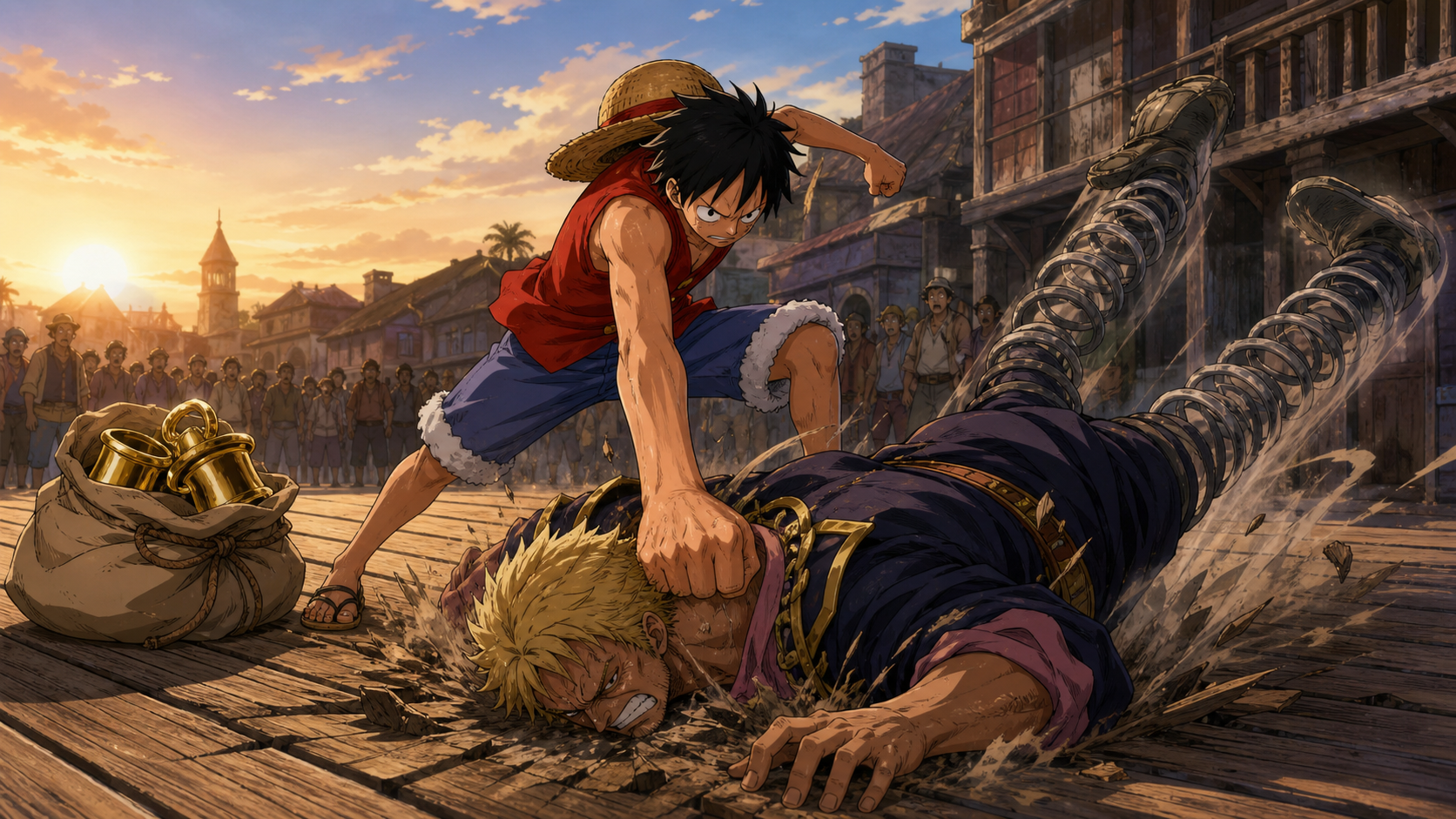
Bellamy compresses his legs and ricochets between buildings, roofs, and walkways. Mock Town’s hard surfaces give his Spring-Spring power speed and changing attack angles.
His technique endangers residents and structures beyond Luffy. Every missed trajectory can break a wall, collapse a roof, or strike someone who never entered the fight.
A responsible evacuation would create distance from rebound surfaces and open a clear corridor toward the shore. The town instead crowds closer.
Luffy watches rather than chasing. Bellamy’s speed matters less when his path must eventually return to the person he wants to hit.
Bellamy mistakes movement for control
The spring attack looks overwhelming because Bellamy fills the visible space. He controls where the crowd looks without controlling Luffy’s attention.
Fast movement can hide repeated patterns. Compression, launch, rebound, approach, and recovery create a cycle that observation can expose.
Bellamy believes spectacle proves superiority, so he keeps announcing the attack through noise and destruction. Restraint would require a goal beyond humiliation.
Luffy needs one reliable opening rather than a longer exchange. The simplest response also limits additional damage to Mock Town.
A single punch ends the philosophy Bellamy performed
Luffy strikes Bellamy once and drives him into the boardwalk. The fight ends before Bellamy can revise the scene into another public lesson about dreamers.
The punch matters because Luffy refused the same opponent when only pride was at stake. Force arrives after robbery, assault, and harm to allies.
Decisive force still needs limits. Luffy does not continue beating an unconscious opponent, punish the crowd, or attack every Bellamy Pirate.
The contrast exposes Bellamy’s error: capacity and willingness are different facts. Luffy always possessed force and chose when the reason justified use.
Recovery of the gold keeps the action tied to Cricket
Luffy gathers Cricket’s gold rather than waiting for admiration. The artifacts remain the purpose of his return to Mock Town.
He should confirm the inventory against Cricket’s records and preserve fragile surfaces during transport. A sack protects speed more than archaeological context.
Any missing piece, broken item, or contaminated record should be documented before leaving. Recovery cannot be assumed complete because the largest objects are visible.
The town owes witness accounts and restitution for property damage connected to the raid. Bellamy’s defeat does not erase everyone who helped locate Cricket or watched the theft.
Sarquiss understands the raised fist before hearing a threat
Sarquiss tries to challenge Luffy after Bellamy falls, but fear spreads when Luffy raises the fist marked by the confrontation.
The gesture works because the crew just received evidence that their hierarchy can collapse in one strike. Luffy does not need another victim to communicate capacity.
He points upward when asked where he is going. Sky Island remains the destination even after Mock Town spent two episodes treating the dream as a joke.
Luffy leaves with the gold and a deadline. Victory has value only if he returns to the launch Cricket prepared.
Mihawk reads the new bounties as movement in the world
Dracule Mihawk receives Luffy and Zoro’s updated posters at sea. He recognizes that their actions around Crocodile now disturb the government’s preferred balance.
A bounty is a state document, not a neutral biography. The amount still signals how urgently institutions want other people to treat a target.
Mihawk’s interest shows that recognition travels beyond Mock Town’s small social order. Zoro’s promise and Luffy’s rise now register among established powers.
Neither man controls the audiences receiving those images. Friends, rivals, opportunists, and officials can interpret the same paper toward different ends.
The Five Elders discuss balance as an administrative problem
At Mary Geoise, the Five Elders receive reports about Crocodile’s defeat and the vacant Warlord position. Their language centers stability among great powers.
The meeting treats affected communities as abstractions. Alabasta’s suffering matters mainly because one sanctioned pirate no longer performs the role assigned by government.
Replacing Crocodile without examining how the system enabled him would reproduce the same structural risk under a new name.
Accountability requires records of oversight failures, victims, secret operations, and government knowledge. A vacancy is not the whole problem.
Shanks contacting Whitebeard alarms the world’s highest authority
The government learns that Red-Haired Shanks has sent a messenger to Whitebeard. Officials consider direct contact between the two pirate powers dangerously destabilizing.
Their fear reveals a limit of formal authority. The government can issue titles and bounties while remaining unable to control which powerful people speak to one another.
Interception may prevent a meeting or destroy information that could reduce danger. Officials need evidence about purpose before treating communication itself as an attack.
The episode expands Jaya’s theme: institutions often prefer a controllable story to an uncertain conversation.
Warlord participation exposes coercion inside the meeting
The gathering includes pirates whose government status does not make them ordinary public servants. Their presence is built on leverage, exemption, and mutual usefulness.
Doflamingo demonstrates control over another person’s body, turning the room into a warning about what sanctioned power can do without immediate consequence.
Officials who tolerate intimidation during selection cannot credibly promise that the chosen replacement will protect civilians outside the chamber.
A legitimate process would set disclosure rules, conflict checks, enforceable limits, and removal procedures. The Warlord system offers prestige before accountability.
Lafitte enters uninvited with a candidate no one recognizes
Lafitte appears at Mary Geoise and recommends his captain, Marshall D. Teach, for Crocodile’s vacant position. Sengoku does not recognize the name.
Lack of public reputation should trigger investigation rather than admiration for confidence. A candidate seeking legal power while promising a dramatic demonstration creates immediate risk.
Lafitte’s ability to reach the meeting also raises a security failure. Officials cannot evaluate his proposal while ignoring how an unauthorized pirate entered a protected space.
The nomination turns obscurity into strategy. Teach plans to manufacture the record required for institutional access.
Whitebeard refuses to receive Shanks through a subordinate
Rockstar carries Shanks’s letter to Whitebeard and encounters a crew that treats rank, history, and personal presence as essential to respect.
Whitebeard tears the message and says Shanks should come himself with good drink. The rejection humiliates the messenger without resolving the warning.
Rockstar should not carry responsibility for two captains’ status dispute. A messenger needs safe passage, clear authority, and a route to report refusal.
Whitebeard’s medical setting also shows power alongside vulnerability. Nurses and treatment do not reduce his command, but health should inform meeting safety and timing.
Shanks responds by preparing to go personally
Rockstar reports through a Den Den Mushi, and Shanks accepts that the message failed. He tells the crew to prepare for direct contact.
Going personally may satisfy Whitebeard’s protocol while increasing the government’s fear of an alliance or confrontation.
Shanks needs a clear agenda, limits on escort size, and communication channels that reduce accidental escalation before the ships meet.
The episode does not reveal the full warning yet. Viewers should preserve uncertainty rather than filling the missing content with later knowledge.
Blackbeard’s name reorganizes the strangers from Mock Town
Lafitte identifies Marshall D. Teach as his captain, revealing the bearded stranger who defended dreams as Blackbeard. The earlier pie argument and dream speech gain new strategic weight.
Shared belief never established shared ethics. Teach values ambition while preparing to use another person’s capture as proof of worth.
His crew’s unusual members now read as a coordinated unit rather than unrelated eccentric people scattered across town.
Luffy and Zoro’s caution outside the bar was justified. Recognition of a familiar principle did not require trust in the speaker.
A 100-million bounty becomes Blackbeard’s application material
Teach sees Luffy’s new poster and selects him as a target valuable enough to make the Blackbeard name known. A government number becomes an incentive for private capture.
The Warlord vacancy creates the market. Officials seek a replacement, Lafitte promises a demonstration, and Teach identifies a person whose body can become the credential.
This chain separates institutional violence from direct orders while preserving the result. The government may never name Luffy to Teach, yet the system teaches him what proof will be rewarded.
Blackbeard calls the pursuit fate. Naming strategy as fate can hide planning, choice, and responsibility behind inevitability.
Mock Town cannot contain the scale of the episode anymore
Bellamy’s defeat feels enormous to the people who built their social order around him. Beyond Jaya, governments and legendary crews are already moving around larger questions.
The episode shifts from one boardwalk to Mary Geoise, Whitebeard’s ship, Shanks’s crew, Mihawk at sea, and Blackbeard’s pursuit.
Scale does not make the local harm trivial. Cricket’s stolen gold remains the reason Luffy acted, even while that action changes how distant powers read his name.
Good worldbuilding preserves both levels: one injured person deserves recovery, and the recovery can still alter a global system.
Luffy leaves before the new danger receives a name
Luffy is already carrying the gold back across Jaya while Teach decides to hunt the 100-million man. The two routes move toward different futures without either captain seeing the full map.
The Straw Hats have a South Bird, a repaired ship, and a launch deadline. Blackbeard has a crew, a political objective, and information that may send him after them.
Nami needs the Merry ready to depart immediately after Luffy returns. Delay now exposes the wounded alliance to Bellamy’s remnants and the crew to a stronger pursuer.
Cricket should receive the recovered evidence before launch if time allows. The act belongs to him, not to Luffy’s reputation.
Episode 151 makes recognition more dangerous than ridicule
Luffy disproves Mock Town’s judgment with one punch, but recognition does not create safety. The bounty that silences Bellamy’s crowd also attracts Blackbeard.
Government meetings, pirate messages, and wanted posters all convert people into strategic information. Every institution in the episode decides whose name has value and why.
The episode also offers a checklist for the hours after a public confrontation. Cricket’s artifacts need an inventory, Bellamy and his crew need identification, witnesses need statements, injured alliance members need continued care, and the Merry needs another inspection before launch. Luffy’s deadline should remain visible to every person finishing the ship. Mock Town residents who disclosed Cricket’s location should understand how their gossip enabled the raid. None of those duties disappear because one punch produced a memorable ending.
Beyond Jaya, the same discipline applies at larger scale. The Five Elders need to examine Crocodile’s victims before filling his seat. Shanks and Whitebeard need a meeting protocol that protects messengers and crews. Sengoku needs evidence about Teach before considering Lafitte’s proposal. Wanted posters need to be read as government claims with consequences, not complete accounts of human beings. Episode 151 connects each failure through people acting on compressed information while refusing the context that might slow them down.
RaeRae’s verdict: keep this one. Episode 151 delivers a satisfying end to Bellamy’s performance while refusing to let victory become a simple reward.
Luffy recovers ten years of Cricket’s proof and immediately becomes proof for someone else’s ambition. The road to the sky now runs beneath a world already rearranging around his name.