
RaeRae Reacts · One Piece Episode 128
Escape from Alabasta
One Piece Episode 128 gives the Straw Hats a feast, Hina a blockade, Bon Clay an escape plan, and Vivi a noon deadline that changes everything.
The feast is emergency recovery wearing a party hat
Episode 128 finally lets the Straw Hats eat, laugh, and make a mess in the palace dining hall. After poison, blood loss, dehydration, explosions, and a civil war, food becomes more than a punch line.
Luffy treats the table like a competitive sport because his body has been running on stubbornness. Sanji notices the kitchen. Chopper should notice every plate, bruise, and bandage. The crew needs calories, salt, water, sleep, and medical follow-up before anybody calls them recovered.
The episode earns the comedy because the danger has not disappeared. Hina is already closing the ports. Every ridiculous bite sits beside a clock.
Joy belongs in the aftermath
Serious recovery does not require permanent misery. People who survived catastrophe need permission to laugh without proving that the losses meant nothing.
The palace feast creates a small room where the crew can be loud instead of brave. Nobody asks Vivi to deliver a speech every minute. Nobody asks Luffy to stand like a statue. Their friendship looks ordinary again, which may be the most healing image available.
Joy becomes dangerous only when leaders use celebration to bury accountability. Alabasta still needs investigations, aid, memorials, and honest records. A meal can coexist with that work.
The bathhouse chaos returns every body to itself
The great bath gives the episode another burst of comedy, but bathing also marks a boundary between battle and departure.
Dust, dried blood, smoke, and poison residue have followed the crew across the desert. Clean water offers warmth and privacy after days when every body became a weapon, shield, target, or patient.
The joke-heavy scene should never erase consent or dignity. Recovery spaces work when people control who sees them, who touches them, and when they leave. Comedy lands best when nobody’s discomfort becomes compulsory entertainment.
Cobra says thank you without buying the crew
Cobra thanks the Straw Hats again because one sentence underground could never carry the whole debt.
He does not offer Luffy a title, military post, or political bargain. That restraint respects the crew’s freedom and keeps gratitude from becoming a contract.
Material thanks still matter. The palace can provide food, treatment, supplies, repairs, intelligence, and a safe route. Friendship does not require an invoice, but leadership should not use Luffy’s refusal of ceremony as an excuse to withhold care.
Higher bounties turn rescue into evidence against the rescuers
Luffy’s bounty rises, and Zoro becomes a wanted man. The government looks at Alabasta and sees more dangerous pirates.
That framing exposes the problem with reputation systems controlled by power. Luffy defeated a state-approved criminal and helped stop a war. Zoro protected civilians and his crew. Their reward is a larger target.
A bounty does not measure morality. A bounty measures how strongly the state wants control. Sometimes danger and wrongdoing overlap. Episode 128 makes the gap impossible to ignore.
Hina blocks the ports instead of chasing one road
Hina responds like an officer who understands geography. She seals Alabasta’s ports to remove the crew’s obvious exits.
The blockade raises pressure without undoing Tashigi’s choice. One Marine unit protected the exhausted pirates in a specific moment. Another officer now applies standing orders across the coast.
That difference shows why individual decency cannot substitute for institutional reform. Tashigi bought time. Hina’s fleet proves that the larger machine still moves.
A blockade affects civilians before pirates
Closing ports can trap the Straw Hats, but ships also carry medicine, grain, repair materials, workers, refugees, and news.
Alabasta has just survived drought and war. Any blockade needs humanitarian lanes, published rules, medical exceptions, and a short review schedule. Otherwise, a pirate hunt shifts cost onto citizens who never joined the chase.
Hina may see a tactical perimeter. Port families see lost wages, delayed supplies, and another armed authority controlling movement. Both views exist at once.
The timing makes those costs sharper. Rain has only just returned, roads may be damaged, local stores are depleted, and displaced families need supplies from outside the capital. Marine commanders should coordinate with civilian harbor leaders instead of treating every boat as a possible accomplice. Search rules need limits, written records, and appeal routes. Otherwise, emergency security becomes another source of arbitrary power.
Smaller fishing crews deserve protection as well. A large merchant can absorb delay more easily than a family that sells one day’s catch. Fair enforcement measures harm by household, not only by tonnage. Hina’s operation may catch a pirate ship. Alabasta should still document every civilian cost created along the way.
Bon Clay moves the Merry before the trap closes
Bon Clay has moved the Going Merry upstream on the Sandora River, turning a blocked harbor into a solvable problem.
The plan works because he acts before the crew can ask. He reads the danger, protects the ship, and creates a meeting point beyond the obvious Marine net.
This is practical solidarity. Grand declarations are easy. Moving someone else’s ship through hostile territory, keeping the route secret, and waiting under pressure require competence.
The Merry is home, transport, and evidence of continuity
The crew cannot continue without the Going Merry. Their ship holds supplies, tools, personal objects, memories, and the physical pattern of daily life.
Protecting the Merry protects more than property. Displacement after a crisis often strips people of every familiar object. Returning to the ship gives the Straw Hats a stable center while the world around them changes.
The vessel also carries damage. Usopp and the crew should inspect the hull, rigging, water stores, medical supplies, and food before a high-speed escape. Urgency cannot make wood unbreakable.
The Super Spot-Billed Ducks become the escape engine
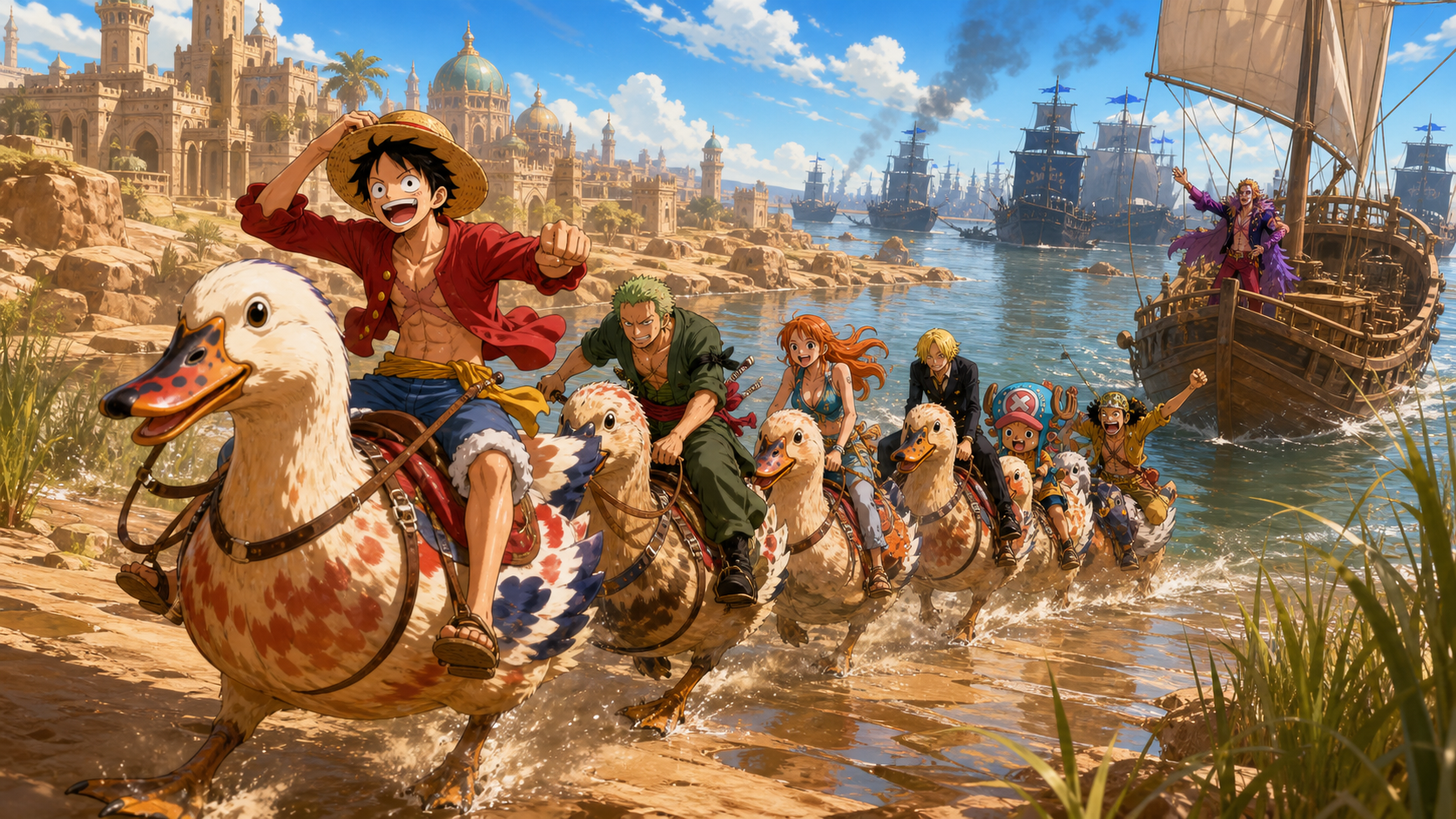
The crew rides the Super Spot-Billed Duck Squad toward the upstream rendezvous. The animals turn logistics into glorious chaos.
Karoo and the ducks already proved that Alabasta’s resistance never belonged to humans alone. They carried messages, crossed danger, protected riders, and kept moving through exhaustion.
Care must follow service. The ducks need water, rest, wound checks, safe footing, and handlers who recognize stress. A heroic animal is still a living worker, not a disposable vehicle.
The escape succeeds through local knowledge
Hina controls the ports. Bon Clay knows where to move the Merry. The ducks know the terrain. Vivi understands the capital and the risks around her decision.
The Straw Hats survive because they trust people who understand Alabasta better than they do. Luffy’s strength cannot replace a river route, a hidden ship, or a fast mount.
That humility makes the crew effective. They lead when force is needed and follow when somebody else owns the map.
Vivi receives a deadline instead of emotional pressure
The crew tells Vivi that anyone who wants to keep traveling should meet them at the eastern port at noon.
They do not drag her away, demand an answer in front of the palace, or make friendship depend on immediate obedience. The deadline is real because escape cannot wait forever, but the decision remains hers.
That balance matters. Freedom without time can become fantasy. Time without choice becomes coercion. The crew offers both a door and a closing hour.
Vivi is choosing between two real lives
Traveling with the Straw Hats means freedom, danger, chosen family, and a future she cannot predict.
Staying means reconstruction, public duty, grief work, institutional repair, and a country that knows her voice. Neither path proves more courageous.
Stories often frame adventure as freedom and responsibility as surrender. Vivi’s dilemma rejects that shortcut. She may want the sea and still choose Alabasta. She may love her people and still feel trapped by their need. Both feelings can be true.
Her decision also belongs to a young woman whose country has treated her body, voice, and schedule as public property. Advisors may call staying obvious. Friends may secretly hope she leaves. Citizens may read departure as abandonment. None of those pressures should replace her own answer.
A healthy palace would prepare for either choice. Cobra and the council need a succession and reconstruction plan that does not collapse without Vivi. The Straw Hats need an escape plan that does not punish her absence. Real choice exists only when both groups can survive the answer they do not want.
Noon at the eastern port is a trust test
The meeting point turns the next episode into a countdown. Every crew member knows what they hope to see. Nobody can make Vivi appear.
Trust means preparing to leave whether she comes or not. The Merry must be ready. The escape route must remain clear. The crew cannot expose Alabasta by lingering under a blockade.
Their restraint protects Vivi from having to reject them face to face before an audience. She can decide in private, then act.
Recovery work continues after the pirates leave
Alabasta still needs triage, shelter, clean water, food distribution, missing-person searches, evidence preservation, mine and weapons clearance, and transparent aid records.
Rebel communities need protection from retaliation. Royal officials need review. Baroque Works victims need routes to testimony and compensation. People who lost homes or family members need long-term support beyond the first rain.
The Straw Hats helped create space for recovery. They cannot perform recovery for the country. Vivi’s choice carries that difference.
Production lets comedy carry the countdown
Yoshiyuki Suga’s script connects the feast, bath, Cobra’s thanks, bounty news, Hina’s blockade, Bon Clay’s ship move, the duck ride, and Vivi’s noon decision.
Junji Shimizu’s direction keeps the palace comedy fast while the Marine perimeter tightens outside. Every laugh buys emotional release, and every cut toward escape planning reminds us that safety has an expiration time.
Noboru Koizumi’s animation direction gives the dining and bathhouse scenes elastic energy, then turns the duck charge into controlled motion. Miyuki Sato and Toshiaki Marumori keep Alabasta warm and bright after the rain without erasing damage.
What Episode 128 changes
The Straw Hats recover through a chaotic palace feast and bath while Cobra thanks them again.
Luffy’s bounty increases, and Zoro receives his first bounty.
Hina seals Alabasta’s ports to capture both men and their crew.
Bon Clay moves the Going Merry upstream on the Sandora River, giving the pirates another exit.
The crew rides the Super Spot-Billed Ducks toward the ship and tells Vivi to meet them at the eastern port by noon if she wants to continue traveling.
Episode details
Japanese title: 海賊たちの宴とアラバスタ脱出作戦!
English title: The Pirates’ Banquet and Operation Escape from Alabasta
Japanese broadcast: October 6, 2002
Saga: Alabasta
Material: Manga-canon adaptation
Script: Yoshiyuki Suga
Episode direction: Junji Shimizu
Animation direction: Noboru Koizumi
Art: Miyuki Sato and Toshiaki Marumori
The official One Piece guide confirms the palace feast and bath, Cobra’s thanks, Luffy’s higher bounty, Zoro becoming wanted, Hina’s port blockade, the Super Spot-Billed Duck escape, Bon Clay moving the Merry upstream, and the eastern-port invitation to Vivi. The medical, consent, animal-care, blockade, recovery, logistics, labor, and public-accountability analysis is RaeRae’s reading of those events.
Final verdict
Episode 128 earns a 9 out of 10. The episode knows that laughter after a war is not disrespect. Laughter is proof that the crew can feel something beyond survival again.
Bon Clay steals the practical MVP title by moving the Merry before Hina closes the cage. Karoo and the ducks turn a military escape into pure One Piece chaos. Cobra offers gratitude without ownership. The crew gives Vivi a choice without pretending that time has stopped.
The feast works because the story refuses to live inside trauma forever. Luffy can inhale a table, the crew can wreck a bath, and Sanji can lose his mind without cheapening the people who died. Grief and comedy share the palace because survivors contain more than one emotion. That range feels more honest than a single solemn note.
The escape planning also respects every kind of labor that big victories hide. Someone feeds the crew. Someone cleans wounds. Someone moves the ship. Animals carry riders. Local allies protect routes. A king shares intelligence. A navigator keeps time. Luffy remains the captain, but nobody escapes through captain energy alone.
The strongest beat is the noon deadline. Vivi has spent the entire arc fighting for her country. Now she must decide whether saving Alabasta means staying inside the future she created. The Straw Hats leave the door open, trust her to choose, and race toward the river because love does not cancel the blockade.