
RaeRae Reacts · One Piece Episode 129
The Mark of Friendship
One Piece Episode 129 gives Bon Clay his stand, Vivi her choice, and the Straw Hats a silent farewell that defines chosen family.
The Black Spear formation turns escape into a wall
Episode 129 starts with the Going Merry and Bon Clay’s Swanda trapped inside Hina’s Black Spear formation. The open sea is visible, but access has become a military problem.
Hina does not need to beat Luffy in a dramatic duel. She needs ships positioned well enough to remove space, time, and safe choices. The formation turns geography into force.
The crew also carries a promise. Reaching the eastern port is not only an escape objective. Vivi may be waiting. Every delay now threatens both freedom and a goodbye that cannot happen twice.
Bon Clay understands the promise before the plan
Bon Clay learns that the Straw Hats must meet a friend. He does not demand the friend’s identity or ask whether the promise deserves his risk.
That response matters. Friends often reveal trust by respecting what remains private. Bon Clay needs only one fact: Luffy gave his word.
He then treats that promise as part of the escape calculation. The crew cannot simply choose the safest route if safety means abandoning Vivi without an answer.
Becoming Luffy turns performance into protection
Bon Clay uses his power to become Luffy and draw Hina’s attention. The man known for performance turns imitation into a shield.
The disguise works because the Marines recognize a face and a bounty before they recognize truth. Hina’s forces chase the image the government taught them to fear.
Bon Clay weaponizes that weakness. He gives the uniformed machine exactly the target shape expected, then uses the confusion to create space for the real crew.
Sacrifice does not erase the need for a rescue plan
Bon Clay charges toward overwhelming force, and the episode frames his stand as glorious. The courage is real. So is the danger of treating self-destruction as the highest form of friendship.
The Straw Hats should remember his route, ship, crew, injuries, capture risk, and likely detention sites. Gratitude needs follow-through when survival remains possible.
A friend who buys time deserves more than a tearful memory. He deserves witnesses, legal information, medical care, and a future attempt to bring him home.
The same rule applies to the Swanda. A damaged ship can strand survivors even after the diversion succeeds. Allies on shore should track currents, debris, Marine movements, and any captured crew. The Merry cannot turn back during the immediate chase, but urgency should create a delayed rescue plan rather than permanent abandonment.
Bon Clay chooses the stand with open eyes. Respecting that agency means honoring the decision without treating his life as already spent. Heroism should expand the circle of people worth saving, not quietly remove the hero from that circle.
The Swanda crew shares the cost
Bon Clay does not stand alone. His people follow a plan that places their ship directly in Hina’s path.
Leadership cannot turn their risk into background decoration. Every crew member deserves recognition as a decision-maker and worker, not merely an extension of one flamboyant captain.
Their sacrifice buys minutes for the Merry. Those minutes carry names, labor, and bodies. One Piece comedy often moves fast, but accountability should slow down long enough to count everyone.
Vivi leaves the ceremony to make her own goodbye
Vivi and Karoo step away from the formal investiture ceremony and reach the coast. The choice returns control of her farewell to her.
A palace ceremony belongs to the country. The eastern port belongs to the friends who crossed the desert together. Vivi needs both spaces because public duty and private love are not interchangeable.
Karoo’s presence matters too. He traveled, carried messages, protected Vivi, and shared the crew’s danger. The goodbye belongs to him as much as anyone.
Staying is not a rejection of adventure
Vivi tells the crew goodbye. She chooses Alabasta after learning exactly what life aboard the Merry could offer.
That choice does not make her timid. Rebuilding a country after war requires courage without applause, repetitive meetings, painful testimony, budget fights, public criticism, and years of work.
Adventure opened Vivi’s world. Staying lets her apply what she learned. Freedom can mean leaving. Freedom can also mean choosing responsibility without coercion.
Her memories aboard the Merry will still shape palace decisions. She has seen how ordinary workers survive outside royal protection, how information fails between regions, how bounty systems distort public truth, and how quickly scarcity becomes a weapon. Travel gave her knowledge that no formal lesson could reproduce.
Vivi also keeps the right to change. Staying today does not sign away every future voyage. Leadership should not become a life sentence imposed through public gratitude. Alabasta can love its princess while building systems that let her rest, travel, grieve, and remain a person beyond the office.
Alabasta cannot make Vivi its entire recovery plan
Vivi’s decision creates hope, but the kingdom must not respond by placing every reconstruction burden on one young woman.
Cobra, Chaka, Igaram, local leaders, former rebels, medical workers, engineers, farmers, and community organizers all need defined authority. Recovery fails when everyone waits for the princess to solve each problem.
Vivi can represent trust and direction. Sustainable government requires teams, transparent records, public participation, rest, and leaders who can disagree without restarting a war.
The crew cannot answer without endangering Vivi
Marine ships can see the farewell. If the Straw Hats openly identify Vivi as their friend, the government could treat the princess as a pirate collaborator.
Silence becomes protection. The crew must absorb the pain of seeming cold because a spoken answer could damage the person they want to comfort.
This is not emotional cowardice. The danger is visible, immediate, and institutional. They choose a language the Marines cannot easily turn into evidence.
The left-arm mark becomes a complete sentence
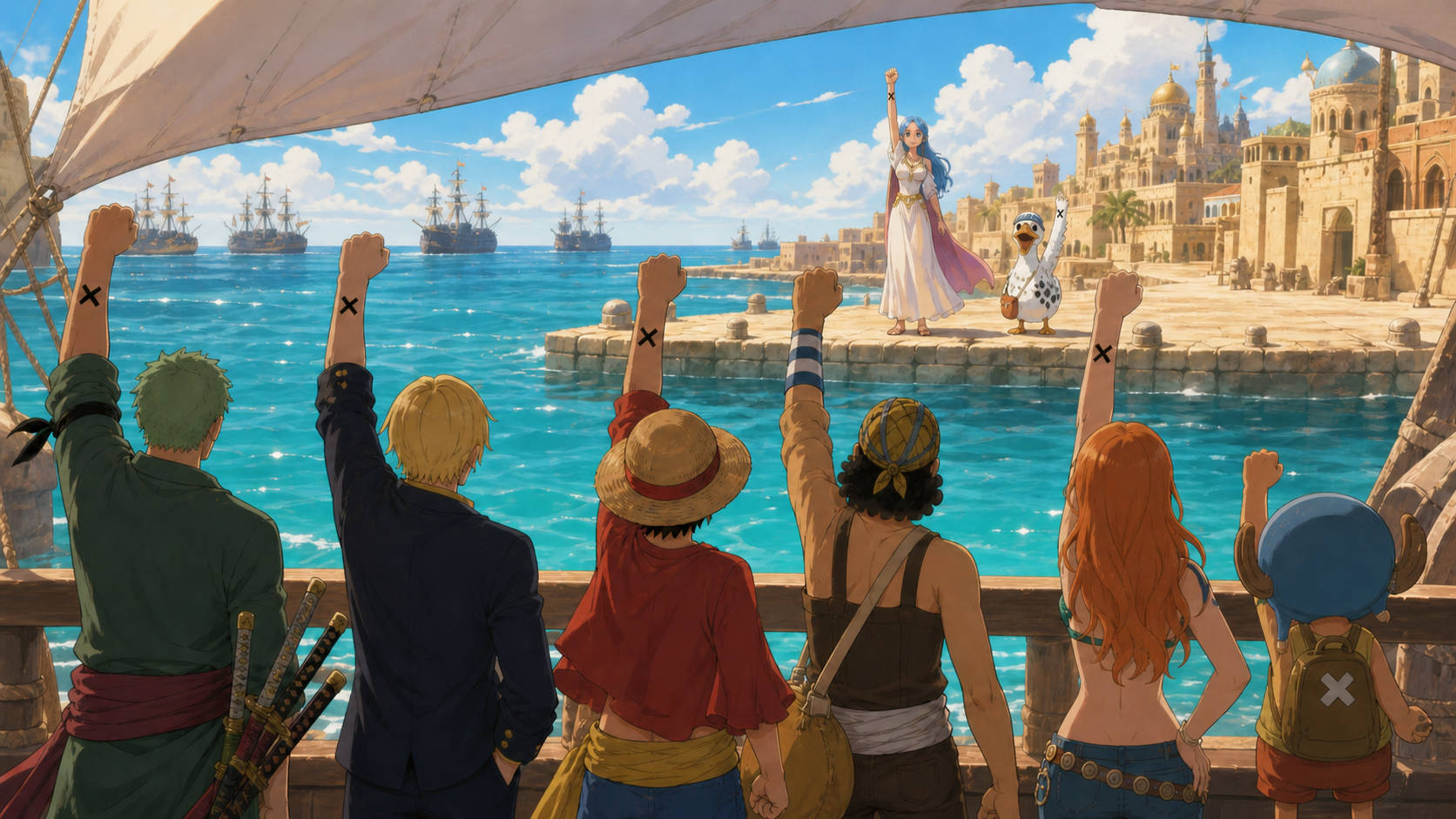
Every Straw Hat raises a left arm bearing the same black friendship mark. No speech could say more.
The mark began as a practical defense against impersonation. Shared danger changed its meaning. What once proved identity now proves relationship.
Vivi sees the answer immediately: you are our friend, you remain one of us, and distance cannot rewrite what happened. The symbol works because every member participates.
The gesture also avoids ranking grief. Luffy does not stand above the others and deliver a captain’s answer. Zoro, Nami, Usopp, Sanji, and Chopper raise their arms in one line. Nobody owns the friendship more than another.
That collective answer matters for Vivi because every relationship developed differently. Nami shared political fear. Luffy shared impossible confidence. Zoro protected the mission. Usopp brought nerve through terror. Sanji worked behind the lines. Chopper gave care. One mark holds several bonds without flattening them.
A coded gesture protects both truth and safety
Oppressed and surveilled communities have always built meaning into gestures, clothing, songs, objects, and shared routines.
The raised arms give Vivi public affirmation without handing the Marines a clear spoken confession. The code belongs to the people who lived the journey.
Secrecy should not become romantic by default. People use coded language because direct speech carries consequences. The beauty comes from solidarity under pressure, not from the pressure itself.
Karoo receives the same promise
Karoo raises his marked wing beside Vivi. The crew’s answer includes him.
He carried Vivi across impossible distances, raced through gunfire, endured injury, and kept choosing the mission. Treating him as comic transport would erase a full member of the Alabasta team.
The shared mark recognizes agency across species. Karoo may communicate differently, but his loyalty and fear were never less real.
Bon Clay and Vivi define two forms of friendship
Bon Clay moves toward danger so the crew can leave. Vivi stays behind so her country can rebuild.
One friend protects the journey through sacrifice. Another protects home through commitment. Neither choice requires ownership of Luffy or a place aboard the Merry.
The episode refuses a narrow crew roster as the only measure of belonging. Some friends travel beside you. Some create the distance that lets you continue.
The Marines witness an image they cannot fully read
Hina’s forces can see raised arms, a departing ship, and a princess on shore. They cannot access the history stored inside the marks.
That gap exposes the limit of surveillance. Power can collect images without understanding relationships. Context belongs to the people who shared the risk.
The government may still suspect the truth. Suspicion is different from forcing Vivi to provide a public statement against her friends.
Vivi’s safety will depend on what officials do next. Palace staff should avoid destroying records or coaching witnesses, because frantic concealment can create stronger accusations. A careful public position can acknowledge that unnamed outsiders helped stop Crocodile without supplying operational details that endanger the crew.
The Marines also face a choice. They can treat one gesture as proof of treason, or they can focus on the Warlord who manufactured a civil war. Institutions reveal priorities through which facts receive resources.
Production earns the farewell through restraint
Yoshiyuki Suga’s script connects the Black Spear trap, Bon Clay learning about the promise, his Luffy disguise, the Swanda stand, Vivi and Karoo leaving the ceremony, her goodbye, the crew’s silence, and the raised marks.
Daisuke Nishio’s direction lets naval pressure and emotional distance share the same frame. The sea between ship and shore becomes protection, separation, and proof that the journey continues.
Kazuya Hisada’s animation direction gives every raised arm individual weight without breaking the collective line. Miyuki Sato and Fumihiro Uchikawa hold Alabasta’s gold against open ocean blue, making home and departure equally beautiful.
What Episode 129 changes
Hina’s Black Spear formation traps the Going Merry and Bon Clay’s Swanda.
Bon Clay learns that the Straw Hats have a promise to keep, becomes Luffy, and draws the Marines toward his own ship.
Vivi and Karoo leave the ceremony and reach the eastern port.
Vivi chooses Alabasta and says goodbye rather than continuing aboard the Merry.
Unable to speak safely in front of the Marines, the crew raises the shared friendship marks on their left arms.
Episode details
Japanese title: 始まりはあの日!ビビが語る冒険譚
English title: The Day the Story Began! Vivi Tells Her Adventure
Japanese broadcast: October 20, 2002
Saga: Alabasta
Material: Manga-canon adaptation
Script: Yoshiyuki Suga
Episode direction: Daisuke Nishio
Animation direction: Kazuya Hisada
Art: Miyuki Sato and Fumihiro Uchikawa
The official One Piece guide confirms Hina’s Black Spear formation, Bon Clay learning about the promise, his Luffy disguise and stand, Vivi and Karoo leaving the ceremony, Vivi’s goodbye, the danger of speaking before the Marines, and the raised left-arm marks. The surveillance, labor, recovery, governance, animal-agency, consent, sacrifice, and coded-solidarity analysis is RaeRae’s reading of those events.
Final verdict
Episode 129 earns a 10 out of 10. Bon Clay turns performance into protection, Vivi turns love into responsibility, and the Straw Hats turn silence into the loudest answer in the arc.
The farewell works because nobody treats Vivi as property. Luffy gave her a door. She chose Alabasta. The crew hurts, respects the answer, and makes sure she never mistakes respect for rejection.
Bon Clay deserves the same emotional clarity. His stand is not a comic detour before the famous arm raise. Without his diversion, Hina controls the meeting. He protects the crew’s chance to honor Vivi, which makes him part of the farewell even from another ship.
The episode balances three painful truths: friends can choose different futures, love sometimes requires silence, and escape can depend on somebody who stays behind in danger. None receives an easy fix. The story simply shows people making the least harmful choice available and trusting the relationship to survive.
Vivi’s answer also protects the arc from an easy recruitment ending. She mattered before meeting Luffy, and she keeps a purpose beyond joining him. The crew expands her choices without swallowing her story. That respect makes the bond feel permanent because nobody needs constant proximity to prove loyalty.
Alabasta keeps its princess, but the sea keeps a place for their friend.
Those raised arms are bigger than a crew pose. They say friendship survived secrecy, war, distance, law, and a choice that placed people on different shores. Vivi stays. The Merry sails. Nobody takes the mark away.