
RaeRae Reacts · One Piece Episode 127
Different Ideas of Justice
One Piece Episode 127 tests several kinds of justice as Tashigi arrests Crocodile, protects Luffy’s crew, and Alabasta finally disarms.
The war ends when people put the weapons down
Episode 127 opens after the miracle and refuses to confuse silence with peace. Rain has reached Alubarna, Crocodile has fallen, and Vivi finally broke through the battlefield noise. None of those victories automatically disarms thousands of frightened people.
Chaka gives the royal army a plain order: throw away the weapons. That command matters because a ceasefire needs visible proof. A soldier cannot read every stranger’s intentions, but everyone can see an empty hand. One sword hitting wet stone gives the next person permission to release another.
The episode understands the difference between defeating a villain and ending the system he built. Luffy removes Crocodile. Vivi restores contact. Chaka turns that contact into a shared action. Peace arrives through several people doing separate jobs at the right moment.
Chaka chooses de-escalation over victory theater
Chaka could frame the royal army as the winning side. He does the opposite. His soldiers lower their weapons first, which accepts the risk that peace always demands from somebody.
That choice does not make the rebels innocent or the palace perfect. Alabasta still carries legitimate anger about drought, power, and secrecy. Chaka simply recognizes that another swing will kill someone who no longer needs to die.
Leaders love ordering courage when someone else pays. Ordering restraint requires a different spine. Chaka has to trust Vivi, trust the rain, trust the evidence, and trust tired people to recognize an exit from the nightmare.
Igaram brings the missing evidence into public view
Igaram returns with the man who posed as Cobra in Nanohana. The deception finally receives a human witness who can explain what happened.
Baroque Works did not win support through one persuasive speech. The organization staged royal cruelty, manipulated scarcity, planted agents, and repeated lies until neighbors treated each other as enemies. Exposing the false Cobra gives citizens a concrete bridge between private suspicion and public proof.
A fair recovery process needs more than one frightened confession. Investigators should document who issued orders, who supplied Dance Powder, which officials disappeared, how messages were intercepted, and where money moved. The witness begins the record. He should not become the whole record.
Cobra does not steal the rescue
Cobra entrusts Luffy to Zoro and the others instead of turning the pirate captain into a royal trophy. That restraint protects the crew from a public ceremony they cannot safely attend.
The king knows Luffy saved his country. He also knows the Marines will not erase a pirate warrant because gratitude feels correct. Cobra therefore helps without pretending that the institution outside Alabasta suddenly became simple.
His decision respects Vivi as well. She can speak for her country without forcing her friends to stand beside the throne as political endorsements. Friendship survives because the palace does not convert rescue into ownership.
The Straw Hats finally spend their last ounce of strength
Zoro and the crew carry Luffy until every body gives out. They collapse on the roadside together, dirty, injured, and completely finished.
That image corrects the usual victory pose. The Straw Hats did not walk through Alabasta untouched because they possessed superior spirit. They survived poison, blood loss, explosions, broken bones, dehydration, and repeated fights because friends kept covering the next impossible gap.
Collapse becomes honest information. Chopper needs to assess airway, bleeding, fractures, poison exposure, burns, and shock before anyone demands a feast or a getaway. Rest is not weakness after a crisis. Rest is the first responsible medical order.
Tashigi arrests Crocodile without rewriting the truth
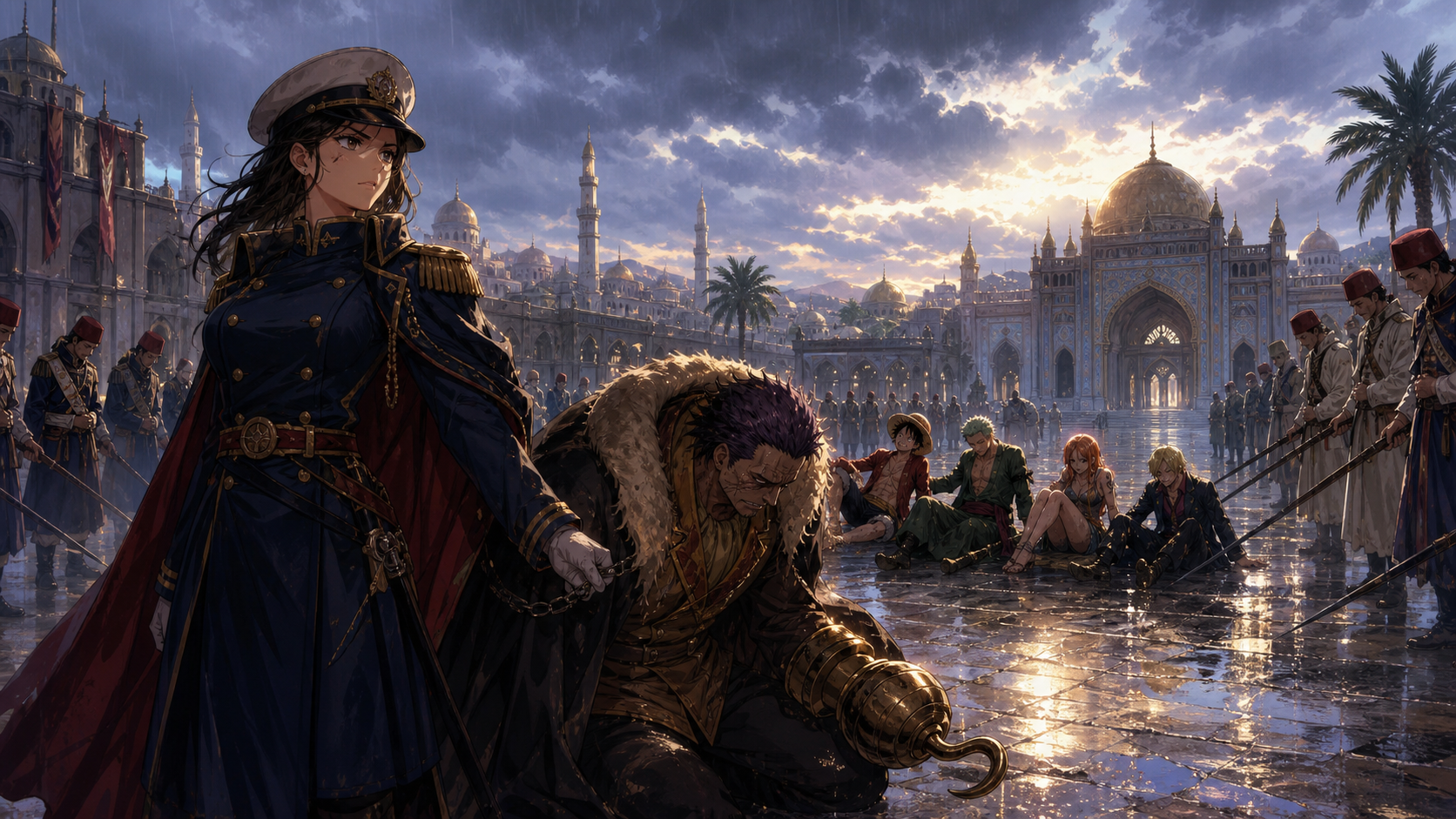
Tashigi takes Crocodile into custody, but the arrest does not belong to Marine heroism. Luffy defeated him. Vivi stopped the war. Alabasta’s people survived the conspiracy.
The uniform gives Tashigi authority to secure the prisoner. Authority does not give her the right to claim someone else’s work. Her face carries that discomfort before any report reaches headquarters.
This tension makes her one of the episode’s strongest figures. She wants justice, yet justice arrives through pirates while a government-approved Warlord caused the disaster. A badge can either protect the official story or protect the people standing in front of her. Tashigi chooses the people.
Hands off the Straw Hats is a moral order
Tashigi orders her unit not to touch the Straw Hats. The command is short because hesitation could turn exhausted rescuers into prisoners.
She does not declare piracy legal. She recognizes a specific debt and a specific truth: arresting the crew now would reward the institution that empowered Crocodile while punishing the people who stopped him.
Good judgment often lives inside that narrow space. Rules matter, but rules detached from evidence become camouflage for cowardice. Tashigi accepts professional risk rather than hiding behind procedure.
Justice has more than one uniform
The Japanese title names pirates and several kinds of justice. Episode 127 takes that plural seriously.
Luffy’s justice protects a friend without asking permission. Vivi’s justice makes citizens visible to each other again. Chaka’s justice stops retaliatory killing. Igaram’s justice exposes a lie. Tashigi’s justice refuses a dishonest arrest. Cobra’s justice gives credit without possession.
No single version solves Alabasta. The episode does not flatten those choices into a cheerful slogan either. Each person holds different power, carries different duties, and risks different consequences. Justice becomes credible when action matches the people most likely to suffer.
Crocodile’s title exposes a government failure
Crocodile operated under state approval as one of the Seven Warlords. That fact cannot disappear beneath handcuffs.
Alabasta needs an inquiry into who vouched for him, which warnings were ignored, how his criminal network operated for years, and why the public had no safe route to challenge his status. Calling him a rogue criminal would protect every structure that helped him.
Tashigi sees the contradiction up close. Her organization can arrest the defeated man, yet the same global system lent him legitimacy. Accountability must travel upward or the next Crocodile will receive another polished title.
The Marines owe Alabasta a truthful report
A public report should name the Straw Hats’ role, Baroque Works’ infiltration, the false Cobra operation, the Dance Powder manipulation, the bomb plot, and the civilian cost.
Headquarters may prefer a clean Marine victory. Such a version would damage recovery because survivors need their own memories confirmed. Propaganda after trauma tells people that official comfort matters more than lived experience.
Tashigi cannot control every headline, but she can preserve evidence, record testimony, and resist a false statement. One honest officer cannot repair an institution alone. She can make dishonesty harder.
Smoker and Hina wait beyond the capital
The episode moves offshore, where Smoker and Hina represent the larger machine now closing around Alabasta.
Smoker already understands that chasing Luffy cannot explain what happened. Hina brings another command presence, another fleet, and another set of obligations. Their meeting widens the story beyond the rain-soaked street.
The sea has not become safe because the desert war ended. The Straw Hats still need medical care, a route to the Going Merry, and protection from forces that may follow orders without Tashigi’s context.
Hina changes the escape calculation
Hina’s presence matters before she makes any grand move. A second Marine officer means more ships, more surveillance, and less room for an improvised departure.
The crew cannot simply wake up and sprint toward the horizon. Their bodies are wrecked, their ship has limits, and the government now has reason to control the public narrative around Crocodile.
That pressure gives the aftermath real suspense. Recovery and escape pull in opposite directions. Chopper needs time. The Marines reduce time. Friends inside Alabasta must create space without turning the new peace into another battle.
Disarmament needs safety after the first gesture
Dropping weapons stops the immediate killing. Keeping weapons down requires practical safeguards.
Royal forces should establish neutral collection points, separate injured fighters from active units, post clear routes to clinics, reunite families, and prevent revenge arrests. Rebel leaders should receive guarantees that surrender will not become a roundup.
Women, children, displaced residents, disabled survivors, and people without political connections need dedicated access to food, water, shelter, and information. A ceasefire built only for armed men leaves much of the country outside peace.
Evidence must survive the rain
Rain brings relief, but rain can also destroy paper, footprints, residue, damaged equipment, and crime-scene traces.
Investigators need to secure Baroque Works offices, weapons stores, communication records, uniforms, coded orders, financial ledgers, and witness statements. The false Cobra witness should receive protection from retaliation and coercion.
Alabasta also needs independent copies. A single palace archive could disappear under political pressure. Civic leaders, medical workers, local communities, and trusted outside observers should hold parts of the record.
Victims need care before the victory banquet
The episode wisely keeps celebration at arm’s length. Streets remain full of wounded people, collapsed fighters, frightened families, and damaged homes.
Medical triage must come before ceremony. Clean water needs testing after long contamination and sudden runoff. Temporary shelters need privacy, sanitation, accessibility, and protection from exploitation. Missing-person lists need one public system instead of scattered rumors.
Grief will not follow a royal timetable. Some citizens will feel relief, some rage, some shame, and some numbness. Recovery becomes safer when nobody treats one emotional response as proof of loyalty.
Production turns exhaustion into the real climax
Yoshiyuki Suga’s script moves from Chaka’s disarmament order to Igaram’s evidence, Cobra’s handoff, the crew’s collapse, Tashigi’s arrest, her protection order, and the offshore Marine threat.
Harume Kosaka’s direction lets rain, lowered weapons, and exhausted bodies carry the aftermath. The episode does not chase Crocodile’s defeat with a louder explosion.
Masayuki Takagi’s animation direction gives Tashigi controlled weight and lets the crew lose tension all at once. Miyuki Sato and Michiyo Kawasaki keep Alubarna beautiful without hiding wet rubble, mud, and damage.
What Episode 127 changes
Chaka orders the royal army to discard its weapons, turning the ceasefire into a visible public act.
Igaram presents the witness who confirms that the Cobra seen in Nanohana was an impostor.
Zoro and the others carry Luffy away from Cobra, then collapse from exhaustion on the roadside.
Tashigi arrests Crocodile and orders the Marines to leave the Straw Hats alone.
Smoker and Hina wait offshore, keeping pressure on the crew’s recovery and escape.
Episode details
Japanese title: 武器よさらば!海賊といくつかの正義
English title: Farewell to Arms! Pirates and Different Ideas of Justice
Japanese broadcast: October 6, 2002
Saga: Alabasta
Material: Manga-canon adaptation
Script: Yoshiyuki Suga
Episode direction: Harume Kosaka
Animation direction: Masayuki Takagi
Art: Miyuki Sato and Michiyo Kawasaki
The official One Piece guide confirms Chaka’s disarmament order, Igaram bringing the impostor witness, Cobra entrusting Luffy to the crew, the Straw Hats collapsing, Tashigi arresting Crocodile and protecting the pirates, plus Smoker and Hina offshore. The institutional accountability, medical, evidence, ceasefire, recovery, accessibility, and public-trust analysis is RaeRae’s reading of those events.
Final verdict
Episode 127 earns a 9.5 out of 10. Crocodile’s defeat gave the arc spectacle. This aftermath gives the victory a conscience.
Chaka lowers the temperature. Igaram produces proof. Cobra protects the people who saved him. The Straw Hats finally fall down. Tashigi sees the truth and risks her career rather than arresting exhausted heroes for somebody else’s convenience.
That refusal matters because institutions usually protect themselves through tidy stories. A Marine defeated the Warlord. A king restored order. A rebellion ended. Every sentence sounds respectable while erasing the pirate who broke the underground cage, the princess who made two armies listen, and the citizens who survived years of manufactured fear. Tashigi cannot repair every official lie, but she can refuse to become the first person who repeats one.
The episode also leaves room for consequences that a victory montage would skip. Crocodile needs a lawful transfer. Witnesses need protection. The injured need treatment. Rebel families need guarantees. Royal officials need scrutiny. Marines need to explain how one of their approved powers built a criminal state beneath a capital. Alabasta deserves answers before anybody declares the system healed.
Most of all, the Straw Hats deserve sleep. Their collapse turns friendship into something physical: bodies carried until nobody can take another step. Nobody asks them to perform heroism after the danger passes. That small mercy feels earned.
The title gets the last word. Justice does not belong to a coat, crown, flag, sword, or wanted poster. Justice belongs to choices made when power offers an easier lie. Tashigi chooses the harder truth, and Alabasta gets one more chance to breathe.