
RaeRae Reacts · One Piece Episode 126
Rain Falls on Alabasta
One Piece Episode 126 ends Luffy’s Crocodile fight as rain quiets Alabasta and lets Vivi’s call for peace reach both armies.
Quick reaction
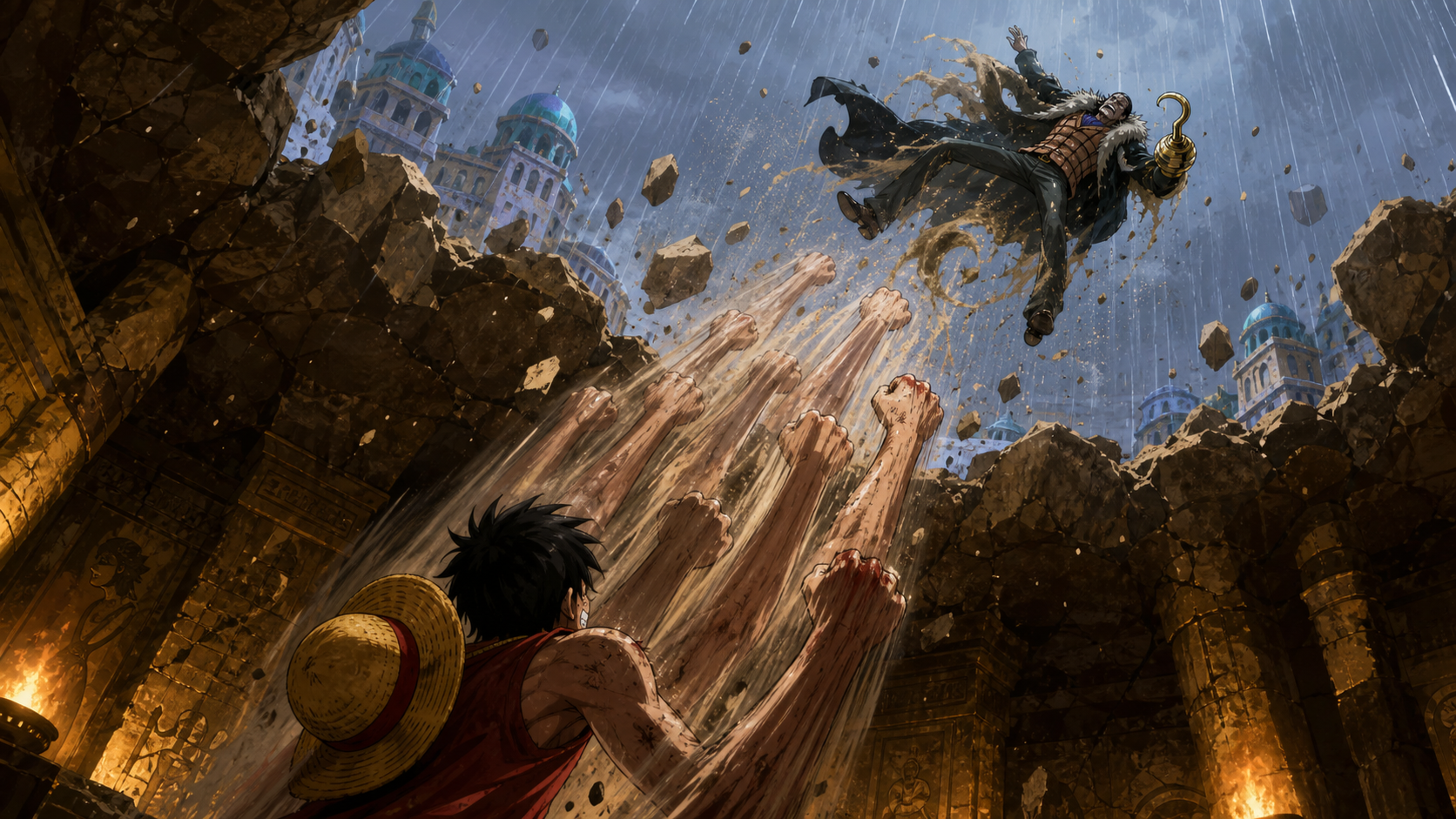
One Piece Episode 126 breaks Crocodile’s poison blade, drives him through the bedrock with Gum-Gum Storm, and finally lets rain reach Alabasta. The villain wanted a kingdom buried under sand and manufactured certainty. He exits the arc airborne, publicly visible, and getting rained on. RaeRae appreciates narrative filing systems.
The explosion above the city does not immediately stop the armies. Vivi keeps calling out. Underground, Luffy fights through poison and launches Crocodile into the open. Rain settles the dust, removes the sand advantage, and creates the quiet where Vivi’s voice can finally reach people.
RaeRae’s bottom line: Luffy defeats the architect, but rain and collective recognition end the war.
The explosion does not automatically stop combat
Both armies see the shell explode above Alubarna and continue fighting. Spectacle alone cannot reverse a conflict built through years of grievance, infiltration, and immediate fear.
People inside close combat may not understand what exploded, who moved the shell, or whether another attack is coming. Noise can increase panic instead of producing reflection. Fighters respond to the person directly in front of them because that threat feels more immediate than a distant sky.
Stopping a weapon prevents casualties. Ending a war still requires communication, verified orders, and enough safety for people to lower weapons without feeling exposed.
Vivi keeps speaking after the dramatic rescue
Vivi does not treat the explosion as the conclusion. She continues telling both sides to stop because the cannon was only one part of Crocodile’s plan.
Her persistence matters more than volume. Every repeated call preserves the correct message until conditions allow reception. She cannot force thousands to hear through battle noise, but silence would guarantee that nobody receives the truth from her.
Leadership here means continuing necessary work after the scene that looked like the climax. Pell’s flight bought survival. Vivi must convert survival into ceasefire.
Luffy is fighting through systemic poison
Crocodile’s toxin has entered Luffy’s body while blood loss, dehydration, exertion, and falling debris compound the damage. Determination can organize action, but determination does not neutralize chemistry.
Luffy likely has a shrinking window before weakness, impaired coordination, breathing difficulty, or unconsciousness makes further combat impossible. Every exchange consumes time needed for treatment.
The risk continues after victory. Chopper needs the toxin source, exposure time, symptoms, and any available antidote. Removing Crocodile from the fight cannot remove molecules already circulating.
Breaking the poison spike removes one delivery system
Luffy breaks Crocodile’s poison blade, eliminating the immediate puncture threat. The act shows that defensive priorities can change a duel even before the opponent falls.
Destroying the weapon limits new exposure and forces Crocodile back toward sand attacks, hook strikes, and dehydration. Luffy does not need to survive the same hidden mechanism twice.
Weapon control should include preserving fragments when possible because medics may use residue to identify the toxin. The collapsing sanctuary makes evidence collection unrealistic, yet the principle still matters for later accountability.
Gum-Gum Storm converts pain into upward force
Luffy unleashes a rapid barrage that drives Crocodile vertically through the chamber. The attack combines repeated contact, speed, and a direction aligned with the weakened ceiling.
Because blood keeps the fists from passing through sand, each impact accumulates instead of disappearing. Crocodile cannot reset his body cleanly between strikes.
The technique is not random punching. Luffy uses the structure as part of the attack, choosing a path that removes Crocodile from the underground refuge and exposes him to the sky above Alabasta.
The bedrock breakthrough makes defeat public
Crocodile bursts through stone into open air. The physical route matters because he built power through secrecy, underground operations, false heroism, and hidden agents.
Public visibility changes the meaning of the victory. Citizens and soldiers can see the supposedly untouchable Warlord defeated. Rumor no longer carries the entire burden of proof.
The breakthrough also creates rescue access to the sanctuary, though falling rock may endanger people below. Responders need to stabilize the opening before treating the crater as a safe entrance.
Crocodile loses control of the narrative
For years, Crocodile presented himself as Alabasta’s protector while secretly engineering the crisis. His public defeat fractures that image.
A defeated body does not automatically publish every record, but the sight gives investigators room to present evidence without competing against invincibility. Cobra, Vivi, Koza, Tashigi, Smoker, and surviving witnesses can connect the organization to the war.
Accountability still needs documentation, testimony, custody, and protection against loyal agents destroying files. The punch opens political space. Institutions must use that space responsibly.
Rain changes the material battlefield
Rain wets sand, settles dust, cools overheated surfaces, and improves visibility. Crocodile’s environmental advantage weakens across the city at the exact moment his body emerges.
For injured people, rain offers relief but also medical complications. Open wounds need protection from contaminated runoff. Wet stone becomes slippery, collapsed structures may shift, and sudden water can move debris through low areas.
The same weather that symbolizes restoration requires practical response. Hope and hazard can fall from the same cloud.
Rain is evidence against the manufactured drought
Alabasta’s people were taught to interpret missing rain as royal theft or divine abandonment. Rainfall after Crocodile’s defeat undermines that story.
Weather alone cannot explain every mechanism of Dance Powder manipulation, but timing creates a powerful shared signal that the crisis was not what propaganda claimed.
Vivi’s voice reaches people when noise falls
Rain helps quiet the battlefield, but people also begin recognizing the pattern around them. Crocodile appears defeated, the dust settles, and the urgency of retaliation weakens.
Vivi’s words have not suddenly become more correct. Conditions have become capable of carrying the same truth she repeated earlier.
The scene rejects the idea that unheard speech lacks value. Communication depends on speaker, channel, environment, and listener readiness. Vivi maintained the signal until the system changed.
Ceasefire requires visible first movers
Once people hear Vivi, somebody must lower a weapon first. That movement carries risk because the opposing side may interpret restraint as weakness.
Commanders can reduce the risk by repeating the order, raising open hands, separating units, and assigning neutral witnesses. Medics should enter only after firing lanes are controlled.
Every visible act of restraint creates permission for the next person. Peace spreads through coordinated behavior, not a single emotion.
Cobra thanks Luffy without claiming the victory
Cobra’s gratitude recognizes that Luffy defeated Crocodile and protected Alabasta’s chance to recover. The king does not need to pretend the monarchy solved its own crisis.
At the same time, Luffy’s victory sits beside work from Vivi, Koza, Pell, the Straw Hats, royal guards, rebels who sought truth, Marines who assisted, and civilians who survived.
Healthy gratitude can name one decisive act without erasing the network. Crocodile wanted all credit and all control. Alabasta’s recovery should distribute recognition more honestly.
Luffy’s smile refuses transactional heroism
Luffy answers Cobra with an enormous smile rather than a demand for rank, payment, or political authority.
He fought because Vivi is his friend and because Crocodile harmed people. The absence of a transaction protects Vivi from owing her country’s future to a pirate captain.
That freedom does not remove material responsibility toward the crew. They need medical care, food, safe shelter, ship support, and a route away from Marine custody. Gratitude should become care even when the hero does not submit an invoice.
Pell’s apparent loss needs collective mourning
The city survives because Pell carried the shell away. People now face relief and grief at the same time.
Public mourning should name his service without using his choice to pressure other guards toward the same standard of self-destruction. A memorial can honor courage while an investigation asks why one person had to carry the entire safety failure.
Vivi deserves private space as well as ceremonial expectation. Political leaders often lose permission to grieve when citizens need reassurance. Support staff can protect both responsibilities.
Recovery begins before celebration
Alabasta needs triage, missing-person searches, fire control, structural assessment, clean water, food distribution, and safe disarmament before any festival.
Rain does not repair broken buildings or reunite families. Victory creates permission to begin recovery, not evidence that recovery already happened.
Production choices make rain feel earned
Michiru Shimada’s script connects the continuing battle, Vivi’s calls, poison pressure, the broken spike, Gum-Gum Storm, Crocodile’s public defeat, rainfall, ceasefire, Cobra’s thanks, and Luffy’s smile.
Munehisa Sakai’s direction holds underground intensity against the open sky, then lets rain change sound, visibility, and rhythm across the city.
Eisaku Inoue’s animation direction gives the final barrage accelerating weight and makes the bedrock breakthrough readable. Miyuki Sato and Kunihiro Chida transform Alubarna from dust-heavy gold into rain-cooled blue without losing the city’s damage.
What Episode 126 changes
Both armies continue fighting after the cannon explosion while Vivi keeps calling for peace.
Luffy breaks Crocodile’s poison spike and launches him through the underground bedrock with Gum-Gum Storm.
Rain begins falling across Alabasta, the battlefield quiets, and Vivi’s voice finally reaches both sides.
The war subsides, and Cobra thanks Luffy, who responds with a broad smile.
The sequence also changes how victory works in this story. Luffy wins the duel, but Vivi wins the public moment. Her persistence turns a private defeat beneath the palace into a ceasefire that ordinary people can recognize. Neither success replaces the other. Physical force removes Crocodile from control, while political trust gives frightened soldiers a reason to stop.
That distinction protects Vivi from becoming a decorative witness to Luffy’s strength. She has spent the arc gathering proof, confronting officials, crossing the desert, entering the battlefield, and refusing despair. Episode 126 pays off that labor by making her voice the final signal. The rain helps, but the crowd hears a leader whose credibility survived every attempt to silence her.
Alabasta now has a narrow chance to rebuild public memory honestly. Citizens need to learn how Baroque Works manufactured scarcity, impersonated allies, redirected blame, and profited from mistrust. Without that explanation, survivors could treat the ceasefire as a miracle and remain vulnerable to the next manipulator. Peace needs a record, not only relief.
Episode details
Japanese title: 越えていく!アラバスタに雨が降る!
English title: Surpassing the Limit! Rain Falls in Alabasta
Japanese broadcast: September 15, 2002
Saga: Alabasta
Material: Manga-canon adaptation
Script: Michiru Shimada
Episode direction: Munehisa Sakai
Animation direction: Eisaku Inoue
Art: Miyuki Sato and Kunihiro Chida
The official One Piece guide confirms both armies continuing after the blast, Luffy breaking the poison spike, Gum-Gum Storm driving Crocodile through the bedrock, rain beginning, Vivi’s voice reaching the crowd, the battle settling, and Cobra thanking Luffy. The medical, communication, ceasefire, weather, evidence, recovery, grief, labor, and accountability analysis is RaeRae’s reading of those events.
Final verdict
Episode 126 earns a 10 out of 10. Luffy’s final attack is huge, but the episode knows that defeating one man and stopping thousands of people are different tasks.
Crocodile leaves the underground world where he controlled information. Rain exposes him, weakens his sand, settles the dust, and creates a shared pause. Vivi uses that pause to finish the work she began long before Luffy arrived.
The episode never pretends that rainfall can erase casualties, displacement, hunger, or betrayal. Instead, the weather gives Alabasta enough quiet to choose a next step. That restraint makes the emotional release stronger. Celebration can come later, after the injured receive care, families locate missing relatives, weapons are secured, and the conspiracy becomes public knowledge.
Every district will recover at a different pace. Royal announcements should therefore publish clear aid routes, clinic locations, water access, and reunion points instead of promising instant normalcy. Residents deserve practical information alongside hopeful speeches. Honest updates can rebuild the public trust that Crocodile spent years exploiting.
Luffy’s smile lands because he does not seize the center after winning. Cobra can thank him, Vivi can address her people, and the kingdom can own its recovery. A hero who refuses political possession leaves room for local leadership. That choice fits the Straw Hats at their best: they break the cage, protect their friend, and trust her to decide what freedom should become.
The best image is not only Crocodile flying through stone. The best image is a kingdom finally able to hear itself. Rain falls. Weapons lower. Cobra says thank you. Luffy smiles because friendship was always enough reason to fight, and shared freedom remains the only reward he truly wants.