
RaeRae Reacts · One Piece Episode 125
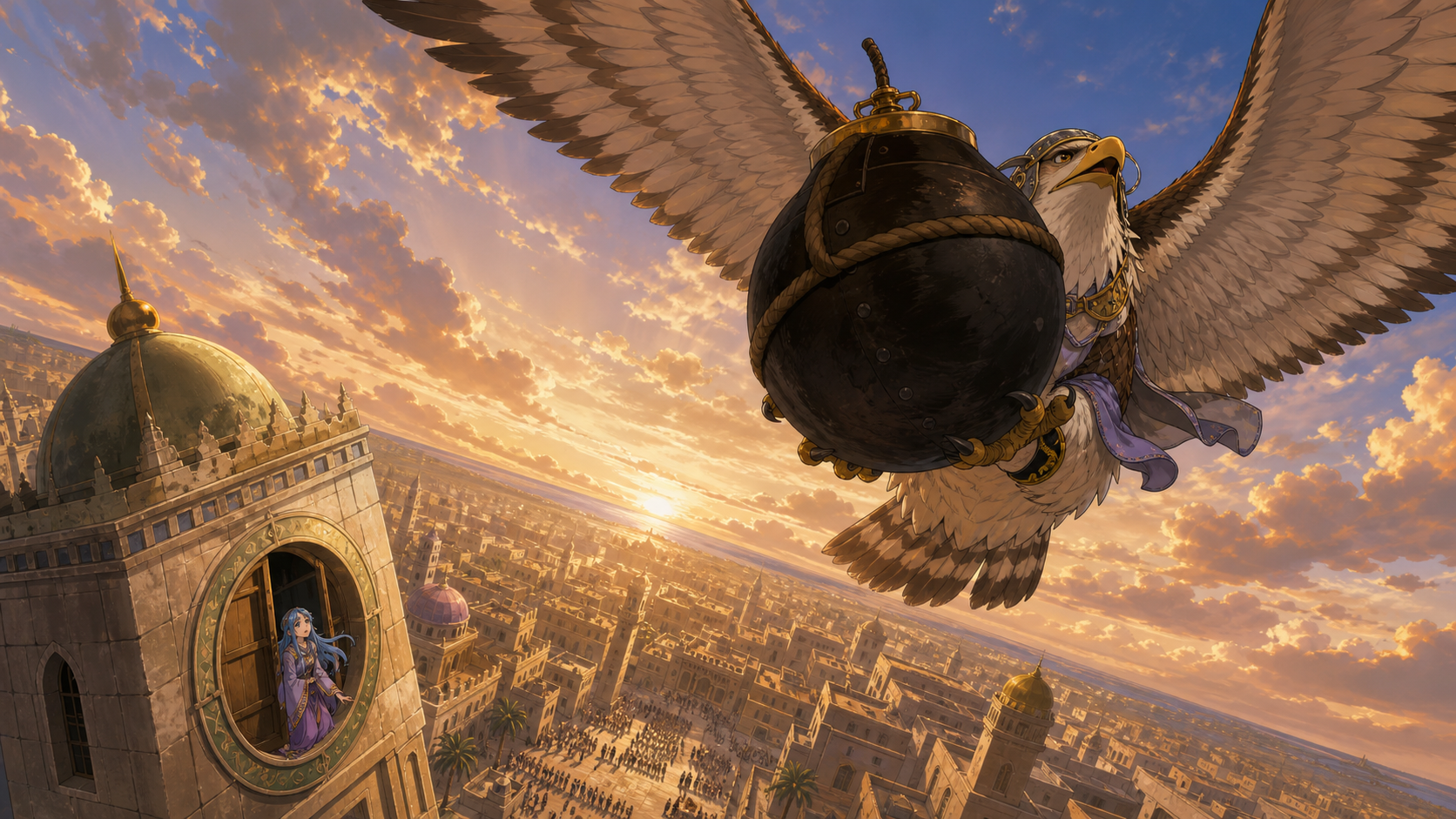
Pell Carries the Bomb Skyward
One Piece Episode 125 sends Vivi through the Straw Hats’ launch chain before Pell carries the timed shell away from Alubarna.
Quick reaction
One Piece Episode 125 lets the team stop the cannon, reveals that stopping the cannon does not stop the bomb, and then asks Pell to carry the entire nightmare into the sky. Alabasta has apparently subscribed to emergencies with hidden terms and conditions.
Nami turns Usopp, Sanji, Zoro, and Chopper into a human launch system so Vivi can reach the clock tower. Vivi cuts the fuse. The shell keeps counting down because the explosive is timed. Pell returns, takes the bomb, and flies upward while remembering the promise behind his role as guardian.
RaeRae’s bottom line: Pell’s choice is emotionally devastating because the episode shows the team doing everything right first. Sacrifice arrives after coordination reaches its limit, not because nobody tried.
The sequence also protects Vivi from the lazy accusation that she only watches other people solve her country’s problems. She finds the weapon, accepts the launch, reaches the operators, cuts the fuse, checks the result, and confronts the hidden timer. Pell’s arrival does not erase her competence. His flight answers the one physical problem no grounded person can solve within the remaining seconds.
Crocodile’s poison keeps a second crisis alive
Luffy continues fighting underground while Crocodile’s poison affects his body. The threat does not pause because the clock-tower team reaches the cannon.
Poison creates delayed uncertainty. Luffy may still move and strike while circulation carries the toxin. Symptoms can worsen after the duel, especially alongside blood loss, dehydration, and exhaustion.
A complete victory plan needs an antidote and extraction route. Chopper is aboveground, the sanctuary is collapsing, and communication between locations is nearly impossible. Luffy has to finish quickly without knowing whether medical treatment can reach him in time.
Nami designs a human launch system
Vivi needs to reach the top of the clock tower faster than stairs or climbing can manage. Nami uses Usopp, Sanji, Zoro, and Chopper as staged launch points.
The plan converts each person’s body, strength, position, and timing into one vertical route. No single member can throw Vivi the full distance safely. The sequence compounds momentum across several people.
This is field engineering with zero rehearsal. Every angle matters. A weak handoff leaves Vivi short. Too much force sends her past the target. A delayed catch breaks the chain. Nami’s contribution is not standing nearby with an idea. She calculates a usable system from exhausted teammates and a hostile structure.
The launch depends on consent and trust
Using people as a platform can sound dehumanizing outside the emergency context. Here, the team agrees to the plan because the shared goal is immediate and the roles match available strengths.
Vivi also accepts the risk of being launched through open air toward armed agents and a massive explosive. Trust runs in both directions. The throwers must believe she can complete the final task, and she must believe every hand will meet her at the correct moment.
Emergency consent remains imperfect under a countdown, but nobody coerces a disposable member into danger for prestige. Everyone takes a defined share of the physical risk.
Injured teammates still need role limits
Usopp, Zoro, Sanji, Nami, and Chopper have already survived severe fights. The launch plan uses bodies with bruises, fractures, cuts, fatigue, and depleted reserves.
Adrenaline can mask pain without repairing damage. A person who completes one throw may collapse immediately after. Chopper should assess who can safely bear weight, who needs stabilization, and where failure would cause the least additional harm.
The episode celebrates collective effort, but good care requires checking those bodies after the crisis. Success does not retroactively make every strain safe.
Vivi reaches the clock face as the political lead
The team sends Vivi to the top because she knows the stakes, owns the decision, and refuses to leave her people beneath the blast.
Her position is not symbolic decoration. She identifies the threat, directs the search, accepts the launch, confronts the operators, and reaches the fuse. The Straw Hats create access for the person already leading the mission.
This distinction matters. Support does not replace local authority. The crew’s strength expands Vivi’s ability to protect Alabasta instead of turning her country into a backdrop for somebody else’s heroism.
Cutting the fuse solves the visible mechanism
Vivi severs the cannon fuse and stops the expected firing sequence. Based on the evidence available, that action should prevent ignition.
The moment deserves recognition because she reaches the correct component under fire and time pressure. Failure comes from hidden system design, not incompetence.
Emergency teams often face the same problem: a visible control suggests shutdown while an independent backup remains active. Verification must follow intervention. Check heat, sound, timers, pressure, secondary wires, and payload status before declaring the device safe.
The shell has an independent timer
The explosive continues counting down after the fuse is cut. Baroque Works built redundancy for mass casualty, ensuring that loss of the operators or firing system would not protect the plaza.
A timed shell changes every disposal option. The team cannot simply unload the cannon and store the projectile nearby. The blast radius follows the shell.
Disarming may require technical knowledge nobody possesses. Moving the device becomes the only available method, but moving transfers extreme risk to the carrier and any route beneath that carrier.
The hidden timer exposes a verification failure
The team assumed the cannon’s fuse controlled the explosion because the visible mechanism invited that conclusion. Baroque Works exploited the assumption.
Robust threat assessment asks whether failure modes are independent. Can the shell detonate without firing? Can the operators trigger a remote signal? Can impact activate the payload? Can a second device punish the rescue team?
Thirty seconds never allowed a complete inspection, but naming the missed questions matters for future security. Alabasta will need explosive-response training, infrastructure audits, and procedures that treat apparent shutdown as provisional.
Pell returns after being shot
Pell reaches the tower despite the earlier gunshot and fall. His return is not evidence that the injury was minor. His movement shows how strongly he prioritizes the people below.
Flight while wounded can worsen bleeding, impair balance, and reduce lifting capacity. Carrying a massive shell adds strain at the exact moment his body needs stability.
Pell likely understands those limits better than anyone watching. The decision gains weight because he knows flight, altitude, the city, and the payload’s danger. He chooses with professional knowledge, not blind optimism.
The guardian role becomes a specific action
Pell calls himself Alabasta’s guardian and lifts the bomb away from the plaza. The title becomes meaningful because the action protects identifiable people from an identifiable threat.
Guardian language can become empty ceremony when institutions use honor to demand endless sacrifice. Pell’s choice feels personal because his commitment predates the countdown and includes a relationship with Vivi and the country beyond the palace.
Still, Alabasta should never build future safety around the expectation that one protector will absorb every system failure. A nation honors guardians by reducing the need for suicidal intervention.
Vivi watches duty become unbearable
Vivi has spent the saga trying to prevent other people from dying for her country. Pell’s choice places that fear directly in front of her.
She cannot substitute herself because Pell’s falcon form provides the necessary speed and altitude. She cannot disarm the timer because seconds remain. Her lack of an alternative does not make the moment emotionally acceptable.
Leadership sometimes includes witnessing a sacrifice that the leader neither ordered nor wanted. The aftermath will require space for grief without turning grief into guilt for another person’s autonomous decision.
Childhood memory explains the bond, not ownership
Pell remembers words exchanged when Vivi was young and the promise embedded in his service. The memory explains why protecting her and Alabasta feels inseparable.
Protection should not imply that Vivi owns his life. The scene works because Pell chooses how to fulfill his oath. Love and duty shape the choice without converting a person into royal property.
Carrying the shell upward is evacuation by altitude
Pell cannot move thousands of people out of the blast radius, so he moves the blast away from thousands of people. Altitude becomes the evacuation route.
The method reduces ground exposure but creates other hazards. Debris, pressure, heat, and sound can still affect the city depending on height and yield. Pell must climb as quickly and vertically as possible while maintaining grip.
Airspace also needs to remain clear. Other flyers or rescue attempts could increase casualties. Once Pell commits, the people below can only seek cover and prepare for the shock wave.
The plaza still needs emergency instructions
Removing the shell does not justify watching the sky in an open crowd. Soldiers and civilians should move behind solid structures, protect heads and ears, avoid windows, and prepare for falling debris.
Medics should establish triage zones outside likely collapse paths. Fire teams should watch rooftops, and commanders should stop combat so emergency lanes remain open.
The crowd may not understand what Pell carries. Clear commands matter more than complete explanations during the remaining seconds. Accountability and public briefing can follow survival.
After the blast, responders should expect hearing injuries, broken glass, roof damage, panic movement, and secondary fires even when the main explosion occurs above the city. A successful removal reduces harm rather than guaranteeing zero harm. Prepared teams can begin assessment immediately instead of waiting for visible flames.
Luffy’s underground fight remains connected
Pell carries the bomb because Crocodile built the operation. Luffy fights Crocodile because stopping the architect matters after stopping one weapon.
If Crocodile escapes, surviving agents, hidden resources, and political influence could create another attack. If Luffy loses to poison, the team may save the plaza while leaving the person most capable of ending the organization trapped below.
The two climaxes protect Alabasta from different layers: Pell removes the immediate blast, while Luffy tries to remove the system’s leader.
Production choices earn the emotional turn
Yoshiyuki Suga’s script lets Nami’s engineering, the launch chain, Vivi’s fuse cut, the hidden timer, Pell’s return, and the flight unfold as escalating consequences.
Hidehiko Kadota’s direction keeps the team action readable before slowing around Pell’s decision and memory. The pause creates emotional space without pretending the countdown stopped.
Hideaki Maniwa’s animation direction gives the launch sequence mechanical clarity and Pell’s ascent physical weight. Miyuki Sato and Toshiaki Marumori keep the tower, plaza, shell, and open sky aligned so viewers understand the distance Pell must create.
What Episode 125 changes
Nami organizes Usopp, Sanji, Zoro, and Chopper into a launch chain that sends Vivi to the top of the clock tower.
Vivi cuts the cannon fuse, but the team discovers that the shell contains an independent timed explosive.
Pell returns despite being shot, takes the shell, and flies high above Alubarna with only seconds remaining.
Luffy continues fighting underground while suffering from Crocodile’s poison.
Episode details
Japanese title: 偉大なる翼!我が名は国の守護神ペル
English title: Magnificent Wings! My Name Is Pell, Guardian Deity of the Country
Japanese broadcast: September 8, 2002
Saga: Alabasta
Material: Manga-canon adaptation
Script: Yoshiyuki Suga
Episode direction: Hidehiko Kadota
Animation direction: Hideaki Maniwa
Art: Miyuki Sato and Toshiaki Marumori
The official One Piece guide confirms Luffy suffering from Crocodile’s poison, Nami creating the launch plan, Usopp, Sanji, Zoro, and Chopper serving as launch points, Vivi cutting the fuse, the shell’s independent timer, and Pell carrying the bomb into the sky. The medical, engineering, labor, consent, explosive-response, leadership, grief, evacuation, and accountability analysis is RaeRae’s reading of those events.
Final verdict
Episode 125 earns a 10 out of 10. The team builds an impossible route, Vivi reaches the fuse, and the story still finds one deeper layer of danger.
Pell’s flight hurts because nobody treats him as the first solution. Every available person contributes before the final choice appears. His wings do not erase their work. Their work creates the moment where his unique ability can save the plaza.
The episode understands that a guardian is not a title announced from a safe balcony. A guardian carries danger away from people who may never know every name in the chain that saved them. Pell rises above Alubarna with the shell. Below him stands an entire network of effort, trust, injury, and love.