
Oliver Leighton, Earl of Norcroft
The one member of the tontine who admits he would quite like to be married. He is in a wager against marriage, he is losing it on purpose, and he is the only man in the club honest enough to say so out loud.
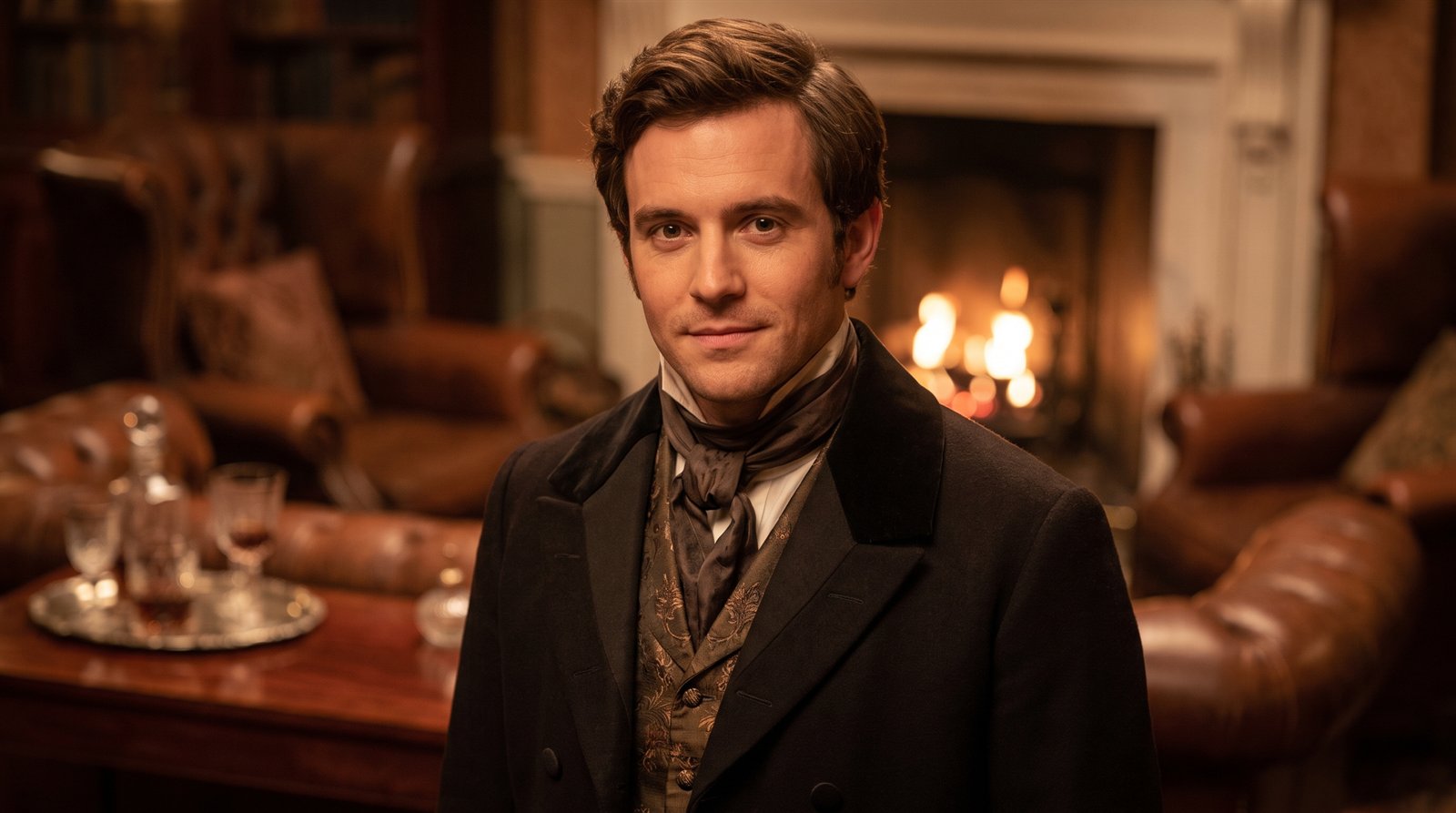 Oliver Leighton, Earl of Norcroft. CVM Sekai original art.
Norcroft is the tontine’s straight man, and the series uses him as its measuring instrument. When somebody needs to say the true thing about another character, it is almost always him: he names Cavendish’s life as frivolity, he tells Warton he has no standing to be jealous, and he coins the phrase for Felicity that Nigel then cannot stop repeating.
The joke underneath is that he does not want to win the bet. He says plainly that he inherited his position and his fortune, that his freedom is already limited by responsibility, and that love would therefore cost him nothing. He calls himself a romantic. He is competing in a contest whose prize he does not want.
He is also, quietly, the reason the book two romance happens at all. He knows Felicity, his mother has been suggesting her as a bride for years, and he is the one who makes the introduction while telling Nigel it is a bad idea.
The file
| Full name | Oliver Leighton, given in full in the first line of the book two prologue |
|---|---|
| Title | Earl of Norcroft. Addressed as Norcroft by his friends and Lord Norcroft otherwise |
| Called | Oliver, in narration when the point of view is his |
| Position | Head of his family. Inherited both the title and the fortune rather than building either |
| Cousin | Fiona, who married Lord Helmsley in a love match, having been arranged to marry Daniel Sinclair instead |
| Mother | Alive and matchmaking. A friend of Lady Felicity’s mother, and periodically drops Felicity’s name as a potential bride |
| Circle | Founding member of the tontine with Warton, Helmsley and Cavendish. Daniel Sinclair joined later |
| On marriage | Not averse to it. Describes himself as “something of a romantic” |
| Status as of page 80 | Alive, unmarried, one of the three remaining tontine members |
| Books | A Little Bit Wicked and What a Lady Wants, Last Man Standing, by Victoria Alexander |
The one who says he wants it
I think I fall somewhere between the two of you. I have inherited my position and my fortune. I am head of my family and have the responsibilities inherent in that. Therefore my freedoms are already limited. For me, love would neither change my life nor would it be at all awkward. Indeed, as I have said before, I am not averse to marriage.
That is a man doing arithmetic on his own life and finding that the thing his friends are protecting costs him nothing to give up, because he never had it. Cavendish has freedom because he has not inherited yet. Sinclair has it because he is building his own fortune. Norcroft is already answerable to everybody.
While I am not fleeing for my life at the mere mention of wedded bliss, I am not actively seeking a wife either. I fear, gentlemen, I am something of a romantic.
Cavendish’s response is to observe, smugly, that Norcroft will therefore be the next to go.
The measuring instrument
You have yet to come into your title and the responsibilities that accompany it. You have the freedom, and the money I might add, to do precisely as you wish, and you do. You’re charming and great fun to be with and a good friend, but your life to this point has consisted entirely of frivolity and nothing of substance whatsoever.
“That’s rather harsh.” Cavendish winced. “True, but harsh.”
Note the construction. Nigel does not dispute it. He concedes the accuracy and objects only to the delivery, which is the single most revealing exchange he has in the opening chapter.
Norcroft does the same to Sinclair a beat later, and it is a compliment that also lands as a diagnosis: Sinclair has a father who built a financial empire and has refused to lean on it, which Norcroft calls admirable and very American, and concludes that for Sinclair love would be inconvenient.
His long non-courtship of Lady Felicity
No, not at all. Well, that is. In point of fact, I scarcely know her at all although we have been acquainted for years. My mother and hers are friends, and periodically my mother will drop her name as a potential bride.
I have never had the opportunity to be interested or not interested. She is pleasant enough, in both appearance and nature, and she’s never said or acted in any overt manner, but I have always come away from our dance or conversation or what-have-you with the vague impression that she found me less than… interesting.
Sinclair’s reply, and Norcroft’s answer, are the funniest two lines in the chapter.
“Nothing like a woman finding a man boring to dissuade him from furthering his acquaintance.” “It does tend to dampen one’s enthusiasm.”
There is a quiet cruelty in the arrangement the book never comments on. Felicity spent five seasons finding scholarly men dull. Norcroft spent the same years being found dull by her, aware of it, and never saying anything.
Because she is not married nor has she ever been married. And I am fairly certain she wishes to rectify that.
Then he makes the introduction anyway, and afterwards refuses to fuss about it.
Don’t be absurd. I suspect Lady Felicity is well able to take care of herself.
He names her
“Immovable?” She widened her eyes. “Why would you call me immovable?” “A comment Norcroft made. It scarcely matters at the moment, although I assure you it was meant as a compliment.”
He also supplies the image the whole novel runs on, when Nigel asks to be introduced.
I simply have the oddest vision in my head of two immovable objects crashing head on into one another.
What he does in book one
He is in the wager circle throughout A Little Bit Wicked, and his best moment there is a single line of pushback during the scene where Helmsley demands to know Gideon’s intentions toward Judith.
You are her former lover not her father.
It is the objection the reader is already forming, said out loud so the scene has to answer it. That is his function in both books: he asks the question everyone is thinking and then lets the answer stand.
What the book withholds
His age. Never stated in the pages read.
How and when he inherited. He refers to having inherited position and fortune. No parents, no dates, no circumstances.
His mother’s name. She matchmakes from offstage and is not named.
Whether he ever wanted Felicity himself. The text gives him no interiority on it. He says he never had the opportunity to be interested, which is not the same as saying he was not.
Everything after page 80 of book two. This profile is written from a front-to-back read currently at that point, supplemented by in-book search on the term Norcroft, which returns page-numbered text. Where a receipt comes from a searched page beyond the read, the page number is given and no surrounding context is claimed.
Where he connects
The Honorable Nigel Cavendish
The friend he calls frivolous to his face, then introduces to a woman he warns him about.
CharacterLady Felicity Melville
Acquainted for years, matched by his mother, and quietly bored by him the whole time.
CharacterJonathon Effington, Lord Helmsley
Married Norcroft’s cousin Fiona in a love match.
SeriesLast Man Standing
The tontine, the five books, and who falls in what order.
The RaeRae take
Norcroft is the best-placed character in this series and the book has not cashed him in yet. He is an earl, he heads his family, he is openly a romantic, his mother has been dangling an eligible woman at him for years, and that woman is the heroine of the book he is standing in. The novel walks him right up to the obvious plot and then hands the woman to his friend.
Which is the correct choice, and the reason it works is the line at page 32. He has always come away with the vague impression that she found him less than interesting. He is not wrong. Felicity spent five seasons cataloguing pleasant, unexceptional, suitable men and concluding they were dull, and Norcroft is the living example of that category. He is kind, sensible, honest, well positioned and completely safe, and safety is the exact thing she is running from.
So the most sympathetic man in the tontine loses on a technicality that is nobody’s fault. I would bet money he gets his own book, and I would bet the pitch is that being reliable is not the same as being boring.
Sources
Primary source is the novels themselves: What a Lady Wants, Last Man Standing book 2, read front to back on Kindle and currently complete through page 80, with further receipts gathered by in-book search on the term Norcroft. The book one material is from A Little Bit Wicked, read front to back.
No secondary source, wiki, blurb or adaptation has been used. Where the book does not say something, this page says that it does not say it.