
Noriaki Sugiyama
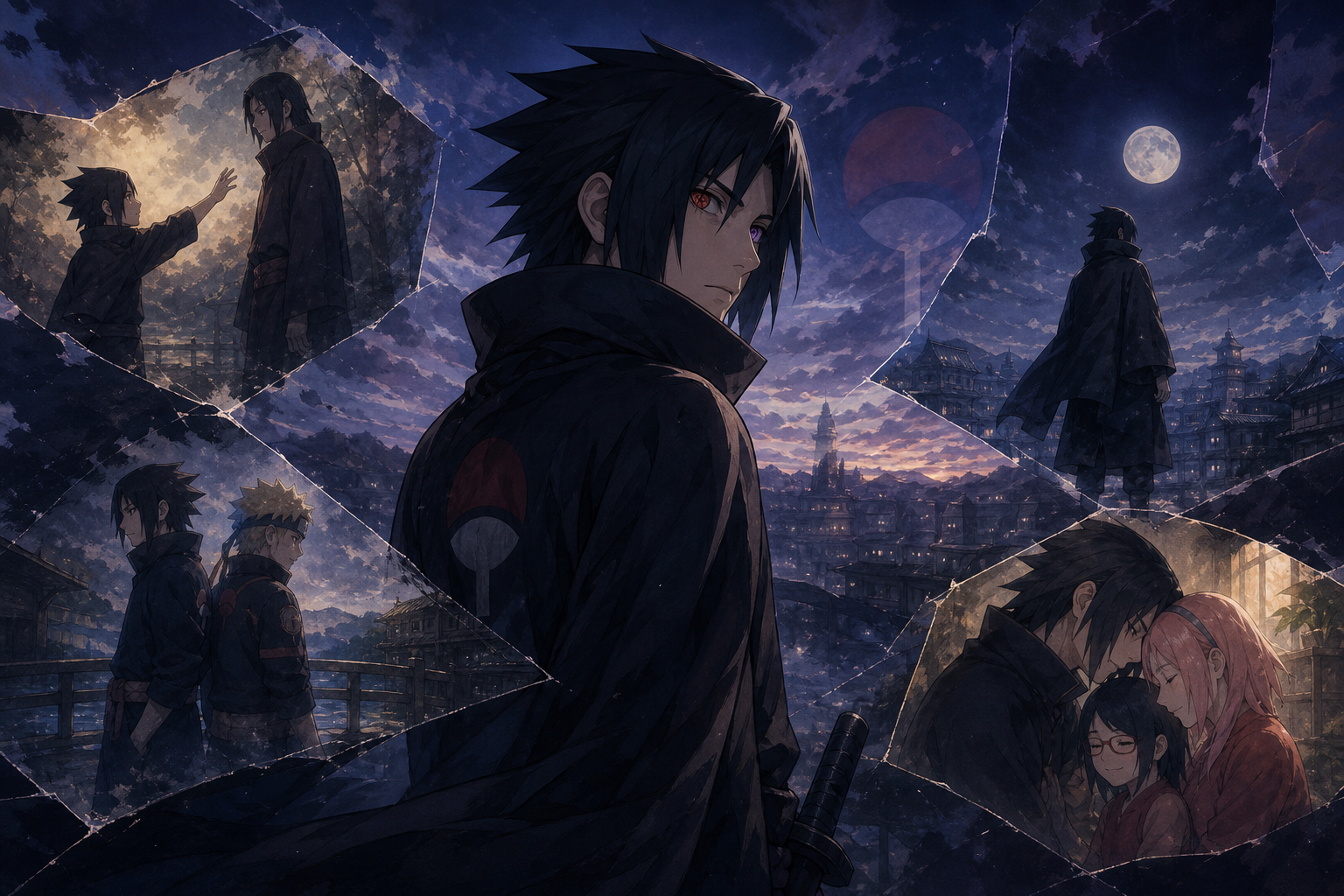
Sasuke Uchiha can freeze a room with three quiet words, then sound suddenly, devastatingly young when grief breaks the seal. Noriaki Sugiyama’s performance makes restraint audible: pride held rigid, love denied, fury rationed, and loneliness leaking through every attempt at control.
The one-sentence truth
Sugiyama does not play Sasuke as an empty “cool rival”; he plays a traumatized boy who converts feeling into precision because precision is the only form of safety he still trusts.
- Name: Noriaki Sugiyama (杉山 紀彰)
- Naruto role: Sasuke Uchiha
- Agency: Stay Luck
- Born: March 9
- Birthplace: Tokyo, Japan
- Performance signatures: controlled intensity, dry comedy, emotional rupture
- Other major roles: Uryū Ishida, Shirō Emiya, England
- Editorial policy: Japanese original performance only
Why Sasuke’s quiet is never empty
Many rival characters are introduced through noise: declarations, threats, theatrical contempt. Sasuke often arrives through subtraction. Sugiyama trims the voice until every syllable feels selected. He rarely gives young Sasuke more breath than the sentence requires. The result is not natural calm. The performance is management.
That distinction matters because Sasuke is a massacre survivor living among people who do not know the full shape of what happened to him. His body remains in Konoha while his attention is organized around an absent brother. Sugiyama lets the character sound socially present and emotionally elsewhere. A clipped reply can dismiss Naruto, warn an enemy, and protect Sasuke from admitting that the exchange mattered:all at once.
The early performance also preserves boyhood beneath polish. Sasuke’s confidence is real, but the confidence is still adolescent: pride sharpens when challenged, irritation arrives faster around Naruto, and moments involving family memory remove years from his voice. The audience hears the child precisely because the character works so hard to sound beyond childhood.
A performance chronology
The Academy survivor. At the beginning, Sasuke’s voice creates distance before Team 7 has a chance to create intimacy. Sugiyama uses level pitch, economical phrasing, and restrained reaction to make Sasuke appear self-contained. Yet comedy keeps betraying that pose. Naruto’s intrusions irritate him into faster timing; Sakura’s attention produces a different guarded stiffness; Kakashi earns alertness even when Sasuke refuses warmth. Team 7 becomes audible as the group capable of changing his tempo.
The Bell Test and the first unwanted bond. During the survival exercise, Sasuke sounds most comfortable when treating the problem as technical. Hunger, competition, and Kakashi’s manipulation can all be solved as systems. Then the team begins acting for one another. Sugiyama does not announce attachment. He lets attachment appear as altered attention: Sasuke responds sooner, listens longer, and uses concern disguised as practicality.
Land of Waves: fear enters the instrument. The Land of Waves arc forces the prodigy into situations where skill cannot guarantee control. Against Zabuza, Sasuke’s precision acquires pressure; inside Haku’s mirrors, breath and pacing expose exhaustion before the words concede exhaustion. When he protects Naruto, the voice no longer has time to maintain the superior rival. The moment lands because Sugiyama permits vulnerability without turning vulnerability into a speech about vulnerability.
Sasuke’s apparent death is one of the first times Naruto hears, and the audience hears, how much relationship had accumulated beneath antagonism. The sacrifice retroactively changes every earlier insult. Sugiyama has been building connection in negative space.
The Chūnin Exams: pride meets terror. Competition initially suits Sasuke’s instrument. Observation, tactical judgment, and contained confidence restore the identity he prefers. Orochimaru destroys that safety. Fear makes the voice less economical; the Curse Mark makes aggression sound intoxicating and alien without erasing Sasuke’s recognizable center. The performance asks a crucial question: when power feels like relief from helplessness, how quickly can relief become dependence?
Itachi returns. With Itachi, Sasuke’s carefully aged voice collapses toward the night of the massacre. Sugiyama accelerates him, roughens him, and allows control to fail. Rage is present, but the devastating layer is the demand underneath revenge: explain why I was loved, spared, and destroyed. Sasuke cannot ask that question directly, so the performance makes revenge carry the demand.
Leaving Konoha and the first Valley of the End. The departure requires coldness sturdy enough to survive Sakura’s appeal and Naruto’s pursuit. Sugiyama makes Sasuke sound as though certainty is being constructed in real time. At the Valley of the End, Naruto repeatedly forces emotional access. Sasuke answers by turning memory into doctrine: bonds create vulnerability; killing the closest friend will create power; solitude is therefore strength. The more philosophically certain the words become, the more the voice reveals their defensive purpose.
Shippuden: rebuilt control. When Sasuke reappears, the voice has recovered stillness, but the stillness is colder and more deliberate. This is not the Academy mask unchanged; the colder voice marks a new identity built under Orochimaru. Sugiyama reduces visible effort. Threat and speed no longer need emphasis because Sasuke expects obedience from the room.
The encounter with Itachi, and the truth that follows, fractures that construction. Sasuke’s later declarations change targets with frightening speed:brother, village, system, revolution:but Sugiyama keeps the emotional through-line coherent. Each ideology is an attempt to give grief a structure large enough to contain grief. The final valley and the sound of surrender. In the last confrontation with Naruto, Sasuke tries to define leadership as solitary absorption of hatred. The performance is controlled because the argument must feel reasoned, not merely villainous. Physical exhaustion gradually strips that control away. By the time both boys can barely move, ideological language gives way to the intimacy Sasuke has spent years refusing. Acceptance does not sound triumphant. Sasuke sounds tired, exposed, and finally honest.
Relationship atlas: how the voice changes by person
Naruto Uzumaki. Dismissal becomes competitive alertness, then involuntary recognition. Naruto is the person most capable of making Sasuke sound his age:and the person who eventually makes ideological certainty lose its rhythm.
Sakura Haruno. Sasuke’s responses to Sakura move between indifference, irritation, protective instinct, cruelty used as severance, and the awkwardness of later accountability. Sugiyama resists romantic softness where the character has not earned softness.
Kakashi Hatake. Respect and resistance coexist. Sasuke listens to Kakashi as a teacher and Sharingan wielder, but bristles when Kakashi’s experience threatens the revenge narrative holding his identity together.
Itachi Uchiha. No relationship changes the instrument more violently. Around Itachi, adult control, childhood terror, love, rage, imitation, and the need for explanation repeatedly occupy the same breath.
Orochimaru. Sasuke speaks with wary calculation, never the uncomplicated devotion of a disciple. Even while accepting power, Sugiyama preserves the sense that Sasuke believes he is using the person who believes he owns him.
Team Taka. Command becomes more explicit, yet moments of rescue and memory reveal bonds forming against Sasuke’s stated program of isolation. The contradiction is audible before he admits the contradiction.
Technique: what to listen for
Breath economy. Early Sasuke seldom spends breath socially. Listen for scenes where inhalation becomes audible; fear, exertion, or emotional access has breached the mask.
Tempo as attachment. Naruto can speed Sasuke up. Itachi can shatter pacing entirely. Orochimaru slows him into calculation. Relationship changes rhythm before vocabulary changes.
Controlled pitch. Sugiyama avoids confusing maturity with an artificially deep voice. Authority comes from placement and intention, which preserves the character’s age across a long chronology.
Rupture earned by restraint. The screams and broken declarations matter because they are rare. Emotional volume becomes narrative evidence, not a permanent character setting.
Career range beyond Konoha
Sugiyama’s official Stay Luck profile credits him as Sasuke in Naruto, Uryū Ishida in Bleach, lead Shirō Emiya in Fate/stay night, England in Hetalia, and many other animation, game, narration, and dubbing roles. Those credits are useful not as a popularity list but as comparative listening.
Uryū Ishida · Bleach. Ishida shares intelligence, formality, rivalry, and pride with Sasuke, but the social engine differs. His precision often performs standards and competence rather than sealing a massacre wound. Comparing the two shows how Sugiyama changes emotional access without discarding a recognizable vocal instrument.
Shirō Emiya · Fate/stay night. Shirō’s stubbornness points outward through ideals of rescue. The role requires more warmth, earnestness, and moral insistence. Where Sasuke compresses feeling to preserve himself, Shirō can sound driven to spend himself for an idea. England · Hetalia. Dry irritation, embarrassment, bluster, and comedy demonstrate how much timing matters. The comparison is especially valuable for listeners who have mistaken Sasuke’s controlled delivery for limited range.
Official career source: Stay Luck’s Noriaki Sugiyama profile.
Why the performance endures
Sasuke’s story changes political object repeatedly, but its emotional problem remains consistent: can a person shaped by catastrophic loss accept connection without treating connection as weakness, debt, or future leverage? Sugiyama keeps that continuity alive through years of narrative transformation. That is why Sasuke can be infuriating without becoming unreadable. Even when the character explains himself badly:or replaces grief with a total theory of the world:the performance allows us to hear the distance between the doctrine and the wound. The audience does not have to approve of Sasuke to understand why the next certainty feels necessary to him.
There is also generosity in the restraint. Sugiyama leaves room for animation, music, silence, and the other performer. A reaction can be small enough that Naruto’s emotional force occupies the foreground while Sasuke’s change remains visible at the edge. This is ensemble acting, not just iconic line delivery.
Essential listening path
- Team 7’s formation and the Bell Test: controlled superiority becoming reluctant attention.
- Land of Waves and Haku’s mirrors: fear, sacrifice, and attachment before admission.
- The Chūnin Exams and Curse Mark: power arriving as both threat and relief.
- Itachi’s return: adult pose collapsing into traumatized childhood.
- The Sasuke Retrieval arc and first Valley of the End: ideology constructed to survive separation.
- Hebi/Taka and the truth about Itachi: grief repeatedly reorganizing purpose.
- The Five Kage Summit: control hardening into isolation and moral extremity.
- The final Valley of the End: exhaustion stripping doctrine down to relationship.
Official story context: Naruto Official’s Sasuke Retrieval retrospective and finale retrospective.