
The Quietly Approaching Threat
Konoha rebuilds through ordinary acts of maturity while a new Akatsuki danger approaches beyond the village’s attention.
Reconstruction begins before the village feels recovered
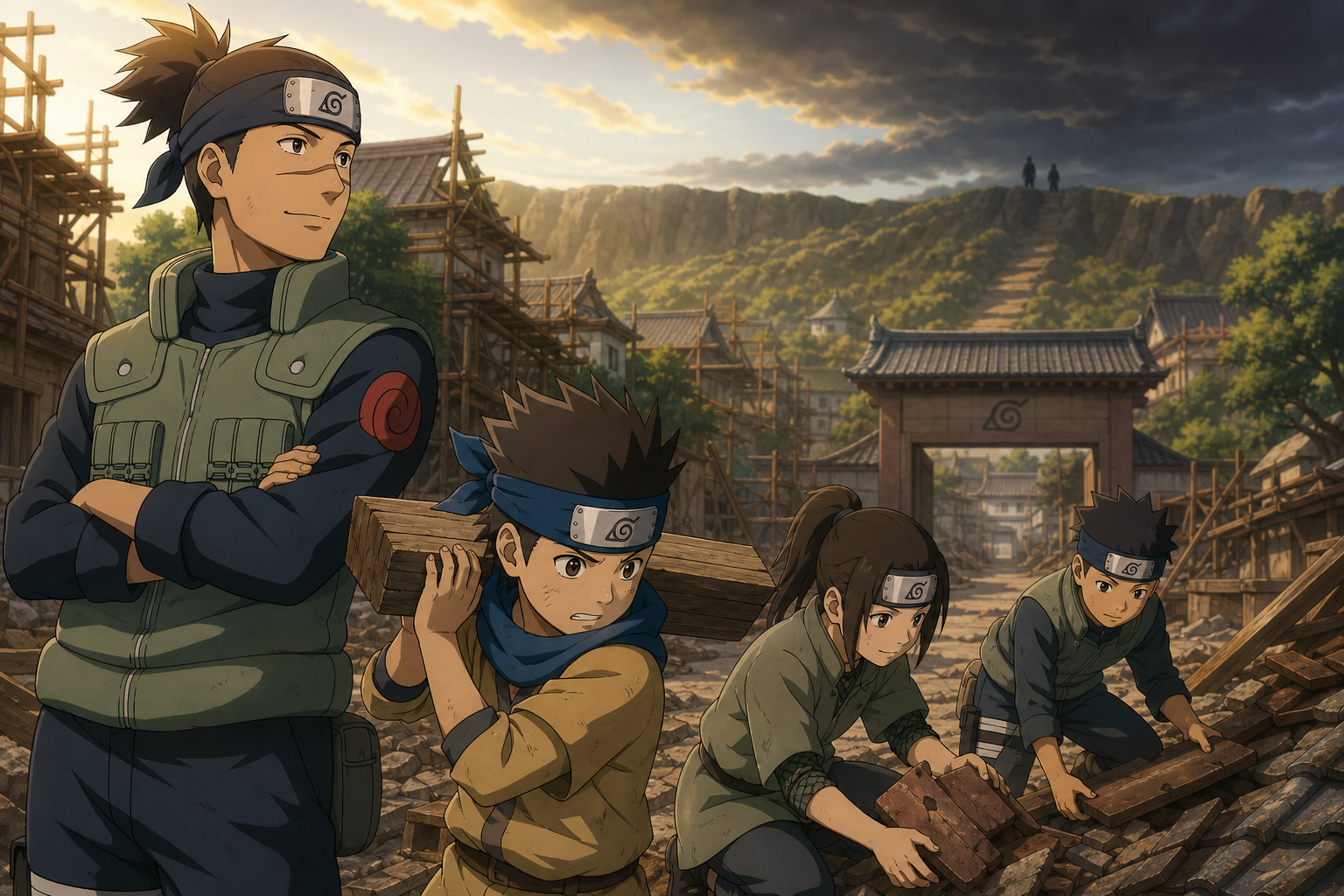
Episode 72 opens with Konoha repairing the visible damage left by Furido's assault. Timber, roof tiles, and cleared streets make recovery measurable.
The work does not mean the crisis has been emotionally resolved. Sora's departure, the revived guardians, and the village's political fractures remain part of what happened.
Rebuilding matters because people cannot wait for perfect closure before restoring daily life.
Iruka watches students become participants
Konohamaru and the other academy students do not stand aside while adults repair everything. They carry materials, clear debris, and contribute according to their ability.
Iruka sees maturity not as sudden power but as willingness to accept useful responsibility.
The children are still young. Their growth appears in understanding that belonging to a village includes helping after danger passes.
Small work preserves what large battles defend
Shinobi techniques can stop an attacker, but victory is incomplete if nobody restores homes, roads, classrooms, and public trust.
The reconstruction scenes give ordinary labor the same moral direction as combat: protect the conditions in which people can keep living together.
Konohamaru's timber does not look as dramatic as a jutsu. It is part of the reason the jutsu was worth using.
Iruka measures growth differently from rank
An academy teacher is trained to notice skills, discipline, and readiness. Here Iruka also notices character.
His students act without being told that the work will make them impressive. They respond to a shared need.
That distinction matters in a shinobi culture where visible strength can easily become the only measure of progress.
The village carries scars that should not be erased completely
The synopsis describes work to erase the scars of battle, but some scars also preserve knowledge. Konoha should repair the damage without pretending the failures behind it never occurred.
Danzo's secrecy, Sora's treatment, and Furido's manipulation created lessons the village needs to remember.
Recovery becomes dangerous when a clean surface is mistaken for an unchanged institution.
Naruto returns from rescue to unfinished training
The Guardian Shinobi crisis interrupted Naruto's wind-nature work and tested his control in the worst possible conditions.
Returning to training is not emotional avoidance by itself. Technique gives Naruto a structured way to convert experience into greater responsibility.
He now understands more clearly that power must remain usable when fear and resonance threaten to aim it elsewhere.
Quiet creates space for danger to approach
The episode's title refuses to let reconstruction become safety. While Konoha looks inward at damage it understands, a new threat moves beyond the village's awareness.
Hidan and Kakuzu do not need to announce themselves while defenders are tired and routines are being restored.
Threat is most effective when ordinary calm convinces people that vigilance can relax.
Akatsuki represents a different kind of pressure
Furido's attack grew from the Land of Fire's political history and Sora's family. Hidan and Kakuzu arrive from a larger organization hunting tailed beasts and accumulating power across borders.
That shift matters. Konoha is moving from an internal conflict to an enemy whose objectives extend far beyond one village dispute.
The next arc will demand different intelligence, alliances, and sacrifices.
Iruka's perspective connects generations
Iruka once taught Naruto when the village mostly saw a problem. Now he watches another group of students learn what community requires.
His pride carries the memory of how much patient recognition can matter. Children become dependable adults partly because someone notices effort before it becomes achievement.
The reconstruction scene is therefore also a teaching scene, even without a classroom.
RaeRae's reaction
I love a recovery episode that understands cleanup is part of the story. Villages do not reset when the battle music stops.
Konohamaru and the others helping gives Iruka a quiet reward. He gets to see that the lessons about responsibility are becoming choices the students make when nobody is scoring them.
The distant threat keeps the warmth from becoming complacent. Konoha is rebuilding yesterday's damage while tomorrow's danger is already walking closer.
Maturity means rebuilding without assuming danger is finished
Episode 72 bridges two arcs through one tension. The village needs normal life, hope, and visible progress. It also needs enough awareness to understand that recovery does not stop the world outside its gates.
Iruka's students model the right balance. They do not freeze because another threat might exist. They perform the useful work in front of them.
The quietly approaching danger will test whether Konoha's adults can do the same: rebuild honestly, preserve what they learned, and meet the next enemy without forcing the youngest generation to carry every consequence.
Official episode reference: Naruto Official episode guide
Licensed episode route: Crunchyroll licensed episode page
Kakashi returns with intelligence while everyone else is looking at rubble
The official episode guide puts Kakashi’s report beside Konoha’s recovery for a reason. Jiraiya’s investigation shows Akatsuki moving again while the village is still measuring damage from an entirely different enemy. The threat is not waiting for Konoha to finish one emotional chapter before opening the next.
Intelligence becomes a form of protection precisely because the danger is not visible from the street. Kakashi brings Tsunade a pattern, not a crater. Leadership has to take that quieter evidence seriously while residents understandably focus on roofs, roads, and people they can see.
Tsunade has to hold Naruto’s training and Akatsuki’s movement in the same frame
Naruto’s new technique remains unfinished after the Guardian Shinobi emergency. Tsunade knows Akatsuki hunts jinchuriki and therefore knows his vulnerability is not theoretical. She must decide how to protect him without turning protection into another cage.
Stopping his growth would leave him less prepared. Treating training as more important than health would spend him as a weapon. The responsible path needs supervision, honest risk limits, and enough intelligence to change the plan when Akatsuki moves closer.
Recovery creates operational blind spots nobody can shame away
Shinobi and civilians are tired. Buildings need repair. Injured people need care. Records, supplies, and patrol routes may be disrupted. Saying the village should simply remain vigilant ignores the physical cost of the last attack.
Good planning starts with that exhaustion instead of scolding it. Rotate watches, shorten reporting chains, protect sleep, and ask neighboring units for support. A tired village does not become safer because leaders demand heroic alertness from everyone at once.
The academy students model useful participation without becoming child soldiers
Konohamaru and his classmates help with tasks suited to their ability. That boundary matters. Children can contribute to community recovery without being pushed into combat or treated as replacements for depleted adults.
Carrying materials, organizing supplies, and assisting supervised cleanup build competence while preserving safety. The lesson is not that every child must earn belonging through labor. It is that young people can be included meaningfully when adults design roles around development rather than desperation.
Iruka’s pride comes from seeing values become behavior
A teacher rarely gets proof that one lesson caused one choice. Growth accumulates through repetition, example, correction, and the moment a student decides what to do without being watched. Iruka sees that moment in the rebuilding work.
His students are not performing for a ranking exam. They notice a need and participate. That is a deeper form of readiness than showing off a technique. A shinobi village survives through judgment long before it needs another flashy jutsu.
Reconstruction should preserve evidence of institutional failure
Repairing Konoha does not mean erasing every record of how Furido breached it, how Danzo’s secrecy widened the crisis, or how Sora was treated. Clean streets can coexist with an honest report.
The village needs after-action reviews, testimony from affected residents, and decisions about barriers, evacuation, grave security, and treatment of manipulated people. Otherwise, rebuilding becomes a stage set covering the same weaknesses. A community honors survivors by learning, not by making the damage disappear quickly enough for leaders to feel competent.
Sora’s departure belongs inside the recovery story
The village may celebrate survival, but one of the people at the center has chosen to leave. That choice should not be framed as ingratitude. Distance may be the first decision Sora makes after adults controlled his history and body.
Naruto can remain his friend without demanding proximity. Konoha can offer care and records without turning help into custody. A safe route away, plus a real route back, shows that rescue restored choice instead of merely transferring ownership.
Naruto’s return to training should include what the crisis taught him
Wind-nature mastery is not only about producing a stronger attack. Naruto just experienced chakra resonance, nearly lost control, and learned that saving someone required restraint as much as force. Those lessons belong in the training plan.
He needs warning signs, team protocols, and ways to stop when emotion changes the risk. Kakashi and Yamato should treat regulation as a skill, not a moral test Naruto passes by gritting his teeth. Power becomes useful when it remains available under the conditions that make it hardest to control.
Kakashi’s information needs distribution without creating panic
Tsunade cannot announce every intelligence detail to the whole village, but keeping the warning inside one office would repeat a familiar weakness. Patrol leaders, medical teams, gate units, and jinchuriki protection details need the parts relevant to their work.
Information should move by need and responsibility, not status alone. Rumor fills the gaps when people sense preparation without explanation. Clear instructions can preserve secrecy while preventing confusion from becoming Akatsuki’s unpaid assistant.
Hidan and Kakuzu arrive with a relationship built around utility
Their partnership is nothing like Naruto and Sora’s fragile friendship or Iruka’s care for students. Hidan and Kakuzu cooperate because their abilities and assignments fit, even while irritation and violence color the bond.
That makes them dangerous in a different way from Furido’s ideological network. They do not need shared affection or a grand vision to work effectively. Konoha cannot assume personal conflict will make an enemy team incompetent. Dysfunction can still be organized.
The Two-Tails hunt expands the moral geography of the story
While Konoha rebuilds, Yugito Nii faces Akatsuki in the Land of Lightning. The danger to jinchuriki exists beyond Naruto, Gaara, or one village’s trauma. Akatsuki turns people across nations into a collection target.
That should push the great villages toward shared intelligence, but politics will make cooperation difficult. Each institution has its own secrets and history of treating jinchuriki as assets. Fighting Akatsuki effectively may require admitting that the organization exploits a system the villages helped create.
Yugito should enter the story as a person, not a warning label
The plot can easily use another jinchuriki’s danger only to increase fear for Naruto. Yugito deserves more than that function. She has a village, training, relationships, and a life before Hidan and Kakuzu select her as prey.
Keeping that personhood visible matters because Akatsuki’s method is reduction. Targets become beasts, numbers, and steps in a plan. The story should not copy the organization’s gaze by treating her capture as useful information about somebody else.
The quiet threat is also the return of institutional habit
Konoha might respond to Akatsuki by tightening control around Naruto, restricting information, and making decisions over his head. Those habits feel protective because secrecy and command are familiar. The Guardian Shinobi arc just demonstrated their cost.
A better response includes Naruto in the risk conversation, explains what Kakashi learned, and establishes boundaries without pretending he is ordinary. Trust does not mean ignoring danger. It means refusing to make danger an excuse for removing the person most affected from every decision.
Normal life is not a distraction from preparedness
People need meals, lessons, jokes, work, and repaired homes. Those routines restore the social fabric that enemies attack. A village kept permanently in emergency posture may survive one assault while losing the life it meant to protect.
The goal is not endless fear. It is resilient normalcy: daily life supported by competent systems that can respond when evidence changes. Konohamaru carrying wood and Kakashi carrying intelligence belong in the same picture.
The bridge between arcs should feel uneasy, not disposable
This episode performs necessary transition work. It lets the previous crisis leave consequences, returns Naruto to his interrupted development, establishes Kakashi’s intelligence, and moves the audience toward Hidan and Kakuzu.
Calling that setup ignores how stories build pressure. Loud disaster only lands when quiet scenes establish what people are trying to restore and what they still do not know. The approaching threat feels dangerous because Konoha has finally exhaled.
The village needs an honest definition of readiness
Readiness cannot mean every shinobi stays armed, awake, and emotionally braced forever. That would turn Akatsuki into the manager of Konoha’s daily life before the organization reaches the gate. A prepared village protects rest, repairs infrastructure, and assigns clear responsibilities so vigilance does not depend on universal exhaustion.
Tsunade can identify which units need immediate intelligence, which routes require temporary reinforcement, and who has authority if a jinchuriki threat appears. Everyone else should be allowed to rebuild ordinary life. Systems exist so individuals do not have to carry the entire emergency in their nervous systems.
Naruto deserves the facts Kakashi brought back
Adults may want to spare him worry while his training is incomplete. Withholding the warning would repeat the logic that damaged Sora: decide what a young person can handle, keep the dangerous history upstairs, then act surprised when someone else controls the explanation.
Naruto needs information appropriate to the threat and his role. He should know Akatsuki is moving, what behaviors increase exposure, whom to contact, and why training plans may change. Inclusion does not mean giving him every classified detail. It means refusing to make his own danger a secret kept from him.
Jiraiya and Kakashi’s investigation only matters if leadership acts on it
Gathering intelligence can become a comforting ritual. Reports arrive, meetings happen, and everyone feels responsible while the enemy continues moving. Tsunade has to translate the warning into patrol, liaison, medical, and training decisions.
She also needs feedback. If a new patrol pattern fails, teams must be able to say so. If Naruto’s health changes, training should adjust. If another village has useful information, pride cannot block cooperation. Intelligence is a living process, not a scroll placed safely in a cabinet.
Reconstruction labor deserves protection from exploitation
Community spirit can hide unequal burdens. The same families may have lost homes, cared for injured relatives, and now feel obligated to rebuild public structures. Academy students may volunteer because they want to help, but adults should ensure safety, rest, food, and supervision.
Praising resilience is cheap if leaders use it to avoid providing resources. Konoha should track who needs housing, compensation, medical follow-up, and time away from duty. Recovery becomes fair when enthusiasm supplements public responsibility instead of replacing it.
Yugito’s fight should trigger solidarity across village lines
Akatsuki depends on every village treating its jinchuriki as a separate secret. Isolation prevents targets from sharing tactics, warning signs, and experience. The organization gains a repeated advantage because governments protect pride more aggressively than people.
A meaningful response would build secure communication among villages and include jinchuriki themselves. They know how surveillance, seals, and public suspicion shape movement. Strategy designed without them may protect assets on paper while making actual people easier to isolate.
The next arc begins with a moral choice about whose danger counts
Konoha has immediate reasons to focus on Naruto. That focus should not make Yugito’s capture distant background. Her danger matters even if saving her offers no direct benefit to the Leaf.
Akatsuki turns empathy into a resource scarcity problem: worry about your own vessel and treat the others as intelligence. The shinobi world will need to reject that framing before it can defeat an organization operating across every border those villages defend.
The episode earns its quietness by making every scene carry two meanings. A repaired roof is safety restored and evidence of vulnerability. A student helping is maturity and proof that children inherit consequences adults created. Naruto training is hope and a reminder that Akatsuki hunts the power inside him. Kakashi reporting is competence and proof that danger crossed someone else’s path. None of those meanings cancels the warmer one. That is the point. Life continues because people rebuild, teach, investigate, and prepare at the time. The threat approaches, but Konoha’s answer does not need panic. It needs attention, memory, and systems worthy of the people rebuilding beneath them.
RaeRae’s full take
I love that the episode makes cleanup visible. Roofs do not repair themselves because Naruto won an emotional argument in a chakra storm. Somebody has to pick up the timber.
Konohamaru and the academy students earn Iruka’s pride by doing useful work without turning it into a performance. That is maturity I can believe.
Kakashi’s report is the chill under all that warmth. Akatsuki is moving while Konoha is tired, Naruto’s technique is unfinished, and the village has every reason to look inward.
Tsunade cannot protect Naruto by freezing him in place. She also cannot treat his training like a production quota. Health, control, and information belong in the plan.
Yugito is not merely a preview of what could happen to Naruto. She is a person already facing the machinery Akatsuki built to reduce jinchuriki to inventory.
Rebuild the village. Learn from the breach. Let children help without making them carry adult failure. Then pay attention to the danger approaching quietly enough to benefit from everyone’s relief.
RaeRae checkpoint: Recovery and vigilance are not opposites. Konoha needs ordinary life restored by ordinary hands, plus leaders honest enough to admit that the next threat is already moving while the paint dries.
Receipts and official routes
- Japanese title, Kakashi’s report from the Jiraiya investigation, Tsunade’s concern about Naruto’s interrupted technique, and Hidan and Kakuzu’s Two-Tails hunt: Naruto Official Site episode guide.
- Licensed title, episode number, reconstruction context, and watch route: Crunchyroll.