
Akatsuki’s Invasion
Kakashi gives Naruto a clearer technical problem while an approaching Akatsuki threat supplies a deadline nobody has announced.
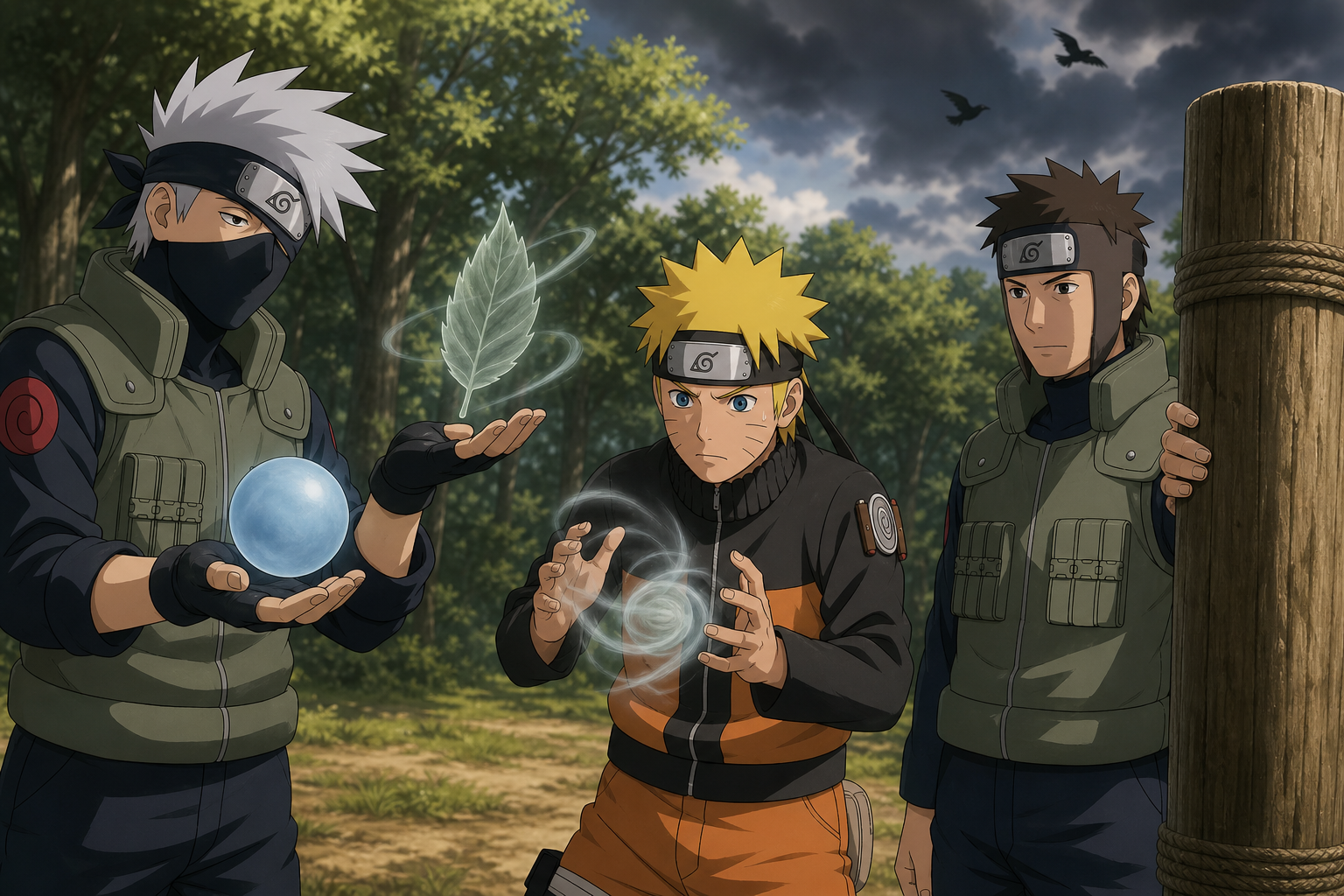
Kakashi returns with a harder version of Naruto's goal
Episode 73 resumes Naruto's new-jutsu training after the Guardian Shinobi crisis. Kakashi explains that the next stage requires more than producing wind chakra or repeating a familiar shape.
Naruto must combine nature transformation with shape transformation while keeping both stable enough to function together.
The challenge is not simply adding more power. It is coordinating two kinds of control that each demand full attention.
A new technique cannot be assembled from enthusiasm alone
Naruto's persistence helps him survive frustrating practice, but it does not automatically solve precision.
Nature transformation determines what chakra does. Shape transformation determines how it behaves in space. Combining them means neither process can be treated as secondary.
The lesson asks Naruto to become technically responsible for every part of the effect he creates.
Kakashi teaches by separating the problem
Kakashi makes the training understandable by distinguishing the components before asking Naruto to merge them.
That method matters for a student who often attacks the whole obstacle at once. A difficult objective becomes manageable when Naruto can identify which failure belongs to shape, which belongs to wind nature, and which appears only during combination.
Good instruction gives effort somewhere precise to go.
Yamato makes dangerous experimentation possible
Yamato's presence is not decorative supervision. Naruto has recently experienced resonance with Sora's chakra, and intensive training can exhaust the control protecting the Nine-Tails seal.
Wood Style gives the session a safety boundary that Naruto cannot provide for himself.
Support does not diminish Naruto's achievement. It creates conditions where responsible risk can produce growth instead of another uncontrolled crisis.
The title places training beside invasion
“Akatsuki's Invasion” creates tension between what Naruto knows and what the audience knows. Naruto is concentrating on a technical breakthrough while Hidan and Kakuzu move into the wider conflict.
Training is therefore urgent without Naruto fully seeing why.
The ability he is building will soon be measured against enemies who will not wait for the lesson to feel complete.
Hidan and Kakuzu approach with different priorities
The new Akatsuki pair carries a threat unlike Furido's political conspiracy. Their work belongs to an organization hunting tailed beasts, collecting resources, and extending influence across borders.
Konoha cannot understand them through the Guardian Shinobi conflict alone.
A new arc requires new intelligence, because assuming every enemy wants the same thing is another form of strategic blindness.
Naruto's recent experience changes the meaning of control
During Sora's transformation, Naruto had to suppress his own Nine-Tails chakra while reaching another person. Control was emotional, physical, and relational.
The new-jutsu exercise returns control to a technical setting, but the lesson carries that history. A powerful technique is only useful if Naruto can remain present enough to choose how it is used.
Precision is part of protecting people from the rescuer's strength.
Shadow-clone acceleration still carries a cost
Naruto can multiply practice through shadow clones and absorb their accumulated experience. That advantage compresses time, not fatigue.
More attempts produce more information, but they can also overwhelm his ability to interpret mistakes thoughtfully.
The training succeeds when quantity feeds refinement rather than becoming a substitute for it.
Reconstruction and training share the same logic
Konoha's workers rebuild roofs and streets piece by piece. Naruto rebuilds his technique by understanding one component at a time.
Neither process looks like a final victory while it is happening. Both depend on repeated accurate work whose value appears later.
The village and its shinobi are preparing for a danger they cannot schedule.
RaeRae's reaction
I like that Kakashi's return does not give Naruto a shortcut disguised as wisdom. He gives him a clearer problem.
Combining nature and shape transformation sounds simple when stated in one sentence, but Naruto has to maintain two different kinds of precision at once. That is exactly the kind of growth he needs after an arc where unstable chakra nearly erased two boys.
The approaching Akatsuki threat makes every imperfect attempt feel more expensive.
Progress becomes readiness before anyone announces the deadline
Episode 73 places Naruto in the uncomfortable space between understanding a goal and being able to perform it. Kakashi can explain the next stage, Yamato can contain risk, and shadow clones can multiply practice. Naruto still has to integrate the pieces.
Outside the training field, Hidan and Kakuzu are already moving. The invasion begins before Konoha feels the pressure directly.
That is the episode's warning: preparation rarely receives a convenient final day. Naruto's discipline now determines how much of his unfinished work will be ready when the enemy arrives.
Official episode reference: Naruto Official episode guide
Licensed episode route: Crunchyroll licensed episode page
The waterfall turns an abstract lesson into visible evidence
Cutting a waterfall with wind chakra gives Naruto a target that cannot flatter him. The water either separates or it does not. Every clone produces immediate evidence about stability, reach, and force. That blunt feedback suits a student who improves fastest when the problem becomes physical.
The exercise also teaches proportion. Naruto does not need to destroy the landscape around the waterfall. He needs to concentrate wind precisely enough to divide one continuous flow. More chakra without control may create noise while leaving the actual task unfinished.
Kakashi’s teaching respects Naruto enough to explain the machinery
He does not tell Naruto to trust a secret method or imitate a move without understanding it. He separates nature transformation from shape transformation and explains why combining them is difficult. Naruto receives a model he can test.
That transparency matters after the Guardian Shinobi arc. Adults withholding important knowledge helped make Sora vulnerable. Kakashi’s lesson operates in the opposite direction: give the young shinobi the underlying logic, supervise the risk, and let him build skill through informed effort.
Shadow clones change the schedule, not the standard
Hundreds of attempts can compress years of repetition, but they cannot decide which mistakes matter. Naruto still has to interpret the accumulated experience and identify patterns. Speed becomes useful only when learning survives the volume.
Kakashi and Yamato should watch for fatigue disguised as determination. The method returns mental and physical strain when clones disperse. If Naruto becomes too exhausted to distinguish progress from brute force, acceleration starts stealing the precision the exercise requires.
Yamato’s supervision is a safety system, not a babysitting joke
Naruto’s seal has just reacted violently to Sora’s implanted chakra. Intensive training adds exhaustion, frustration, and enormous chakra turnover. Yamato’s Wood Style creates a response plan if the Nine-Tails begins pushing through.
That support protects Naruto’s autonomy by making responsible training possible. Without it, leaders might forbid the work or allow a dangerous gamble. A good safety system expands what someone can do while reducing preventable harm.
The title tells us the invasion began before Konoha saw an attacker
Hidan and Kakuzu have already captured the Two-Tails, handed the target to Zetsu, and entered the Land of Fire searching for the Nine-Tails. The village does not need an enemy at its gate for invasion to be underway.
This definition matters for intelligence. Borders, temples, roads, and allied settlements form part of the defensive space. Waiting for an Akatsuki cloak inside Konoha would surrender every earlier chance to understand movement and protect people in their path.
The Fire Temple is not a disposable stop on the way to Naruto
Hidan and Kakuzu reach the temple because they are searching likely locations for the Nine-Tails. Chiriku and the monks become targets because geography and information place them between Akatsuki and Konoha.
The story should treat their danger as its own crisis, not merely a warning delivered through bodies. The temple has people, history, and obligations separate from Naruto. Defending the Land of Fire means those lives count before their suffering produces useful intelligence for the village.
Chiriku’s history makes this more than a random encounter
As a former member of the Twelve Guardian Ninja, Chiriku connects the previous arc’s political history to the new Akatsuki threat. He survived one conflict over service and now faces outsiders who turn human lives into bounty, ritual, and organizational progress.
That continuity prevents the transition from feeling like a reset. The institutions and people introduced during the Guardian Shinobi story remain part of the world. New danger reaches them whether or not the main cast has finished processing the old one.
Hidan and Kakuzu search through violence because people are information to them
The pair does not begin with careful diplomacy. They move from location to location treating resistance, rumor, and death as acceptable search costs. Their goal reduces communities to places that might contain a target.
That mirrors Akatsuki’s treatment of jinchuriki. A person becomes a vessel, a village becomes a lead, and everyone between becomes friction. Konoha needs intelligence that restores the names and stakes hidden by that operational language.
The Two-Tails handoff exposes Akatsuki’s division of labor
Hidan and Kakuzu do not need to complete every stage themselves. Zetsu receives the captured Yugito, letting the pair continue toward the next objective. The organization separates hunting, transport, surveillance, and extraction.
That structure makes Akatsuki harder to stop through one victory. Defeating a field pair may not recover a captured person if the handoff already occurred. Konoha must map routes and roles rather than imagining each enemy carries the whole operation.
Yugito’s capture should haunt the training field
Naruto does not know every detail while working at the waterfall, but the audience does. Another jinchuriki’s body has become Akatsuki cargo while he tries to build a technique for the fights ahead.
The contrast creates urgency without blaming Naruto for not being ready sooner. He is a teenager learning under a threat created by adults and institutions across nations. The moral failure would be leaders using Yugito’s capture to demand limitless sacrifice from him instead of building a wider response.
Tsunade needs cooperation beyond the Leaf’s intelligence network
Akatsuki crosses borders and targets people held under different systems. One village guarding one jinchuriki cannot see the full pattern. Reports about Yugito, Gaara, routes, abilities, and extraction timing should move among leaders faster than pride.
That cooperation also requires honesty about how villages treated jinchuriki. Governments cannot ask targets to trust a shared defense while hiding the decisions that isolated them. Security built on the same secrecy Akatsuki exploits will remain fragile.
Naruto’s technique must have a stop condition
A new attack can become so exciting that finishing it appears to justify any cost. Kakashi and Yamato should define signs that require rest or redesign: dangerous chakra leakage, loss of sensation, inability to maintain shape, or accumulated clone fatigue that compromises judgment.
A stop condition is not pessimism. It prevents ambition from becoming an unspoken order to damage oneself. Naruto’s value cannot depend on delivering a weapon before Akatsuki arrives.
Training should produce judgment alongside power
Naruto needs to know when the technique fits, what collateral risk it carries, and how to abort it. Combining wind nature with the Rasengan may create force whose effects extend beyond the visible target.
Kakashi’s lesson should therefore include deployment, not only construction. A jutsu mastered in isolation remains incomplete if the user cannot choose a safe angle, distance, or moment around teammates and civilians.
The episode contrasts chosen effort with extracted power
Naruto studies, fails, adjusts, and returns. His progress belongs to decisions made with teachers who explain the process. Akatsuki captures jinchuriki and extracts power from people reduced to vessels.
Both sides seek enormous chakra, but the relationship to the person differs. One should create more agency through skill. The other destroys agency to harvest an asset. That ethical contrast matters more than who produces the larger explosion.
Kakashi cannot let urgency contaminate the lesson
He knows Akatsuki is active and may feel the deadline pressing. If that fear turns every mistake into failure, Naruto will rush, conceal pain, or mistake exhaustion for commitment.
A teacher under threat has to communicate urgency without transferring panic. Clear milestones, honest feedback, and permission to report problems will produce readiness faster than shame. Naruto already supplies enough pressure from inside himself.
The arc transition makes preparation part of the battle
Hidan and Kakuzu have not yet attacked Konoha, but choices made now will shape every later encounter. Information shared, patrols assigned, training supervised, and temple warnings delivered can matter as much as any strike.
That is why the episode’s quieter half belongs under an invasion title. Battles begin in systems before they begin on screen. An enemy benefits from every delay that looks harmless because nobody has drawn a weapon yet.
The Fire Temple should have received a warning before Akatsuki arrived
Kakashi and Jiraiya know the organization is moving, and the temple sits inside the Land of Fire with a former Guardian Shinobi among its monks. Even incomplete intelligence could justify a direct alert, reinforced communication, and an evacuation plan for people unable to fight.
A warning does not guarantee victory. It changes whether defenders meet the threat alone and surprised. Institutions often protect information because uncertainty feels embarrassing. Sharing a careful warning is more responsible than waiting for perfect certainty while an enemy crosses the distance.
Chiriku’s bounty reveals another economy built around bodies
Kakuzu sees valuable corpses as money, just as Akatsuki sees jinchuriki as containers. These systems use different prices but share the same reduction. A person’s history, relationships, and choices disappear behind what the body can yield.
That makes the Fire Temple confrontation more than a power test. Chiriku faces enemies whose organization converts death into operating capital. Stopping them requires tracking financial routes and bounty exchanges alongside jutsu. Violence has infrastructure, and ignoring the money leaves part of the network untouched.
Naruto’s clone method needs deliberate reflection breaks
When hundreds of clones return experience at once, Naruto should pause to identify recurring failures rather than immediately creating another wave. Which hand position lost shape? When did wind destabilize? Did fatigue change the error? A short review can make the next hundred attempts different from the last hundred.
Kakashi can help him build that habit by asking for explanations, not merely results. If Naruto can describe why an attempt failed, he is moving from accidental success toward repeatable skill. The battlefield will not give him time to rediscover the technique from scratch.
Urgency cannot justify hiding injury
Naruto knows Akatsuki is dangerous and wants power quickly enough to protect friends. That motivation can make pain feel like weakness or delay. His teachers need a culture where reporting numbness, chakra disruption, or loss of control counts as useful data.
An unfinished technique can be revised. Nerve damage or a broken seal may not offer the same flexibility. Responsible training protects the future user from the present deadline. Konoha needs Naruto capable over time, not briefly spectacular and permanently injured.
The village should prepare for extraction, not only capture attempts
Yugito’s handoff shows that Akatsuki moves a target through stages. Patrols trained only to prevent abduction may fail once transport begins. Konoha needs likely routes, tracking methods, communication with border forces, and a plan for recovering someone before extraction finishes.
That plan should prioritize the captive’s survival. A rescue cannot treat killing the jinchuriki as acceptable denial of resources. Akatsuki’s dehumanization wins if defenders answer by destroying the person to protect the power inside.
The episode’s two halves share one question about time
Naruto compresses training because enemies are moving. Hidan and Kakuzu exploit the time between intelligence, warning, and response. The waterfall and the invasion are both contests over whether people can learn and act before a process reaches completion.
Speed matters, but reckless speed creates new failures. The useful question is not how fast everyone can move. It is which step cannot be skipped without making the next action less effective or less human.
Naruto’s next breakthrough should also remain understandable to the teammates who may fight beside it. They need to know its range, warning signs, setup time, and what happens if the technique collapses. Secret power can impress an enemy once and endanger an ally forever. Explaining the working limits turns mastery into team readiness. That principle applies to intelligence too. Kakashi’s report, the temple warning, and news of Yugito’s capture all become stronger when the right people know what action follows. Knowledge without a route into practice is decoration. This episode sits on the edge of disaster because several processes are moving at once. The best answer is not panic or speed alone. It is precise work shared early enough to matter.
RaeRae’s full take
I like Kakashi giving Naruto a technical problem instead of a motivational poster. Separate the transformations, understand what each controls, then learn where they fail together.
The waterfall is a perfect teacher because it does not care how enthusiastic Naruto feels. Cut it or adjust.
Yamato is essential. Supervision is not stealing Naruto’s achievement. It is the reason this dangerous method can be responsible instead of reckless.
Meanwhile, Hidan and Kakuzu have already captured Yugito and entered the Land of Fire. That is invasion, even if Konoha has not heard the first crash.
The Fire Temple and Chiriku are not scenery placed between Akatsuki and the main character. Their lives count before their destruction becomes a message.
Naruto should train urgently, not disposably. A village that answers the jinchuriki hunters by treating its own jinchuriki like a weapons deadline has learned nothing.
RaeRae checkpoint: Naruto’s new jutsu needs precision, supervision, and judgment. Akatsuki’s invasion proves why he needs power, but it does not grant anyone permission to spend the boy building it.
Receipts and official routes
- Japanese title, Naruto’s waterfall training, the Two-Tails handoff to Zetsu, Hidan and Kakuzu entering the Land of Fire, and their arrival at the Fire Temple: Naruto Official Site episode guide.
- Licensed title, episode number, Kakashi’s return, the next transformation-training stage, and watch route: Crunchyroll.