
My Friend
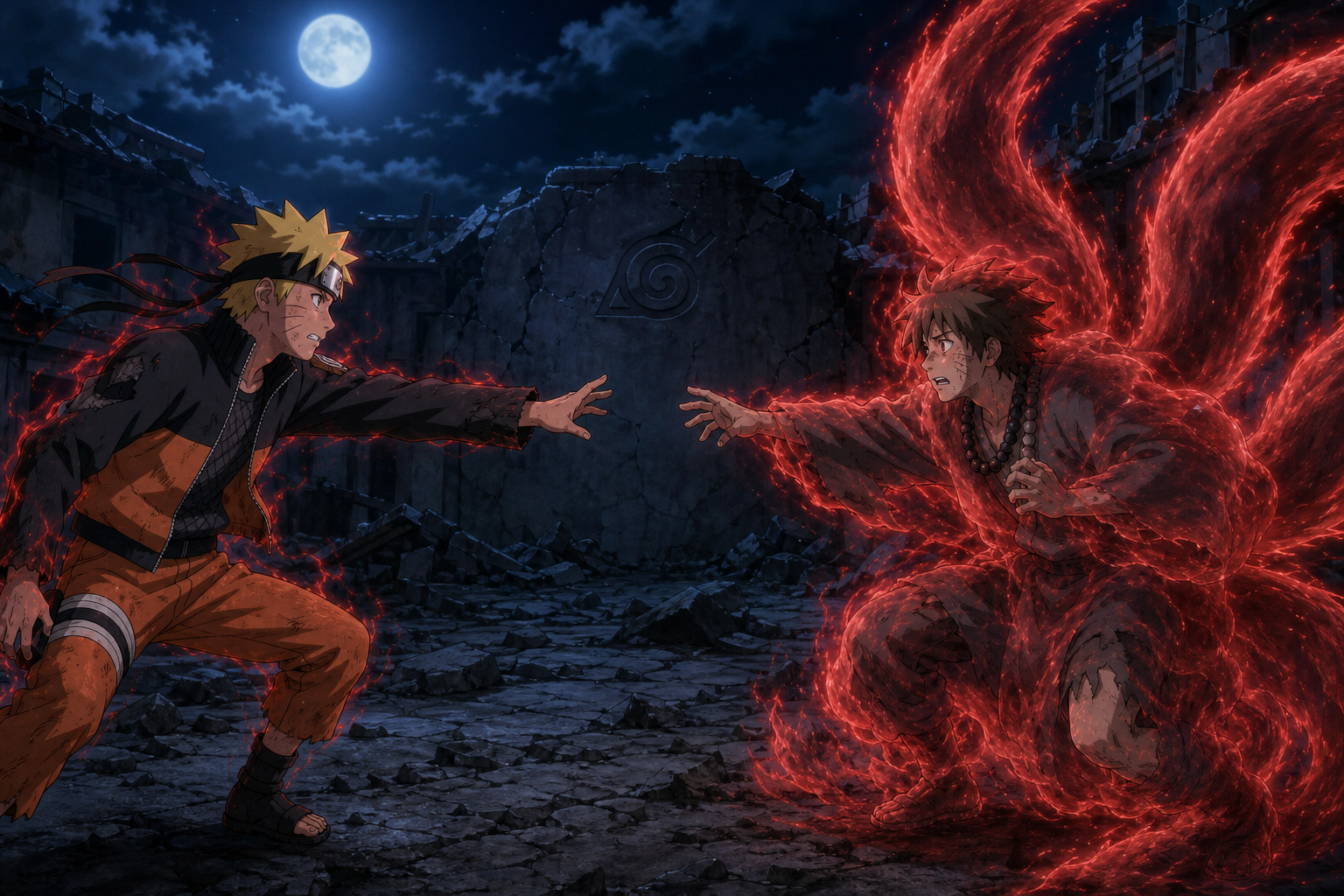
Naruto proves friendship by remaining himself inside the chakra storm and keeping a path open for Sora to choose.
Naruto fights his own chakra while reaching for Sora
Episode 71 makes Naruto's rescue attempt physically dangerous in both directions. Sora's Nine-Tails chakra is overwhelming the battlefield, while resonance pulls at the sealed power inside Naruto.
Naruto cannot help by surrendering to the same force. He has to suppress his own surge and keep moving toward Sora as himself.
The episode defines friendship as presence maintained under pressure, not a feeling announced from safety.
Sora's power leaves everyone else watching
Naruto's comrades can see the danger but cannot enter the chakra storm without making the situation worse. Their helplessness is not indifference.
Sometimes support means recognizing that another person has the only viable route into a crisis. The others protect the perimeter, resist panic, and trust Naruto to use the connection he has built.
That limitation gives Naruto's approach even more weight. There is no larger team rushing in behind him if he loses control.
“My friend” is a claim Sora did not earn through perfection
Naruto calls Sora a friend after arguments, mistrust, attacks, and rejection. The word does not erase any of those events.
It declares that Sora's worst moment does not cancel the relationship or turn him into an object to be eliminated.
Friendship here is not a prize for becoming easy to love. It is a commitment to keep recognizing the person whose behavior has become frightening.
Naruto refuses the logic of disposability
Several adults treated Sora's dangerous chakra as a reason he might need to be contained or killed. Kazuma treated it as a weapon that justified using his son.
Naruto rejects both reductions. He sees the danger clearly and still treats Sora's survival as part of the objective.
That stance is shaped by Naruto's own childhood, when the village often responded to the Nine-Tails before responding to him.
Shared experience gives Naruto a door, not ownership
Naruto understands the terror of losing control to tailed-beast chakra. He knows the shame and isolation that follow an outburst.
That experience helps him identify what Sora may still hear through the transformation. It does not give Naruto authority to decide every feeling Sora should have.
The best use of similarity is creating a path for Sora's own voice to return.
Sora's human response remains inside the cloak
The chakra makes Sora look less recognizable, but the episode insists that his heart and soul have not vanished. Naruto keeps speaking to that interior person.
This matters because violence becomes easier once observers believe there is nobody left to reach. Kazuma's plan depends on turning Sora into pure power.
Every sign of recognition disproves the idea that transformation is destiny.
Naruto's restraint becomes part of the message
Words about control would mean little if Naruto allowed his own Nine-Tails chakra to take over. By resisting it, he demonstrates the choice he is asking Sora to make.
Naruto does not pretend control is effortless. His struggle is visible.
That honesty makes the example useful. Sora is not being told that fear and rage should disappear. He is seeing someone endure them without letting the power choose the next action.
The adults cannot repair this bond for them
Asuma can reveal Kazuma's history and accept responsibility for silence. Yamato can attempt suppression. Sakura and the others can protect lives around the battlefield.
None of them can manufacture Sora's trust in the crucial moment. Naruto and Sora built their connection through conflict, training, and repeated choices.
The rescue depends on that specific history rather than a general speech about Konoha.
Kazuma's control fails when Sora hears another future
Kazuma offered Sora an inherited role: finish the father's cause, punish the village, and become the power others feared.
Naruto offers no grand political destiny. He offers continued relationship after the crisis.
That smaller future is powerful because it belongs to Sora. He can survive, remain angry, ask questions, and decide who he becomes outside Kazuma's script.
RaeRae's reaction
This episode earns its title because Naruto does not use friendship as a magic word. He proves it by fighting the chakra inside himself while moving closer to someone everyone else has reason to fear.
I also appreciate the comrades who have to stand back. Watching is painful, but charging into Sora's cloak would not automatically be brave or helpful.
Naruto reaches Sora because he has the right connection, not because everyone else cares less.
Friendship restores the possibility of choice
Episode 71 brings the Guardian Shinobi arc back to its central human question. Will Sora become the weapon his father designed, or can he remain a person capable of choosing what his inheritance means?
Naruto cannot choose for him. He can keep the door open long enough for Sora to respond.
That is what “my friend” accomplishes. It names a relationship stronger than the role Kazuma imposed and reminds Sora that another life remains available if he can reach for it.
Official episode reference: Naruto Official episode guide
Licensed episode route: Crunchyroll licensed episode page
Naruto’s first responsibility is to remain recognizable
The red chakra answering inside Naruto creates more than a power problem. If he loses himself, Sora sees proof that the force consuming him cannot be resisted. Naruto therefore has to protect his own mind and body as part of the rescue.
That is a difficult lesson for someone who treats self-sacrifice like a reflex. Staying himself may look less heroic than charging deeper, but it gives Sora a stable person to respond to. Friendship needs somebody present on both sides of the word.
The episode makes restraint an active form of strength
Naruto is surrounded by the exact power that has triggered his worst losses of control. He does not win by unleashing more of it. He fights to contain it while continuing to speak, move, and choose.
Restraint here is not passivity or fear of power. It is labor. Naruto holds one crisis inside himself while addressing another outside. That visible effort tells Sora something a perfect speech cannot: control can be difficult, ugly, and still possible.
Calling Sora a friend refuses a condition Kazuma imposed
Kazuma’s version of belonging depended on Sora accepting the inherited cause. Obedience purchased recognition. The moment Sora rejected destruction, the relationship had no room for his choice.
Naruto’s claim works differently. He names Sora a friend during resistance, danger, and emotional collapse. The bond does not require Sora to agree with Konoha or become harmless before it exists. That unconditional recognition gives him somewhere to return without performing loyalty first.
Unconditional friendship does not mean consequence-free behavior
Naruto can refuse to abandon Sora and still protect people from the chakra cloak. Love does not require pretending harm is not happening. In fact, honest friendship should make direct intervention more possible because the goal includes the friend’s future, not merely everybody else’s immediate comfort.
After the crisis, Sora may need to hear what happened and participate in repair. That conversation belongs after safety and medical care. Accountability offered by people who remain present is different from punishment delivered as proof that belonging was conditional all along.
The comrades who stand back still have work to do
The official summary emphasizes their helplessness against Sora’s chakra, but helpless does not have to mean useless. They can maintain distance, move civilians, watch Naruto’s condition, prepare medical support, and stop Kazuma’s remaining allies from exploiting the scene.
Good teams accept that not everyone belongs at the emotional center of every crisis. Charging into the cloak to prove devotion could create more casualties and force Naruto to protect them too. Discipline sometimes looks like holding the perimeter while another relationship does the work only it can do.
Witnesses matter after a frightening transformation
Sora will eventually learn how people looked at him. The comrades’ behavior now can shape whether he remembers only horror or also remembers restraint. They do not need to hide fear. They need to refuse cruelty, spectacle, and language that turns him into a monster.
Later, they can provide factual accounts without exaggeration and challenge rumors that erase Furido’s role. A community decides who belongs partly through the stories it tells after the danger passes.
Naruto speaks to a heart and soul the chakra cannot replace
The official episode description uses that language deliberately. The body has changed, the power is violent, and communication looks nearly impossible. Naruto still addresses an interior person capable of hearing and choosing.
This is not naive denial. It is a tactical and moral refusal to let appearance settle identity. Kazuma needs everyone to believe Sora has become pure weapon. Every response from inside the cloak proves his control remains incomplete.
Sora does not need to answer with a perfect apology
If he reaches toward Naruto, that choice should be enough for the moment. A traumatized child inside forced transformation cannot be expected to explain motives, accept every truth, and reassure frightened adults simultaneously.
The first answer may be a pause, a name, a hand, or one second of resisting the chakra. Rescue should recognize small agency. Demanding a polished declaration would turn recovery into another performance for authority.
Asuma’s battle with Kazuma cannot become the only ending
The former Guardian Shinobi may settle their physical confrontation, but Sora’s future cannot be reduced to which adult wins. He is not the trophy proving one political interpretation correct.
Asuma must survive his duel with enough humility to hear Sora afterward. If he treats Kazuma’s defeat as automatic forgiveness for his own silence, the old generation will once again write the conclusion over the child most affected.
The king question receives its clearest answer in Naruto’s action
Asuma says the next generation is the king. Naruto makes that answer physical by risking himself to preserve Sora’s ability to have a next day and a next choice. He protects a person, not an abstract office.
Kazuma claimed service while spending children and civilians. Naruto’s friendship exposes how empty that claim was. A political principle that cannot protect the frightened child in front of you has already failed its own future.
Friendship gives Sora an identity outside inheritance
Kazuma defined him as son, heir, weapon, and continuation. Konoha’s suspicious adults often defined him as risk. Naruto offers a simpler identity that Sora helped create through shared time.
A friend is not predetermined by blood or assigned by a council. It is a relationship built through choices, including the choice to repair after conflict. That makes it especially dangerous to Kazuma’s plan. Friendship proves Sora’s life contains meaning his father did not authorize.
Naruto must not become Sora’s only acceptable connection
The episode needs their bond, but recovery cannot leave one teenage boy responsible for another person’s entire support system. Naruto has his own seal, trauma, missions, and limits. Sora needs honest adults, medical care, peers, and a community willing to learn.
Making Naruto the sole bridge would recreate isolation with a friend-shaped exception. The healthier outcome uses this rescue to reopen many relationships, not to place every future crisis on Naruto’s shoulders.
“My friend” is a beginning, not a cure
The words can reach Sora without repairing Kazuma’s betrayal, Asuma’s silence, the implanted chakra, or Konoha’s fear. That is not a weakness in the scene. One honest relationship does not need to solve every institution to matter.
The phrase creates time. It reminds Sora that the future contains at least one person who expects him to remain in it. Healing, investigation, and accountability can happen only if he survives long enough to demand them.
The arc should preserve Sora’s right to leave
Being rescued by Naruto does not obligate Sora to stay in Konoha or at the Fire Temple. After adults controlled his body and history, choosing distance may be a legitimate act of recovery.
Friendship can survive geography. If Naruto’s care is truly unconditional, he can support Sora’s decision without treating departure as rejection. A path home matters most when it is not a cage.
Kazuma’s ideology loses when Sora chooses relationship over role
Kazuma offered certainty: one king, one inherited grievance, one purpose. Naruto offers a messier future where Sora can remain angry, ask questions, choose people, and revise himself.
That uncertainty is freedom. It does not promise Sora will never hurt again. It promises the hurt will not be interpreted for him by the man who caused it. Choosing a friend is choosing the right to become more than the role assigned at birth.
The rescue should not become Naruto’s claim to gratitude
Naruto risks himself because Sora matters, not because the act purchases a permanent role in Sora’s life. Afterward, Sora may be grateful, embarrassed, angry, distant, or unable to discuss what happened. Friendship has to survive responses that do not flatter the rescuer.
That boundary protects Naruto too. If he measures the rescue by whether Sora behaves like a loyal friend immediately, disappointment can turn care into pressure. The cleanest gift is survival without an invoice. Sora can decide what the relationship becomes when his body and thoughts belong to him again.
Konoha needs a response to public fear before rumors choose one
People saw catastrophic chakra over the village. Some will connect Sora to the attack without understanding implantation, manipulation, or his resistance. Silence would let the most frightening image become the complete story.
Leaders should explain the attack accurately, identify Kazuma’s responsibility, and refuse language that blames Sora for what was forced into him. They must also protect private medical details. Accountability and privacy can coexist. The village needs enough truth to reject retaliation, while Sora keeps ownership over the parts of his trauma that are not public property.
Friendship after violence requires room for honest memory
Naruto should not ask Sora to remember only the moment he was reached. Sora may remember pain, terror, restraints, frightened faces, and damage he caused. A healthy bond makes room for all of it without turning memory into a trial.
They can discuss what each person saw, correct misunderstandings, and acknowledge where fear shaped behavior. Naruto’s experience can help him tolerate the shame Sora may carry. The point is not to produce one comforting version. It is to prevent secrecy from becoming fertile ground for the next manipulator.
The other young shinobi need support after watching helplessly
Standing outside the chakra storm can create guilt. Someone may believe a better teammate would have found a way in. Another may replay the scene and mistake survival for proof that the risk was smaller than it looked.
Experienced leaders should name the value of perimeter work and explain why restraint protected Naruto’s approach. Teams learn dangerous lessons when only visible intervention receives praise. Sometimes competence means accepting the limit of your role and making sure the person at the center has a safe route back.
Sora’s next training must be chosen, transparent, and medically grounded
Adults may rush to solve the chakra problem through harsher sealing or secret techniques. That reflex would repeat the violation in the name of safety. Sora needs clear options, honest risks, independent advocates, and the ability to refuse non-emergency procedures.
Training should focus on recognition, regulation, escape routes, and communication rather than turning the implanted power into a village asset. If usefulness becomes the price of care, Konoha will reproduce Kazuma’s bargain with nicer language.
Naruto learns that connection does not require taking everything alone
His bond with Sora gives him the best route inward, but Yamato’s suppression, Asuma’s confrontation, medical readiness, and the others’ protection make that route possible. Friendship is not diminished by a team around it.
Naruto’s growth depends on understanding that asking for help can preserve the very relationship he wants to protect. If he burns himself out proving devotion, Sora loses the stable person calling him back. Shared labor keeps care from becoming another form of self-destruction.
The title also asks what friendship sounds like when the other person cannot answer. Naruto keeps speaking without demanding proof that Sora hears him. That patience matters. A relationship is not only the exchange of equal responses; sometimes one person holds the thread until the other can grip it again. The limit is ownership. Naruto can hold the thread, but he cannot pull Sora into a future chosen for him. The movement has to belong to Sora. That balance between persistence and respect is why the scene works. Naruto refuses abandonment without turning rescue into another command from a world that already controlled much.
RaeRae’s full take
This episode works because Naruto does not shout friendship from a safe rooftop. He fights his own chakra for the right to keep saying Sora’s name as himself.
I need the word friend to stay unconditional and honest. Sora is dangerous in this moment. Naruto’s refusal to discard him does not require lying about that danger.
The comrades standing back are not lesser friends. Sometimes the brave move is refusing to make somebody else’s crisis about your need to look useful.
Kazuma gave Sora a role before giving him the truth. Naruto gives him a relationship with no political invoice attached. That difference is the whole fight.
Asuma can defeat Kazuma and still owe Sora answers. Victory does not scrub adults clean.
Sora does not need a flawless redemption speech. He needs one choice that belongs to him and people disciplined enough to recognize it when it comes.
RaeRae checkpoint: Friendship is not permission to control Sora more gently. It is the promise that his danger, anger, and refusal will not erase his personhood or his right to choose what comes after survival.
Receipts and official routes
- Japanese title, Naruto suppressing the Nine-Tails chakra while reaching Sora, the Asuma and Furido conclusion, and the arc’s next Akatsuki movement: Naruto Official Site episode guide.
- Licensed title, episode number, Naruto’s rescue attempt, his comrades’ inability to approach, and watch route: Crunchyroll.