
Resonance
Kazuma’s identity turns inherited grievance into family betrayal while two boys’ unstable chakra amplifies the old conflict.
Furido's face turns manipulation into family betrayal
Episode 70 reveals that Furido is Kazuma, Sora's father and one of the Guardian Shinobi who planned the coup ten years earlier.
The revelation changes every private conversation Sora had with him. Furido did not merely know Kazuma or preserve his memory. Kazuma concealed his identity so he could shape his son without accepting the vulnerability and responsibility of being known as his father.
What sounded like inherited truth was a parent recruiting a child through deception.
Kazuma treated fatherhood as political succession
Kazuma sees Sora's power as proof that his cause can continue. That position reduces fatherhood to the transfer of grievance, ideology, and unfinished duty.
He does not ask what Sora wants after learning the full cost. He expects bloodline to create obligation.
The episode therefore separates inheritance from obedience. A child can understand a parent's history without becoming the instrument that completes it.
Asuma returns to a battle that never emotionally ended
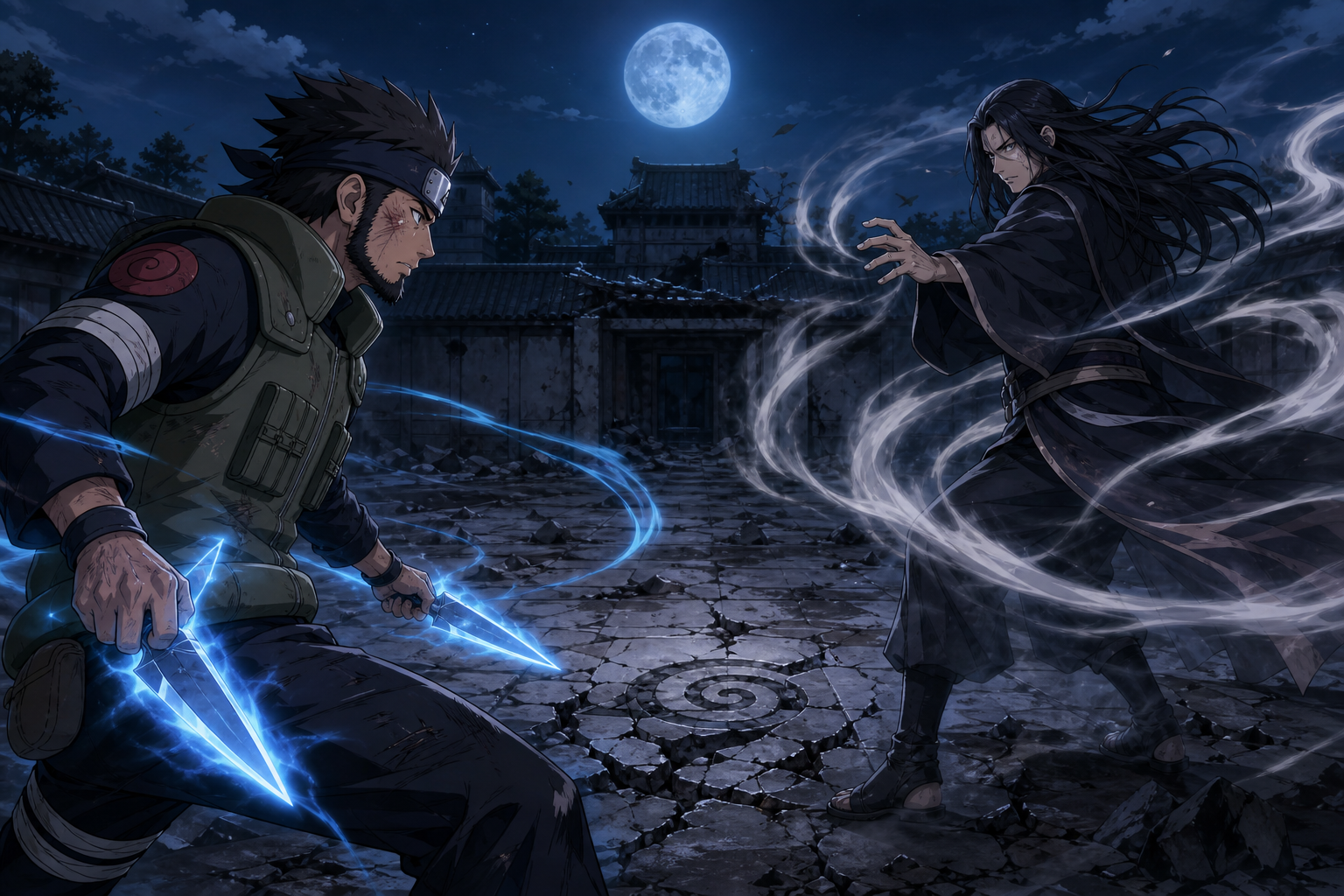
Asuma fought Kazuma during the Guardian Shinobi conflict and believed that chapter had closed with Kazuma's death. The confrontation shows that survival is not the only way a conflict continues.
Secrets, guilt, and the stories adults leave for children can keep a war active for years.
Asuma faces Kazuma again with more than personal honor at stake. He must stop the same ideology from consuming the son both men failed in different ways.
Resonance is shared history amplifying present danger
The title applies to several relationships at once. Asuma and Kazuma resume a duel shaped by the same political split. Naruto's Nine-Tails chakra responds to the chakra released through Sora. Sora's anger echoes Kazuma's grievance.
Resonance does not mean two things are identical. It means one vibration intensifies another.
The danger comes from allowing an old wound to set the frequency for every new choice.
Kazuma's “King” turns people into pieces
Kazuma justifies his actions through duty to the Fire Daimyo, whom he understands as the true king. The argument sounds principled until its human cost becomes visible.
If every shinobi is only a piece serving one ruler, personal judgment becomes disobedience. Civilians can be sacrificed for political correction, and Sora can be used as a weapon because the cause claims a higher authority.
A theory of service that removes moral agency can excuse almost any cruelty.
Asuma's honor depends on protecting choice
Asuma puts his honor on the line, but honor here cannot be nostalgia for the Guardian Shinobi or pride in winning the old duel again.
His most honorable action is preventing Kazuma from defining Sora's future as inherited property.
That requires Asuma to fight while also acknowledging his own silence. He cannot protect Sora by replacing Kazuma's imposed story with another incomplete one.
Naruto and Sora create a dangerous chakra feedback loop
Sora's released chakra does not remain isolated. It begins affecting Naruto's own Nine-Tails power, making each boy's loss of control more likely to intensify the other.
Their emotional similarity now has a physical consequence. Naruto cannot simply approach Sora as an unaffected rescuer. The same power that supports his empathy also places him at risk.
Helping Sora requires Naruto to manage his own response rather than proving that he can endure more chakra.
Yamato confronts a containment problem beyond one body
Yamato's Wood Style has previously helped suppress Naruto's Nine-Tails chakra. Resonance makes the task harder because the surge is distributed across two connected boys and strengthened by an outside design.
Containment becomes a systems problem. Suppressing one source may not hold if the other continues feeding it.
The episode again rewards the enemy for creating relationships between threats while forcing Konoha's defenders to discover those relationships under pressure.
Sora's terror contradicts Kazuma's claim of liberation
Kazuma presents himself as restoring Sora's rightful strength and purpose. Sora's fear reveals the lie.
Liberation should increase a person's ability to choose. The transformation narrows Sora's options, endangers his body, and uses his pain to activate a plan he did not knowingly accept.
The father who claims to reveal Sora's true self is actively making that self harder to reach.
RaeRae's reaction
The Kazuma reveal makes Furido's manipulation so much worse. He had every opportunity to approach Sora as his father and tell the truth. Instead, he staged recognition from a mysterious outsider because mystery gave him more control.
I also like how “resonance” refuses the easy version of the Naruto and Sora parallel. Their chakra can amplify each other in destructive ways. Understanding someone does not automatically make you safe enough to save them.
Naruto has to remain himself while reaching Sora, or both boys become part of Kazuma's weapon.
The old duel can end differently only through the next generation
Episode 70 returns Asuma and Kazuma to their ten-year-old conflict, but repeating the fight cannot by itself resolve what created it. The political question, the concealed history, and Sora's inheritance remain.
The decisive difference is that Sora and Naruto are present. They are not merely pieces belonging to opposing adults. They can interpret the past and choose what continues.
Resonance can amplify destruction, but it can also reveal connection. The outcome depends on whether the next generation is allowed to answer history instead of being ordered to repeat it.
Official episode reference: Naruto Official episode guide
Licensed episode route: Crunchyroll licensed episode page
Kazuma chose disguise because fatherhood would have limited his control
Approaching Sora as Furido let Kazuma present every answer as a gift from the only adult willing to understand. Approaching as his father would have invited harder questions. Where were you? Who altered my body? Why did you leave me at the temple? Why should your political defeat become my duty?
The disguise protected Kazuma from accountability while preserving the emotional authority of blood for the reveal. He wanted the privilege of fatherhood without the obligations. That is not strategic brilliance. It is cowardice dressed in bandages.
The reveal rewrites every earlier conversation without erasing Sora’s feelings
Sora genuinely felt seen by Furido. Learning the man was Kazuma does not make those feelings foolish. It proves how carefully Kazuma used information only he possessed. He knew which absences hurt, which questions remained unanswered, and which praise would sound like belonging.
Sora now has to hold two truths: the connection felt real to him, and Kazuma engineered it for control. Recovery should not demand that he pretend he never cared. It should help him judge the relationship by what happened when his choices diverged from Kazuma’s plan.
Kazuma turns survival into proof that his politics were right
He survived the Guardian Shinobi conflict and treats that survival like moral vindication. Yet living longer than comrades does not settle the argument. It gave him years to refine resentment, collect forbidden methods, and recruit through secrecy.
A cause does not become righteous because its last committed believer refuses to stop. Kazuma’s actions show what the cause has become under his stewardship: revived bodies, village-wide destruction, and a son converted into a chakra device. The method is evidence against the claimed principle.
Asuma’s honor has to include admitting what he got wrong
Putting honor on the line sounds noble, but honor cannot mean preserving a clean image of the side Asuma chose. He must defend Konoha while naming its failures, oppose Kazuma while admitting the cost of silence, and protect Sora without demanding gratitude.
That version of honor is less cinematic than a final strike. It is also harder. Pride wants victory to prove the victor was right about everything. Responsibility accepts that stopping a worse act does not erase earlier harm.
The king question collapses when Kazuma spends the people
Kazuma says loyalty belongs to the Fire Daimyo, then prepares to annihilate a village inside the Land of Fire. The contradiction is not a small tactical excess. It reveals that his king has become an excuse for Kazuma’s authority rather than a person or public he serves.
If civilians can be sacrificed to enforce the correct hierarchy, the hierarchy has replaced its supposed purpose. Asuma’s answer, that the next generation is the king, survives because it creates a limit: you cannot protect the future by treating children as ammunition.
Sora is not an heir to a debt
Kazuma treats bloodline as a contract signed before Sora could read it. His son is expected to avenge, continue, and validate him. None of those duties arose from Sora’s informed choice.
Children inherit stories, consequences, and sometimes power. They do not inherit moral liability for completing a parent’s unfinished violence. Sora can remember Kazuma, mourn him, love parts of him, and still refuse the political assignment. Refusal is not betrayal. It is adulthood beginning.
The chakra resonance creates consent problems for both boys
Sora’s surge begins pulling at Naruto’s own Nine-Tails chakra. Naruto enters the rescue as a helper and becomes physically entangled in the same mechanism. His body starts answering a signal he did not choose.
That means teammates must protect Naruto’s agency too. They should not praise him for enduring unlimited exposure or assume his similarity makes risk acceptable. A rescuer can become another person needing containment and care. Recognizing that change early protects both boys.
Naruto cannot reach Sora by surrendering himself
His instinct is to push closer, take more damage, and prove he will not leave. The gesture carries emotional force, but resonance punishes self-erasure. If Naruto loses control, Sora gains another terrified mirror instead of a stable connection.
Reaching someone sometimes means maintaining the boundary that lets you remain present. Naruto needs Yamato, Asuma, and the wider team. Accepting their help does not weaken the bond. It keeps the bond from becoming Kazuma’s second weapon.
Yamato’s containment should create room, not become the whole answer
Wood Style can suppress chakra, but suppression alone cannot resolve the betrayal driving Sora’s collapse. It buys time for communication, evacuation, and the return of choice. Treating it as a complete solution would reduce Sora to the energy escaping his body.
The goal is not permanent quiet enforced from outside. It is enough safety for Sora and Naruto to participate in what happens next. Good containment serves recovery. Bad containment replaces one controller with another.
Resonance explains how old violence recruits new bodies
Kazuma’s grievance moves through story, secrecy, family expectation, and implanted chakra. Asuma’s guilt influences what he withholds. Naruto’s history shapes how he approaches Sora. The past does not remain behind any of them. It vibrates through current choices.
The episode refuses the fantasy that time automatically heals political violence. Untold history becomes easier to manipulate. Unexamined shame becomes silence. The cycle changes only when someone hears the echo and answers differently.
Asuma must fight Kazuma without making Sora watch another simple execution
Stopping Kazuma may require lethal force. The context still matters to Sora. If adults frame the fight as righteous Asuma destroying evil Kazuma, they repeat the simplification that left him unable to understand his father in the first place.
Sora deserves the truth that Kazuma caused grave harm and was still his father. He should not be forced to celebrate the outcome or comfort the people who fought him. Grief can remain complicated without weakening accountability.
Kazuma’s last chance to act like a father is to release control
He could stop the chakra process, reveal what was done to Sora, and accept that his son may reject him. That would not erase the damage. It would be the first action centered on Sora’s survival rather than Kazuma’s cause.
Instead, Kazuma treats control as love’s proof. The more Sora resists, the more tightly he pushes the inherited mission. A parent who cannot permit refusal is not protecting a legacy. He is consuming a child to preserve his own importance.
Konoha must resist turning Naruto into its acceptable vessel
The village may contrast Naruto’s service with Sora’s rampage and declare one good, one bad. That comparison ignores how much Naruto suffered before recognition and how often his usefulness influenced acceptance.
Both boys deserve dignity beyond whether their dangerous chakra benefits the institution. Naruto should not have to earn personhood by saving everyone, and Sora should not lose personhood because Furido engineered his collapse. The standard must apply before performance.
The aftermath needs two separate truth processes
One investigation should establish the Guardian Shinobi plot, the implantation, the grave theft, and everyone who assisted. Another, protected process should let Sora learn his personal history without turning private trauma into public spectacle.
Those goals overlap but are not identical. Public accountability does not require publishing every detail of a child’s body or grief. Sora’s right to know and the village’s need to learn can coexist with privacy.
Resonance can become solidarity only when difference survives
Naruto and Sora connect because dangerous chakra and public fear shaped both lives. Solidarity does not require one boy to disappear into the other’s story. Naruto can stand beside Sora while acknowledging different origins, losses, and choices.
That is the healthier resonance: shared recognition that makes more room for each person. Kazuma’s resonance amplifies bodies until individuality collapses. Naruto’s task is to keep connection from becoming absorption.
Calling Sora’s chakra incomplete does not make him incomplete
Kazuma’s plan encourages everyone to evaluate Sora by how closely his power resembles the Nine-Tails. That language can turn a child into a failed copy of Naruto or an unfinished version of a weapon. Sora is neither. The chakra was imposed on a life that already had its own worth, relationships, temperament, and future.
Medical teams may need precise language about quantity, stability, and interaction. People speaking to Sora need equal precision about personhood. His condition can be artificial without making his pain fake. His power can be partial without making him lesser. The defect belongs to the adults who treated a body as a container, not to the child forced to carry their decision.
The defenders should interrupt the feedback loop at more than one point
Yamato can suppress chakra, but the team should also create physical distance, remove Kazuma’s influence, reduce emotional provocation, and keep communication steady. A networked crisis rarely yields to one brilliant intervention. Each smaller interruption lowers the burden on the others.
This matters because dependence on one specialist creates another fragile system. If Yamato falters, everyone should not be left without a plan. Asuma can engage Kazuma. Sakura or another medical ninja can monitor physical damage. Naruto can maintain contact only within safe limits. Others can protect civilians and prevent additional interference. Shared responsibility keeps rescue from becoming a heroic gamble.
Kazuma confuses being remembered with being obeyed
He fears that his defeated cause will disappear, so he tries to preserve it through Sora. Yet memory does not require continuation. Sora can remember the Guardian Shinobi conflict, learn why Kazuma acted, and decide the conclusion was wrong.
A parent’s legacy should be able to survive a child’s independent judgment. If it collapses the moment the child refuses, it was never inheritance. It was a command waiting for a younger mouth. Kazuma wants immortality through obedience. Sora’s refusal would offer something more human: a memory examined rather than worshiped.
The village must not celebrate control returning to the adults
If Naruto and Yamato suppress the chakra, observers may feel relief because the dangerous child is quiet again. That relief is understandable and insufficient. Control should return to Sora, not merely to Konoha’s authorities.
The next questions are practical. Can he speak without threat? Can he refuse visitors? Can he participate in treatment decisions? Can he ask for the records adults hid? Can he leave when medically safe? A calm body under permanent surveillance is not the same as recovery. The goal is not obedience after chaos. It is agency after violation.
Resonance also means consequences travel. Kazuma’s secrecy reaches Sora, Asuma’s silence reaches the present duel, and Sora’s chakra reaches Naruto’s seal. Nobody gets to pretend a private decision stays private once another body carries the cost. The answer is not isolation, because isolation gave Furido room to work. It is connection with boundaries, truth, and consent. People must share information without claiming ownership, offer help without demanding surrender, and remember that closeness can amplify care as easily as fear. Naruto and Sora need that second kind of resonance now: two boys remaining distinct while refusing to let the other disappear inside inherited violence in every direction.
RaeRae’s full take
Kazuma hiding behind Furido tells me he knew exactly what an honest father-son conversation would cost him. Sora might say no. So he built loyalty before revealing who was asking.
The king debate is finished the second Kazuma decides civilians and his own child are expendable. Your political theory does not protect the country if it requires burning the people inside it.
Asuma needs to stop him, but I do not want victory used as detergent for Konoha’s mistakes. He can be right in this fight and wrong about what his silence cost Sora.
The physical resonance is vicious because Naruto’s best qualification for helping also makes him vulnerable. He has to keep himself intact. Martyrdom would hand Kazuma two boys instead of one.
Sora is not a sequel to Kazuma. He is not a debt, an heirloom, or a delayed weapon. He gets to decide what his father’s story means after surviving it.
The cycle ends when the next generation receives history without being ordered to repeat it. Anything less is the same old war with younger bodies.
RaeRae checkpoint: Kazuma calls bloodline duty, calls coercion inheritance, and calls synchronized chakra destiny. Sora’s right to refuse all three is the one answer his father never planned for.
Receipts and official routes
- Japanese title, Kazuma’s identity, the renewed Asuma confrontation, and the Nine-Tails chakra resonance between Sora and Naruto: Naruto Official Site episode guide.
- Licensed title, episode number, Kazuma reveal, and watch route: Crunchyroll.