
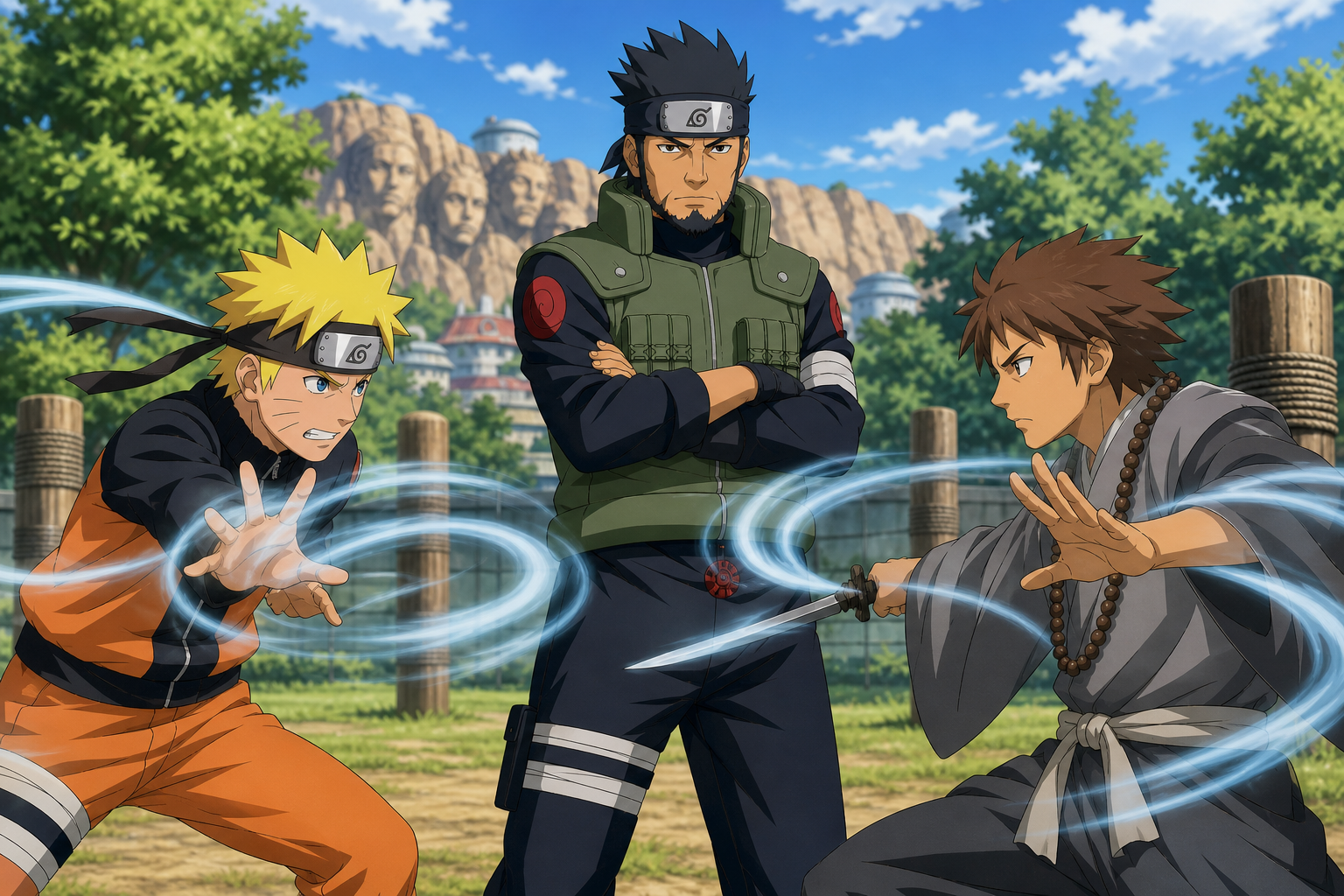
The Two Kings
Asuma turns shared wind chakra into a lesson about discipline, mentorship, and the future strength exists to protect.
Asuma turns rivalry into shared training
Episode 63 brings Naruto and Sora to the same teacher by chance, then lets their competitiveness do useful work. Both boys possess wind-natured chakra. Both want progress quickly. Neither enjoys appearing weaker than the person beside him.
Asuma does not remove that rivalry. He contains it inside a training structure where comparison can sharpen attention instead of becoming another argument.
The lesson works because Naruto and Sora finally have a problem neither can solve through posture alone.
Wind chakra gives them a real point of connection
Naruto and Sora have repeatedly recognized emotional similarities without knowing what to do with them. Shared wind chakra is more concrete. They can observe the same principle, attempt the same transformation, and compare results that exist outside either boy's pride.
That practical connection matters. Friendship does not have to begin with confession. Sometimes it begins with two people concentrating on the same difficult task and learning that the other person's effort is real.
Their techniques will not become identical, but the underlying nature gives them a common language.
Asuma's “iron fist” is discipline with a purpose
Asuma's coaching is demanding because wind chakra punishes imprecision. The element depends on creating an edge fine enough to separate and penetrate rather than merely producing more visible force.
He pushes both boys toward control instead of rewarding dramatic output. That emphasis directly challenges their habits. Naruto often measures progress through scale and persistence. Sora often treats intensity as proof that his unusual power deserves respect.
Asuma requires them to make strength answer to technique.
Naruto is learning to value refinement
Naruto's shadow clones gave him a way to accelerate elemental training, but speed can hide impatience. He still wants a breakthrough that feels decisive.
Training beside Sora makes every imperfect attempt visible. Naruto cannot rely on enthusiasm alone when another wind user can test the same principle. He has to notice small differences in shape, pressure, and consistency.
This is important growth for a shinobi whose greatest victories once came from refusing to stop. Persistence remains his gift, but refinement determines what that persistence creates.
Sora receives instruction without hidden conditions
Furido praised Sora's power while withholding the knowledge Sora wanted. Asuma offers the opposite kind of relationship. His lesson is direct, observable, and equally demanding for both students.
There is no mysterious destiny attached to success. If Sora improves, it is because he studies the technique and performs the work.
That contrast quietly matters. Honest mentorship can feel less intoxicating than manipulation because it does not flatter every insecurity. It gives Sora something better: a method he can test without surrendering his judgment.
Competition reveals respect before either boy names it
Naruto and Sora may frame their training as a contest, but watching another person struggle seriously changes the meaning of rivalry. Each sees that the other is not bluffing about his determination.
Respect arrives through evidence. Naruto observes Sora's control and temple discipline. Sora sees that Naruto's noisy confidence rests on extraordinary effort rather than effortless praise.
Neither has to become gentle overnight. Their willingness to keep training beside one another already says that dismissal is giving way to attention.
The title asks who deserves to be protected
“The Two Kings” introduces a metaphor that reaches beyond this training session. A king can mean the visible leader everyone assumes is most important, or the future generation whose survival gives leadership its purpose.
The distinction changes how authority should work. If leaders exist only to preserve their own position, everyone beneath them becomes expendable. If leadership protects the people who will inherit the world, sacrifice and duty acquire a different direction.
Asuma's instruction embodies the second idea before he fully explains it. He invests in two difficult young people because their future matters.
A teacher protects possibility, not obedience
Asuma does not need Naruto and Sora to imitate his personality. He gives them technique, boundaries, and a standard they can carry into choices he will not control.
That is the ethical difference between teaching and recruitment. Furido wants Sora's power aligned with a predetermined cause. Asuma wants both boys capable of using their power responsibly.
One relationship narrows the student's future. The other strengthens the student who will choose it.
Sai's empty place remains visible
Sora's temporary assignment creates this training opportunity, but Sai's injury still defines the team arrangement. The episode does not need to place Sai in the field for his absence to matter.
Team Kakashi is adapting around a missing member while trying to protect someone the enemy may be targeting. Naruto's new connection with Sora should expand the team rather than turn Sai into a forgotten vacancy.
Healthy belonging is not a competition for one available place.
RaeRae's reaction
I love that Naruto and Sora finally get a shared activity more useful than arguing about who understands loneliness better. Wind training gives them something honest to measure.
Asuma is exactly the right teacher for this moment. He does not flatter Sora or indulge Naruto's impatience. He expects both of them to work, and that equal standard is a form of respect neither boy can easily dismiss.
The title also adds weight to a training episode. These techniques are not only about who can cut more cleanly. The adults are deciding what kind of future their strength is supposed to protect.
Two students begin imagining strength beyond themselves
Episode 63 uses technical practice to open a political question. Naruto and Sora want stronger wind chakra, but Asuma's presence asks what that strength will serve once they possess it.
The answer cannot be personal recognition alone. Power shaped only around wounded pride remains vulnerable to anyone who knows how to praise it.
Training together gives both boys a different model. Skill can be built through shared effort, passed from one generation to the next, and measured by what it protects. The two kings are not trophies waiting to be claimed. They are the reason a shinobi's strength must become more responsible than his ego.
Official episode reference: Naruto Official episode guide
Licensed episode route: Crunchyroll licensed episode page
Shared wind chakra creates a comparison neither boy can bluff through
Naruto and Sora can argue about courage, loneliness, or who understands whom, but a cut on the training surface produces evidence. Each attempt shows control, consistency, and where force breaks down.
That honesty makes technical work a useful relationship space. Neither boy has to disclose everything before he can recognize the other’s effort.
Respect begins when performance replaces assumption.
Asuma keeps competition useful by controlling the standard
If victory meant producing the largest blast, Naruto and Sora would reward their worst habits. Asuma makes precision the measure. The edge has to be thin, directed, and repeatable.
Competition then encourages observation instead of spectacle. Each boy can notice what the other controls better and adjust.
A teacher shapes rivalry by deciding which behavior earns recognition.
Naruto’s persistence needs a stopping rule
He can repeat an exercise long after most students quit, especially with Shadow Clones multiplying attempts. That endurance creates opportunity and can also hide exhaustion.
Asuma should treat rest, review, and physical warning signs as part of the method. Training becomes less effective when Naruto confuses collapse with commitment.
Discipline includes knowing when another repetition will produce damage instead of learning.
Sora needs praise connected to work rather than destiny
Furido admired Sora’s power and implied it proved a larger purpose. Asuma can recognize improvement without claiming ownership of its meaning.
Specific feedback matters: the edge held longer, the angle improved, the chakra stayed stable. Those observations belong to actions Sora can repeat.
Earned confidence is harder to manipulate because it does not depend on one adult declaring him chosen.
The iron fist should describe rigor, not humiliation
Demanding instruction can be direct without using shame. Naruto and Sora already turn insecurity into competition; public ridicule would make every failure feel like a threat to belonging.
Asuma’s standard works when both students understand the goal, receive usable correction, and retain dignity.
Strength built through fear remains vulnerable to anyone offering relief.
Wind reveals personality through technique without determining morality
Naruto may favor volume and improvisation. Sora may show sharper aggression or temple discipline. Those tendencies shape how they learn, but elemental nature does not assign virtue.
Furido wants power to look like destiny. Honest training keeps it a capability whose purpose remains chosen.
The same wind can defend, wound, clear a path, or become somebody else’s weapon.
Training together creates ordinary time the relationship desperately needs
Most of Naruto and Sora’s contact has occurred around danger, suspicion, or arguments. Repeated practice lets them exist beside one another without every exchange deciding the future.
Ordinary frustration can build familiarity. They see mistakes, jokes, irritation, and recovery.
Trust often grows through uneventful continuity rather than one dramatic declaration.
Asuma’s history gives the lesson political weight
He once served among the Guardian Shinobi Twelve and lived through conflict over who the Land of Fire’s strength should protect. His instruction cannot be separated from that experience.
Teaching two wind users is also an investment in what comes after him. He gives them tools without demanding that they inherit every conclusion he reached.
A mentor passes capacity forward, not obedience backward.
The kings metaphor asks where protection ultimately points
The visible leader may appear to be the king, but Asuma’s larger lesson directs attention toward the children and future a shinobi’s strength exists to preserve.
Authority becomes ethical when it protects lives beyond its own continuation. If leaders treat people as expendable pieces, titles lose their moral claim.
The metaphor matters because both boys are vulnerable to adults who define service for them.
Naruto and Sora are students before they are symbols
It is tempting to make them embodiments of rival futures, jinchuriki-like power, or generational hope. Training reminds us that they are teenagers trying to shape chakra correctly.
Their hands tire. Their concentration slips. They want praise and hate looking foolish.
Protecting the future begins by treating young people as people in the present.
Sora can admire Asuma without replacing one dependency with another
Asuma’s directness and wind expertise may feel uniquely validating. Healthy mentorship should widen Sora’s support rather than make one adult the sole source of truth.
Chiriku, Team Kakashi, and Sora’s own judgment still matter. Questions should be welcomed, and information about his father should not become a reward.
A teacher succeeds when the student becomes more capable of evaluating every teacher.
Naruto learns that another wind user does not diminish his uniqueness
Sora’s skill may provoke competitiveness because Naruto has only recently discovered his elemental nature. Sharing wind does not make Naruto replaceable or turn progress into a scarce resource.
The comparison can expand his understanding of what the element permits.
Identity grows stronger when similarity becomes a source of learning instead of a threat.
Sora learns that equality can feel demanding
Asuma does not lower expectations because Sora is wounded or targeted. Equal instruction may initially feel harsher than Furido’s admiration, but it treats Sora as capable of responsibility.
Support remains necessary. Equality is not ignoring different circumstances.
It means those circumstances inform the method without erasing the standard or the person.
The exercise gives both boys a language for discussing control
Instead of arguing about whether Sora is dangerous or Naruto is reckless, they can talk about chakra stability, edge formation, fatigue, and intention. Technical language makes warning signs more specific.
Specificity reduces shame because a failed attempt becomes something to examine rather than proof of bad character.
Control improves when people can name what changed before crisis arrives.
Sakura and Yamato should remain part of the learning system
Asuma may lead wind instruction, but Sakura can monitor physical strain and Yamato can connect chakra control to team safety. Naruto and Sora should not disappear into a private mentorship bubble.
Shared oversight prevents one relationship from carrying every need.
It also ensures training serves the current mission rather than becoming an escape from it.
The two kings are not prizes the adults get to possess
If the metaphor points toward the next generation, protection cannot become ownership. Adults do not safeguard young people so those young people will reproduce one approved worldview.
Naruto and Sora must eventually decide what their strength serves. Mentors provide history, skills, and accountability.
The future remains meaningful only if the people living it retain agency.
Formation practice exposes whether rivalry can yield to responsibility
Naruto and Sora would rather continue wind training because individual progress feels immediate. Team formations demand attention to spacing, timing, and another person’s movement. Success belongs to the group instead of one student.
Yamato’s lesson therefore tests a different kind of control. Each boy must restrain the urge to prove himself when the formation requires support.
Power becomes useful to teammates only after ego stops dictating every position.
The strongest wind user is not automatically the best protector
A sharper edge can win a technical contest and still endanger the person nearby. Protection requires judgment about distance, timing, consequences, and whether force is necessary at all.
Asuma’s broader metaphor refuses to crown whoever produces the flashiest result. The future needs people who can carry power without making everyone else absorb its cost.
Technical mastery and ethical direction must develop together.
Asuma can answer questions about the Guardian Twelve without making Sora earn them
Sora’s training relationship creates a natural opening for family and political history. Asuma should not hold answers until Sora demonstrates loyalty or sufficient control.
He can distinguish what he knows, what he witnessed, and what remains uncertain. That honesty gives Sora material he can compare with Furido’s claim.
Truth offered without a hidden bargain weakens manipulation while respecting Sora’s right to his own past.
Naruto’s clones could turn the rivalry into shared experimentation
Different clones can test angles, pressures, and timing while Sora observes results. Sora’s feedback can then change Naruto’s next set of attempts, and his own technique can supply another comparison.
That process transforms competition into collaboration without requiring either boy to surrender ambition.
They improve faster when the question changes from who wins to what the combined evidence teaches.
Failure beside another person can become intimacy
Both boys protect themselves through performance. Training makes failure visible in small, survivable doses. A leaf does not split. An edge wavers. A formation falls apart.
If mockery does not follow, each failed attempt becomes evidence that imperfection does not cause exile. They can correct, try again, and remain teammates.
That ordinary safety challenges loneliness more effectively than insisting they trust immediately.
The kings metaphor should make adults accountable too
If the younger generation is what shinobi strength must protect, adults cannot invoke that future while hiding history, exploiting bodies, or demanding obedience. Protection has to shape present conduct.
Asuma, Yamato, Chiriku, and Konoha must ask whether their choices give Naruto and Sora more agency or merely produce useful successors.
A metaphor becomes ethical only when leaders accept the obligations it places on them.
Competition needs recovery or it becomes another source of isolation
After a difficult session, Naruto and Sora should compare what worked, acknowledge fatigue, and leave the field without carrying every result into the next argument. Constant ranking would make training emotionally unsafe.
Recovery includes food, rest, and a chance to interact without performing. Those quieter moments allow respect earned during practice to become part of ordinary behavior.
Rivalry stays useful when both people remain more important than the scoreboard.
The future cannot be protected by sacrificing every present need
Adults often justify brutal training or secrecy by invoking dangers ahead. Naruto and Sora do need preparation, but sleep, truthful information, bodily safety, and relationships are not distractions from that future.
They are the conditions that make a worthwhile future possible. A generation trained only to endure harm may reproduce the same institutions that harmed it.
Asuma’s lesson succeeds when strength expands what the boys can protect without requiring them to disappear inside duty.
That distinction keeps the kings from becoming excuses for adult control. Naruto and Sora deserve guidance that prepares them for danger, respects their present humanity, and leaves enough freedom for their future choices to remain genuinely their own afterward.
RaeRae’s full take
I love putting Naruto and Sora beside the same stubborn training problem. Emotional similarity made them defensive. Wind chakra gives them evidence. You cannot posture a clean edge into existence.
Asuma is the right teacher because his praise is tied to work, not destiny. Furido tells Sora his power proves he is chosen. Asuma tells him what improved and what still needs control. One creates dependence. The other creates skill.
Naruto needs this rivalry too. Persistence is not precision, and a thousand repetitions do not excuse ignoring fatigue or feedback. Let Sora challenge the assumption that effort alone settles every question.
The kings metaphor matters because adults keep deciding what children’s power should serve. Protecting the future cannot mean owning it. Teach them enough history to understand the stakes, then respect that their choices must still be theirs.
I also want Sakura, Yamato, Chiriku, and Sai’s absence kept inside the frame. No single teacher or friendship should become Sora’s entire support system.
This training is powerful because it is ordinary. Two difficult boys fail, compare, improve, and stay beside each other. That repeated presence may do more against Furido’s manipulation than the grandest speech Naruto could deliver.
RaeRae checkpoint: Furido praises power as destiny. Asuma teaches power as responsibility. The difference is whether Sora becomes more dependent on an adult or more capable of choosing for himself.
Receipts and official routes
- Episode number, Japanese title, team formation practice, Naruto and Sora’s wind training, Asuma’s instruction, and official placement: Naruto Official Site episode guide.
- Licensed title and episode route: Crunchyroll.