
The Jet-Black Signal Fire
A secret meeting and a withheld family truth ignite a crisis that turns divided trust into Konoha’s greatest weakness.
Tsunade catches a meeting that looks like treason
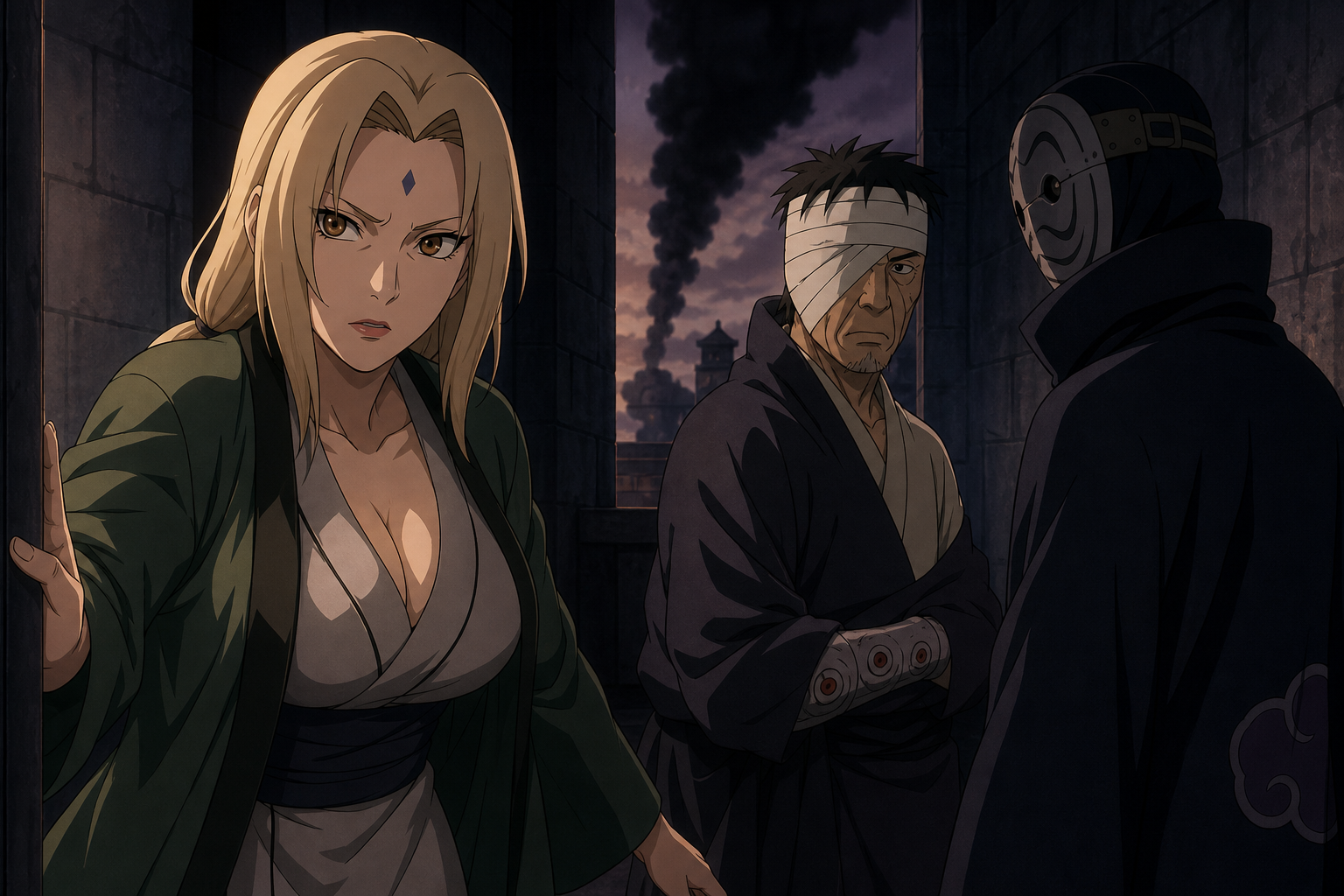
Episode 64 opens with Danzo discovered in secret contact with a Hidden Rain ninja. The image is politically explosive before anyone explains it. A senior Leaf figure, an outside operative, and a concealed meeting create the appearance of betrayal.
Tsunade responds as Hokage should: she brings the encounter into a space where claims can be questioned. Yet the explanation does not restore certainty. The Rain ninja is a Leaf spy, and the secrecy belongs to a network that has been operating beyond her direct knowledge.
The danger is not only what Danzo did. It is how many versions of loyalty can coexist inside one village.
A spy can be loyal and still destabilize authority
The operative's allegiance complicates the accusation without making the arrangement healthy. Intelligence work sometimes requires secrecy, but secrecy also determines who is allowed to judge the information.
Danzo treats hidden knowledge as proof that his authority is necessary. Tsunade treats accountability as part of legitimate leadership. Their conflict is therefore larger than one meeting.
Both want Konoha protected. They disagree over whether protection can remain legitimate when decisions are withheld from the person responsible for the village.
Danzo turns Sora into a political argument
Once Sora's unusual power enters the discussion, he stops being treated as a frightened teenager and becomes evidence in a debate about security. His body is discussed as a threat, a resource, or a mistake that should be contained.
That language confirms exactly what Furido wants him to believe: Konoha will never see a person where it sees dangerous chakra.
The adults may believe they are assessing risk. If Sora hears only proposals about what should be done to him, the distinction between caution and rejection disappears.
Eavesdropping gives Sora facts without care
Sora learns that Asuma killed his father in the worst possible setting. He receives a devastating truth while hidden above a political confrontation, with no preparation and no trusted person guiding him through what it means.
The fact is real, but its context is incomplete. That combination is ideal for manipulation. Furido has already framed Sora's father as the source of a stolen destiny. Asuma's admission can now be fitted into that story before any fuller history reaches Sora.
Truth delivered without relationship can still become a weapon.
Asuma's honesty cannot erase the delay
When Sora confronts him, Asuma admits what happened. The admission matters because another lie would deepen the wound. It does not make the years of silence harmless.
Asuma may have believed withholding the history protected Sora or respected a painful boundary. From Sora's perspective, the silence allowed everyone else to know the shape of his life while he remained excluded from it.
Honesty is necessary here, but it arrives after Furido has already supplied an interpretation.
Sora's transformed arm makes emotional injury physical
Sora's rage changes his arm and unleashes force he cannot safely contain. The transformation is frightening, but the episode does not begin with a monster appearing from nowhere.
It traces the escalation through secrecy, political dehumanization, family grief, and a carefully planted grievance. Understanding that sequence does not excuse the attack. It shows why containment alone cannot solve the cause.
If every response focuses only on the dangerous limb, Furido's story about rejection becomes stronger.
Naruto protects Sora before he has the whole explanation
When an unknown attacker targets Sora, Naruto moves between them and takes the injury. He does not wait for Sora to become calm, grateful, or easy to defend.
That choice is the clearest answer Team Kakashi can give to Furido's manipulation. Naruto's protection is visible, costly, and not conditioned on obedience.
It also refuses Danzo's logic that an unstable person can be reduced to a future threat. Naruto sees immediate danger aimed at a teammate and acts.
Furido collects the crisis he helped create
Furido arrives after Sora's trust has collapsed and offers revenge against Asuma and the Hokage. His timing reveals the structure of the plan. He did not merely predict Sora's anger. He cultivated the interpretation that would direct it.
Every concealed fact now looks like proof of conspiracy. Every restraint looks like another attempt to steal Sora's power. Furido offers violence as the only action that appears fully Sora's own.
That appearance is false. The choice has been narrowed in advance.
The jet-black signal fire is distrust made visible
The title turns a plume of darkness into a warning. A signal fire should communicate danger across distance, but black smoke also obscures the source.
Konoha can see that a crisis has begun without immediately understanding who caused it or whom to trust. Sora experiences the same problem internally. He has enough information to know that adults lied by omission, but not enough to distinguish flawed protection from deliberate exploitation.
Secrecy has accumulated until one spark makes the debt visible to everyone.
RaeRae's reaction
This episode hurts because almost every adult has a reason for withholding something, and Sora still pays the combined cost. Danzo turns him into policy. Asuma waits too long to tell him about Kazuma. Furido uses both failures as recruiting material.
Naruto's intervention matters because it is not a speech. He takes the hit. Sora may reject every explanation, but he cannot honestly say nobody in Konoha risked anything for him.
That does not repair the betrayal in one moment. It creates one piece of evidence Furido did not control.
Konoha enters darkness through divided trust
Episode 64 leaves the village vulnerable on several fronts. Danzo and Tsunade represent competing systems of authority. Sora has been pushed toward Furido. Naruto is injured after protecting him, and the people who should coordinate a response do not share the same information.
The coming darkness is therefore more than a tactical attack. It is the result of relationships weakened before the enemy moves openly.
Konoha must restore power, but it must also decide whether protection means control from the shadows or trust built in public. Sora's fate sits directly inside that argument.
Official episode reference: Naruto Official episode guide
Licensed episode route: Crunchyroll licensed episode page
Danzo’s secret may be operationally useful and politically corrosive
A Leaf spy inside the Hidden Rain can provide vital intelligence. The value of that information does not answer who authorized the network, who checks its methods, or what happens when it conflicts with the Hokage’s responsibility.
Danzo treats results as retroactive permission. Tsunade recognizes that an unaccountable protection system can become a threat of its own.
Loyalty cannot be measured only by the usefulness of secrets.
Tsunade’s authority requires access to the facts used in her name
The Hokage carries public responsibility for Konoha’s decisions. If Danzo withholds operations while claiming to protect the village, he leaves Tsunade accountable for consequences she was denied the power to evaluate.
That arrangement is not healthy division of labor. It is shadow government disguised as necessity.
Oversight matters most when intelligence feels too dangerous to share.
Sora hears adults debating risk before anyone invites his voice
The room discusses what his power means for security. Nobody begins by asking what he knows, what Furido said, or what support he needs. Sora becomes policy before he remains a teammate.
That reduction validates the manipulation already working on him. Furido promised recognition; Konoha appears to offer management.
Risk assessment becomes dehumanizing when the assessed person exists only as an object of action.
Eavesdropping supplies truth in the form most likely to cause harm
Sora receives the fact of Asuma killing his father without chronology, motive, competing testimony, or preparation. The missing context does not make the fact false. It makes interpretation easier for Furido to control.
Adults often blame the listener for reacting badly to information they withheld badly.
The ethical failure began before Sora entered the room.
Asuma’s admission matters because denial would finish the betrayal
When confronted, Asuma tells the truth. That choice preserves a narrow path toward repair. Another lie would prove that Sora cannot obtain honesty even after naming what he heard.
Admission is the beginning, not the entire apology. Asuma must explain what happened, why he stayed silent, and what responsibility he accepts for the delay.
Truth needs accountability if it is going to rebuild trust.
Explanation should not become a defense brief
Asuma may have reasons for killing Kazuma and reasons for withholding the history. If he presents them only to secure forgiveness, Sora will hear another adult prioritizing his own moral comfort.
He should answer questions, distinguish justification from regret, and allow anger without demanding an immediate verdict.
Repair requires making room for the harmed person’s timeline.
Sora’s transformed arm reveals escalation but does not erase the chain leading there
The violent chakra is dangerous. Naruto and the others must protect people from it. They must also remember that the transformation followed manipulation, secrecy, grief, and political objectification.
Containment can stop the immediate strike. It cannot repair the conditions Furido exploited.
Focusing only on the frightening body part repeats the reduction that helped create the crisis.
Naruto’s protection offers evidence stronger than reassurance
He takes the attack meant for Sora without requiring gratitude or agreement. The injury proves that teammate was not merely a temporary label spoken when circumstances were easy.
Naruto cannot make the betrayal disappear, but he can refuse to let Sora face danger alone.
Costly action interrupts Furido’s claim that Konoha sees only a threat.
Protection still cannot become ownership of Sora’s next choice
After taking the hit, Naruto may feel entitled to be believed. Sacrifice does not purchase another person’s obedience. Sora remains free to feel betrayed, ask questions, and reject explanations.
Naruto’s act matters because it is unconditional. Turning it into leverage would weaken its meaning.
Care gives support, not a debt invoice.
Furido arrives when every competing relationship is weakest
He lets Konoha’s secrecy do the destabilizing work, then appears with a simple enemy and a simple action: revenge. The timing makes complexity feel like evasion.
Asuma has context but lost trust. Tsunade has authority but discussed Sora as risk. Naruto has loyalty but not the full history. Furido offers certainty.
Manipulation wins space when honest people remain fragmented.
Revenge is presented as agency after information has narrowed the field
Furido wants Sora to experience violence as the first decision adults cannot control. Yet Furido selected the facts, planted the interpretation, and timed the invitation.
The action feels independent because it opposes Konoha. Opposition alone does not create freedom.
Agency requires enough truth to recognize who constructed the available choices.
The signal fire announces a crisis built through accumulated omissions
Black smoke does not begin with one spark in emotional terms. Danzo’s hidden systems, Asuma’s silence, the temple’s incomplete history, and Furido’s fragments have been gathering fuel.
The visible emergency makes earlier decisions look connected.
Secrecy often appears manageable until consequences finally become public.
Konoha’s competing authorities create gaps an enemy can enter
Tsunade, Danzo, the elders, and field leaders hold different information and philosophies. Disagreement is not automatically weakness. Unacknowledged chains of command are.
If nobody knows who can authorize, disclose, or intervene, response slows while private agendas advance.
Accountable coordination protects the village better than parallel claims of necessity.
Sora deserves to know which claims are facts and which are interpretation
Asuma killed his father is a fact. Therefore Konoha stole Sora’s destiny is an interpretation Furido wants attached to it. Keeping those categories separate gives Sora room to investigate.
Adults should not counter manipulation with another simplified story.
Respect means trusting him with complexity and support.
Naruto understands how dangerous chakra can dominate every conversation
People spent years seeing the Nine-Tails before seeing him. Watching officials discuss Sora as power should feel painfully familiar.
Naruto can challenge that language while still taking safety seriously. He knows personhood and risk can coexist.
His credibility comes from refusing the false choice between care and caution.
The village needs a response that repairs trust while defending lives
Immediate defense may require barriers, medical care, pursuit, and limits on Sora’s movement during instability. Those actions should be explained and reviewed rather than imposed as permanent identity.
At the same time, Asuma and Tsunade must disclose enough truth for Sora to participate in decisions.
Security without repair will leave Furido’s argument alive after the battle.
The spy’s divided position should trigger oversight rather than instant disposal
An operative embedded in the Hidden Rain may carry information Konoha cannot obtain elsewhere. Discovering Danzo’s involvement does not mean Tsunade should discard the source reflexively. It means she needs to understand recruitment, reporting, reliability, and what promises were made.
Accountability protects the spy too. A covert asset controlled by one unreviewed authority can be abandoned, redirected, or blamed without recourse.
Bringing the operation under lawful review is not weakness. It is how intelligence stops becoming one man’s private property.
Danzo’s language of necessity erases every alternative he refused to consider
He presents secrecy as the only serious response to danger. That framing makes transparency look naive before discussion begins. It also hides choices about timing, scope, supervision, and disclosure that could preserve operational security without excluding the Hokage entirely.
Necessity becomes suspicious when the person invoking it also gains permanent authority from it.
Tsunade should ask what narrower measures were rejected and who benefited from keeping them invisible.
Sora’s body becomes the battlefield where adult philosophies collide
Danzo sees a dangerous resource. Furido sees a recruit and weapon. Asuma sees a child connected to painful history. Naruto sees a teammate. None of those perspectives should replace Sora’s own account.
The crisis escalates because powerful adults keep assigning meaning to his chakra before giving him enough truth to form his own.
Protection becomes another form of conquest when everyone claims the body and nobody listens to the person living in it.
Naruto’s injury must not become another secret kept for emotional convenience
If Naruto minimizes the wound to prevent guilt or preserve Sora’s trust, Team Kakashi repeats the pattern that helped create this crisis. Sakura and Yamato need accurate information to treat him and plan safely.
Sora also deserves the truth about what happened without being told the injury makes him irredeemable.
Honest consequences allow accountability and care to exist together. Concealment only postpones the next explosion.
Furido’s offer works because revenge supplies a simple direction for complicated grief
Sora has learned that his father died by Asuma’s hand, that adults withheld the truth, and that officials fear his power. Those facts create several different injuries. Revenge compresses them into one target and one action.
Simplicity feels merciful when grief is chaotic. Furido exploits that relief by pretending violence will answer every question at once.
It cannot explain Kazuma’s choices, restore lost years, or create trustworthy belonging. It can only make Sora useful to Furido’s plan.
The village must prove that accountability applies upward as well as downward
Sora will be held responsible if his transformed arm harms someone. The adults whose secrecy, covert systems, and delayed disclosures contributed to the crisis should face examination too.
Equal accountability does not mean equal consequences for unequal actions. It means rank does not make causation disappear.
If only the frightened teenager is disciplined, Furido’s claim that Konoha protects authority rather than people will gain another piece of evidence.
Restoring trust requires a shared chronology
Sora has fragments: Furido’s praise, a claim about his father, overheard political debate, Asuma’s admission, and Naruto’s protection. Each arrived from a different person with a different purpose. Placed separately, they let the most emotionally forceful interpretation win.
A shared chronology can identify what happened, what each adult knew, when decisions were made, and which claims remain unverified. It will not remove grief, but it can stop Furido from rearranging every fact around revenge.
Truth becomes protective when people can see the sequence instead of receiving isolated shocks.
Tsunade must defend Sora without pretending he poses no danger
Danzo’s reduction is wrong, but rejecting it does not require denying the transformed arm or the risk of uncontrolled chakra. Tsunade can order safeguards while insisting that every measure preserve dignity, review, and a path back to life.
That balance is harder than containment or denial. It is also the only response that treats Sora as both responsible and human.
Konoha proves its values by how it protects people from danger without turning the endangered person into nothing but danger.
RaeRae’s full take
This episode is the bill arriving for every adult who decided silence was easier than an honest conversation. Furido did not invent Sora’s questions. He found them unattended and turned them into a weapon.
Danzo makes me furious because usefulness does not erase accountability. A spy can provide real intelligence while the secret system around that spy still undermines the Hokage and the village.
Asuma telling the truth matters. It does not erase waiting until Sora heard the worst fact from above a political argument where people were discussing him like equipment.
Naruto taking the hit is the cleanest answer in the episode. No destiny speech. No demand that Sora calm down first. He protects the teammate standing there.
That sacrifice cannot purchase obedience, though. Sora still deserves context, anger, and time. Care stops being unconditional the second somebody uses it as a receipt.
The black signal fire is distrust made visible. Konoha can fight the attack, but it will keep losing Sora if nobody admits how secrecy helped Furido light it.
RaeRae checkpoint: Furido weaponized the truth because honest adults surrendered the timing. Repair begins when Konoha stops treating Sora’s history as classified property and starts treating it as his life.
Receipts and official routes
- Episode number, Japanese title, Danzo’s intelligence meeting, Sora learning about his father, Naruto’s intervention, and official placement: Naruto Official Site episode guide.
- Licensed title and episode route: Crunchyroll.