
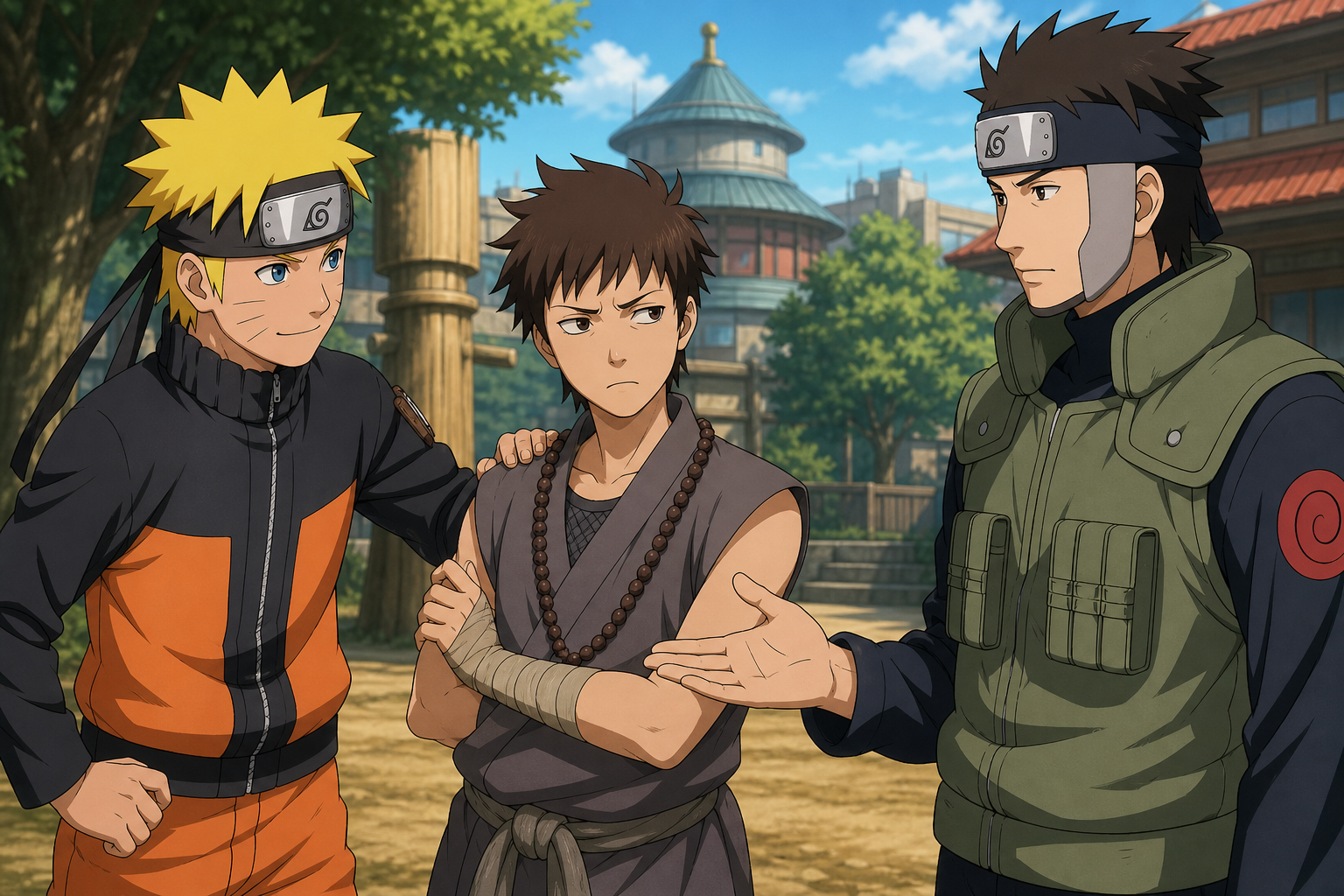
Teammate
A temporary place on Team Kakashi gives Sora visible obligations, shared risk, and a chance to test belonging through action.
Yamato identifies Sora as the real target
Episode 62 begins by changing the meaning of the graveyard attack. Yamato concludes that the intruders were not ordinary grave robbers. Their movements, timing, and interest in the group point toward Sora himself.
That conclusion turns Sora from a difficult companion into the center of the mission. The question is no longer whether Team Kakashi should tolerate him nearby. Keeping him close becomes the safest way to understand who is pursuing him and why.
Yamato responds by making the relationship official enough to carry responsibility: Sora will temporarily join Team Kakashi while Sai recovers.
A temporary assignment creates real obligations
The word “temporary” can sound like a limit on belonging, but it also establishes duties that did not exist before. Team Kakashi must protect Sora, share information with him, and treat his safety as part of the mission.
Sora must also accept that teammates are allowed to question his choices when those choices endanger everyone. He is not being absorbed into the group as a symbol. He is being asked to operate within a structure where action has consequences for other people.
The appointment gives him a place without pretending trust is already complete.
Sai's absence shapes the team even when he is off-screen
Sora is assigned as a stand-in for the injured Sai, but one person cannot simply replace another. Sai brought reconnaissance, aerial mobility, precise observation, and a newly developing loyalty that belonged specifically to him.
Sora brings different strengths and a different set of risks. His wind chakra, temple training, anger, and connection to the attackers change the team's balance rather than restoring the old one.
Calling him a stand-in describes an open position. It does not erase Sai's identity or make Sora responsible for performing it.
Yamato uses structure instead of demanding affection
Yamato does not wait for Naruto and Sora to like each other. He gives them a working relationship first. That is practical leadership.
Teams often build trust through repeated, observable choices rather than instant emotional agreement. A mission creates shared expectations: report danger, protect the person beside you, and do not conceal information that changes the plan.
Yamato's decision gives Naruto and Sora a framework in which cooperation can become evidence. Neither boy has to pretend the tension is gone.
Naruto's welcome is sincere but not effortless
Naruto recognizes something familiar in Sora's isolation, yet recognition does not automatically make him patient. Both boys are proud, reactive, and sensitive to disrespect. They can understand each other's wounds while still finding each other irritating.
That friction keeps the relationship honest. Naruto is not a perfectly calm mentor who has solved every version of loneliness. He is a teenager still learning how to offer another person the acceptance he once wanted.
Welcoming Sora requires more than declaring similarity. It requires leaving room for Sora to respond badly without withdrawing the offer immediately.
Sora arrives in Konoha already expecting rejection
The Hidden Leaf Village offers unfamiliar streets, unfamiliar rules, and people who do not know what Sora carries. He reads ordinary curiosity through years of defensiveness.
That expectation can create the reaction it fears. If Sora treats every glance as hostility, conflict becomes proof that he was right not to trust anyone. Furido's earlier words make this pattern even more dangerous by suggesting that other people fear a power they cannot understand.
The team must distinguish between holding Sora accountable and confirming the story that everyone wants to suppress him.
Conflict becomes part of the enemy's strategy
Furido does not need to stand beside Sora to influence him. The promise of hidden knowledge about his father follows him into Konoha. Every disagreement can now be interpreted through that private message.
If Naruto challenges Sora, Furido's praise may feel more appealing. If Yamato imposes a limit, Furido's language about destiny may make discipline look like control. Manipulation works by giving future frustration a predetermined explanation.
Team Kakashi is therefore competing with a story it may not yet know Sora has heard.
Teammates need access to the same truth
The previous battlefield punished Team Kakashi by separating its members physically. This episode shows the emotional version of the same danger. Sora possesses information about Furido that the others need, while Yamato understands aspects of the attack that Sora may not accept.
Without shared information, everyone is making decisions on a different map. The team label only becomes meaningful when those maps can be compared.
Sora's hardest task may be admitting that Furido reached him. Team Kakashi's hardest task may be hearing that admission without turning immediately to accusation.
Naruto and Sora test belonging through argument
Their clashes are not evidence that the assignment has failed. They reveal where each boy expects humiliation, abandonment, or control.
Naruto often pushes connection with the same force he brings to combat. Sora often protects himself by refusing the premise that he needs anyone. Put together, they can turn every attempt at closeness into a contest.
The useful question is not whether they argue. It is whether either one stays after the argument and changes his next choice.
RaeRae's reaction
I like Yamato's decision because it does not romanticize Sora's situation. He recognizes that Sora may be the target, sees that Sai's injury has changed the team's capacity, and creates a practical answer.
The assignment also refuses the idea that one lonely boy automatically knows how to help another. Naruto has real empathy for Sora, but he can still be loud, impatient, and convinced that persistence will solve everything. Sora can want belonging and resist every form it takes.
That messiness makes “teammate” feel earned as a direction rather than handed out as a conclusion.
A place on the team is an invitation to choose
Episode 62 gives Sora something Furido did not: a role with visible obligations and people whose actions can be tested over time. Furido offered mystery, destiny, and private recognition. Team Kakashi offers shared risk.
Shared risk is less flattering, but it is also more honest. Naruto, Sakura, Yamato, and the absent Sai are not asking Sora to believe a hidden story on faith. They are giving him repeated opportunities to see what they do.
The temporary assignment will matter only if Sora begins to treat those actions as evidence. Becoming a teammate is not the end of his uncertainty. It is the first setting in which he can answer it with choices of his own.
Official episode reference: Naruto Official episode guide
Licensed episode route: Crunchyroll licensed episode page
A team assignment gives Sora something Furido carefully avoided
Furido offered recognition without accountability. Team Kakashi offers a role where every person can observe what the others do over time. Sora can disagree, ask questions, make mistakes, and see whether people remain present afterward.
That is less intoxicating than destiny. It is also harder to fake.
Belonging becomes credible through repeated conduct rather than one stranger’s perfect sentence.
Temporary does not have to mean disposable
Sora will hear the limit in Yamato’s invitation. A temporary place can resemble every conditional relationship he already fears. The team must show that a defined assignment still includes respect, information, and protection.
They should also explain what ends the arrangement and what happens afterward. Ambiguity lets Sora imagine that one conflict will send him away.
Clear boundaries can create security when they are not used as threats.
Sai’s recovery must remain visible inside the new formation
Sora fills an operational opening, not Sai’s identity. Treating teammates as interchangeable would repeat the logic that valued Sai mainly for usefulness.
The group can welcome Sora while checking on Sai, preserving his place, and adapting tasks to different abilities. Inclusion does not require pretending absence has no emotional weight.
A healthy team expands responsibility without erasing the person who is healing.
Yamato creates structure because affection cannot be ordered
He cannot command Naruto and Sora to trust one another. He can establish expectations about reporting, protection, routes, and shared risk. Those rules give each boy evidence to evaluate.
Structure also prevents empathy from becoming favoritism. Sora receives responsibilities alongside support.
The assignment respects him more by expecting contribution than by treating him as fragile cargo.
Naruto needs to welcome Sora without performing sainthood
Naruto recognizes loneliness, but he remains competitive, loud, and easily provoked. Pretending otherwise would make the relationship false from the start.
He can apologize when he pushes too hard, name when Sora hurts him, and return after arguments. Repair matters more than flawless patience.
Sora needs a real teammate, not a polished symbol of recovery.
Sora’s suspicion is understandable and still requires accountability
Years of incomplete answers make him alert to rejection. That history explains why neutral boundaries may feel hostile. It does not excuse endangering teammates or withholding information about Furido.
Compassion should help the group respond effectively, not eliminate consequences.
Accountability becomes trustworthy when it addresses an action without declaring the entire person unwanted.
The team label creates a duty to share Furido’s contact
Sora possesses information that changes the mission: Furido praised his power and claimed a connection to his father. Keeping that private leaves everyone operating on a false map.
Disclosure will feel risky because adults may react with control. Team Kakashi must make honesty safer than secrecy by listening before accusing.
Shared intelligence is the practical foundation beneath the emotional word teammate.
Naruto should offer his experience as testimony, not a diagnosis
He can describe being feared, isolated, and tempted by power that threatened agency. He cannot announce that Sora feels exactly the same or prescribe the same solution.
Testimony says this happened to me. Diagnosis says I know what you are. The first invites comparison; the second closes it.
Respect leaves Sora room to name differences Naruto cannot see.
Sakura’s role includes protecting the relationship from becoming a boys’ contest
Naruto and Sora can turn vulnerability into competition. Each may try to prove greater pain, strength, or independence. Sakura can challenge that rhythm and redirect attention toward the mission.
She can also build trust with Sora directly rather than existing as Naruto’s ally in every disagreement.
A team fails when one new relationship becomes its entire emotional structure.
Yamato must explain surveillance before it feels like containment
If Sora is the enemy’s target, increased protection makes sense. Secret monitoring would confirm his belief that adults see danger before personhood.
Yamato should state what risks exist, what measures follow, and how Sora can participate. Transparency will not remove every objection, but it gives disagreement an honest object.
Safety works better when the protected person understands the plan.
Konoha offers belonging and can still reproduce exclusion
The village is home to Naruto, but it spent years treating him as a threat. Arrival in Konoha does not guarantee Sora fairness. Curious looks, rumors, and institutional caution may recreate the temple’s distance.
Naruto’s affection for the village should not require denying its failures.
He can welcome Sora honestly by showing both the people who changed and the systems that still need challenging.
Ordinary tasks may build more trust than dramatic rescue
Eating together, training, reporting, and navigating the village give Sora repeated low-stakes evidence. A spectacular save can create gratitude without creating security.
Ordinary cooperation lets people be irritating, useful, tired, funny, and wrong without the relationship collapsing.
Belonging becomes durable when it survives days that are not emergencies.
Furido benefits whenever the team treats questions as disloyalty
Sora will compare every response with Furido’s apparent openness. If Team Kakashi punishes curiosity about his father, the enemy’s private invitation becomes more attractive.
The group can reject Furido’s manipulation while investigating the underlying history seriously.
Questions become less dangerous when truthful people are willing to stay in the conversation.
The assignment gives Sora choices rather than a single promised destiny
Furido frames power as proof of one predetermined purpose. Teamwork presents many smaller choices: share information, protect Sakura, listen to Yamato, challenge Naruto, admit fear, or ask for help.
None carries the glamour of being chosen by Heaven. Together they build agency.
A life becomes one’s own through repeated decisions, not obedience to somebody else’s grand explanation.
Conflict can produce evidence when repair follows it
Naruto and Sora will argue. The important moment arrives afterward. Does either acknowledge harm, clarify meaning, or change behavior?
Repair proves that disagreement is not automatic exile. For someone expecting abandonment, that lesson may matter more than immediate harmony.
A teammate is not a person who never creates friction. A teammate participates in what happens after friction.
The team should make space for Sora without centering every mission on him
Sora deserves attention because he is targeted and newly assigned. Constantly reorganizing everyone around his emotions could create resentment and reinforce the belief that he is only a crisis.
Balanced inclusion gives him tasks, listens to needs, and preserves other relationships.
He belongs most fully when he can contribute to a shared purpose rather than remain the permanent subject of concern.
Sora needs permission to contribute before trust feels complete
Waiting until everyone feels comfortable would leave him permanently outside. Missions rarely provide emotional certainty first. Yamato gives Sora defined work so competence, honesty, and care can become observable.
Contribution should not become an audition where one mistake proves he never belonged. The same standards and opportunities for repair must apply to every teammate.
Equality becomes credible when evaluation is consistent rather than shaped by fear of the newcomer.
Naruto should notice when enthusiasm starts speaking over consent
He wants Sora included and may push invitations, explanations, or comparisons faster than Sora can accept them. Good intention does not make pressure invisible.
Naruto can offer food, training, company, or conversation and allow a refusal without turning it into a crisis. Leaving the option open communicates steadiness better than demanding gratitude.
Welcome becomes safer when the invited person retains control over the pace.
Sakura can establish trust through practical clarity
She can explain injuries, mission risks, village expectations, and what support is available without wrapping every fact in emotional persuasion. For somebody surrounded by hidden history, direct information may feel more respectful than reassurance.
Sakura can also ask what Sora already knows before assuming ignorance.
A practical relationship gives him another route into the team beyond Naruto’s intense identification.
The absent conversation about Furido remains the largest weakness
A uniform and assignment cannot protect Sora from a story nobody else knows he is carrying. Furido’s words will shape how he interprets orders, boundaries, and conflict inside Konoha.
The team must create openings for disclosure without interrogation. Specific questions, calm privacy, and a promise to verify claims together can help.
Silence becomes less attractive when truth is met with curiosity rather than immediate punishment.
Returning Sai should not force Sora back into emotional exile
The temporary assignment will eventually end or change. If Sora experiences Sai’s recovery as automatic expulsion, every fear about conditional belonging will look confirmed.
The team can mark the transition honestly, celebrate Sai’s return, and identify relationships or responsibilities that continue beyond the formal slot.
Belonging should not depend entirely on an injured person remaining unavailable.
A teammate should know why the mission matters beyond personal danger
Sora is the likely target, but the operation also concerns violated graves, the Fire Temple, and an old political conflict. Explaining that wider frame prevents every decision from feeling like adults managing him.
It also lets Sora contribute knowledge about the temple and his own encounters without becoming the entire objective.
Shared purpose turns protection into cooperation because everyone can see what their choices defend.
Trust needs a route for saying no safely
If Sora cannot refuse a training suggestion, question an order, or ask for space without threatening his place, the team will feel like another conditional institution. A safe no does not eliminate command during immediate danger. It creates honest discussion everywhere else.
Naruto also benefits from learning that refusal is not abandonment. He can remain present without converting every boundary into a challenge.
Belonging becomes stronger when consent survives disagreement and the relationship continues afterward.
That freedom matters because Sora has spent years reading every limit as proof that affection will disappear. A team earns credibility when it can hear discomfort, explain necessity, change course when possible, and remain committed after the answer arrives.
RaeRae’s full take
I like that Yamato gives Sora a job instead of another speech about trust. Furido offered perfect recognition in private because he wants dependence. Team Kakashi offers imperfect people whose behavior can be watched, questioned, and tested.
Temporary still needs explanation. Sora already expects every place to disappear. Tell him how the assignment works, what protection means, and what happens when Sai returns. Do not make uncertainty do the emotional labor.
Sai is not a vacancy with a face. Keep his recovery visible. Welcoming Sora should never require proving that teammates are replaceable parts.
Naruto will mess this up sometimes. Good. Let him be sincere and impatient, generous and defensive. Then let him apologize and return. Repair is more convincing than perfection on a fandom page or inside a friendship.
I need Sora to share Furido’s claim, and I need the team to earn that disclosure by not humiliating him. Wanting answers about his father is not betrayal. An enemy exploited a legitimate need.
“Teammate” is a direction, not a coronation. Sora gets a place where choices affect other people and other people’s choices can finally become evidence. That is how belonging starts becoming real.
RaeRae checkpoint: Furido tells Sora who destiny says he is. Team Kakashi gives him room to show who he chooses to be, one imperfect shared decision at a time.
Receipts and official routes
- Episode number, Japanese title, Sora’s temporary Team Kakashi assignment, Sai’s recovery, Konoha arrival, and official placement: Naruto Official Site episode guide.
- Licensed title and episode route: Crunchyroll.