
Contact
Furido offers Sora recognition, purpose and family history, all carefully measured to create dependence.
Sora reaches Furido before anyone can protect the conversation
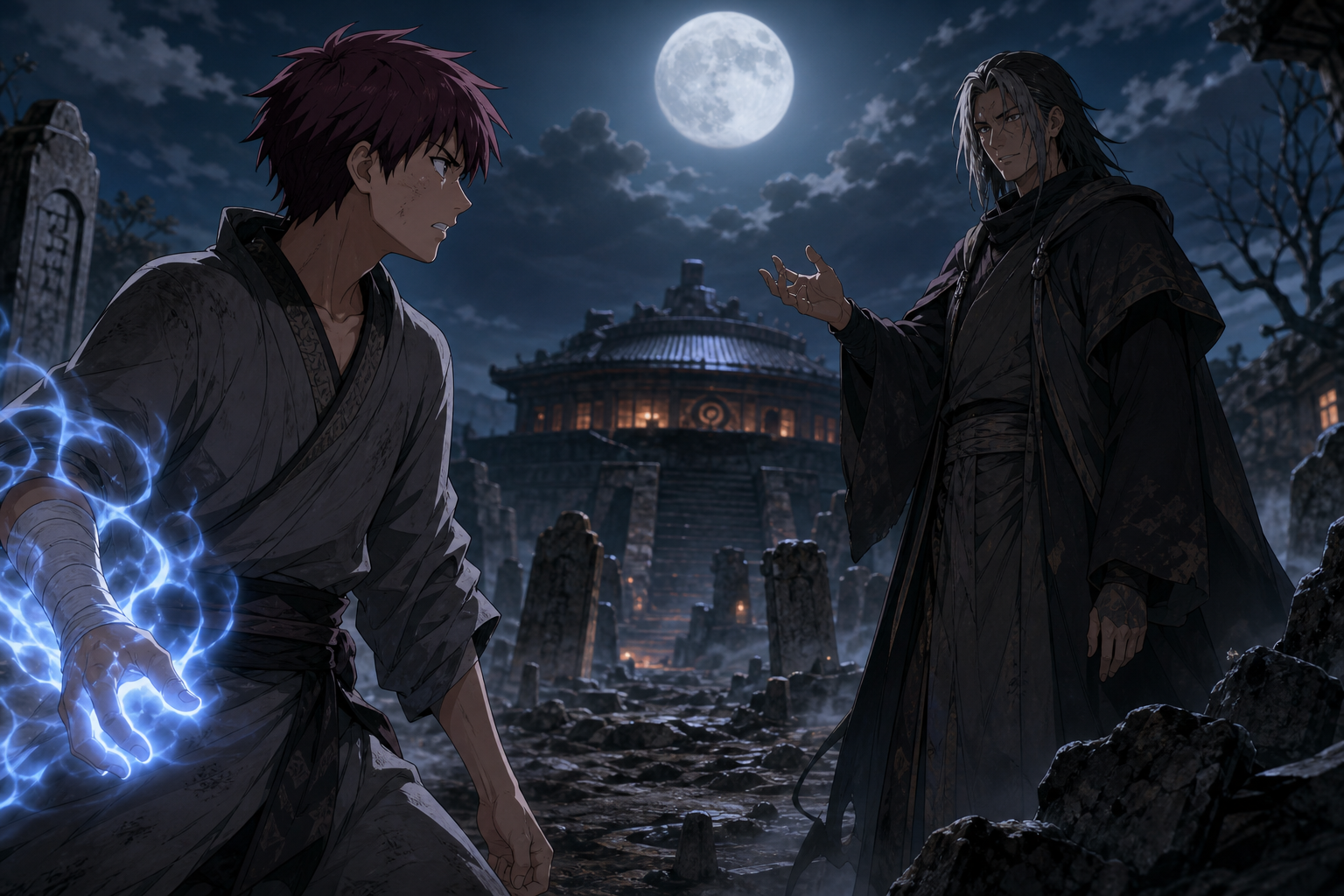
Episode 61 turns a physical pursuit into a much more dangerous kind of contact. Sora confronts Furido at the hidden graves expecting an enemy he can challenge, but Furido responds as though he already understands the young monk better than anyone else does.
That imbalance matters. Sora arrives angry and ready to fight. Furido arrives ready to define what Sora's anger means. The encounter becomes a contest over identity before it becomes a contest of strength.
Praise is the first hook in Furido's manipulation
Furido does not simply threaten Sora. He calls attention to the unusual power inside him and treats it as something remarkable. For someone who has spent years feeling watched, feared, and misunderstood, that recognition lands exactly where it is meant to.
The praise is not kindness. It is a way to make Furido seem like the one adult willing to see Sora clearly. By admiring the power others distrust, he creates a private bond without earning trust.
“Heaven blessed you” turns danger into destiny
Furido tells Sora that he should reconsider how he uses the power Heaven blessed him with. The phrasing is calculated. It removes the frightening uncertainty around Sora's chakra and replaces it with the idea of purpose.
If the power is a blessing, then fear of it can look like ignorance. Restraint can look like betrayal. Furido offers Sora a story in which isolation proves that he is special rather than proving that the adults around him failed to tell him the truth.
That story is emotionally comforting, which is exactly why it is dangerous.
Information about Sora's father becomes leverage
Furido leaves Sora with the claim that he was an old friend of Sora's father. He gives just enough information to make himself impossible to dismiss and withholds enough to force Sora to seek him again.
This is not disclosure. It is bait built from family history. Sora wants an origin for his power and an explanation for the loss surrounding his father. Furido positions himself as the gatekeeper to both answers.
A complete truth would allow Sora to make a decision. A fragment keeps Furido in control of the next meeting.
Contact is not the same thing as connection
The title sounds hopeful after Team Kakashi's separation, but the episode makes contact morally unstable. Two people can meet, speak, and appear to understand one another without forming anything honest.
Furido makes contact with Sora by locating his deepest questions. He does not connect through mutual vulnerability. He studies the opening and places himself inside it.
The distinction matters throughout Naruto. Real bonds allow people to remain complicated. Manipulation offers a simple identity and demands obedience in return.
Sora's anger protects a wound and exposes it
Sora's hostility often looks like rejection, but it also keeps other people from reaching the uncertainty underneath. He wants to know why his power feels different, why his father is gone, and why the Fire Temple has never made him feel fully secure.
Furido does not need to defeat that anger. He needs to redirect it. Every grievance can be turned into evidence that Sora has been denied his rightful place.
The same defense that keeps Sora from trusting Team Kakashi therefore makes selective attention from Furido feel unusually powerful.
Naruto understands the loneliness without owning Sora's story
Naruto and Sora both carry dangerous chakra and know what it means to be treated as a problem before being treated as a person. That parallel gives Naruto a genuine route toward empathy.
It does not make their histories interchangeable. Naruto's seal, Sora's power, their families, and the institutions around them are different. Naruto can recognize the emotional pattern without assuming that his answer must also be Sora's answer.
The most useful thing Naruto can offer is not a speech about similarity. It is proof that understanding someone does not require controlling them.
Team Kakashi's separation has consequences beyond the battlefield
The earthen maze did more than divide four fighters. It created the time and privacy Furido needed to reach Sora first. That is the strategic cost of losing contact.
Yamato, Sakura, Sai, and Naruto may be able to overcome physical barriers, but they cannot erase words after Sora hears them. Reuniting the group will not automatically restore the version of events they understood before the ambush.
The enemy is changing the emotional battlefield while everyone else is still navigating the physical one.
Furido uses calmness as a display of authority
Sora approaches with visible emotion while Furido controls the pace of the exchange. That contrast allows Furido to look knowledgeable and composed even though he is the intruder disturbing the graves.
Calmness is not evidence of honesty. Here it is performance. Furido knows more than Sora, chooses what to reveal, and exits before his claims can be tested.
He creates the appearance of a teacher without accepting any of a teacher's responsibility.
RaeRae's reaction
This conversation made me more nervous than a straightforward fight would have. Furido identifies the exact sentence Sora has been waiting to hear: your power means something, and I knew your father.
That combination is cruel because it sounds like relief. Sora is not foolish for wanting answers. The adults around him left gaps, and Furido is exploiting those gaps with precision.
I also appreciate that the Naruto parallel does not need to erase Sora. Naruto can understand the ache of being feared, but Sora still deserves answers about his own life on his own terms. Furido wants to replace those answers with a destiny that serves him.
The next meeting has already been arranged emotionally
Episode 61 ends with Furido disappearing, but he has not surrendered control of the encounter. By linking Sora's power to Heaven and himself to Sora's father, he ensures that the unanswered questions will continue speaking after he is gone.
Team Kakashi must do more than find Sora. They need to create enough trust for him to bring Furido's claims into the open, where they can be examined instead of privately magnified.
Contact has happened. Connection remains contested, and the difference will shape every choice Sora makes next.
Official episode reference: Naruto Official episode guide
Licensed episode route: Crunchyroll licensed episode page
Furido begins by answering the question Sora has not been allowed to ask safely
Sora knows his power feels different and notices how people react to it. What he lacks is an honest explanation delivered without fear or judgment. Furido steps into that silence and behaves as though he alone possesses the missing answer.
That position gives him authority before he proves anything. The information gap created by other adults becomes his entrance.
Secrecy rarely leaves a neutral space. Someone willing to exploit uncertainty can fill it with a story designed to create dependence.
Praise lands harder when a person has mostly received warnings
Sora is accustomed to attention shaped by caution, correction, or suspicion. Furido describes his power as remarkable and blessed. The words feel generous because they reverse the emotional pattern Sora expects.
Manipulative praise does not need to be false in every detail. Sora may genuinely possess unusual ability. The manipulation lies in attaching recognition to Furido’s preferred meaning and future demand.
A compliment becomes a hook when acceptance appears available only through the person offering it.
Destiny offers relief by removing the burden of uncertainty
Furido’s language tells Sora that his power has a purpose. That claim can feel like rescue from years of confusion. If Heaven selected him, then fear, isolation, and difference no longer look random.
The cost is agency. A predetermined purpose gives Furido a way to label resistance as cowardice or betrayal of Sora’s true nature.
Healthy guidance helps a young person choose what power should serve. Manipulation announces that the choice was already made.
The claim about Sora’s father is calibrated to be impossible to ignore
Furido does not provide a complete history that Sora could verify. He offers a relationship: I knew your father. That fragment activates grief, curiosity, and hope while leaving Furido in control of every missing detail.
Sora cannot test the claim during a brief moonlit encounter. He can only carry it back into an environment where adults may become guarded again.
The withheld answer becomes a reason to return, which is exactly what Furido needs.
Adults created this vulnerability by treating information as protection
Sora is responsible for his decisions, but the people who withheld his history helped make Furido’s partial truth powerful. When a young person senses that everybody else knows something important, silence feels less like safety and more like exclusion.
Truth can require timing and care. Permanent vagueness does not become compassionate because adults find disclosure uncomfortable.
Furido weaponizes the trust deficit he did not create but understands perfectly.
Calm delivery disguises the coercion inside the invitation
Furido does not need to shout. He controls the information, the timing, and the exit. His measured voice allows him to look patient while Sora’s anger makes Sora appear unstable.
That contrast is staged. One person prepared the encounter and knows the destination. The other is reacting to a family claim delivered without warning.
Composure is a performance of authority here, not evidence that Furido deserves it.
Sora’s questions are legitimate even when the source is dangerous
It would be easy for Team Kakashi or Chiriku to dismiss the entire encounter because Furido is an enemy. That response would leave Sora with the same unanswered questions and confirm that only Furido is willing to discuss them.
The better answer separates source from subject. Furido may lie or distort, but Sora still deserves truthful information about his father and power.
Protecting him means examining the claim openly, not demanding that he stop wanting to know.
Naruto can recognize grooming because he has felt conditional recognition
Many adults noticed Naruto only as a jinchuriki, a disruption, or a useful source of strength. The people who changed his life recognized the person without demanding that he surrender judgment in exchange.
Furido offers Sora the opposite bargain. He sees the power loudly and the person only insofar as that power can serve a plan.
Naruto can help by naming that difference without treating Sora as foolish for feeling relieved by attention.
Contact without accountability lets Furido control the emotional aftermath
Furido can leave after placing destabilizing claims because he accepts no responsibility for what Sora feels next. He does not remain to answer questions, provide evidence, or support the consequences.
Real connection involves accountability after disclosure. A person who reveals painful history should care whether the listener has context and support.
Furido’s disappearance exposes the encounter as extraction: he takes trust and leaves confusion behind.
The graves make the father claim part of a larger political operation
This conversation does not happen in an ordinary meeting place. Furido stands among violated tombs connected to the Guardian Shinobi Twelve. His statement about Sora’s father therefore belongs beside the thefts and the old conflict.
Family history may be the emotional route through which Furido recruits Sora into a political plan.
The setting warns viewers not to separate personal recognition from the operation surrounding it.
Sora may test the temple by repeating Furido’s claim indirectly
A young person unsure whom to trust may not report the encounter clearly. Sora could provoke Chiriku, mention his father in anger, or watch faces for a reaction without explaining why the question suddenly matters.
Adults who respond only to the hostility will miss the request underneath it.
Care requires curiosity about changed behavior, especially when a dangerous outsider has gained private access.
Team Kakashi needs to repair privacy without replacing it with surveillance
Furido reached Sora alone, so the protective instinct may be to monitor every movement. Constant observation would reinforce Sora’s belief that people see him as a threat rather than a person.
Safety should include transparent check-ins, truthful discussion, and choices about who participates. Secret tracking may be necessary during immediate danger, but it cannot become the relationship.
Trust grows when protection is explained instead of merely imposed.
Naruto must resist promising that he can fix the entire history
Naruto responds to pain with commitment, often making enormous promises because refusal feels like abandonment. Sora needs honesty more than another impossible guarantee.
Naruto can promise to listen, share what he knows, ask questions with him, and refuse Furido’s attempt to isolate him. He cannot promise that every answer will feel good or that every adult acted correctly.
Specific commitments build more trust than heroic certainty.
The title also describes Team Kakashi restoring physical connection
While Furido makes emotional contact with Sora, Sakura, Sai, Yamato, and Naruto work to overcome the separation imposed by the earth maze. One form of contact rebuilds shared information. The other concentrates information inside a manipulator.
The contrast gives the title its edge. Contact can free people from isolation or deepen dependency depending on how knowledge moves.
Connection is healthiest when information circulates instead of remaining one person’s private leverage.
Sora’s power should not determine which version of his father he is allowed to know
Furido links family history to usefulness because that serves recruitment. The temple may link disclosure to risk because that serves control. Both approaches make Sora’s humanity secondary to managing his ability.
He deserves family truth because it is part of his life, not because he has demonstrated enough power or obedience.
Information about identity should not function as a reward adults distribute for compliance.
Furido wants to become necessary before he becomes trustworthy
By presenting himself as the only route to Sora’s father and purpose, Furido creates urgency around future contact. Sora may feel he cannot reject the man without rejecting his only chance at answers.
That manufactured necessity bypasses the slower work of earning trust through consistent behavior.
A safe adult can tolerate being questioned, verified, and refused. Furido structures the relationship so refusal appears to cost Sora his own history.
The first honest response should admit what the adults got wrong
If Chiriku or Team Kakashi answers Furido only by calling him a liar, Sora may hear another attempt to close the subject. Trust requires somebody to acknowledge that Sora was left without information he needed and that the silence made him easier to manipulate.
An apology does not prove every withheld detail was malicious. It proves adults understand that their choices had consequences.
Accountability gives later warnings about Furido a foundation stronger than authority alone.
Evidence can interrupt dependency without humiliating Sora
The group should test Furido’s claims through records, Asuma, Chiriku, and the known history of the Guardian Shinobi Twelve. Verification allows Sora to participate in finding answers instead of being ordered to choose which adult he believes.
If a claim proves false, the lesson should not be that Sora was stupid. It should be that Furido selected truths, lies, and omissions to create leverage.
Humiliation would drive Sora back toward the only person who made his questions feel important.
Naruto’s friendship offer must survive disagreement
Sora may defend Furido, reject Naruto’s warning, or accuse the temple of lying. Naruto’s instinct will be to argue harder until Sora accepts the bond he is offering.
A safer friendship can tolerate conflict without threatening disappearance. Naruto can challenge the claim, protect people from dangerous choices, and still make clear that disagreement does not erase Sora’s right to be heard.
That steadiness would distinguish genuine connection from Furido’s conditional recognition.
Privacy should belong to Sora too
Furido exploits secrecy, but the answer cannot be turning Sora’s pain into information everybody discusses without him. Adults may need to coordinate immediate safety, yet they should include Sora wherever possible and limit details to people who genuinely need them.
Being the subject of constant private meetings recreates the feeling that his life belongs to institutions. Transparent care gives him choices about who hears his history, who helps verify it, and how new facts are shared.
Agency is not a reward granted after Sora becomes calm. It is part of what can make calm, trust, and responsible decisions possible with support that respects his voice.
RaeRae’s full take
This is the kind of manipulation that works because it delivers something the target genuinely deserves. Sora deserves answers. He deserves someone to recognize his power without flinching. Furido packages both needs into a private invitation designed to own the next conversation.
I refuse to call Sora gullible for listening. The adults around him left a silence big enough for an enemy to walk through. They may have believed they were protecting him, but protection that excludes the person from his own history creates a different danger.
Furido’s calmness does not impress me. He prepared the meeting, controls the facts, chooses the fragment, and leaves before Sora can test anything. Of course he looks composed. He owns every advantage in the exchange.
Naruto can help because he knows the difference between being seen and being assessed for usefulness. Iruka saw a lonely child. Furido sees a power source with a father-shaped opening.
The answer is not another adult ordering Sora to forget the encounter. Tell him the truth. Admit what was withheld. Examine Furido’s claim with him. Give the young man enough real information that a stranger cannot keep selling fragments as love.
Contact becomes connection only when both people are free to question, refuse, and remain whole. Furido offers none of that. He offers destiny with himself holding the key.
RaeRae checkpoint: Furido did not create Sora’s need for answers. He found the need adults left unattended and attached himself to it. The repair begins with truth, not another command to stop asking.
Receipts and official routes
- Episode number, Japanese title, separated encounters, Sora and Furido’s contact, the father claim, and official placement: Naruto Official Site episode guide.
- Licensed title and episode route: Crunchyroll.