
Vicissitudes of Life
The enemy reshapes the land until teamwork has to survive without proximity.
The trap changes the land before the team can change its plan
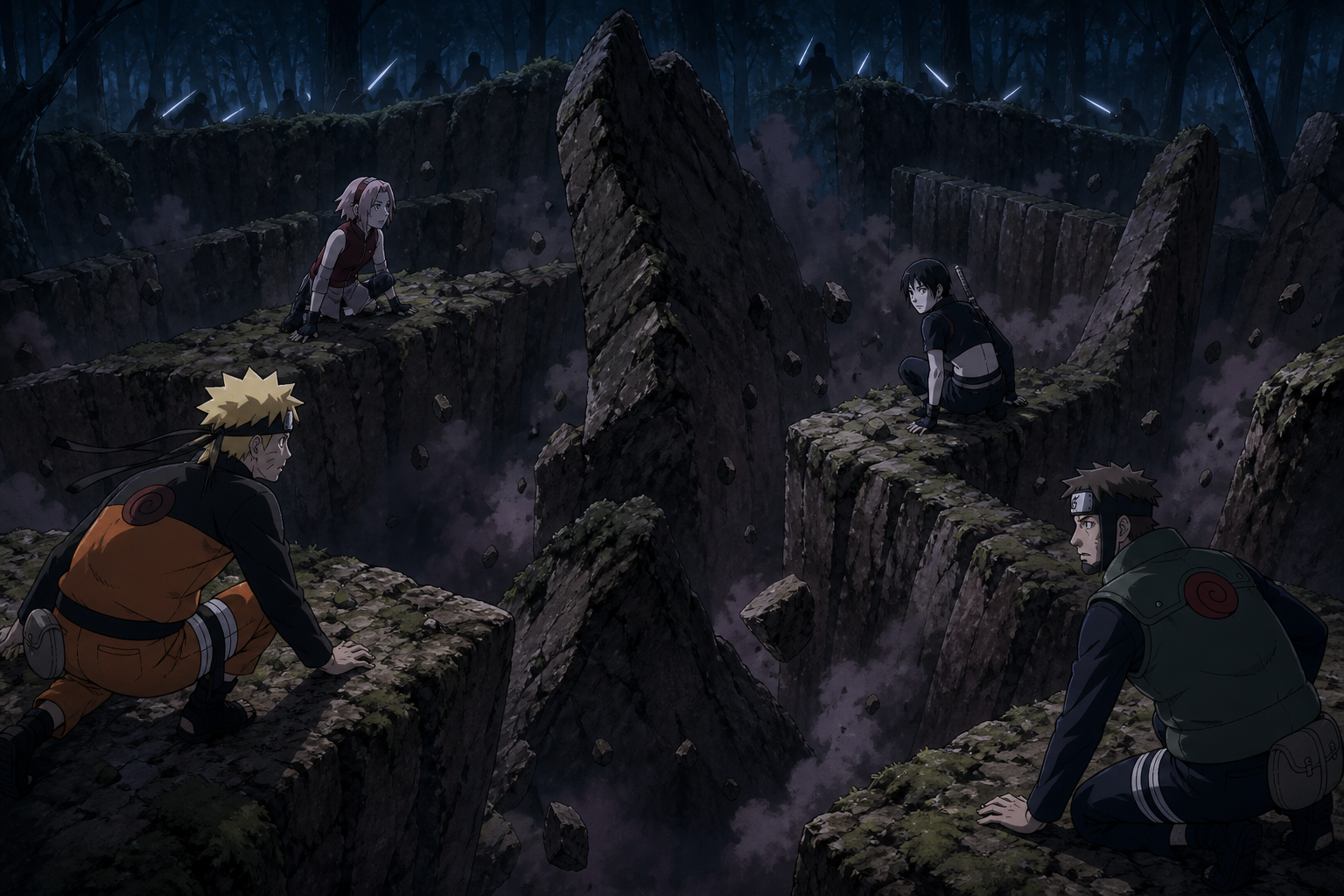
Episode 60 activates the full design behind the stolen coffin. Earth Summoning Jutsu tears the battlefield into walls, ledges, and corridors that separate Team Kakashi.
The terrain is not background. It is the enemy's primary weapon. Naruto, Sakura, Sai, and Yamato lose the shared sight lines and mutual support that make them a team. Assassins attack from positions chosen in advance, while the Leaf shinobi have to understand the new map under pressure.
The ambush works because the enemy controls where every decision can happen.
Familiar ground creates an advantage before the first strike
The attackers know the paths, elevations, blind corners, and likely escape routes. Team Kakashi knows only that the ground beneath it can no longer be trusted.
That imbalance explains why strong shinobi can be placed on the defensive without an opponent immediately overpowering them. Information has already done part of the fighting.
The episode reinforces a lesson from the coffin trap: preparation can move people more effectively than force. The enemy chose the location and rehearsed the possibilities before Team Kakashi arrived.
Separation attacks the team's greatest recent improvement
The Tenchi Bridge mission exposed secrecy inside Team Kakashi. Sai followed a hidden order, Naruto lost control, and Sakura concealed the cause of her injury. The Fire Temple assignment offered a chance to work through shared information.
Earth Summoning Jutsu removes the physical conditions for that cooperation. Each person must act without immediate access to the others' observations.
The enemy is not only dividing bodies. It is testing whether the trust built since Sai's return can survive distance.
Yamato loses direct control of the battlefield
Yamato's leadership depends on seeing the team and adjusting roles as evidence changes. The rising stone breaks that overview. He cannot protect everyone at once or issue instructions across walls the enemy keeps moving.
This is a different challenge from containing Naruto. Yamato has power suited to reshaping terrain, but the enemy owns the timing and knows the land underneath the summoned structures.
Leadership becomes the work of giving each teammate enough shared method that they can function when the captain is no longer visible.
Naruto has to fight without letting urgency aim him again
Naruto entered the trap by chasing the coffin. Once isolated, he faces attackers who can exploit the same instinct. Every retreating figure or opening may be another path chosen for him.
His wind training offers a technical foundation, but the more important skill remains judgment. Naruto must notice when movement is invitation, when pressure is meant to provoke a charge, and when surviving the enclosure matters more than landing the first hit.
Strength begins with refusing to become predictable under emotion.
Sakura's control becomes more valuable than spectacle
Sakura is powerful enough to break stone, but destroying the nearest wall may not reunite the team if the structure is layered or designed to collapse. She has to read the terrain before committing force.
Her medical and analytical training supports that restraint. She can examine cracks, dust movement, and the direction of attacks to infer which barriers are structural and which are bait.
The episode gives her a problem where precision protects the team more reliably than a dramatic punch.
Sai can map a battlefield the enemy keeps hiding
Sai's ink techniques are well suited to reconnaissance. Small creations can travel through gaps, look over walls, and test routes without exposing a teammate.
That ability turns his outsider's observational habits into a team resource. Root trained Sai to collect information for a separate authority. Team Kakashi now needs him to share what he sees so everyone can rebuild a common map.
Belonging becomes practical when private knowledge returns to the group.
The assassins use uncertainty as pressure
An unseen or partially seen attacker forces a person to imagine threats in every direction. The assassins do not need to strike constantly. They can let the moving earth, isolated positions, and weapon glints maintain fear.
That method conserves their energy while exhausting the trapped team. It also increases the chance that someone will act impulsively simply to end uncertainty.
Team Kakashi's answer must be communication, evidence, and controlled movement rather than frantic pursuit.
“Vicissitudes” describes change nobody controls completely
The title points toward shifts in fortune and circumstance. Solid ground becomes a maze. A rescue becomes survival. A coordinated team becomes four isolated fighters.
The episode does not treat adaptability as cheerful flexibility. Change can be violent, imposed, and unfair. Skill lies in responding without pretending the disruption was welcome.
Naruto's life has been shaped by exactly that kind of change. The battlefield makes the metaphor physical.
RaeRae's reaction
I love when terrain feels like an intelligent enemy. Team Kakashi is not suddenly weak. The assassins have simply arranged a fight where every advantage belongs to them before anyone exchanges a blow.
The separation also makes me think about how recently this group became a real team. Sai has only begun choosing them, Naruto is still learning control, and Sakura is still carrying the aftermath of the bridge. Now they have to trust each other without being able to see one another.
Naruto's hardest job is not smashing the biggest wall. It is recognizing that the enemy wants him to charge toward whatever looks urgent. The coffin already proved that.
Reuniting requires rebuilding shared information
Episode 60 leaves Team Kakashi fighting across a battlefield designed to keep it fragmented. The immediate objective is no longer the coffin. It is restoring contact, understanding the summoned terrain, and preventing the assassins from defeating isolated teammates one at a time.
The enemy knows the land, but Team Kakashi knows one another. That knowledge becomes useful only if each person can predict how the others will respond and create signals across the barriers.
The fight is therefore a contest between prepared terrain and practiced trust. The next episode will show whether the team can make contact before separation becomes defeat.
Official episode reference: Naruto Official episode guide
Licensed episode route: Crunchyroll licensed episode page
The earth maze makes geography behave like an order
A wall does more than block movement. It tells Naruto where he can run, tells Sakura which direction looks open, and decides who can see Sai or Yamato. The enemy converts terrain into a chain of instructions without speaking.
That is why destroying one barrier may not restore freedom. If every apparent exit leads toward another prepared position, movement still belongs to the person who designed the maze.
Team Kakashi needs a map of intention, not merely a map of stone.
Prepared terrain turns average timing into overwhelming timing
The attackers do not need to be faster than every Leaf shinobi in open combat. They need to strike when a corridor narrows, when a teammate disappears behind a wall, or when attention follows the latest tremor.
The maze creates those moments repeatedly. Each assassin can conserve energy while the trapped team reacts to false openings and unstable ground.
Preparation multiplies ability because it decides when ability will matter most.
Yamato’s Wood Style does not automatically cancel control of the earth
Yamato can reshape terrain, create barriers, and restrain opponents, but elemental capability is not a permission slip to ignore the trap’s structure. A powerful response aimed in the wrong direction may reinforce the enemy’s plan or endanger an unseen teammate.
He must first understand how the walls connect, where the seals anchor, and whether movement above ground mirrors something hidden below.
Leadership requires resisting the pressure to prove dominance with the biggest available technique.
Naruto has hundreds of possible scouts if he stops treating clones as fists
Shadow Clones can test corridors, trigger suspected boundaries, relay observations, and establish whether two routes reconnect. Their value is not limited to surrounding an opponent.
The method fits Naruto’s recent training. Returned experience can turn many failed routes into one usable mental map. The cost remains real because fatigue and pain return too.
Smart reconnaissance uses enough clones to gather information without exhausting the original before the actual fight begins.
Sakura’s strength should create deliberate openings, not random rubble
Sakura can break stone. The question is which stone. A wall may support another barrier, conceal a teammate, hold a seal, or protect the team from an attacker waiting above.
Her control makes her suited to testing weak points and applying force along a chosen fracture. Precision distinguishes escape work from simply adding another collapse to an already unstable battlefield.
The strongest punch is the one connected to the best evidence.
Sai’s ink can carry a shared map across physical separation
Small ink creatures can travel over ridges or through narrow gaps that human bodies cannot safely use. They can mark routes, locate teammates, and deliver short instructions when voices cannot cross the maze.
That makes Sai a communication bridge rather than a solitary observer. Root valued information flowing upward to command. Team Kakashi needs information moving sideways among equals.
Every message he shares weakens the enemy’s attempt to make isolation permanent.
Assassins on the ridges benefit from seeing without being seen
Height grants more than range. It gives the attackers a changing overview of how each trapped person responds. They can redirect pressure, close a route, or let fear do the work while remaining difficult to target.
Team Kakashi should assume observation continues even during silence. A pause in attacks may be the enemy studying rather than retreating.
Breaking sight lines selectively can deny information without blinding the team further.
The title describes instability without pretending change is automatically growth
“Vicissitudes of Life” recognizes that circumstances shift, sometimes violently and without consent. Solid ground becomes a prison. A recovery mission becomes a collection of isolated survival problems.
Adaptation is necessary, but the episode does not need to romanticize what forced it. People can learn from disruption while still naming the disruption as harm.
Growth belongs to the team’s response, not to the trap that endangered them.
Physical separation exposes the difference between trust and supervision
Yamato cannot watch every teammate. If the group functions only when he assigns each move, the maze has already dismantled it. Trust means Sakura, Sai, and Naruto can apply shared priorities when direct instruction disappears.
That does not eliminate accountability. They still need to report, regroup, and explain decisions afterward.
A mature team carries leadership principles into spaces where the leader cannot physically stand.
Naruto must decide whether every enemy movement deserves pursuit
The coffin trained his attention toward whatever retreats. Inside the maze, an attacker can repeat that manipulation with a glimpse, a sound, or an opening that closes slowly enough to invite a chase.
Naruto needs to ask what the movement accomplishes for the enemy. Does it separate him further, pull him from a signal, or position him under higher ground?
Suspicion becomes practical when it changes the next step rather than freezing him in place.
Contact with teammates is an objective equal to contact with the enemy
Battle stories often reward finding the opponent first. Here, locating Sakura, Sai, or Yamato may matter more. Shared information can expose the trap, while isolated victories may leave the larger operation untouched.
Naruto’s instinct to protect people should redirect toward restoring the team instead of proving he can defeat his assigned attacker alone.
Reunion is tactical strength, not emotional distraction.
The maze punishes anyone who assumes silence means safety
Stone absorbs sight and alters sound. A quiet corridor may hide an attacker, a moving wall, or a teammate unable to answer. The absence of visible danger provides weak evidence in terrain designed to conceal.
Team Kakashi needs active checks: clones, ink scouts, markings, timed signals, and attention to dust or vibration.
Calm should come from gathered information rather than wishful interpretation.
The enemy is testing roles the team only recently learned to share
Yamato leads. Sai scouts. Sakura analyzes and protects. Naruto supplies adaptable force. Those descriptions are useful until the maze separates each person from the role everyone expects.
Now Naruto may need to scout, Sakura may need to choose the route, Sai may need to hold ground, and Yamato may need to trust rather than intervene.
Teamwork becomes resilient when skills overlap enough that isolation does not erase the mission.
Escaping the maze without understanding it leaves the next team vulnerable
A hole in the wall may solve the immediate enclosure. Konoha still needs to know how the technique activates, what anchors it, how far it reaches, and what warning signs appeared before the ground moved.
Those details turn survival into institutional knowledge. Without them, another squad can be pulled into the same arrangement.
Debriefing is part of victory because memory should protect people who were not present.
The trap’s greatest weapon is making every person feel uniquely responsible
Isolation encourages Naruto to believe he must fix everything in his corridor, Sakura to worry she has become unreachable, Sai to retreat into self-reliance, and Yamato to blame himself for losing oversight.
Those private burdens consume attention the enemy would otherwise have to defeat directly.
A shared plan reminds each person that incomplete knowledge is a condition of the battlefield, not an individual moral failure.
Terrain control cannot manufacture the relationships it tries to break
The enemy can move stone between teammates. It cannot erase what they know about one another. Naruto knows Sakura will look for a structural answer. Sakura knows Naruto will make noise. Yamato knows Sai will observe before committing.
Those expectations can become signals if the team uses them carefully.
Trust is invisible terrain carried inside the people the maze separates.
Every isolated fight should be judged by its effect on reunion
An opponent may tempt each teammate into treating a personal duel as the entire mission. Winning that duel can still waste time, reveal techniques, or pull the fighter deeper into the maze.
The useful question is not only whether an attack lands. It is whether the choice opens a route, restores contact, protects another person, or exposes how the trap works.
That standard keeps individual pride from replacing the group’s objective.
Signals must be distinctive enough that the enemy cannot imitate them easily
Noise travels strangely through stone corridors. A shouted name may echo from the wrong direction, and an intelligent attacker can reproduce a simple call to lure someone forward.
Team Kakashi needs signals tied to knowledge outsiders are unlikely to possess: a pattern of impacts, a particular ink mark, a clone carrying agreed information, or a timed sequence.
Communication is only protective when the receiver can evaluate whether it truly came from the team.
The maze turns patience into a form of resistance
The assassins benefit whenever uncertainty makes someone move before thinking. A measured pause denies them that reflex, especially if the pause is used to inspect dust, listen for shifting stone, or send a scout.
Patience does not mean waiting helplessly for the enemy’s next action. It means choosing a tempo the enemy did not dictate.
Naruto’s usual speed becomes more valuable after attention identifies where speed can actually break the pattern.
Team Kakashi can leave evidence for one another even without direct contact
A scratched arrow, broken edge, ink symbol, or deliberately placed clone can turn a private route into shared knowledge. Each person can make the maze easier for the teammate who arrives later.
That habit transforms isolation from four separate experiences into a cumulative investigation. Nobody has to solve the entire structure alone.
Belonging becomes visible through traces that say someone was here, understood part of the problem, and expected the others to keep going.
Adaptability should preserve purpose while changing method
The original plan was to recover the stolen guardian. The maze makes direct pursuit unsafe, but it does not erase the larger obligation to the temple, the dead, or one another.
Team Kakashi can change routes, divide tasks, retreat from a corridor, or delay an attack without abandoning the mission. Flexibility becomes meaningful when the reason for acting remains clear even as the action changes.
That distinction matters for Naruto. He often treats a revised method as weakened commitment. Here, refusing the enemy’s chosen path is the most committed response available. The goal survives because the team stops confusing one approach with the only honorable approach for everyone involved.
RaeRae’s full take
I love the nastiness of a battlefield that keeps editing itself. Team Kakashi cannot memorize one layout and settle in. Every wall says the enemy had time, information, and enough confidence to choose where each person would panic.
This is where Naruto’s clones should become investigators. He has an entire information network inside one technique, and the returned experience can map the maze faster than one body charging through corridors.
Sakura should not waste her control by smashing whatever stands nearest. Let her read the load, choose the fracture, and remind everyone that precision is not lesser power.
Sai may be the quiet key. Ink creatures can cross spaces the team cannot, and every shared observation turns Root’s lonely surveillance training into actual belonging.
Yamato’s hardest lesson is trust. He cannot contain every threat, see every teammate, or issue every decision. If his leadership worked before the walls rose, pieces of it should remain inside the team afterward.
The earth maze changes circumstances, not identity. The enemy wants four isolated targets. Team Kakashi has to remain one group in the only place the walls cannot reach: the plan they keep carrying for one another.
RaeRae checkpoint: The walls separate bodies, not obligations. Every choice that restores information, protects an unseen teammate, or rejects an enemy-selected route is Team Kakashi refusing to become four convenient targets.
Receipts and official routes
- Episode number, Japanese title, Earth Summoning battlefield, team separation, enemy encounters, and official placement: Naruto Official Site episode guide.
- Licensed title and episode route: Crunchyroll.