
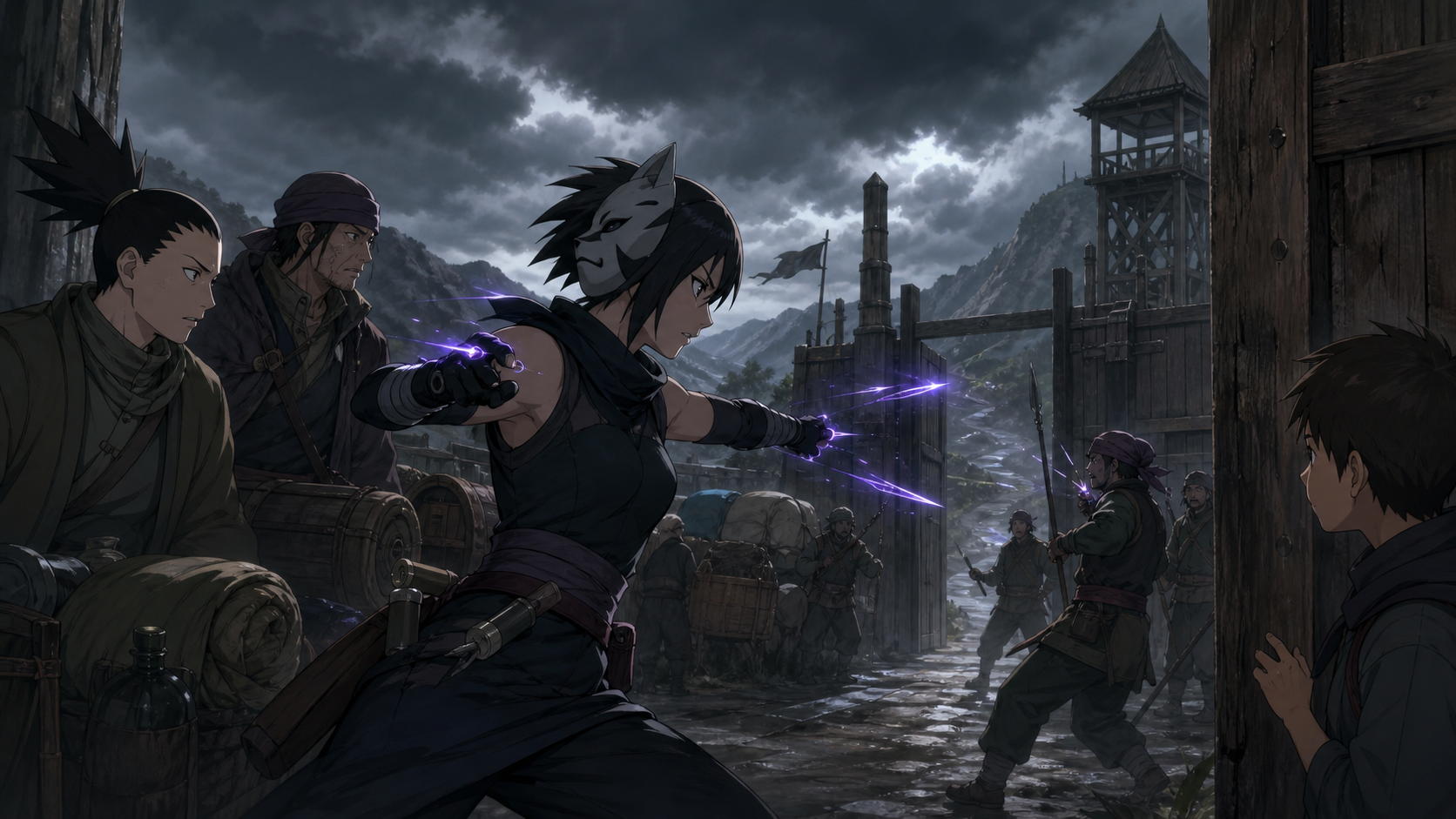
Dark Clouds
The infiltration succeeds because Soku can perform disposability convincingly, exposing how much truth the mission must borrow from the system it opposes.
Bottom line
“Dark Clouds” turns infiltration into an argument about how villages produce the missing-nin they later call disposable. Shikamaru, Ro, and Soku enter the Land of Silence as merchants, only to find a checkpoint system built around suspicion, recruitment, and contempt for established shinobi authority. Soku's anger at being underestimated becomes the mission's most believable cover because Konoha has also treated her as a weapon defined by a chakra-needle technique. Shikamaru lets a local boy named Komori hear a staged conversation about killing her if she defects, then sends Soku ahead as an apparent deserter. She defeats the guards, attacks her own teammates, and gains entry while Komori believes he has helped expose a genuine fracture. The plan succeeds, but success does not make every method healthy. Shikamaru weaponizes Soku's real grievance, repeats the threat villages use against deserters, and depends on her willingness to perform betrayal convincingly. The Land of Silence offers freedom by exploiting people alienated from hidden villages; Konoha answers through a covert mission that confirms some of Gengo's criticism. The team must distinguish necessary deception from the very system of disposability they were sent to stop.
Episode 490 continues the Shikamaru Hiden adaptation
Episode 490 is titled “Dark Clouds.” The episode aired in Japan on January 19, 2017, and adapts the Land of Silence infiltration from *Shikamaru Hiden: A Cloud Drifting in Silent Darkness*.
The anime expands Soku's staged defection and Komori's role in getting the team through Tobari's defenses.
Sai hears an attack on his belonging
An unseen speaker questions whether Team 7 still needs him now that Sasuke has returned. The manipulation targets a fear shaped by joining an established team as a replacement.
Old insecurity becomes an entry point.
Sasuke's return complicates Sai's position
Team 7's emotional history predates him and carries enormous narrative weight inside Konoha. Sai has built real relationships without receiving the same childhood foundation.
Belonging can feel conditional even when earned.
Root taught Sai to expect replacement
Danzō trained children as interchangeable tools and punished attachment. Gengo's voice can revive that framework by presenting friendship as another temporary assignment.
Conditioning survives institutional collapse.
The manipulation uses partial truth
Sasuke has returned, and Sai did enter the team after his defection. The lie lies in claiming that one relationship cancels another.
Propaganda works best through accurate fragments.
Shikamaru's team approaches the Land of Silence
The country lies beyond familiar village authority and gathers people leaving other systems. Every step inward reduces access to backup.
Geography increases operational isolation.
They disguise themselves as merchants
Commercial movement offers a plausible reason for travel without openly declaring shinobi affiliation. The cover also reflects how trade crosses boundaries military teams cannot.
Ordinary labor becomes protective identity.
Ro carries veteran composure
He understands that successful infiltration often depends on being forgettable rather than impressive. His restraint balances Soku's impatience and Shikamaru's visible calculation.
Experience manages the team's surface.
Soku dislikes the slow approach
Her precise combat ability makes direct removal of guards seem faster. Waiting requires accepting dependence on people she considers less efficient.
Skill can make subtlety feel insulting.
Shikamaru attempts a cover explanation
His improvised merchant speech lacks the confidence expected from his strategic reputation. Planning large patterns does not make every performance natural.
Intelligence has social limits.
Watchers notice the team
Local surveillance begins before the formal checkpoint. The Land of Silence has built layers of observation around entry, suggesting fear of infiltration alongside active recruitment.
Closed systems monitor strangers and residents alike.
Two pursuers follow them
Soku detects the threat and responds before the watchers can close distance. Her sensory awareness protects the cover while risking excessive force.
Quick action solves one problem and creates another.
Soku disables the first man
Her chakra needle strikes with enough precision to neutralize a target quietly. The technique demonstrates why ANBU values her despite dismissing her age.
Competence demands respect without removing oversight.
The second pursuer destroys their access plan
The intended route becomes unusable, sending the team back toward public spaces and improvised intelligence gathering. A careful operation loses certainty quickly.
Adaptation begins where planning fails.
A tavern becomes the information hub
Travelers, recruiters, laborers, and local enforcers overlap inside one room. Informal conversation may reveal more than official maps.
Public space carries hidden networks.
The bartender offers little help
Whether from fear, loyalty, or self-protection, he avoids giving strangers an easy route through Tobari. Local people live with consequences after infiltrators leave.
Silence may be survival rather than allegiance.
A man recruits assistance
Someone searching for shinobi support presents a possible route toward the controlled village. His contemptuous language exposes how employers value missing-nin as cheap tools.
Freedom markets can reproduce exploitation.
Soku reacts to insults against shinobi
The recruiter treats village operatives as expendable or inferior, touching a professional identity she has fought to establish. Anger makes her cover harder to maintain.
Disrespect reaches a real wound.
She nearly kills him
Soku's response exceeds the immediate threat and would expose the mission. Precision without emotional regulation can become disproportionate violence.
Power needs a deliberate stopping point.
Shikamaru intervenes
He rejects murder as unnecessary and strategically disastrous. Leadership means restraining a teammate without humiliating her grievance.
Correction should preserve dignity.
Soku considers the Land of Silence's promise
She suggests that a country valuing her ability might offer more opportunity than Konoha. The thought works as cover because the dissatisfaction is plausible.
Recruitment targets unmet recognition.
Shikamaru warns about desertion
Leaving a hidden village carries severe punishment because missing-nin possess classified techniques and intelligence. The policy protects communities through threatened violence against former members.
Belonging remains partly coercive.
His warning confirms Gengo's critique
If a shinobi cannot leave without being hunted, village membership is not fully voluntary. Security concerns are real, but permanence enforced by death invites resistance.
Peace needs a humane exit system.
Tobari enforcers enter the tavern
Local shinobi begin checking identities and searching for suspicious travelers. The team can no longer remain anonymous through passive cover.
State pressure reaches the public room.
Soku proposes killing the search team
Her solution would remove witnesses quickly and announce a skilled hostile presence to the entire country. Shikamaru refuses the escalation.
Operational discipline protects lives and cover.
Komori offers a hiding place
The young worker leads them below the tavern while officials search upstairs. His help appears motivated by resentment toward Tobari's arrogance.
Local dissent gives outsiders access.
Komori refuses complete identification
He understands that knowing their purpose could make him a hostage or liability. The boy shows political awareness beyond his position.
Survival requires controlled knowledge.
He detects a rat nearby
Komori hears or senses movement the infiltrators initially overlook. The small moment reveals an ability useful to Gengo's surveillance network.
Apparent harmlessness conceals training.
Shikamaru asks about bypassing the checkpoint
The question tests whether Komori has access, loyalty, or a desire to undermine local authority. Direct need becomes bait for the boy's response.
Information gathering becomes mutual evaluation.
Soku storms away
Her anger looks like a real break with Shikamaru after repeated disagreement. The performance draws Komori's sympathy because her grievance has been made visible all day.
Convincing deception grows from authentic feeling.
Komori follows her
He offers support to someone who appears ready to reject village control. His sympathy may be personal, operational, or both.
Recruiters often begin by validating pain.
Shikamaru stages a lethal conversation
He asks Ro whether they can silence Soku if she truly deserts. The language is designed for Komori and Soku to overhear.
The plan uses Konoha's harsh policy as theater.
Ro agrees to the performance
His calm answer makes the threat credible and gives Soku a reason to flee immediately. Veteran discipline supports a deception that could damage team trust if poorly controlled.
Coordination depends on prior agreement.
Soku appears betrayed
Her reaction communicates that Konoha values her only while obedient. The performance works because she already fears being treated as a technique before a person.
Mission cover borrows from institutional harm.
Komori reveals a hidden route
He directs her toward a way through the Tobari checkpoint and believes he is helping a genuine deserter. The team gains access by manipulating a local intermediary.
Useful cooperation lacks informed consent.
Soku presents herself at the gate
She declares defection and offers her ability to the Land of Silence. The guards evaluate her as a possible asset rather than a person seeking refuge.
Recruitment repeats the valuation she fled.
The guards dismiss her age
They assume youth means weakness and question whether Konoha would send such a child. Their contempt gives Soku a familiar obstacle to defeat.
Underestimation becomes entry leverage.
She defeats the local fighters
Chakra needles establish immediate value without a prolonged battle. The demonstration turns her body into a credential.
Power purchases conditional acceptance.
Komori vouches for her story
His endorsement converts the unknown operative into a credible deserter. Gengo's network depends on people who identify and channel disaffected shinobi.
Belonging begins through sponsorship.
Shikamaru and Ro arrive as pursuers
Their appearance completes the narrative that Konoha will kill a departing operative. Local guards can witness the threat Gengo describes.
The infiltration stages institutional cruelty.
Soku attacks both teammates
She uses her needles with apparent lethal precision, dropping Shikamaru and Ro before the Tobari watchers. The performance must convince trained observers.
Trust allows danger to look real.
Ro interrupts Shikamaru at the right moment
Their choreography prevents the Shadow Possession Technique from ending Soku's escape too easily. Each teammate performs opposition while protecting the plan.
Coordination hides inside conflict.
Komori believes the pair are dead
The apparent killings secure Soku's value and remove immediate suspicion. The boy becomes witness to violence the team designed for him to misunderstand.
Deception imposes emotional cost on outsiders.
Soku enters Tobari
She reaches the village as a successful defector and leaves an opening for her team. The first phase succeeds without an actual death.
Infiltration advances through controlled appearance.
She renders Komori unconscious
Once his role is complete, Soku prevents him from warning others or observing the next step. The action protects the mission while confirming that his trust was instrumental.
Operational necessity can still exploit a child.
Shikamaru and Ro wake later
The chakra needles simulated death without killing them. Soku's precision proves that the staged betrayal depended on deep knowledge of her technique.
Apparent recklessness was planned control.
Shikamaru identified Komori as a plant
The boy knew too much, detected movement too easily, and guided dissatisfaction toward defection. Shikamaru used the recruiter instead of exposing him immediately.
Reading motive created the entry strategy.
The team reunites inside the system
Soku's route allows all three operatives to cross the checkpoint and continue toward Gengo. Their cover now depends on maintaining separate public roles.
Success increases the cost of discovery.
The plan raises questions about leadership
Shikamaru trusted Soku's skill enough to build the mission around her, yet he also exploited a grievance he had barely addressed directly. Strategic respect and emotional care are not interchangeable.
Teams need both forms of recognition.
Soku’s cover works because the grievance is real
The checkpoint guards believe her because every part of the story fits a system they understand. Konoha values a young operative for lethal precision, limits her control over how that ability is used, and threatens deserters who carry classified knowledge. The mission invents betrayal, but it does not invent the conditions making betrayal plausible.
That should unsettle Shikamaru. Strategy uses reality. Leadership has to change the reality after the mission. If Soku returns to the same dismissive structure once her performance is no longer useful, Gengo’s recruitment argument remains stronger than the operation sent to stop him.
A chosen name is part of professional agency
Soku tells people how she wants to be addressed. That assertion may look small beside chakra needles and covert entry, but institutions reveal respect through small repetitions. Calling her by the chosen field name recognizes that she is more than a technique registered in someone else’s file.
Her age does not remove the need for oversight, and talent does not turn every impulse into sound judgment. Shikamaru can stop disproportionate force while respecting her expertise. Correction becomes ethical when it protects others without shrinking the person being corrected.
Komori is not disposable mission equipment
He recruits, watches, and guides people toward Gengo, so using his assumptions against him has operational logic. He is also a young person shaped by local power who believes he is helping someone escape execution. The team engineers an emotional reality for him and discards his informed consent because secrecy makes that useful.
Espionage rarely offers clean choices. That does not mean consequences vanish. Shikamaru should record what happened, protect Komori from retaliation where possible, and resist turning local civilians into tools whose harm disappears when the objective advances.
The Land of Silence sells freedom through usefulness
Soku reaches the gate claiming she wants a place that values her, and guards respond by demanding a demonstration. The new system criticizes hidden villages for treating shinobi as tools, then makes power the price of entry. Acceptance remains conditional on what her body can do for authority.
Gengo’s promise succeeds because it offers recognition before people notice the terms. A humane alternative needs rights not tied to combat value: safe exit from military service, civilian work, legal identity, health care, housing, and a way to protect secrets without threatening death.
Missing-nin policy needs a route home or elsewhere
Villages have legitimate reasons to protect operational knowledge and residents from trained fighters who defect during conflict. Automatic pursuit and execution convert membership into permanent ownership. Someone who cannot leave without being killed has not consented freely to remain.
Postwar reform should distinguish people planning violence from people seeking another life. Review, debriefing, limited confidentiality agreements, relocation support, and cross-village agreements would be harder than a blanket death rule. Harder is not impossible.
Shikamaru must repair trust after using it
Ro and Soku perform danger because they trust one another’s control. That precision is impressive. It does not answer what happens when the cover ends. Soku deserves acknowledgment that her real frustration became mission material and space to say whether the plan cost more than Shikamaru anticipated.
A good strategist studies people. A good leader also lets people describe themselves after the strategy is finished. Debriefing should include emotional consequence, not only whether the checkpoint opened.
The episode also shows why covert teams need authority that can be audited after secrecy ends. Shikamaru decides when Soku’s grievance becomes cover, when Komori may be deceived, when apparent death is necessary, and how much allied governments are allowed to know. Each choice may be defensible under immediate conditions. Taken together, they place enormous moral discretion in one exhausted strategist operating beyond public view. Documentation is not bureaucracy here. It is how people later ask whether the deception was proportionate, whether a less harmful route existed, whether Soku consented freely, and what support Komori received after becoming collateral to the plan. Ro’s presence adds experience but not independent review if his role is simply to validate Shikamaru’s design. Kakashi remains responsible for the mission he authorized, including foreseeable harm outside Konoha’s borders. The Land of Silence cannot become a place where great villages suspend their own standards because residents are politically inconvenient. If the alliance wants legitimacy, it must create rules for cross-border covert action, civilian protection, capture, assassination thresholds, evidence preservation, and post-mission disclosure. Gengo gains power by pointing at hypocrisy. The strongest answer is not denying every accusation. It is building systems willing to admit where the accusation lands and change accordingly. Soku’s performance gets the team through a gate. Her real treatment after the gate will reveal whether Konoha understands the difference between using someone well and valuing her as a person. That distinction must survive success, because institutions become most dangerous when a brilliant outcome teaches leaders that every hidden method was justified. A mission can work and still require apology, compensation, reform, or a firm rule that the same tactic will not be used again next time.
Final verdict
“Dark Clouds” succeeds as an infiltration episode because the staged betrayal is built from real political fault lines. Soku can plausibly defect because Konoha values her lethal precision while village law threatens anyone who leaves with death. Gengo can plausibly recruit her because the Land of Silence promises status outside inherited hierarchy. Neither system begins by asking what kind of life she wants beyond usefulness. Shikamaru recognizes Komori as a recruiter and turns the boy's surveillance against him, staging a conversation about silencing Soku before she appears to kill both teammates at Tobari's gate. The plan is clever, controlled, and ethically uncomfortable. Komori is manipulated, Soku's pain becomes operational material, and Konoha's coercive desertion policy supplies the most convincing evidence for Gengo's worldview. Crossing the checkpoint proves Shikamaru can enter the organization. Defeating Gengo will require proving that his own alliance can offer belonging without ownership, secrecy, or disposability.
Sources and watch notes
- Naruto Official episode guide for the official series record.
- Crunchyroll for the licensed episode route where available.
What I am carrying forward
Episode 491 tests the team inside Tobari. I am carrying forward Soku’s performed disposability, Komori’s manipulated trust, Gengo’s conditional welcome, Konoha’s lethal desertion policy, Sai’s targeted insecurity, and Shikamaru’s obligation to repair the relationships his plan uses. Entry is not proof their system is better.