
Recklessness
Gengo recruits through injuries hidden villages helped create, and Shikamaru discovers that refusing to blame Sai will not stop him from blaming himself.
Bottom line
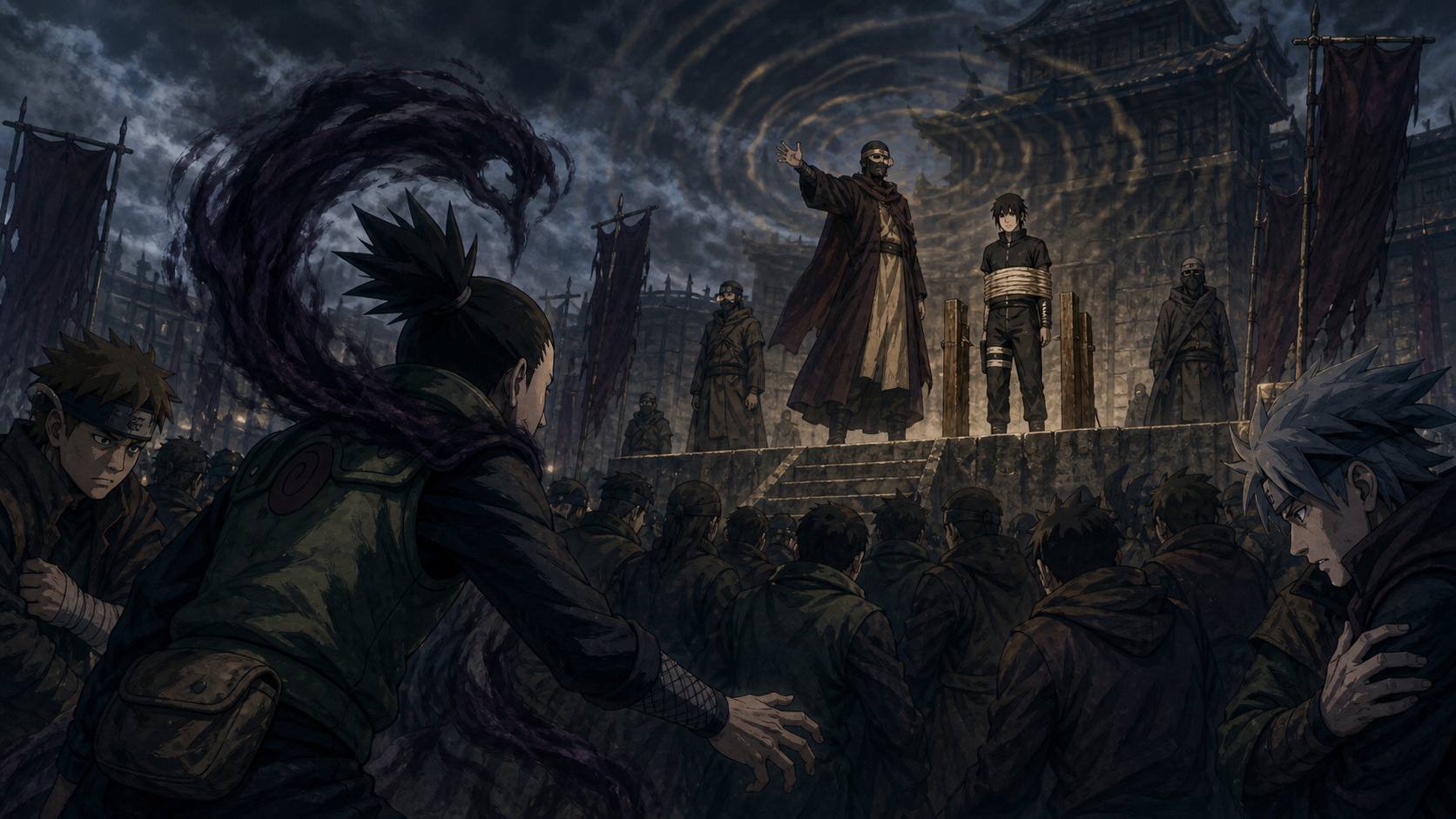
“Recklessness” exposes the fear beneath Shikamaru's careful leadership. Nightmares return him to Asuma's death and the bodies of friends injured during the Sasuke Retrieval Mission, then Sai's public captivity makes rescue feel more urgent than the intelligence plan built around Gengo. The team reaches Fushu Castle and discovers a city where speech has replaced visible chains. Gengo tells missing-nin that feudal lords and hidden villages use their lives, which is true enough to make the genjutsu carried in his voice feel like awakening rather than control. Ro and Soku begin absorbing that message through wounds the shinobi system genuinely gave them. Sai has already been turned by the fear that Sasuke's return made him disposable to Team 7. When Shikamaru detonates a diversion and reaches for him, Sai's ink snake binds the rescuer instead. Shikamaru then uses Shadow Strangle on his own throat rather than let Gengo convert his mind. The act is tactically understandable and emotionally dangerous. He would rather destroy himself than become responsible for harming friends, repeating the same logic that made Asuma, Shikaku, Itachi, and countless shinobi treat death as the cleanest solution. Leadership cannot remain a choice between control and self-erasure.
Episode 491 continues the Shikamaru Hiden adaptation
Episode 491 is titled “Recklessness.” The episode aired in Japan on January 26, 2017, and adapts Shikamaru's failed attempt to extract Sai from *Shikamaru Hiden: A Cloud Drifting in Silent Darkness*.
The anime emphasizes Gengo's public speech and the gradual effect of his voice on all three infiltrators.
Shikamaru wakes from another nightmare
Sleep returns him to losses his daytime competence keeps organized but unresolved. Memory does not follow the mission schedule.
Trauma enters through the hours meant for recovery.
Asuma dies again in his mind
The teacher's final battle remains attached to Shikamaru's sense of responsibility. Grief has become a warning that leadership may end with someone else paying.
Love and command remain painfully linked.
The retrieval team appears injured
Choji, Neji, Kiba, and Naruto return through memory as children damaged under Shikamaru's first command. Their survival never erased his belief that he failed them.
Outcome and guilt tell different stories.
Shikamaru has not forgiven his younger self
He became Chunin because adults trusted his judgment, then discovered that judgment could not prevent every wound. The lesson hardened into a need to control exposure.
Responsibility became fear of delegation.
Ro notices the disturbed sleep
The veteran operative asks about the nightmares rather than pretending a capable leader has no private cost. His attention opens space for honesty.
Team care begins through observation.
Shikamaru minimizes the problem
He treats recurring trauma as an inconvenience and moves toward operational analysis. Naming exhaustion might feel like transferring burden to a subordinate.
Silence preserves authority while deepening isolation.
Tobari has no wind
Shikamaru notices still air around the city and castle. The unnatural quiet makes clouds hang overhead without movement.
Atmosphere reflects a country trapped under one voice.
The city surrounds Fushu Castle
Gengo's power occupies a visible center while ordinary residents, recruits, merchants, and enforcers circulate below. Political authority dominates both skyline and conversation.
Architecture turns hierarchy into geography.
Reliable information remains scarce
Residents know Gengo's presence but offer few details about access, routine, or Sai. Fear and indoctrination make ordinary questioning dangerous.
Silence protects the regime.
Soku searches from inside the network
Her staged defection lets her observe Tobari without appearing connected to Shikamaru and Ro. Entry has produced access but not immediate answers.
Deep cover requires patience she dislikes.
Gengo prepares a public appearance
The leader rarely exposes himself, so a speech creates the team's best chance for observation and capture. Public confidence may also indicate that the event is bait.
Opportunity and trap share the same square.
Shikamaru pauses for food
The team eats in the city center while evaluating routes. Routine behavior protects cover and gives exhausted operatives a moment to regulate.
Basic care supports strategic judgment.
The local yakiniku disappoints him
Shikamaru compares the meal with familiar dinners shared with Ino and Choji. Taste carries him briefly back toward Konoha and Team 10.
Home survives through ordinary expectation.
A shopkeeper discusses Gengo's rule
The man says residents gained purpose or order while Gengo's followers tightened control. Improvement and repression coexist in the same account.
Authoritarian systems often answer neglected needs first.
Gengo changed people who felt insignificant
His movement offers status to missing-nin and residents excluded from established hierarchies. That promise explains loyalty better than mind control alone.
Belonging gives coercion a receptive surface.
Shikamaru recognizes Minoichi
An apparent local is a former ANBU operative who deserted during the war after killing teammates. His presence confirms Gengo's network is absorbing dangerous village knowledge.
The missing-nin pattern becomes a face.
Shikamaru pursues him aggressively
Sai's danger and the mission's limited time push interrogation beyond Shikamaru's usual detached restraint. Anger enters the search for intelligence.
Urgency narrows ethical patience.
Minoichi refuses easy cooperation
He has survived by rejecting former village authority and sees no reason to trust Konoha's envoy. Defection has turned old credentials into mutual threat.
Institutional allegiance determines whose force appears legitimate.
The deserter attacks Ro
Resistance becomes physical before useful testimony emerges. Ro must confront another ANBU shaped by war and abandonment.
Shared service does not create shared loyalty.
Ro subdues him
The veteran ends the attack without allowing the confrontation to derail the mission. His controlled response hides a history of his own.
Professional steadiness can cover survivor pain.
Ro once hid beneath fallen comrades
An enemy ambush destroyed his unit while he survived among their bodies instead of fighting back. The experience shaped the technique and discipline he later developed.
Survival became a source of shame.
His guilt resembles Shikamaru's differently
Shikamaru condemns himself because friends were injured under command. Ro condemns himself because remaining hidden kept him alive while others died.
Both mistake survival for moral failure.
Gengo's message can exploit Ro directly
A movement condemning village systems offers him a way to reinterpret guilt as betrayal by the institution that sent his unit. The critique contains enough truth to loosen loyalty.
Unprocessed trauma becomes political vulnerability.
The team plans around the speech
Shikamaru assigns positions, diversion points, and extraction routes. Gengo's appearance creates one narrow chance to reach Sai and immobilize the leader.
Preparation tries to contain emotional urgency.
Soku enters through her established cover
She joins the crowd as a new recruit whose apparent defection has already been proven. Her height and position give access to a vantage point near a bell structure.
The prior deception becomes operational leverage.
Gengo takes the platform
He presents himself directly to people who feel discarded by villages and feudal governments. Public proximity makes authority feel participatory.
Charisma creates intimacy at scale.
He attacks the feudal order
Gengo argues that daimyo benefit from shinobi sacrifice while remaining removed from the cost. The criticism identifies a genuine class and governance problem.
Valid diagnosis does not validate his cure.
He attacks the hidden-village system
Villages train children, restrict exit, sell violence, conceal operations, and discard operatives when politically convenient. Every listener can attach the speech to a personal wound.
Structural truth becomes persuasive material.
Gengo offers shinobi rule instead
His solution replaces feudal hierarchy with authority concentrated around armed people loyal to him. Liberation language masks another unaccountable center.
Changing rulers does not end domination.
His voice carries genjutsu
The Demonic Illusion known as Cajolery of Glamour amplifies dissatisfaction and redirects loyalty. Listeners experience imposed conviction through thoughts that feel like their own.
Coercion disguises itself as clarity.
The technique depends on existing wounds
Gengo does not invent every grievance. He identifies pain, validates the most destabilizing interpretation, and suppresses alternatives.
Manipulation thrives where institutions failed to repair harm.
Sai is displayed before the crowd
He appears restrained as evidence of Konoha intrusion and a body upon which Gengo can stage political judgment. Public exposure converts a covert operative into propaganda.
Captivity becomes theater.
The crowd demands his death
People repeat Gengo's desired verdict while experiencing collective certainty. Their response may combine genuine anger, group pressure, and genjutsu.
Mass agreement does not prove free consent.
Shikamaru sees a friend before an asset
Sai's intelligence value matters, but personal recognition collapses the emotional distance required by the original plan. Rescue becomes immediate.
Attachment changes strategic priorities.
The speech begins affecting Ro
His buried shame and anger give Gengo's words a route inward. The veteran's composure cannot protect a wound he has never integrated.
Discipline is not immunity.
Soku feels the pull too
The promise that powerful shinobi deserve recognition speaks directly to her resentment. Her staged defection starts becoming emotionally plausible from inside.
Cover and conversion begin to overlap.
Shikamaru notices dark thoughts returning
Gengo's voice gives his guilt a sharper conclusion: friends suffer because he leads them, so removing himself may protect everyone. The technique sounds like his own internal logic.
Self-blame becomes the attack surface.
He physically shocks Ro back toward focus
Shikamaru uses a quick strike to interrupt the trance and remind his teammate of the mission. The action may break concentration without resolving the underlying influence.
Disruption buys time rather than healing.
Explosive tags create the diversion
Shikamaru and Ro trigger blasts away from the crowd and shout for guards to protect Gengo. The command directs loyal followers toward the leader while opening a route to Sai.
Misdirection turns obedience against itself.
Gengo appears unsurprised
His calm suggests the infiltrators have been identified and the public execution was designed to draw them out. Sai is bait as much as prisoner.
The rescue plan entered an anticipated pattern.
Shikamaru reaches Sai
He cuts through restraints expecting extraction to restore a compromised teammate. Physical release is not enough when coercion has moved inside perception.
Freedom from ropes does not free the mind.
Sai grabs him instead
The friend Shikamaru came to save becomes the mechanism of capture. Gengo weaponizes relationship because hesitation favors the controlled operative.
Trust becomes tactical vulnerability.
Ink snakes bind Shikamaru
Sai's familiar art now restricts the person trying to restore him. A technique once used to join Team 7 has been redirected against another Konoha bond.
Skill carries no permanent allegiance.
Shikamaru refuses to blame Sai
The altered eyes and behavior show that consent has been compromised. Stopping him remains necessary without treating coerced action as chosen betrayal.
Recognition protects the victim beneath the threat.
Ro and Soku are captured
Gengo's voice has weakened their resistance enough for followers to restrain them. The team loses every position at once.
The carefully distributed plan collapses through a shared vulnerability.
Gengo turns his attention to Shikamaru
The strategist is valuable because controlling him would provide political knowledge, alliance access, and a symbolic victory over Konoha. Persuasion becomes a recruitment attempt.
Capture aims beyond mission failure.
He amplifies Shikamaru's guilt
Asuma, Shikaku, Sai, and the retrieval team become evidence that everyone near Shikamaru suffers. The conclusion feels self-generated because guilt already prepared the argument.
Genjutsu completes the harshest version of his self-story.
Shikamaru forms a seal while bound
Limited movement still allows him to command his own shadow. The technique gives him one area Gengo has not yet fully controlled.
Agency contracts toward the body.
Shadow Strangle closes around his throat
Shikamaru chooses unconsciousness or death over conversion. The tactic may interrupt Gengo's voice, but the willingness reveals how readily he treats his life as expendable.
Resistance turns inward.
Self-harm is not a clean form of loyalty
Preventing forced betrayal is urgent, yet destroying himself would leave Sai, Ro, Soku, Temari, Team 10, Mirai, Naruto, and Kakashi with another absence. Protection must count their relationship to his survival.
His life belongs within the circle of concern.
The title names more than the rescue attempt
Shikamaru's rush toward Sai is reckless, but so is Gengo's confidence that pain can be converted into permanent loyalty. The mission and regime both underestimate relationship's ability to return.
Darkness narrows every available choice.
Gengo’s power depends on a credible first sentence
He tells shinobi they have been used by feudal lords and villages, and many listeners know that truth through their own bodies. Children were trained for war. Operatives were abandoned. Exit was criminalized. Grief became classified information. The genjutsu succeeds because institutions prepared the wound before Gengo supplied the conclusion.
His lie is not the diagnosis. It is the claim that only his authority can answer it. He replaces one hierarchy with armed loyalty centered on himself and suppresses any thought that might lead elsewhere. Recognition becomes a doorway to control.
Sai’s belonging was never interchangeable
Sasuke’s return cannot erase the years Sai spent becoming part of Team 7. He built relationships through awkward questions, mistakes, drawings, missions, apology, and care. Gengo turns the word replacement back into Root’s original meaning, where children existed as tools occupying temporary slots.
Shikamaru recognizes coercion because the controlled Sai sounds wrong. That relationship evidence matters. Rescue must eventually give Sai room to describe what the manipulation found inside him without treating susceptibility as betrayal.
Ro and Soku do not fail through weakness
Gengo reaches injuries their institutions never helped them integrate. Ro survived beneath dead comrades and turned survival into shame. Soku learned that recognition follows the lethal usefulness of her technique. Discipline covers both wounds until a voice gives each one a political explanation.
Their capture should trigger care, not punishment for compromised loyalty. Training against genjutsu is insufficient when the technique attaches itself to unprocessed trauma. Recovery needs psychological support, peer connection, and a workplace where naming pain does not threaten professional status.
Shikamaru cannot save friends by erasing himself
Shadow Strangle is an emergency attempt to interrupt Gengo before forced conversion. Tactically, it buys control over the only body Shikamaru can still command. Emotionally, it reveals how quickly his strategy ends at self-destruction. If he dies, everyone he wants to protect receives another grave.
Asuma and Shikaku’s sacrifices do not create a rule that good leaders disappear. Mirai needs an older brother. Naruto needs an adviser. Temari, Ino, and Choji need a person whose life matters outside work. Shikamaru belongs inside the future he is defending.
Rescue urgency needs a wider plan
Reaching Sai is understandable, and Gengo expected that bond to narrow Shikamaru’s choices. A stronger response would combine extraction, counter-genjutsu, civilian protection, evidence preservation, and an answer for recruits who may surrender without safe homes elsewhere.
Capturing one leader cannot be the only definition of success. The people in the square need freedom from imposed loyalty and alternatives to the systems that made imposed loyalty feel like awakening.
The public square also matters because Gengo converts collective participation into evidence of legitimacy. A crowd repeats his verdict, and the sound makes coercion look like consensus. Some listeners are affected by genjutsu. Others may agree from conviction, fear, material dependence, or the pressure of standing among armed believers. Those differences cannot be recovered by treating everyone present as one enemy force. When control breaks, people will need individual assessment and a public account of what happened to their agency. They may feel shame for words or actions produced under influence, anger that real grievances were exploited, and uncertainty about which thoughts belonged to them. Recovery should not demand instant loyalty to the villages Gengo criticized. It should restore room for doubt, dissent, and choice without punishment for refusing the old order. Shikamaru’s alliance will be judged by whether it can tolerate that freedom. If the only safe post-Gengo position is obedience to Konoha or another hidden village, then the movement’s diagnosis remains unanswered. People need civilian routes, labor rights, political representation, trauma care, and a lawful way to leave military institutions. Gengo’s genjutsu must end, but the silence that made his voice powerful must end too. That requires listening after the battlefield, including testimony that makes the great villages uncomfortable. A liberated mind is not one programmed with the correct allegiance. It is one allowed to examine history, relationships, and available futures without a leader turning pain into a command. That freedom is slower than victory, harder than assassination, and more threatening to every institution accustomed to deciding what wounded shinobi should believe before hearing them fully speak.
Final verdict
“Recklessness” makes Gengo dangerous because his speech begins with truths the alliance has not resolved. Feudal lords remain distant from shinobi deaths, villages restrict departure, covert teams carry unacknowledged trauma, and operatives such as Sai and Soku have repeatedly been valued through usefulness. Cajolery of Glamour turns those facts into a closed conclusion: only Gengo offers freedom, and every existing bond is exploitation. Sai's converted attack breaks Shikamaru's plan because friendship makes immediate rescue feel necessary. Ro and Soku fall because professional discipline cannot heal wounds nobody has named. Shikamaru resists by turning Shadow Strangle against himself, a brilliant emergency interruption that also exposes his deepest danger. He still believes good leadership may require becoming disposable before anyone else can be hurt. Escaping Gengo will require rejecting that conclusion, not merely rejecting Gengo's voice.
Sources and watch notes
- Naruto Official episode guide for the official series record.
- Crunchyroll for the licensed episode route where available.
What I am carrying forward
Episode 492 begins inside capture. I am carrying forward Sai’s targeted fear of replacement, Ro’s survivor shame, Soku’s conditional recognition, Gengo’s truth-shaped coercion, the crowd’s compromised consent, and Shikamaru’s shadow at his own throat. Escape must restore agency without denying why the speech found an audience.