
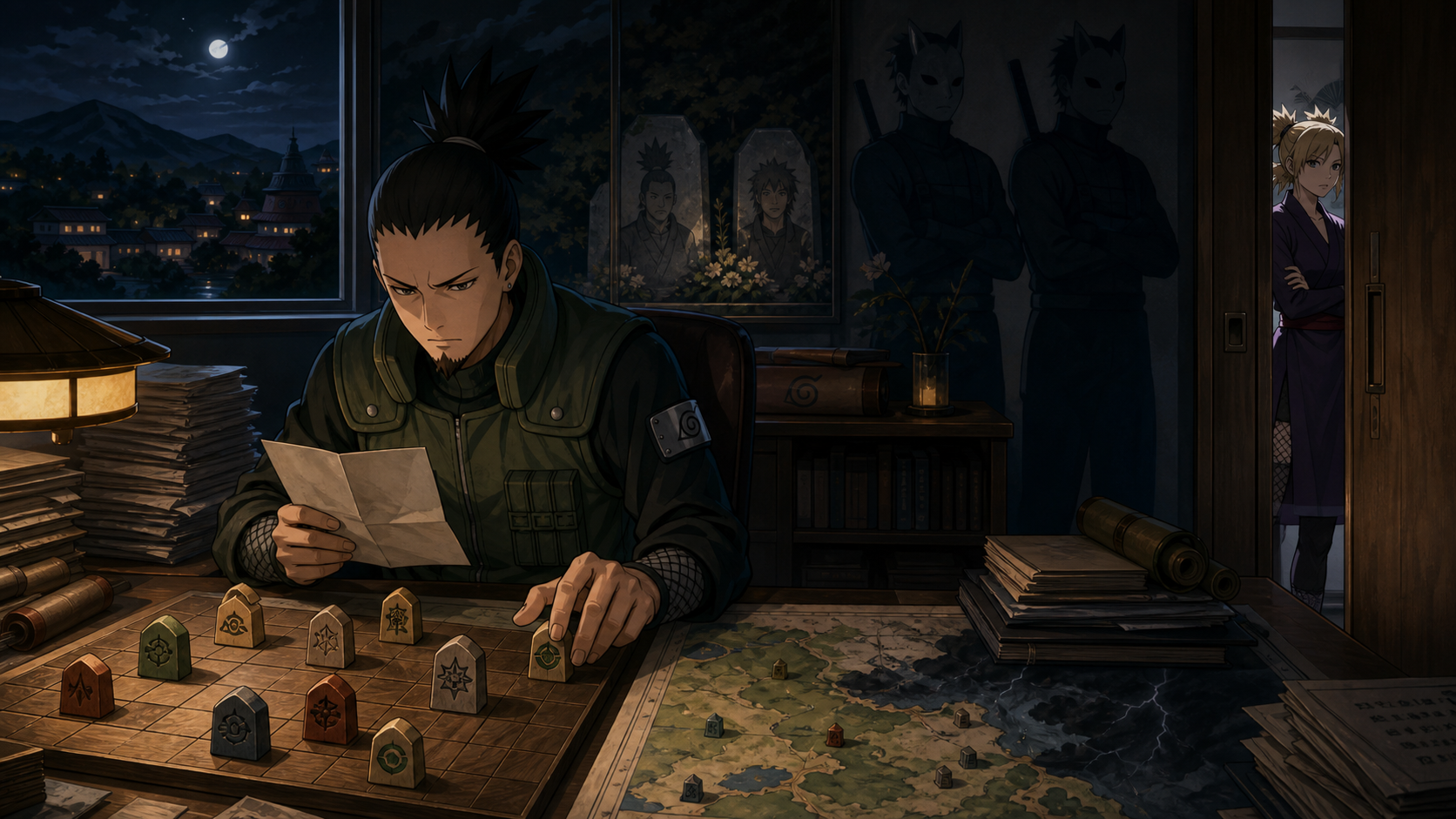
The State of Affairs
Shikamaru keeps the postwar alliance functioning, then mistakes carrying confidential risk alone for the same thing as responsible leadership.
Bottom line
“The State of Affairs” gives Shikamaru the postwar burden nobody celebrates: maintaining an alliance after shared catastrophe stops making cooperation automatic. He handles Kakashi's reports, defeats Onoki at shogi, trains alone, and tells himself every sacrifice is temporary until Naruto becomes Hokage. Meanwhile, requests for shinobi assistance decline, missing-nin disappear into the Land of Silence, and Sai's investigation produces a message that sounds increasingly unlike him. Shikamaru withholds those suspicions from the Shinobi Union and Temari, believing secrecy protects the mission. Her anger exposes the cost of that habit. He is not only carrying confidential information; he is shutting out a trusted diplomatic partner who can see that he is struggling. Kakashi then assigns him to capture or assassinate Gengo with the ANBU operatives Ro and Hinoko. Before leaving, Shikamaru visits Shikaku and Asuma's graves, eats with Ino and Choji, meets Kurenai and Mirai, and tells Naruto to remain himself. Those encounters reveal the truth beneath his detached competence. Shikamaru fears another retrieval mission where friends pay for his leadership, so he tries to reduce the number of people allowed to share risk. Responsibility has become isolation wearing a professional face.
Episode 489 begins the Shikamaru Hiden adaptation
Episode 489 is titled “The State of Affairs.” The episode aired in Japan on January 12, 2017, and begins a five-episode adaptation of Takashi Yano's novel *Shikamaru Hiden: A Cloud Drifting in Silent Darkness*.
The anime changes parts of the novel while retaining Shikamaru's political work and the Land of Silence mission.
Shikamaru works inside the Hokage office
He and Yurito process documents supporting Kakashi's administration. The boy once bored by every assignment now handles the paperwork holding a multinational peace together.
Intelligence has become institutional labor.
Paper replaces battlefield urgency
Reports, requests, budgets, and diplomatic notes lack the visible stakes of combat. Their consequences still determine who receives protection and which tensions become crises.
Quiet work can carry national risk.
Kakashi tells them to rest
The Hokage recognizes that constant work reduces judgment rather than proving dedication. His advice also reflects a leader who spent much of life using missions to avoid grief.
Experience gives the warning personal weight.
Shikamaru dismisses the concern
He treats fatigue as a manageable inconvenience because the work feels necessary and temporary. Competence makes overwork easier for everyone else to accept.
Reliability can hide depletion.
Naruto's future becomes his deadline
Shikamaru says he will carry the administrative load until Naruto is ready to become Hokage. The promise gives current sacrifice a clear purpose.
Support risks becoming self-erasure.
Preparing Naruto requires more than substitution
If Shikamaru quietly handles every difficult system, Naruto cannot learn governance through participation. A future Hokage needs education, exposure, disagreement, and accountable practice.
Friendship should build capacity, not dependence.
Shikamaru plays shogi with Onoki
The retired Tsuchikage becomes an opponent across the board rather than across national battle lines. Their game reflects the alliance's transformation of former rivals into political peers.
Strategy creates a language across generations.
He defeats the veteran leader
Shikamaru sees patterns faster and controls the endgame. Winning demonstrates intellectual authority without requiring formal rank above the elder Kage.
Ability can cross hierarchy.
Onoki carries a difficult legacy
He helped sustain mercenary systems, conflict, and hard national policy before choosing alliance during the war. Shikamaru studies peace beside someone shaped by older failures.
Survival can produce knowledge without innocence.
Shikamaru trains in the forest
Desk work has not removed the need for physical and chakra readiness. He practices alone because a strategist sent into danger must still survive direct confrontation.
Planning cannot replace bodily preparation.
Solitary training also reveals restlessness
Movement gives him relief from reports while keeping every hour productive. He changes tasks without truly stopping.
Overwork can disguise itself as variety.
The Shinobi Union meets in the Land of Iron
Representatives gather on neutral ground to assess cooperation among villages. The war alliance now needs routine governance rather than emergency command.
Peace requires recurring maintenance.
Requests for shinobi aid are declining
Fewer missions and missing contracts threaten village economies built around military labor. Peace creates a practical identity crisis for institutions designed to sell force.
Success destabilizes the old business model.
Missing-nin are disappearing too
Rogue shinobi vanish from multiple regions rather than appearing in ordinary intelligence channels. Their movement suggests recruitment toward a shared destination.
Absence becomes a pattern across borders.
Every village has reason for concern
The missing fighters may carry secrets, rare techniques, grievances, and combat experience. One organized network could exploit weaknesses in the young alliance.
Fragmented intelligence favors the recruiter.
Shikamaru says the matter is under investigation
His answer is formally accurate and deliberately incomplete. He protects Konoha's covert operation from a room of allies.
Confidentiality and alliance trust enter tension.
Temari recognizes concealment
She knows Shikamaru's pauses, evasions, and habit of minimizing danger. Diplomatic experience also tells her that a vague answer may hide risk relevant to every village.
Personal knowledge sharpens political reading.
She questions him privately
Temari offers an opportunity to share burden outside the formal meeting. Her concern is not mere romantic curiosity.
She represents both Sand and a trusted relationship.
Shikamaru refuses to explain
He treats secrecy as the safest option and decides alone what information she can handle. Protection becomes paternalistic when the protected person has equal strategic standing.
Withholding can deny agency.
Temari strikes him in anger
The slap is framed as comic frustration, but physical aggression is not healthy communication. Her underlying grievance remains valid without making violence necessary.
Care needs direct words and boundaries.
Their conflict exposes unequal access
Shikamaru expects Temari to trust his silence while refusing to trust her judgment. A partnership cannot grow when one person controls the information defining risk.
Intimacy requires reciprocal confidence.
Kakashi reveals Konoha's working theory
Missing-nin appear to be gathering in the Land of Silence under a leader named Gengo. The country has become a destination for people alienated from hidden villages.
Recruitment grows where institutions leave grievance unanswered.
The Land of Silence sits outside the major powers
Smaller countries often absorb displacement, black markets, and armed groups produced by great-nation conflict. Their instability is not separate from the alliance's history.
Margins record costs the center overlooks.
Gengo offers belonging to rogue shinobi
He gathers people rejected, hunted, or disillusioned by village systems. Recruitment works because the promise answers real emotional and material needs.
Propaganda gains strength from neglected truth.
Konoha has investigated quietly
Public accusation could drive Gengo underground or provoke diplomatic conflict before evidence is secure. Secrecy gives investigators room to observe.
Silence also prevents allied scrutiny.
Sai led the reconnaissance team
His ANBU experience, emotional discipline, and infiltration skills make him a logical choice. His history under Root also makes ideological manipulation a particular danger.
The mission touches old conditioning.
Sai's companions are killed
The investigation has already produced deaths before Shikamaru receives the full assignment. Gengo's organization is willing and able to eliminate covert threats.
The mission is no longer preliminary.
Sai sends a troubling report
His language sounds altered, detached in a way that differs from his usual learned directness. The message provides information while raising doubt about the sender's freedom.
Communication becomes evidence of compromise.
Shikamaru notices the tonal shift
Years of working beside Sai give him a baseline for comparison. Friendship supports intelligence analysis through knowledge no codebook can replace.
Relationship becomes a diagnostic tool.
Kakashi worries Sai has been captured or persuaded
Either possibility means the Land of Silence can neutralize elite operatives without obvious public confrontation. Recovery must account for psychological control as well as detention.
Rescue requires understanding the mechanism.
The mission targets Gengo directly
Kakashi asks Shikamaru to capture the leader if possible and assassinate him if necessary. The order carries enormous discretion into another country.
Covert authority needs a demanding threshold.
Assassination risks repeating old policy
Hidden villages have long solved political problems through unreviewed killing. Removing Gengo may stop immediate recruitment while leaving grievances and succession structures intact.
Security should not avoid political diagnosis.
Shikamaru accepts the assignment
Sai's danger, alliance stability, and his own strategic skill make refusal unlikely. He also believes that taking the burden himself protects friends from another failed mission.
Duty and trauma point in the same direction.
Ro joins the team
The veteran ANBU provides infiltration experience and a controlled public manner. His age and service give the mission practical memory beyond Shikamaru's planning.
Expertise is distributed across the unit.
Hinoko prefers the name Soku
The young operative asserts a chosen field identity and brings a chakra-needle technique capable of precise long-range attacks. Her confidence challenges assumptions based on age.
Naming is part of professional agency.
Soku's ability can kill silently
Chakra needles fit an infiltration mission where open battle could expose foreign involvement. Precision does not remove the moral weight of covert lethal force.
Technical cleanliness is not ethical simplicity.
Shikamaru visits Shikaku's grave
His father died directing the alliance while trusting the next generation to complete the war. Shikamaru now occupies the advisory role that once seemed remote.
Inheritance arrives as work and absence.
He also visits Asuma
The teacher who framed young shinobi as the king left Shikamaru responsible for protecting those who come next. Every leadership decision carries that remembered lesson.
Mentorship continues after death.
Kurenai arrives with Mirai
Asuma's family makes the future concrete rather than symbolic. Mirai knows Shikamaru through a bond created before she could remember her father.
The king has a name and a face.
Mirai greets him as an older brother
Her affection places Shikamaru inside a family responsibility beyond official duty. He cannot reduce himself to a replaceable strategist without affecting her life.
Connection contradicts disposable service.
The graves intensify his fear of failure
Shikaku and Asuma both died fulfilling shinobi roles. Shikamaru may read their sacrifice as a standard he must be ready to repeat.
Honor can become dangerous permission for self-neglect.
He remembers the Sasuke Retrieval Mission
His first command ended with every teammate seriously injured and Sasuke still gone. Although the team survived, Shikamaru internalized the result as proof that leadership exposes friends to harm.
Old failure shapes current secrecy.
Dinner reunites Ino-Shika-Cho
Ino and Choji meet him outside an operational briefing. Food and conversation restore the team as friends whose lives continue beyond formation tactics.
Ordinary companionship challenges professional isolation.
They discuss how much has changed
Careers, relationships, war losses, and future responsibilities have replaced their genin routine. Growth is visible through the people still able to share a table.
Continuity survives transformation.
Shikamaru does not tell them everything
He protects mission secrecy and avoids asking them to share another dangerous retrieval. The choice also denies close friends the chance to notice or support him fully.
Confidentiality can deepen loneliness.
Naruto meets him at the village gate
The future Hokage is heading for ramen while Shikamaru prepares for an assassination mission. The contrast preserves Naruto's ordinary habits beside national expectation.
Leadership grows from a recognizable person.
Shikamaru tells Naruto to remain himself
He does not want office to erase Naruto's empathy, directness, and instinct to see rejected people. Those qualities made the alliance possible before administrative competence arrived.
Preparation should refine identity, not replace identity.
The advice conceals the mission
Naruto hears encouragement without knowing the danger Shikamaru is carrying for his future government. Protecting Naruto from every shadow could reproduce the secrecy that damaged earlier Hokage systems.
Future leadership needs informed trust.
Shikamaru leaves with Ro and Soku
The small team reduces diplomatic exposure and increases vulnerability if Gengo's organization controls perception or loyalty. Their success depends on trust formed quickly under concealment.
Three people enter a country built around silence.
Peace creates work the monument cannot show
Shikamaru’s desk is where victory becomes policy. Mission requests, budgets, missing-nin reports, diplomatic meetings, and unanswered messages decide whether the alliance survives after fear stops holding everyone together. None of that work looks heroic. Every failure can still send children and civilians back into violence.
The danger is that invisible labor becomes an excuse to make the worker invisible too. Shikamaru is so competent that Kakashi, Naruto, and the Union can benefit from his depletion without confronting how much judgment has been concentrated in one exhausted person. Sustainable governance needs teams, records, handoffs, disagreement, and rest.
Preparing Naruto cannot mean replacing him
Shikamaru wants Naruto to become Hokage without losing the empathy that made people trust him. That is loving and politically sound. Quietly performing every difficult decision in advance risks leaving Naruto unprepared for the office he will inherit. Support should create capacity, not dependency hidden beneath friendship.
Naruto needs to learn how budgets reveal priorities, how covert authority gets reviewed, how allied villages share sensitive information, and how a leader responds when peace threatens the economy built around missions. Protecting him from those shadows would repeat the secrecy that damaged earlier Hokage administrations.
Temari is a diplomatic partner, not an audience
Her concern carries personal knowledge and Sand’s political stake. Shikamaru decides alone that silence protects her, then expects trust without offering the information that would let her assess risk. That is not partnership. It is control presented as burden-bearing.
Temari’s strike is still not healthy communication. The scene can validate her grievance without treating physical aggression as romantic comedy. Both adults need direct language, boundaries, and respect for the other’s agency. Caring deeply does not make either person entitled to conceal or hit.
Gengo recruits from real abandonment
Missing-nin do not gather in the Land of Silence because propaganda invented every grievance. Hidden villages trained children, discarded operatives, criminalized departure, and built economies around violence. Gengo offers belonging where those systems failed. That truth makes his organization dangerous because the promise has material credibility.
Assassinating him may interrupt command. It will not answer why people arrived. Shikamaru has to investigate wages, safety, identity, political exclusion, and the future available to shinobi whose old role disappeared with peace. Otherwise another recruiter can inherit the same neglected population.
Sai’s altered voice is relationship evidence
A formal report contains facts, but Shikamaru notices tone because he knows Sai. Years of watching him learn emotion, friendship, humor, and directness create a baseline no cipher can supply. Relationship becomes intelligence without reducing Sai to a sentimental clue.
That insight should push Shikamaru toward connection rather than further isolation. If knowing people helps detect coercion, then excluding trusted partners weakens the very method that revealed the danger.
The graves make Shikamaru’s overwork understandable without making it sustainable. Shikaku and Asuma both turned responsibility into sacrifice, and the village remembers them through honor. Their deaths can teach courage, but they can also teach a young leader that usefulness is measured by willingness to disappear. Mirai interrupts that lesson. She needs Shikamaru alive, present, and capable of being more than a strategist inherited from her father. Ino and Choji need a friend who can sit at dinner without converting every relationship into operational protection. Temari needs an equal who trusts her judgment before crisis forces disclosure. Naruto needs an adviser willing to disagree openly instead of building a government around decisions the Hokage never learns to make. These obligations do not compete with the mission. They define what mission success is supposed to preserve. Rest is not withdrawal from duty when exhaustion narrows judgment and encourages secrecy. Asking for help is not repeating the retrieval failure when the team has agency, expertise, and a right to understand shared risk. Shikamaru’s hardest move will not be predicting Gengo. It will be rejecting the belief that good leadership means controlling every danger before anyone he loves can choose to stand beside him. The alliance was born through distributed effort. Its administration should follow the same principle. Peace cannot depend on one brilliant man quietly becoming the casualty nobody notices because his body still reports to work. A responsible office notices that kind of disappearance early, redistributes labor, documents authority, and treats the strategist’s health as part of national security rather than private avoidable weakness.
Final verdict
“The State of Affairs” turns Shikamaru's famous intelligence into a vulnerability when everyone begins relying on him to carry what nobody else sees. He keeps Kakashi's government moving, monitors a fragile alliance, recognizes Sai's altered message, and accepts a mission whose failure could destabilize several nations. Those accomplishments are real. So is the cost. Shikamaru withholds relevant concern from Temari, limits what Ino and Choji can know, and encourages Naruto without letting the future Hokage understand the shadow work performed in his name. Visits to Shikaku and Asuma reveal why. Leadership still feels like the Sasuke Retrieval Mission, where command meant watching friends return broken. Ro and Soku give him a capable team, but capability cannot replace shared authority and honest support. Gengo recruits missing-nin by promising belonging outside failed village systems. Shikamaru will need more than a brilliant assassination plan to defeat that promise. He will need to trust the relationships he keeps trying to protect through silence.
Sources and watch notes
- Naruto Official episode guide for the official series record.
- Crunchyroll for the licensed episode route where available.
What I am carrying forward
Episode 490 enters the Land of Silence. I am carrying forward Sai’s altered message, Gengo’s credible promise of belonging, Temari’s excluded knowledge, Ro and Soku’s covert authority, the assassination order, and Shikamaru’s fear that leadership means friends returning broken. The mission must challenge isolation on both sides.