
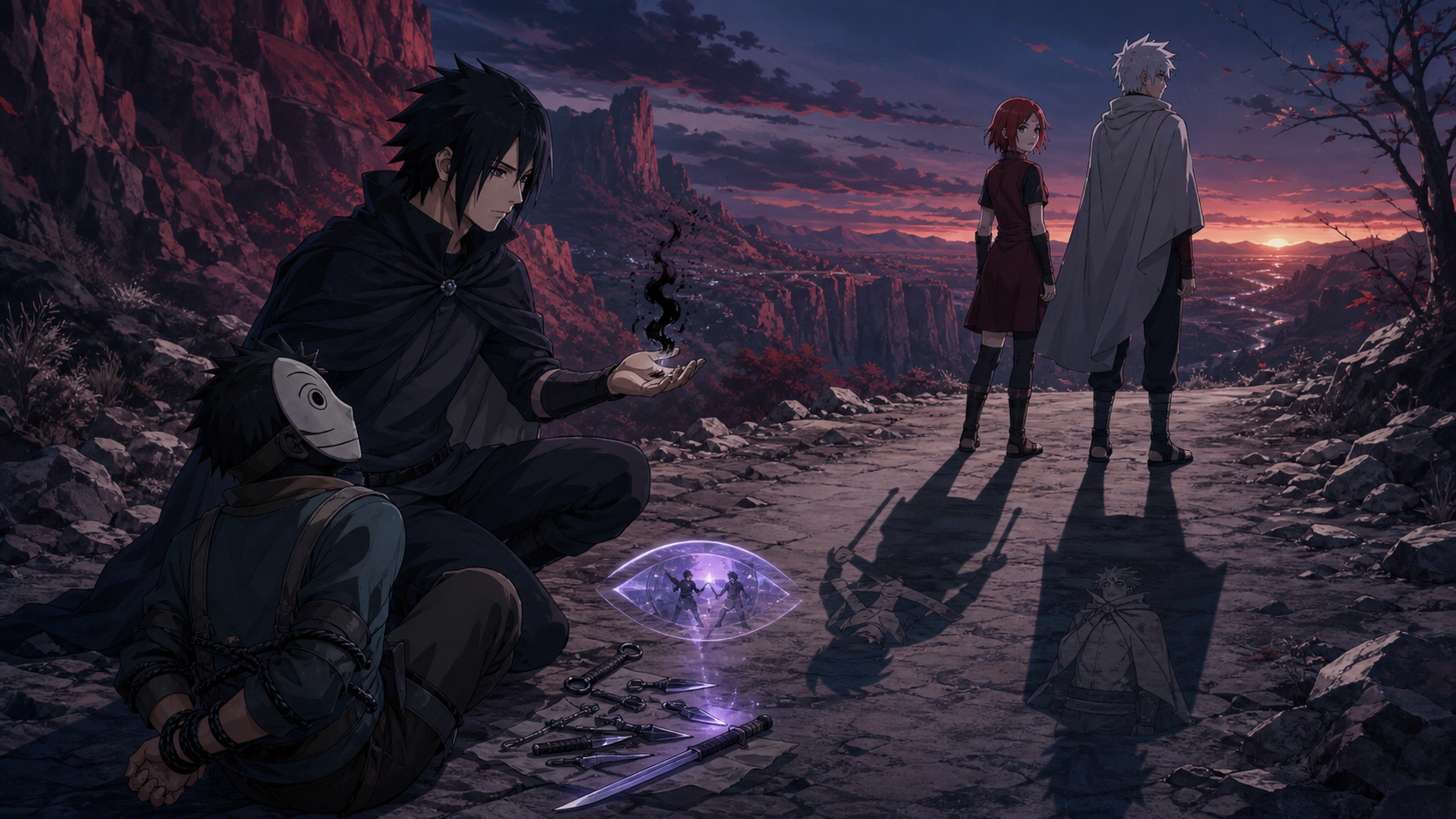
Fuushin
Sasuke recognizes deception without returning to indiscriminate violence and learns that inherited suffering never guarantees inherited innocence.
Bottom line
“Fūshin” turns Sasuke's investigation into a history lesson about bloodline persecution and a test of whether he can recognize deception without returning to indiscriminate violence. At the Coliseum, Sasuke, Yamato, and Orochimaru contain exploding patrons while protecting people who had been enjoying coerced combat moments earlier. En Oyashiro then explains that the Chinoike clan was expelled from the Land of Lightning after the Uchiha enforced a noble family's demand, pushing another dojutsu clan into the Valley of Hell. Sasuke follows that history toward the Land of Hot Water with Chino and Nowaki, unaware that both companions are directing his route. A decoy attacker tries to draw him away through chakra-enhanced blades, earth walls, and rubber projectiles. Sasuke defeats the man without killing him, reads the relevant memory, and confirms that Nowaki is Fushin. The reveal matters beyond surprise. Postwar Sasuke has learned to distrust appearances while preserving enough restraint to gather truth. Yet En's account also requires him to confront a harder fact: the Uchiha were victims of Konoha and agents of violence against another displaced clan. Inherited suffering never guarantees inherited innocence.
Episode 486 continues the Sasuke Shinden adaptation
Episode 486 is titled “Fūshin.” The episode aired in Japan on December 15, 2016, and adapts the middle portion of Shin Towada's *Sasuke Shinden: Book of Sunrise*.
The anime reshapes the novel's chronology and places the Coliseum crisis directly before the Valley of Hell investigation.
The exploding patron interrupts the match
Sasuke's scheduled fight with Futsu stops when a spectator displays the red eyes and unstable body seen in Konoha's controlled victims. The emergency exposes a hidden campaign inside a private arena.
Spectacle becomes immediate danger.
Sasuke uses the Sharingan first
He reads the victim's chakra and disrupts the controlling effect before detonation can spread. Visual power answers visual coercion through preservation rather than domination.
The Uchiha eye interrupts stolen agency.
More patrons begin transforming
The first body was not an isolated insertion. Multiple wealthy attendees have already been compromised, turning the arena's private boxes into a field of possible explosions.
The attack was prepared before Sasuke arrived.
The audience cannot remain spectators
People who paid to watch owned shinobi risk death now experience their own bodies as targets. That reversal does not make coercion deserved.
Justice cannot copy the abuser's method.
Yamato arrives to contain damage
Wood Release creates barriers around unstable victims and reduces the blast radius. His intervention prioritizes survival even for patrons involved in exploitation.
Rescue does not erase later accountability.
Orochimaru deploys snakes defensively
He smothers an explosion and protects bystanders using abilities once associated with invasion and experimentation. Helpful action demonstrates present utility without settling past crimes.
Conduct can improve while judgment remains open.
Sasuke coordinates rather than fighting alone
The crisis requires dojutsu, Wood Release, containment, and rapid triage. No single technique can secure every body across the Coliseum.
Cooperation replaces solitary spectacle.
Saving patrons does not validate the Coliseum
Emergency ethics require protecting life regardless of social role. Once the attack ends, ownership, trafficking, and forced combat still demand intervention.
Rescue and reform are separate duties.
A chakra blade targets Sasuke
An enhanced knife arrives amid confusion, suggesting someone is using the mass panic to test or kill him. The projectile links the new attack to the Bamboo Village trail.
Chaos provides cover for a second objective.
Sasuke blocks the weapon
Susanoo gives him protection without redirecting danger toward surrounding civilians. Defensive power allows observation before pursuit.
Restraint begins with buying time.
He starts after the assailant
The fleeing attacker offers the clearest immediate route toward the network. Pursuit could reveal Fushin or the dojutsu user controlling the bombs.
Investigation moves through staged bait.
Chino is placed near another explosion
The apparent companion becomes endangered at the precise moment Sasuke must choose between chasing the attacker and saving someone nearby. The situation tests priorities and helps conceal her role.
Vulnerability can be performed strategically.
Sasuke chooses Chino's safety
He abandons the cleaner pursuit rather than treating one life as acceptable collateral. Chino is surprised because his reputation suggests colder calculation.
Atonement becomes visible through interruption.
Chino's surprise reveals her expectations
She knows Sasuke as a former international criminal who once sacrificed allies to revenge. His current choice complicates the version of him needed for her grievance.
Changed conduct disrupts a simple enemy story.
Nowaki rejoins them
His arrival restores the traveling pair's harmless presentation after the crisis. The large, shy figure appears protective rather than controlling.
Disguise depends on predictable interpretation.
Yamato confirms the same technique
The victims match those who attacked Konoha, establishing a single campaign across multiple locations. The Coliseum is not a disconnected criminal incident.
Evidence joins the cases.
En Oyashiro agrees to meet Sasuke
The secretive dealer comes forward after witnessing Sasuke's response. Interest in rare power and concern for business both motivate cooperation.
Information arrives through compromised incentives.
En treats the crisis as a market threat
If exploding humans become common, private fighters and buyers lose value or confidence. His willingness to help reflects commercial self-preservation more clearly than moral awakening.
Useful testimony can come from selfish motives.
Sasuke asks about Fushin
The name remains the strongest connection between the Dark Thunder Group, bloodline fighters, and the exploding-human attacks. Sasuke keeps the interview focused despite En's evasive style.
Direct questions resist theatrical distraction.
Fushin once guarded En
Oyashiro employed the shinobi as part of a private collection of rare abilities. Guard work offered status within a relationship still structured through ownership.
Protection and captivity can coexist.
A child with red eyes escaped with Fushin
En remembers a younger bloodline user connected to the former guard. The detail points toward Chino without naming her openly.
The answer sits beside Sasuke in disguised form.
En recounts the Chinoike clan's exile
The clan possessed the Ketsuryugan, a dojutsu associated with control over iron-rich blood and powerful genjutsu. Their ability made them politically useful and feared.
Rare power became grounds for removal.
A Lightning noble demanded banishment
After conflict inside an elite household, the Chinoike were blamed and forced from their home. Punishment targeted an entire clan rather than establishing individual responsibility.
Collective guilt becomes inherited displacement.
The Uchiha enforced the expulsion
Another dojutsu clan acted on behalf of political authority and drove the Chinoike into exile. The Uchiha's later victimization does not erase this earlier role.
Oppressed groups can still become agents of oppression.
Sasuke hears an unfamiliar clan history
Neither revenge training nor Konoha's official accounts taught him about the Chinoike. The Uchiha story he carried centered massacre, discrimination, and resistance.
Historical truth expands beyond family memory.
He wonders whether Itachi knew
Sasuke still measures hidden Uchiha history through the brother who carried so many state secrets. The question reflects longing for guidance and suspicion of another withheld truth.
Itachi cannot remain the answer to every unknown.
Orochimaru cannot confirm the possibility
Even his extensive research does not contain every clan record. Lack of evidence prevents Sasuke from assigning knowledge to his brother for emotional convenience.
Uncertainty deserves honest limits.
The Chinoike were sent to the Valley of Hell
The remote canyon in the Land of Hot Water contains iron-rich red water, harsh heat, and thick steam. Geography turns banishment into generational confinement.
Exile is violence stretched across time.
Yugakure failed to investigate later signs
Red water was mistaken for evidence of catastrophe, and the area became forbidden rather than supported. Administrative distance helped the displaced clan disappear from public concern.
Neglect can complete what expulsion begins.
The clan survived before internal collapse
Chinoike members endured the valley for years, but close confinement and inherited strain eventually produced deadly conflict. Their destruction was not a simple consequence of bloodline temperament.
Forced conditions shaped the disaster.
En provides the Land of Hot Water location
He gives Sasuke a concrete route while withholding parts of his personal connection to the clan. Assistance remains selective.
Truth is being managed by someone inside the story.
Orochimaru distrusts En's openness
The dealer usually protects identity and assets carefully. Sudden cooperation suggests that Sasuke is being directed toward an outcome En finds useful.
Accurate information can still be manipulative.
Sasuke leaves with Chino and Nowaki
Both companions hear the history that secretly belongs to them while performing curiosity alongside him. The journey becomes an investigation staged by its subjects.
Sasuke travels inside the deception.
The Land of Hot Water holds another crowd
A large group of controlled people blocks their path. The campaign has expanded beyond targeted infiltration toward mass weaponization.
Human bodies form the roadblock.
Sasuke puts the victims to sleep
Genjutsu ends immediate movement without drawing blood and triggering detonation. The response preserves lives while clearing the route.
Precision defeats the trap's violent premise.
Another enhanced knife appears
The projectile repeats the Coliseum signature and invites Sasuke into pursuit. Someone wants him separated from Chino and Nowaki or moving along a controlled route.
Repetition becomes evidence.
Sasuke follows the attacker
He now possesses enough context to test whether the fleeing figure is Fushin. The chase depends less on anger than pattern recognition.
Suspicion becomes methodical.
Ordinary knives replace the enhanced blade
The assailant keeps throwing weapons, but Sasuke notices that later blades lack the same chakra. The mismatch suggests substitution or borrowed assistance.
Small technical differences expose a staged identity.
Sasuke turns a knife against the decoy
He uses the attacker's own tool to end the pursuit without a lethal finishing strike. Control of distance and timing replaces overwhelming force.
Efficiency leaves room for questioning.
The decoy uses earth walls
Terrain manipulation slows the chase and creates cover. The technique does not match the wind-based bloodline associated with Fushin.
Ability contradicts the claimed trail.
Rubber projectiles counter lightning
The attacker prepares insulating material against Sasuke's known nature transformation. Planning shows access to intelligence without proving the man's identity.
Countermeasures can be borrowed.
Amaterasu ends the resistance
Sasuke applies black flame, then extinguishes the technique before death. The sequence demonstrates frightening power disciplined toward capture.
Stopping force becomes as important as releasing force.
The Sharingan reads the decoy's memory
Sasuke discovers that Karyu was recruited to distract him and that the enhanced blade came from elsewhere. The memory converts suspicion into evidence.
Interrogation avoids prolonged physical abuse.
Karyu links the plan to Nowaki
The disguised companion supplied the chakra blade and used the decoy to preserve his cover. Sasuke's earlier observation at Bamboo Village now fits the Coliseum attack.
Separate clues converge on the traveler beside him.
Sasuke identifies Nowaki as Fushin
He has tracked the target while unknowingly traveling with him. Naming the deception removes the polite persona's protective value.
Recognition ends the staged companionship.
Nowaki abandons the harmless appearance
The shy manner and oversized form were constructed to lower suspicion. Fushin reveals a different body and confrontational presence.
Identity has been used as tactical equipment.
Fushin is not the final controller
His role in the Lightning Group and the attack matters, but evidence still points toward the red-eyed partner directing explosive humans. Exposing one disguise does not finish the case.
The conspiracy has another center.
The Uchiha can be victims and enforcers
En Oyashiro’s history complicates the moral record Sasuke inherited. The Uchiha suffered surveillance, segregation, collective suspicion, state-sanctioned massacre, and decades of official lies. Those truths remain. The clan also enforced another ruling family’s collective punishment by driving the Chinoike into exile. One history does not cancel the other.
I resist stories that demand a clean category because clean categories protect power. If victimhood guarantees innocence, then harm committed through an oppressed group becomes impossible to name. If earlier enforcement erases later persecution, then Konoha gains an excuse for massacre. Accountability needs enough room to hold both without turning either into leverage against the other.
Exile is violence carried by geography
The Valley of Hell does not look like a prison with guards and bars, yet banishment makes the landscape perform confinement. Heat, red water, isolation, restricted travel, and public fear stretch one political decision across generations. When the community later fractures, outsiders can describe the collapse as proof the clan was dangerous rather than evidence of what imposed conditions did.
Yugakure’s failure to investigate deepens that abandonment. Authorities see alarming water, declare an area forbidden, and let distance replace responsibility. Administrative avoidance finishes what direct expulsion began.
Sasuke’s restraint protects evidence
He defeats Karyu without killing him, extinguishes Amaterasu, and reads the mismatch between techniques before accepting the identity placed in front of him. Those choices save a life and preserve information. They also show why restraint is not softness. It is the discipline required to distinguish a decoy from the person directing him.
Old Sasuke often treated uncertainty as permission to strike harder. Postwar Sasuke slows interpretation long enough for details to matter. Atonement becomes visible through method: less certainty, less collateral damage, more communication, and a willingness to let evidence revise the first story.
Chino performs vulnerability for a reason
Her endangered position at the Coliseum helps redirect Sasuke while testing what kind of man he has become. The tactic manipulates real ethical instinct. When he chooses her safety over the cleaner pursuit, his conduct complicates the enemy image she has carried. That does not dissolve her grievance. It makes revenge harder to organize around a fixed character.
Chino has been traveling inside her own history while pretending it belongs to distant people. That concealment gives her control after a life shaped by other people’s ownership. It also uses Sasuke and leaves controlled victims inside a plan they never chose. Trauma explains the strategy without making every choice harmless.
Fushin’s disguise hides divided responsibility
Nowaki appears shy, oversized, and protective while Fushin exists as the feared target somewhere ahead. Splitting those identities lets him guide Sasuke, supply weapons, and recruit decoys without attracting the scrutiny attached to his real name. The reveal is not only visual. It exposes how the investigation has been managed by the people it seeks.
Fushin remains responsible for helping the campaign. He is also connected to Chino through loyalty formed under exploitation. The episode should not reduce him to a disposable lieutenant once the disguise falls. His choices belong inside the same account of coercion, attachment, and harm.
Rescue does not reward Coliseum patrons
Sasuke, Yamato, and Orochimaru protect people who financed forced combat because bodily autonomy does not become conditional on moral worth. Saving them does not validate the arena or erase their participation. It preserves the possibility of investigation, testimony, restitution, and consequence without copying the controller’s method.
Justice becomes credible when it refuses revenge’s shortcuts. The patrons can survive and still answer for ownership. Controlled attackers can be restrained and still remain victims. Sasuke can change and still carry a record that new choices do not delete.
The episode also asks what a survivor owes to history he did not personally create. Sasuke was born generations after the Chinoike expulsion. He cannot confess to an enforcement mission he never joined, and he should not be treated as a biological container for every Uchiha act. He can listen without defensiveness, acknowledge the record, refuse denial, and use present access to help expose what institutions buried. Responsibility is not inherited guilt. It is the obligation to respond ethically when inherited benefit, reputation, or power places truth in your hands. Chino deserves the same distinction. She did not choose her clan’s banishment or destruction. She did choose a campaign that controls strangers and converts bodies into bombs. Naming that choice does not side with the nobles or villages that harmed her people. It insists that liberation cannot reproduce the loss of agency at the center of her grievance. This is where Sasuke’s encounter becomes more than two dojutsu users comparing wounds. Both know what it means for clan history to swallow individual identity. Both have been shaped by adults who managed truth. The question is whether recognition can interrupt repetition before another person becomes material for revenge. Sasuke’s restraint suggests one path. Chino’s reveal will test whether she can imagine justice that leaves other people’s bodies and futures under their own authority. Historical truth matters when it changes conduct instead of assigning blood guilt.
Final verdict
“Fūshin” advances the mystery by making restraint the clearest proof of Sasuke's change. He saves Coliseum patrons who had financed exploitation, interrupts explosions without killing controlled victims, rescues Chino instead of chasing the easier lead, and captures a decoy without allowing Amaterasu to consume him. Those choices do not erase Sasuke's history. They show accountability becoming behavior under pressure. En Oyashiro's account then widens the moral record. The Chinoike were collectively banished, and the Uchiha enforced that political punishment before later suffering state discrimination and massacre themselves. Sasuke must hold both truths without turning inherited victimhood into inherited innocence. By recognizing the chakra mismatch in the thrown blades and reading Karyu's memory, he exposes Nowaki as Fushin through evidence rather than rage. The victory remains partial because Fushin is another instrument beside the person whose red eyes have directed the journey from the beginning.
Sources and watch notes
- Naruto Official episode guide for the official series record.
- Crunchyroll for the licensed episode route where available.
What I am carrying forward
Episode 487 reaches the Ketsuryugan reveal. I am carrying forward the Chinoike exile, Uchiha enforcement, En’s selective history, Chino’s performed vulnerability, Fushin’s divided identity, and Sasuke’s evidence-preserving restraint. The next confrontation must hold inherited grievance and present responsibility in the same frame.